A Quiet Grandeur: An Appraisal of The Tableeghi Jamaat

TableeghMy attempts at landing upon an official Tableeghi Jamat statement on the attacks on a Tableeghi centre in Khyber-Pakhtunkhwa (Pakistan) and on Tableeghi Jamat members in Karachi fell in vain. I ceased to wonder when I chanced to meet a lady who was an acquaintance of one of the victims of the mosque target-killing in Karachi. With remarkable serenity and a muted delight on her face that was almost transcendental, she mentioned how the deceased from South Africa had always harboured the hope to die in Pakistan- the place where the work of Tableegh had been revived after the first generation of Muslims, and upon the same model.

It was one of those moments one feels so foolish, one does not have anything to say as one tries to grapple with a sublime yet humbling understanding. I understood why my attempt to look up Tableeghi Jamat’s ‘official statement’ on the targeting of its associates was incredibly unintelligent and utterly in vain.

 In my search for an anchor and handhold in this Roller-coaster Ride to Nowhere that life sometimes seems to become, I had been in and out of a dizzying variety of religious groups and organizations: big and small, spiritual and political, militant and pacifist, sectarian and pluralist… yet it never seemed a final homecoming, and I was always an unsettled, restive maverick- desperately seeking, perpetually and hopelessly unfulfilled. But the long, exhausting and frustrating journey was never in vain_ because I read the pointers all along the way. I experienced, I learnt, I understood…

 Travelling on life’s winding ways eventually afforded a rare opportunity for close, firsthand observation of a phenomenon I had always had a blind spot towards: the silently grandiose project of the Tableeghi Jamat. The work of Tableegh hinges on fundamental Islamic ethics and values, and demonstrates great spiritual discipline. The Tableeghi Jamat operates with mindboggling organization and efficiency which becomes even more awe-inspiring given the fact that it is entirely autonomous with no source of external funding or even any necessary financial contribution from workers. In fact, there does not even exist any rigid organizational structure, any formal administrative hierarchy or even a membership procedure. This is also why there is no official record of the number of workers in Tableegh- Wikipedia estimates it at 120 million, but it is highly likely for the numbers to be much vaster- the footprint of the work of the Tableegh is literally everywhere- from the remotest areas in rural Pakistan to nations abroad- with workers ranging from every social class, group and ethnicity, striving for personal spiritual purification and that of fellow beings. A tableegh associate from the US observes: ‘Unlike Christian missions with millions of dollars of funding these people include the likes of people I have heard about who polished shoes in a bazaar in Pakistan, sold their clothes and walked on foot in East Africa with barely any food-  to call people to Allah.’

 During my years of self-discovery and my informal study of Islam I had often wrestled with obstinate questions for which answers often remained elusive. The stunningly simple, incredibly straight, quiet and consistent way of the Tableegh addressed and even resolved most of those.

 I used to wonder why I, having been raised in Islam should have a privilege over those raised in other faith traditions, when my choice to be born with the Islamic faith handed down to me was not a witting one. So how can eternal salvation depend upon an inherited faith or a privilege of upbringing as we self-righteously damn those denied the same.  I began to see faith less as a privilege and more as an enormous trust and responsibility that had to be shared_ and that mankind’s deprivation from the sweetness of Eeman is the burden of those entrusted with it. Tableeghi Jamat, with its simple emphasis on ‘Dawah’ (Invitation to Faith) and reinvigoration of faith through sharing and including concedes to the idea that faith is a responsibility towards mankind and the world, and that the misguidance and evil of this world is our problem; and that for the purgation and salvation of mankind every iota of individual effort must be spent. This intense spiritual drive is not born out of religious chauvinism or self-righteous, narcissistic proselytism, but out of a sincerity that is inherently humane and compassionate (khalis) towards fellow beings; a selflessness that beautifies. The characteristic humility and heartwarming gentility of those working in the path of the Tableegh thus stands explained.

 Many who proclaim religious association use it for a comfortable sense of self-righteousness that lulls and dulls the self-reprimanding conscience; or for other selfish purposes, since religiosity is highly venerated in this society. Yet the demand and the right of religion on us is that it be submitted to; that we give ourselves to it and in the process learn to give up all that is profane and degenerate. The essence of faith is submission, which is attained when we learn to let go of the self and forego its selfishness. The highest expression and evidence of this submission is sacrifice. The work of Tableegh in the path of God and His people is essentially a sacrifice every step of the way, requiring precious time, energy, financial contribution and distance from one’s nearest and dearest. It requires dealing with adverse and hostile circumstances and with all kinds of people while keeping one’s poise and spiritual largesse for the sake of Allah. This is in the footsteps of the first generation of Islam. Walking in this blessed path means that in turn one receives spiritual bounties, rising to a higher station of spirituality.

 The Tableegh brings together a rare and perfectly blended mix of individualist and communitarian approaches. While the prime focus is the tazkiyah (inner purification) of every individual, and individuals rather than groups are reached out to, yet there is a strongly communitarian dimension. The work involves connecting and bonding with others for naught else but compassion and a shared faith and vision. The purity and selflessness of this bond gets people together indissolubly. The beauty of the connection can only be experienced.

 A particularly interesting regular Tableegh activity is the weekly ‘Gasht’- walking on foot door to door to invite others to pray in the neighbourhood mosque and to stay for a short religious sitting afterwards. A Pakistani-American approached by some participants of a Tableeghi Gasht says, ‘The knock of a few simply dressed men asking me to come pray in the mosque right across my house may have been the very way to the corridor to change I wished for…’ He goes on to add: ‘In all major cities in the US they do some work- very humble, peaceful and honest people who have doors slammed on their faces but do not get discouraged. May Allah protect the sisters and brothers associated with it.’

 But while the Tableegh is primarily a spiritual enterprise, it strongly bears upon society and politics with its characteristic quiet persistence. While many contemporary religious groups prioritize political ascendancy and power, making all else conditional upon that, the Tableegh has a sounder basis more in tune with the Prophetic method.

The understanding is based upon the idea that our collective affairs are a sum of our individual states; therefore the means to purge and mend society is through spiritual purification at the personal level. Through this individual spiritual revival all levels of society can be impacted and dented into. With this bottom-up approach, individual moral purification radiates towards the echelons of power and authority as the work of Tableegh quietly pervades.

 Restraint from direct involvement in the business of power politics also brings the additional advantage of safe operation without raising suspicion and alarm. Some months ago when the Interior Minister Rehman Malik accused the Jamat of harbouring terrorists, prominent politicians from a number of parties with no religious associations denounced the statement and defended the activities of the Jamat as purely a moral-spiritual project. The widespread support from all sections of society that the Jamat garnered in the wake of the recent heinous attack at its centre in Peshawar is overwhelming and something to speak of, as no other contemporary religious group in Pakistan can match this level of deep-rooted acceptance and appreciation among the masses.

 The Tableegh’s enthusiastic renunciation of ideological/political associations or any sectarian posturing and its exclusive emphasis on basic religio-spiritual values make its approach an antidote to virulent sectarianism gnawing into this society. It even serves as an effective antidote to militancy which rejects traditional Islamic scholarship in favour of a literalist, inflexible and revisionist interpretation. The Hanafi madhab is largely followed in the subcontinent, which is why the Tableegh has become well-entrenched in the society, owned by the generality of the population, and capable of the mass appeal it has garnered.

 On the question of Jihad, the Tableeghi Jamat believes that the option of using military means cannot be used when the spiritual and social project of Islam has not been taken up effectively and the mission to convey the Message completely and universally (itmam ul hujjah) not yet fulfilled. Moreover, with the prevailing moral degeneracy in Muslim societies, Jihad in the field is irrelevant and self-defeating. Ignominy and oppression will crush Muslim subjects as long as there is no genuine effort at moral and spiritual uplift, as Allah says: ‘God does not change the condition of a people unless they change what is in themselves.’  This understanding is also inspired by a humane concern and compassion.  Jihad against the infidel without having tried to present the Message in its entirety and pristine character is a poor substitute for the more compassionate overture towards the enemy_ that is, winning him over to faith through upstanding moral conduct, sincerely reaching out and striving for the establishment of peace and justice. A senior of the Tableegh is said to have remarked something to this effect to someone seeking clarification on the Jamat’s stance on Jihad: ‘You Jihadists help fill up the hellfire with infidels while we change hearts to get candidates for paradise.’ Contemporary Jihadists, according to the Tableeghi Jamat, betray the gradualism of the Prophet (SAW)’s way.

 Yet the Tableeghi Jamat is part and parcel of the societies it is engendered in and operates in. The patriarchal social structure of society in this part of the world has sought religious cover in the ranks of many religious groups, the Tableeghi Jamat being no exception. The work of Tableegh primarily involves and addresses men_ their wives, daughters, mothers and sisters are provided with a ‘parallel universe’ in which selected tableegh activities are replicated within a strictly closed, segregated environment. The mainstream fieldwork of Tableegh as well as the mass instruction is dominated by men, with their women relegated to a subsidiary role. Besides, the gender segregation to an extreme degree deprives women of a holistic and wholesome experience of life and the world and limits their sphere to the domestic and familial alone. This has resulted in a narrowness of perspective and superficiality of insight characterizing women of the Tableeghi Jamat. This is particularly so in second and third generation Tableeghis who have had cloistered upbringing and few opportunities for self-development through education and experience. Besides, second and third generation tableeghis inherit the religious lifestyle without having the liberty to make personal choice, often taking up Tableegh and religious practice as habit and ritual rather than as actions of the heart.

 The literature used for religious instruction and tazkiyah (purification) as well as the methodology with which it is delivered is dated from the earlier half of the previous century. While it has inspired millions and continues to do so, the outmoded language and style limits its outreach and appeal to the younger generation and fails to address their dilemmas and questions about religion, modernity and secularity in this day and age. There is an absence of content that can present an alternative discourse to respond to or even recognize the innovations and challenges of the current milieu.

 An insurmountable problem with Muslim education in the subcontinent is the disconnect between ‘maqulat’ (the rational sciences) and ‘manqulat’ (transmitted knowledge). Religious education has entirely jettisoned the ‘maqulat’ as secular and profane, and this in turn has sharpened the artificial gulf between ‘Deen’ (the religious worldview and way of life) and ‘Dunya’ (the secular/worldly domain) in society. As a result, the religiously educated are consigned solely to the business of the seminary and pulpit whereas those with a modern secular education become the movers and shakers of society – a sort of privileged elite. The disconnect between the religiously educated conservative Muslims and the secularized therefore runs along the lines of social class. As a result, the religious are generally viewed as a lower social group deprived of social prestige, disengaged from decision making and opinion leadership, pigeonholed into the narrow realm of strictly religious affairs with little to do with the business of the world. Most do begin to reflect this relegation of ‘deen’ to the unworldly and otherworldly. In the process they become insular, islandic and static utopias in a rapidly changing, complex world. The malaise infects all religious groups and its repercussions are visible in the rank and file of Tableeghi Jamat in Pakistan.

 The Gulen Movement in Turkey shares with the Tableeghi Jamat its non-sectarian, non-ideological spiritual and social project. It shares the all-embracing mass appeal and loose structure giving individual space and freedom, as well as the refusal to politicize and confront. Very insightfully, both movements refuse to ghettoize religion under a narrow, exclusivist, parochial banner. However, the Gulen Movement has chosen to do some things differently. It has taken on modernity and its exigencies, risen to its challenges while ensuring the relevance of religious ethics as the panacea for the evils of materialistic, permissive, libertarian secular societies. The Gulen Movement promotes social activism and rights advocacy as religious causes and is dedicated towards healing, harmonizing, building bridges and problem-solving. It makes issues of social justice, rights and liberties the business of religion- a sacred calling of the faith. This, alongwith the contemporaneity of language, style and content has given the Gulen Movement a progressive outlook and an incredible popularity among Turkey’s younger population_ a monumental achievement for any essentially religious movement in this day and age. It is an example we have much to learn from.

 Given the Tableeghi Jamat’s vision, direction, spiritual appeal, inclusiveness and wide outreach, it has tremendous potential and promise. It can and ought to lend itself to the project of chiselling faith-inspired minds in positions of leadership and decision making in the academia, public administration, economics, media and politics. For this it must engage itself with the intellectual challenges that impede the spiritual journey of many bright young minds privileged with education in institutions for the English-speaking urban elite who are trained into critical inquiry. Any religious movement aiming for the establishment of Islam and its values in society which feels that it owes a debt to the future must prioritize leadership development among Muslim youth. For this, the concerns and questions of young minds with leadership potential need to be explicitly and directly addressed.

 An unwillingness to adapt to the exigencies of the times is symptomatic of stagnation and regression which characterize the length and breadth of modern Islamic movements in the Muslim world, with few exceptions. This leads to an intellectual stuntedness that repels our brightest and most promising minds as these groups fail to answer their questions about the role and engagement of religion with the world, life and society. Dr. Muhammad Iqbal resented this stasis as a result of a stubborn refusal to win space in the medley of competing ideas. He sees it as a harbinger of perpetual irrelevance. He writes, ‘The claim of the present generations of Muslim liberals to interpret the foundational legal principles in the light of their own experience and the altered conditions of modern life is in my opinion perfectly justified. The teaching of the Quran that life is a process of progressive creation necessitates that each generation – guided but unhampered by the work of its predecessors- should be permitted to solve its problems.’

Down to Earth – With a Bump

laurenbooth_profileIt doesn’t happen quickly, it takes time.

For a long time you can’t imagine it happening at all.

Then one morning, you wake up and it’s living within you. A spiky, pebble in the midst of joyous certainty; disappointment.

Disappointment in the Ummah, you are now a part of.

For ‘born Muslims’ the acknowledgement that those who try to follow the teachings of the Prophet of Mercy, (May Allah The Most Merciful bless him) always fall short, comes with the territory. If you are from Pakistan or Bangladesh or Egypt or Palestine, or any other majority Muslim nation, you will have most likely experienced all manners of corruption from the political level down.

Family members, being human beings after all, will have done as we all do; raised their voices, gossiped (probably), missed Fajr and failed in a thousand, small, yet visible ways, to fully embody the teachings we are directed to follow in the Quran. Teachings that if taken to heart, absorbed into the very core of our understanding and then translated into our daily lives, would make this testing reality, dunya, so much easier to bear.

‘Born Muslims’ inevitably try and warn those of us who take testimony of faith as adults, in a variety of ways about the disappointment to come:

“Not all Muslims are good, be careful”; “We don’t keep our promises, pray for us.”

And always my favourite: “Facial veil is no guarantee of piety!”

New Muslims can’t and don’t listen. It is as if our eyes only seek out the good in our brothers and sisters. We are blinded by love, filled with joyous hope.

Finding Islam through the Kindness of People

This apparent ‘naiveté’ seems to jar many brothers and sisters. It is almost as if they can’t wait to burst the bubble of our new found admiration for this community. This family-in-faith, remain stunned, as I announce in lectures that: “I came to Islam through the incredible character and kindness of the people.”

Yet, it’s true.

In 2005, I first set foot in the Holy Land, Palestine. There, in homes, of which the wealthiest I was invited to would be considered the poorest in the West, I learnt about love, patience and generosity; And how to host guests; And how to bring up children; And how to be a good human being.

Time and again, I would make excuses to go back to Falastin, treading the fertile grounds of Jenin, Nablus, Bethlehem. All because my heart yearned to spend time with the most remarkable people I had ever met.

After one such visit to the Gaza Strip, I experienced the terrible humiliation visited upon Palestinians, even in old age, at the Israeli ‘Crossing’ known as Erez; Half a mile of concentration camp style watchtowers, barbed wire, concrete and turnstiles cruel for livestock – terrible for human beings.

An elderly Gazan grandmother, traveling to America for a spinal operation, was turned back time and again at the crossing, without explanation, until she missed her flight and her operation. It took the rest of us; UN workers, Fatah government ministers, business men, five hours to pass through the hellish process.

I had booked a Palestinian taxi driver, Jamal, to collect me at around 11:00 am. It was now past 5:00 pm, dark, winter. My mobile battery had long ago died.

Suddenly a car sped towards me in the empty parking lot. It was my taxi.

“I booked you for 1:00 pm” I said aghast.

“Yes” replied Jamal “I waited from then”.

“For five hours?” His response made me weep all the way to Jerusalem, Al Quds.

“A Muslim man would never leave a woman on her own in danger.”

Subhan Allah!

These inspiring moments have not been limited to a land under occupation, nor to those whom hardship and poverty has cleansed of arrogance.

From Palestine to the UK

Back in London, my path continued to cross gentle women, whose manners were unlike any I had encountered before, with sweetness from another, purer, age and time. Women who despite working in highly regarded professions, as lecturers, doctors and teachers, greeted me, an unbelieving stranger, with greater love than many I had known all my life.

Then I took my shahadah and I waited for the change (that all my born Muslim friends warned me) was certain to happen.

One morning, in February this year I woke up to find that it had arrived. Suddenly, not everyone around me was shiny, amazing. Everywhere I looked Muslims were bragging, lying, gossiping, drinking alcohol, stealing, flirting and every other sin, major and minor.

What happened guys?

On reflection, two realizations occur within the revert that finally bring this grim moment to fruition. The first is that we, ourselves, start to fail more and more. In our ibadah, in our speech, in our deeds. From those glorious first days and months when we are immersed in learning Islam, where constant dhikr creates something like an invisible force-shield, around the believer who practices. It keeps us in check, protects us from harm.

Oh how we fill our waking hours with the Quran, reading books on Hadith and downloading inspirational lectures by people of knowledge. A person, who accepts Islam wholly and completely, cannot be late for prayer. It is unthinkable. Clutching a sheet of paper or a donated book, the newbies nervously, cautiously, hearts swelling with love, work the way through Salah. They will painstakingly mouth each alien vowel, respecting every sacred syllable. How direct is the unwavering gaze downwards – which is an imitation of the blessed Prophet’s own concentrated eye line during prayer. How the grateful, saved heart cries towards Allah, The Merciful, who has cleared away all our previous sins.

“Ihdinas Sirat al Mustiqeem”

 Do we seek shortcuts in our wudhu? No!

Do we watch TV shows which may show kissing or drinking alcohol? No!

Do we hang out with chatty (gossipy) friends – No!

This is the moment born Muslims may see us as ‘extreme’ in our practice.

This is the moment too when our ‘khushoo’, sincerity in seeking Allah’s face, is at its highest peak. Love is everywhere, peace is possible, and faith is all.

As I say, then we begin to falter. You know how it goes. First you drag your feet a little, to the prayer mat. A week later, barely noticed, all your prayers are last minute and rushed. Soon after that Fajr is done ‘before going to work’ and not pre-dawn. And here we all are together at last in our weakened, stumbling, frail, version of faith.

A second powerful blow is delivered as experience means we must realign our expectations of our community. What I mean is this.

You are Already a Kinder Person 

Compared to the world outside the Ummah; great sections of our community are and always will be, inshaAllah, amazing. Whole villages are known in far flung places to be beacons of hope to the traveller and seeker of knowledge. Whilst in every city in every nation on every continent, humble servants of The One, quietly support friends, neighbours and strangers as best they can, even if it means personal hardship.

 ‘They (the true believers) give food, out of love for Allah, to the poor, the orphan and the slave, saying: We feed you only for Allah’s pleasure – we desire from you neither reward nor thanks.’ (Al Qur’an 76:8–9)

 Coming from the cold, hard, materialistic, half drunken, non-Muslim world, I can tell you that thanks to the teachings of Prophet Muhammad (peace upon him) you are already a kinder person than you otherwise would be. How quickly sisters jump to one another’s aid where children are concerned for example. I never had the kind of support I now have, outside the Ummah. How quickly we rally together to help a family if a member falls ill and times are hard. Did I see this so routinely outside? Not at all!

In February the differential, the gap between how good we all manage to be and what we should be, was simply made clear. The natural goodness of those around me has become something I now take for granted.

Yusuf Islam is famously credited as saying: “Thank God I learned about Islam before I met Muslims”. I can understand that.

The question we must answer as disappointment in everyone else pecks at the grains of our faith. Have we already become one of ‘those’ Muslims – more likely to put others off this complete way of life, than be an example of its high principles?

Also published on OnIslam.net

The Clash of Spirit of Sacrifice and Lavishness

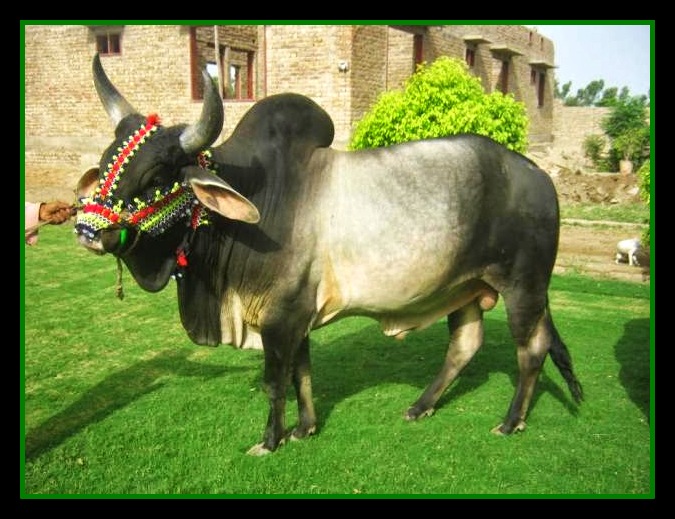
KhoobsuratJanwarEidDepression and psychological complex amongst sacrificial animals would be highest during Zilhaj if they could comprehend the criteria of ‘khoobsurat janwar’ which Pakistanis have created. Similar to how the advertisements make us believe that we need products to look good and for example, men and women who use fairness creams excel both in professional and personal life because of their fair skin tone, even the animals have to undergo a strict regime in order to become beautiful.

They are given the best diet which includes butter, milk, etc. As a result of which they grow up to be superior and bulkier than the rest and also are really heavy on the pockets of those purchasing them. However, it is surprising how the demand for these ‘khoobsurat janwars’ has increased even with the high inflation, escalating poverty and low employment and growth rates in Pakistan. Not only is poverty increasing, but so is social inequality. The phrase ‘the rich get richer and poor poorer’ fits our situation completely. If one were to look at the lavish lifestyle and expenditures of the elite Pakistanis, they might think that Pakistan has a really small fraction of people living in poverty. Because of the fact that it is an ‘Islamic Republic’ after all and if the rich are rolling in money then obviously their taxes and charities must easily be able to help the underprivileged section of the population. But unfortunately due to the lack of a proper system and trust in the government these funds are not efficiently allocated and spent. If people could trust the state they would pay taxes and in return the State would provide basic facilities to the population, like it happens elsewhere in the world where countries are governed with the idea of justice and honesty.

Interestingly, our tax authorities endorse the slogan of, ‘See no evil’, and there is nobody to question how people who go at lengths to make sure that they find a way to hide their true incomes and declare their incomes to be as low as possible can afford such expensive animals and various other commodities for that matter.

Amidst the huge tents, posing for pictures with the animals, flashy lights and various other pompous activities, we fail to realize how miserable we make those who are less fortunate than us feel. What goes through the mind of the chowkidaar or the man who takes care of the animal which cost almost about seven to eight years of his earnings is something we cannot fathom, that is if we ever bother. The increasing disparity is one of the root causes of crimes in a society. Plato warned of this evil “There should exist among the citizens neither extreme poverty nor, again, excessive wealth, for both are productive of great evil . . . Now the legislator should determine what is to be the limit of poverty or of wealth.” One of the main reasons behind social chaos which leads to the weakening of the state is imbalance of wealth.

While there is nothing wrong in spending a million or more on the purchase of sacrificial animals, what I fail to understand is why one cannot buy ten cows for a million instead of buying one? This way, there would be more meat to consume and distribute amongst relatives, neighbours, friends and the needy. Is it because sacrificial animals have become a status symbol? If yes, then the purpose of sacrifice is lost because it is not just the sacrifice of the animal but what the example of Hazrat Ibrahim and Hazrat Ismail (A.S.) in its true essence teaches us is that we should defeat our ‘Nafs’ and be ready to sacrifice all our desires for Allah. Then is not the desire to show off dominating us? Is it not ignoring the purpose of sacrifice? Allah says in the Holy Quran:

‘It is not their meat nor their blood, that reaches Allah: it is your piety that reaches Him’.

So if the blood and meat do not reach Allah but piety, then we really need to contemplate if we really are pious and if not, then nothing at all is reaching Allah.

Our Holy Prophet (PBUH) has taught us that actions are judged by intentions. There is no use of following rites and customs blindly if we do not completely embrace the true meaning of Islam. Islam is not just limited to rituals and the five pillars. It places utmost importance on the principles of social justice, welfare, fairness and protection of human rights. Eid is to be celebrated with the entire Muslim Ummah and therefore it is incumbent upon us to make sure everyone enjoys this occasion.

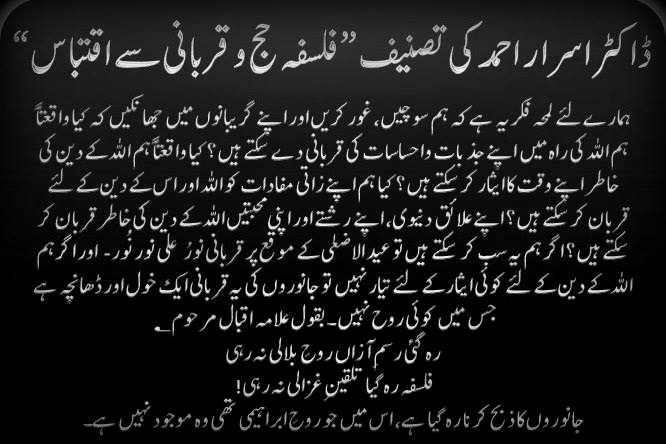
I leave you with the words of Dr. Israr Ahmed who has put this social problem eloquently that we have lost the spirit of sacrifice when it comes to following the ‘Deen’ of Allah. We are not ready to sacrifice our time, our comfort and our desires in the way of Allah. We do slaughter animals but we are completely devoid of the spirit of Ibrahim (AS) and the lesson his life teaches us.

IsrarAhmed

Muslim Schools, Hijab and the Media

laurenbooth_profile‘I’m not wearing that!’ My 12 year old daughter winces as we examine the bathing suit she must wear for swimming lessons at her private girls school in Manchester. A whole section is cut away from rear ribs to the (very) lower spine. As for the front, well, the thighs of the suit are so high cut the overall effect is less year 8 swim club, than a Rihanna photo-shoot. It serves me right – for not sending my daughter to a Muslim secondary school.

Despite the negative press you may have read about (dread phrase) ‘Muslim Schools,’ both my daughters and I have found the establishments near us to be welcoming, inspiring and (as a mum of teenage girls), with a dress code that is refreshingly, modest.

Our views, based on solid experience of local Muslim schools, are far from the media portrayal of the norm. Just take a look at the headlines. In recent days, two Islamic schools have featured unfavourably. Al-Madinah in Derby, a new 4 -16 Muslim Faith state school, opened just a year ago has been temporarily shut down after its first Ofsted report, closed the gates due to a “health and safety issue.“

At the same time one of the only other state Muslim schools in the country, Tauheedul Islam Girls’ High School has been criticised in the press for its dress code. Girls who attend Tauheedul Islam’s High are expected to wear a headscarf to school. And it is this uniform code which has incited negative coverage against this otherwise highly successful state, establishment.

Whilst the mainstream media were seeking a way to tarnish Tauheedul Islam’s Highs excellent reputation, the school, quietly, at the same time, topped a league table of 3,000 UK state establishments. Trinity Mirror’s data unit, backed by academics compiled the list seeking to give a ‘comprehensive’ view of the quality of schools UK wide. The data focused on academic results, teaching quality, and – crucially – the behaviour and prospects of its pupils. Tauheedul ranked the best in ALL these departments.

It is a sign of the mainstream media’s political agenda that to date no daily paper has followed up this story with a positive request (as would usually be the case) for glossy interviews with faculty staff and headteachers.

Thus British readers of anything but a single newspaper are unaware that an Islamic School in Britain currently ranks as the best in the country according to the most recent and very comprehensive study, a school that also has the highest approval of parents, pupils, local government and policy makers in Whitehall. No mean feat in the current climate.

Bizarrely, when I speak to a department editor she insisted that; ‘That league table was from years ago. It’s not recent. It’s old. But I’ll check.’

I call back sometime later and point out that the report was printed two days earlier and is new.

‘Hmm, still can’t verify it’ which is odd as the page is easily found via a way out new-fangled gizmo called Google. Why is she so reticent to repeat the findings? What she said next was both offensive and revealing ‘We just don’t believe everything that head teacher tells you, Lauren, so make sure you check these things carefully.’

Hinting that a head teacher is massaging figures that have been released in a national daily independently of the school is a stunning insult. One I cannot imagine being made of any other head teacher of high standing. Or anything bar criminal standing for that matter.

In the end it took a personal interview, to accompany the article I wrote – recognising the legitimacy of Tauheedul’s great results, to push the Sunday Times to revisit the theme of modesty in school uniforms for girls. Oh and my actual piece? In the end did not appear in the actual paper but only in the online edition and even then it is only available to subscribers. Meanwhile, my interview on girls modesty in schools being a positive was published in the corner of a page whose main story was ‘British imams willing to marry girls of 14 in secret.‘

British papers want readers to fear the ‘spectre’ of  Islam. Yet, the argument for firm moral guidance and a sense of community, being central to schools is completely ‘on message’ with current government thinking.

Michael Gove the Education Secretary has spoken clearly about the role of schools in effecting positive changes in students’ lives beyond the national Curriculum norms and well into the realms of social mentoring. He has insisted that schools have a major role to play in “promoting stability” in children’s lives.

“There’s nothing worse if you’re a child than not knowing when bedtime and meal time is, not knowing where mum and dad will be at a particular time,” he said.

“But if you are in a school that’s well run then people insist on discipline and timeliness and they insist that you are polite in the lunch queue and eat with your friends.

“And that discipline is evidence of someone really taking an interest in you; they care enough about you, enough to want you to be part of that community and part of that ordered life.”

During my research it became clear that newspaper editors are using the governments agenda for ‘inclusiveness’ try to focus fury on this element in relation to Muslim schools.

‘After all Lauren, which non-Muslim girl will wear a headscarf?’ asked the editor of an educational supplement.

Certainly inclusion for all who wish to enter a school is an important marker for the right of a faculty to receive state funding and must be observed.

It is not the right of local children to attend the best school whatever their faith I question here. After all Muslim children in the UK have gone to CofE schools and continue to do so. But if we are talking about fairness then let us look at the coverage another faith school received when it was found to have a clearly non inclusive policy. Yesodey Hatorah Senior Girls School in Hackney is a state funded Jewish school. In a recent survey it was found that whilst 37.82 of local community children are amongst the poorest (in need of free school meals). This state school has a quotient of just 1.62 per cent at this level of need, a clear example of selection by stealth – The media response to this scandal?
Silence!

Meanwhile the schools website states that: Charedi homes do not have TV or other “inappropriate media”, such as the internet. Families will also dress in accordance with the strictest standards of modesty’. Now let’s hear what the media had to say about Tauheeduls dress code and pupil expectations.

The Daily Mail, following the lead of the Sunday Times, wrote (Sept 29th 2013); ‘Pupils have to wear hijabs in and OUT of class for the first time at a state-backed school in Blackburn.

The cover-up was ordered at the 800-pupil Tauheedul Islam Girls’ High School where students already have to dress in long purple tunics over black trousers to ensure flesh is not seen. Under the rules, pupils must ‘wear the hijab outside the school and home, recite the Koran at a least once a week’ and not have stationery which shows ‘unIslamic images’ like pictures of pop stars’.

Sounds terrifying right? Let’s break this down.

Pupils must wear hijab at school and home. The school dress code includes hijab, a legally acceptable requirement for a faith school. But no one at the school or on its literature makes the outlandish claim that they would somehow ‘police’ girls once they leave school premises. The school brochure merely states that it is a hope, an expectation that good school practise travels into the home environment. A far softer statement than that made by Yesodey Hatorah Senior Girls School in Hackney which makes it clear that the homes its girls come from shun TV and the internet. A statement of certainty, not of expectation, regarding the way its pupils live outside school.

Tauheedul Islam’s Head teacher Mr Hamid Patel denies the accusations regarding what pupils wear outside school saying ‘This story is wrong. It is totally incorrect to say that pupils are ‘forced’ to wear hijab outside of school.’ And.
‘We are extremely sorry that despite repeated attempts by us to make sure the Sunday Times got their facts right, this newspaper chose to wilfully misrepresent our school.’

Meanwhile, British children are crying out for greater guidance and support. A report released this week reveals a 30 per cent rise in 10-14 year olds who self-harm. Let’s be clear what this means; a growing number of our teenagers are taking sharp objects and gouging their skin in an attempt to cut away psychological misery. Young people in the UK are, the report finds, traumatised by a maelstrom of modern pressures. These are listed by the children’s organisations responsible for the report to include; Cyber bullying on social networking websites ‘sexting’ and sexual relationships. The director of campaigns at the Young Minds charity calls the emotional climate our children live in “unprecedentedly toxic” with ever younger children being affected.

There is no doubt that the pressures on girls to be ‘hot’; to wear ever skimpier clothes in order to impress hormonal boys (and male teachers), plays a large part in this environmental disaster. We, as parents, play our part, when we ignore or even endorse this sense that school must be cool, including the uniforms.

My girls and I accepted Islam as our religion, three years ago. And after watching me change from a mother, who drank alcohol to a parent at peace (and teetotal), and with their own growing understanding of the basic tenets of Islam (the essential one being that; ‘God is One) both Alex and Holly embraced, this lovely, clean living, faith. My 10 and 12 year old daughters have before (and particularly since) revealed a natural instinct – and a confidence – in their preference, towards covering themselves up in public. Walking down the high street yesterday, Alex noted the school girls with skirts hiked up mid-thigh. Instead of envying the girls physically she said;

The poor things, how horrid to feel you have to be half naked to impress boys.’

As the Northern drizzle pounds our car, Holly puts it more simply. ‘That looks stupid AND cold.’
Sounds weird to our ears doesn’t it? Like our grandmothers speaking rather than modern adolescents. And that’s the point.

The strength of my daughters views on the subject of modesty. A theme of contention in homes, which causes parents either agony or outrage – has surprised me. In a society where so much of ourselves is wrapped in how we are ‘packaged’ or how much ‘beauty’ we can create with modern hair and make-up products. Children are increasingly the victims of a culture that creates female insecurity and sexual victimhood whilst dressing it up as ‘freedom’ and ‘liberation.’ But isn’t it us, and our weak institutions, who put them at risk first?

Instead of being repelled at the idea of modesty at girls schools, British parents should be welcoming a return to uniforms which, to be frank, are not so far off what we ourselves were ‘forced’ to wear.

It is Islamic schools which are a part of a growing positive march towards greater sartorial modesty for girls at school. And they are far from alone. The grotesque pressure on young women to adopt the ‘sexy schoolgirl’ look now a fashion staple from pop videos to men’s magazines has secondary and even primary head teachers making radical uniform amendments. This summer, parents nationwide cringed at the case of Jeremy Forest and the 15 year old pupil he seduced. Now the school he taught in, Bishop Bell Church of England School, East Sussex, wants pupils to have the ‘highest standard’ of appearance. We aren’t talking a new school badge here we are talking about a ban on make-up for girls below school year 10 (ages 14 to 15). And further, a directive to parents from the school office read: “Figure-hugging tight, skinny-fitting styles are not acceptable. Trousers are required to be loose around the ankles without Lycra or similar.”

Nail varnish, body piercings and most items of jewellery have also been deemed ‘not acceptable’.

Yet should a Muslim school outline such a dress code, there is an attempt to create a public and a political outcry

Far from being outraged, a growing number of parents will agree that there are ethical, moral reasons for strict clothing rules for secondary school girls. Indeed skirt bans currently exist in 63 secondary schools nationwide. The overwhelming majority NOT Islamic.

When I was at Copthall Girls school, sometime in the last century, I remember being sent home by Deputy dragon Mrs Wilson for ‘not wearing a skirt but a PELMET Booth!’ I also remember the girls flirted so much with the Sting lookalike Geography teacher he had a nervous breakdown.
In hindsight, how innocent our hitched skirts and batted (bare) eyelashes seem to the hyper sexy looks adopted by this generation. Aided and assisted not only by peer pressure but a weakened sense of social morality across the board in our society.

As for my daughters.
The eldest has chosen to wear hijab to her non Muslim secondary school. Teh faculty of which are very receptive to girls religious choices. Alex says the hijab makes her feel ‘clean and protected.’ My youngest, Holly, is keen to attend the Manchester Muslim High school and currently wears hijab at the Islamic Prep she attends – as part of the uniform.
At the end of the day, back at home, they both take them off to do their homework changing into sweat pants and t shirts.
We are all delighted that no one outside the family will see their knobbly knees or any other part of their girlishness in the coming years and certainly NOT on school grounds where the institution has a duty to protect both their wellbeing.

Who is Behind the Bloodbath?

bloodbathThe catalogue of bloodbath in the Muslim world is harrowing and sickening. I want to know who is responsible for it all. It has been a bloody week – the Westgate shopping centre massacre in Nairobi that left 67 people dead, the killing spree of students in North Eastern Nigeria has left 50 students dead, the bomb blast has left 40 people dead in Peshawar in Pakistan and another bomb in Baghdad has taken the lives of 47 people. I want to know who is behind it all.

While the media and pundits brandish “Islamist terrorists” as the key culprits the more serious questions does not even get discussed. They get buried under the hysteria of the Islamist threat. I would like to know who these people are. What is their true identity? Who is funding them? Where are they getting their weaponry and technical support? Why are they hell bent on doing it in the name of Islam and not Christianity, Judaism or other faiths?

We all know that no true Muslim would ever carry out such atrocious and heinous massacres. Yet they are promoted as the true representatives of Islam and the Muslims by the media; their actions are labelled as Islamic and terroristic at the same time. I want to challenge those who are making a living out of pretending to be an Islamic terrorism expert by posing a few simple questions:

1. They are well aware of the fact that terrorism can never be Islamic but knowingly they make the association. This remains registered in the conscious and sub-conscious minds of people. When they think of Islam they think of bombs, killings and terror. Why do these experts deliberately conceal the truth and make these false associations?

2. By making Islam synonymous with terrorism what do they intend to achieve apart from fanning the fuel of Muslim hatred and discord? They know Islam could end terror and tyranny instantly if the Muslim world was truly free.

3. Why call terrorism, Islamic?

The Muslim world is sick and tired of more and more frontiers being thrust on their faces. They have the internal dictators and despots to fight in their respective homes. They have to struggle against imperialism and neo-colonialism. They are now facing a new menace; unknown people and groups are popping up everywhere and carrying out indiscriminate attacks and massacres using crude bombs with devastating consequences. Whose agenda are these murderous mischief-makers serving?

We all know that according to Islam killing one innocent person is tantamount to killing the entire humanity. In Islam life, intellect, property, family and faith of people are the most basic rights that must always be preserved. Yet, there are people who are randomly picking shopping centres, targeting markets, selecting schools and even choosing mosques to kill Muslims. There are those who are attacking the non-Muslims and their places of worship. A true Muslim would never do anything like that! A genuine Muslim would naturally be deterred by God consciousness, the inevitable consequence of the Hereafter and their scared commitment to fairness and justice.

The truth of who is pulling the strings and who are the real masterminds behind these attacks needs to be uncovered. Who are the paymasters of these bloodthirsty monsters need to be unveiled? Who are the real terrorists?

Anyone who believes in the God, most Merciful and most Kind and the last day would never attack innocent people or kill. These are the works of some dreadful people whose only motive is to demonize Islam and destabilize the Muslim world. A free and modernized Muslim world, embedded in Islam would pose a huge challenge to the interest of these ghastly people. I eagerly wait for that day when the Muslim world would be truly free and Islamic.

My all-time favourite chapter of the Quran summarizes the true character of Muslims in the following timeless words:

“CONSIDER the flight of time!
Verily, humanity is bound to lose
Except those who attain to faith, and do good works, and enjoin upon one another the keeping to truth, and enjoin upon one another patience in adversity.” (Chapter – The Time)

Murder, mayhem and terror has no place in Islam and please do not attribute it to Islam either.

Losing Our Religion

Losing Our Religion

 That’s me in the corner

That’s me in the spotlight

Losing my religion

Trying to keep up with you

And I don’t know if I can do it

Oh no, I’ve said too much

I haven’t said enough…

(R.E.M., Losing My Religion)

 The meandering mythologies of the Greeks have some insightful truths that are relevant even today. Take Narcissus, handsome and definitely hard-to-get, but really a lonesome fellow. His raison d’être was solely gazing at his own image in a still pond. And then he fell for himself – quite literally – and was transformed into a flower. Poor beautiful flower with such an arrogant name. Narcissus was not the only one condemned to become something else. Races before him were condemned to become monkeys. Races after are further at risk of losing their real selves should they choose not to mend their ways. Glory and its grandeur never truly last. In Narcissus’s case, glory, which was the cause behind the condemnation was nothing but delusion.

Self-love is the first ‘lesson of life’ we teach ourselves. “I come first.” “I matter.” “I’m special.” “Why should I care?” The culture around us is no different from what Echo would do for Narcissus. It resonates a subtle and subliminal, almost hypnotic allure, telling us how unique we are: “Because you’re worth it.” “You should be happy.” “Be what you want to be.”  We hear such feel-good phrases all the time. The curse of our time is nothing but the nuisance of narcissism. Celebration and promotion of the self is the rule of thumb for being a happy ‘you.’ Rooted behind this hubris is a deep and mocking truth: the other is nothing, because I am everything.

 Sayyidna ‘Umar bin Khattab (RA), came to the Prophet (SAW) and openly confessed his self-love despite his submission to the faith. And the Prophet told him that you cannot have complete faith unless you love me more than you love yourself. In effect, the Prophet was trying to weed out self-love from Sayyidna ‘Umar’s personality. Why would he do that? Because self-love is the final hurdle towards fully submitting to faith. It’s our self that becomes the ultimate ‘ghuroor’, the ultimate delusion.

 Those of us who claim to have full faith in our faith are deeply and darkly in love with our own selves: our narcissism lies in this claim that we have full faith. And these Words should really put our faith in place and perspective:

Say, You have not [yet] believed; but say [instead], ‘We have submitted,’ for faith has not yet entered your hearts. [49:14]

The same message is echoed in the opening lines of the said chapter: “O you who have believed, do not put [yourselves] before Allah and His Messenger but fear Allah” [49:1] 

Today none of us who believe will have the brash honesty to say that we love our selves (two separate words) more than Allah and His Messenger. No one will have the audacity to even believe in that. So shameful. Unthinkable. Hurmat-e Rasul par jaan bhi qurbaan. But here’s how the dark truth becomes a deeper darkness: because we have believed, we have a right to be in love with our selves even more. I read the Qur’an every day. I take the hijab. I keep my trouser above my ankles. And then we point our finger of shahadah like a dart on to the ‘other’: tsk tsk, look at her in that skimpy top, look at him chatting away with that girl, sigh, you can only pray for them, he’s just a lost cause… on the surface we are innocently indulging in what may think is sorrow for the heedless ummati. But deeper inside, there is less sorrow but more satisfaction – rather schadenfreude – that I’m not in that skimpy top, I’m not with some random girl, I’m not a lost cause. Poor them, but at least it’s not me. I’m (therefore) better than them. This is our delusion, this is our ghuroor, this is our hubris. Our arrogance for our own selves at the expense of our fellow Muslims’ apparent outlook is not just irksome. It’s infectious and injurious for the general well-being of ‘our’ ummah as a whole.

We feel satisfied by the well-known fact that so many people are coming to the deen. But the real sorrow is the ignored fact that so many people are leaving the deen, because of this narcissism of ours. We, who claim to be religious people, are making our fellow ummatis lose their religion. We conveniently forget that we all took our sweet, slow time to stumble towards to the deen, understand it, and then fully submit to it. Or so we believe. Yet we are in this rash rush to make all those around us magically and miraculously ‘come back to the deen’, usually with just one polemical discussion focusing on what we think is right and wrong. Usually such discussions are tempered with a strange, evangelical zeal which somehow is used to justify the admonition. We are so frantic and desperate for the ‘other’ to leave the dark side and come to the light (in which we fortunately bask) that we forget to use an important and integral principle: wisdom. So many people simply reject the idea of faith because they are ‘put off’, or rather ‘told-off’ by religious people. And rightly so; religious people do put people off by showing off this evangelical zeal. One inspiring book, one heartening lecture, one exemplary person is not enough for me to become a master of a truth as complex as faith. With my new-found inspiration, I set out on a mission to call others to my side. But my inspiration is nothing but this: new-found and therefore, half-baked. But more importantly (and I would say detrimentally) it’s not just that my message is not motivating enough because of its inadequacy; my message very soon leaves all motivation behind and becomes nothing more but a play of power: I am right, you are wrong, and only one of us can win. It’s a match of wills. Each will as undefeatable and indefatigable as the other.

 This play of power is what is putting even religious people off by religion. Claimants of religious truth in our day and age range from Dr. Amir Liaquat to Dr. Tahir ul Qadri, and a mass array in between. Each is claiming the truth for their own self. Each is claiming – therefore – that I am better than you. One clarification is necessary: the infamously famous Sunni versus Shia, Salafi versus Sufi, Deobandi versus Barelvi schisms and other such various dichotomies are not the focus of the present discussion. This power-play is ironically running deep within each of these schisms themselves: Sunnis lashing against Sunnis, Shias against Shias, Salafis belitting Salafis, Sufis mocking Sufis and the battle goes relentlessly on… the truth now is not about ideology. It’s about power. “My” truth should triumph. And this truth is nothing but an empty and usually an autonomous assertion. And an assertion can never wholeheartedly convince and give comfort. And truth – Islam – is a matter of the heart, and should bring comfort.

An ummah is in his own right, Sayyidna Ibrahim – peace upon him – is one of the many from whom we – his greatest grand-children, his ummatis – can find valuable lessons on how to monitor ourselves from this power-play which has developed into narcissism. In the 26th chapter of the Noble Qu’ran, The Poets, Sayyidna Ibrahim in his signature style makes the most comprehensive of prayers beginning from the eighty-third to the eighty-ninth verse. The opening and closing of this discourse is most pertinent to us today.

My Lord, Grant me knowledge/authority/wisdom/ and join me with the righteous. [26:83]

Islam was never of a case of winning others over through assertion.

And had your Lord willed, those on earth would have believed, all of them together. So, will you then compel mankind, until they become believers? [10:99]

Here, Allah is advising His Prophet that as much as he would love to have every single soul seek peace in faith, compelling them would not work. With some, even sensible arguments never helped. They don’t even now. Again and again in the Noble Qu’ran, we are told that for some of those who do believe, faith has not ‘yet’ entered your heart. And no one, none of us, can have the authority to truly and rightly know which heart is true and right enough to have itself submitted peacefully in the peaceful submission of Islam.

Islam, like love – is a matter of the heart. The Prophet (SAW) knew this all too well. Several narrations that were voiced for us – the careless caretakers of the deen – focus on this idea and goal that faith dwells in the domain of the heart. The Prophet did not need to make prayers for purifying his heart. He, like Sayyidna Ibrahim, already had that. He phrased those prayers so that we could also aim to attain a detoxified heart. It is narrated by Sayyidna ‘Abdullah bin ‘Umar, may Allah be pleased with him, that the Prophet, Allah’s peace and blessings upon him, said, “Verily the hearts of Adam’s progeny lie between the two Fingers of Ar-Rahman, just as one man’s heart, and He makes the heart turn in whichever direction He Wills.” And then the Prophet made this prayer – “O Allah, the Turner of hearts, turn our hearts towards Your obedience.” [Muslim].

In another narration, Sayyidna Usama bin Zayd, may Allah be pleased with him, says, “The Messenger of Allah – peace and blessings upon him – sent us to [fight] a group of people from the Juhayna tribe. I came across a person and was about to spear him, when he shouted, ‘There is no deity but Allah.’ [without paying any heed] I speared him and killed him. When I returned and informed the Prophet, he said, ‘You killed him even though he testified that there is no deity but Allah?’ I said, ‘O Messenger of Allah, he did that only to save himself.’ He asked, ‘Why did you not split his heart [to verify your assumption]?’” (Bukhari, Muslim). Commentators claim that the last part of the narration expresses a tone of censure and indignation. Sayyidna Usama offers a perfectly logical justification for killing the man. But the Prophet condemns the act by saying that if the tribesman had made the declaration of shahadah, who were you to mock the authenticity or the validity of his declaration by killing him? Did you tear open his heart to verify if he was telling the truth? So even if the tribesman said the shahadah, in the very last minute of his life, who were you to judge? This narration shows us that faith is a choice made by the heart, and it is the heart, the qalb-e saliim, that can vouch for its truth.

If Allah has therefore made our other fellow ummatis declare the shahadah, if most of us by sheer accident of birth have been born into Muslim households, who are we to judge the state of anyone else’s heart? Before we are quick to judge – making the slip from righteousness to self-righteousness – we should remember that faith was given to us by Allah in the first place: whether by making us being born into families whose forefathers were fortunate enough to take up the faith, or by making us get in touch with that one inspiring book, lecture, person, or incident that moved us enough to get back to the faith. We all are reverts, in one way or the other. And this reversion of heart was nothing but an endowment from Allah. We didn’t do anything to deserve this endowment. It was Allah’s choice for us. And we must remember also that Ibliis was the right-hand man, long, long ago. His devotion and worship was unprecedented. As was his slip from righteousness to self-righteousness: I am better than him. From being “Taoous al Malaikah” – the Pride of the Angels – he literally descended to the level of being “Rajiim” – the Disgraced. The pride and plume of the peacock – the literal meaning of the word ‘Taoous’ – his hubris, was the very reason behind the disobedience, and the concomitant and consequent disgrace. We too should be aware of this narcissistic tendency lest we lose the glory of Guidance and Grace given to us, and become disgraced and misguided. Why do we forget that we all take our time to get to what WE believe is immaculate faith. So why the rush to make the “lesser” others revert with a wink of an eye or a raise of an eyebrow? Why the smugness that our faith is so immaculate that we challenge the faith of another?

A contention now might rightly arise about the commandment in our deen to Command Good and Forbid Wrong. How can one just stay quiet when s/he can see a fellow believer blatantly in error? Is that not selfish that you are in a state of salim satisfaction and you let others suffer in their ignorance? The real concern should be to remember:

O you who believe! Let not a group scoff at another group, it may be that the latter are better than the former… How bad is it, to insult one’s brother after having Faith [i.e. to call your Muslim brother (a faithful believer) as: ‘O sinner,’ or ‘O wicked’]. And whosoever does not repent, then such are indeed Zalimun (wrong-doers) [49:11] 

Clearly, such condescending attitude has no place in the deen. If one admittedly believes, then s/he cannot and should not be belittled by another. Forbidding wrong and commanding good is all-good. But the way it is done today, the demeanor in which it is conducted is problematic. We are so quick to label the other person as “misguided”, “sinner”, “deviant”, and as we do that, we are reflexively comparing ourselves with the other. What we are essentially saying is this: you are not as guided as I am. Therefore you are misguided. And I am oh-so-well-guided. We project our preferences for others, meaning good, but we really mean to feel empowered. This polemical and often belligerent approach needs to be corrected. For those of us who subscribe to such a demeanor are being narcissistic about their belief. Ironically, we sought to correct someone’s faith; however, the attempt was not really to correct. But simply to feel good about the tenacity of our own faith. And during this whole process, we ended up making the other question their faith, and by looking at the face of religion that we are putting up so proudly, we have made the subject who was put under our omniscient microscope lose faith in religion, and in their self – even if it’s just a bit. Interestingly, even when Sayyidna Musa and Harun – peace upon them – were sent by Allah to correct Fir’aun, they were categorically asked to speak gently to him:

Go, both of you, to Fir’aun, verily, he has transgressed.

And speak to him with gentle speech that perhaps he may be reminded or fear [Allah]. [20:43-44] 

Prophets were being told to speak gently and not to get combative with a tyrant like Fir’aun. We need to exercise greater caution, care and comfort in how we deal with others whose hearts we are seeking to win over. Several narrations from the Prophet – peace and blessings upon him – focus on the same idea: care and concern for fellow believers. This narration from Sayyidna ‘Abdullah bin ‘Umar cannot be emphasized enough:

The Prophet of Allah – peace and blessings upon him – said, “The perfect Muslim is that from whose tongue and hand another Muslim is safe.” [Bukhari, Muslim]. It would be instructive to note that the words used for ‘safe’ in actual text of the narration are ‘salima’, and the mention of the tongue precedes that of the hand.

We are living in an age and time in which the easiest and most expedient thing to do is set yourself apart from the rest. In one way or the other, we are being compelled to focus on our differences. And this focus is doing nothing more but making the Muslim world and all its voices divisive and defiantly defensive. In the finality of the final analysis, what matters now is that Muslims really need to engage with Islam at a personal level, and focus on what unites us as Muslims – not what separates us. The hackneyed saying that Islam is perfect, Muslims are not is awfully trite, but also awfully true. Islam is correlated with clichés like terrorism, extremism, conservatism. Hardly anyone talks about the face of Islam which is caring and comforting. No one talks about Islam and love, Islam and care, Islam and peace, perhaps because Muslims are showing none to each other. Charity, really begins at home. We are just comfortable with our own self-celebration. And, like pretty much everything else, even Muslims are picking petty battles of power. That really was not the point of Islam and its spread. The goal of Islam – the ultimate and immaculate Favor of Allah – was to spread peace through submission. If Islam is the Favor of Allah, and this submission is to Him alone, then why the fuss?

Allah has not put for any man two hearts inside his body…[33:4] 

Narcissist was condemned to become a flower only after he stooped so low in his self-love. He deluded himself into believing that he alone mattered, he alone was enough. His desperate attempt to love his own image brought about his own downfall. Shaytan had the same fate. As did Fir’aun. As did Bani Israeel. As do Muslims now. Rooted in narcissism is arrogance. And arrogance was the first wrong which could never set things right again. And from it rippled the whole pool of what we call wrong.

In Islam, like in love, there is no room for self-love. Either you love Allah, or you love another – and in most cases, you love your ‘self’. The heart can just house One Love. No other. And all of us who claim to be Muslims, who claim to believe and be faithful to our faith, have already made that precious claim to love no other but Him.

The ‘Begum’ and ‘Saheb’ Culture

Come, visualize with me..

Sakeena, a 10 year old who has never been to school, never enjoyed playing with dolls let alone the funky hi-tech gadgets,  is carrying a 1 year old in her lap, sitting on a table distant to begum saheba’s. Her dull glitterless clothes, unadorned arms and ears tell us, she’s the odd one. Sakeena’s job is to take care of the child who she can hardly carry, feed him, change his nappy and make sure he doesn’t cry while begum saheba enjoys her lavishly decorated table and socialising exercise. Sakeena has no right to run around, play or enjoy with her age-mates at the dinner and absolutely no sharing the table. She may get some food though.

Najma, a 28 year old who looks to be 40, skinny and dark is sweeping the floor of a ‘bangla‘ (a huge mansion). Her two-year old has an ear infection and she does not have money for antibiotics. Her concentration is everywhere. She has to finish work and get her child’s ailment sorted somehow. She takes a day off next day to see the doctor and to take care of her child who does not have proper clothes on his body and no footwear whatsoever whether it’s summer or winter. She gets told off as there was a grand dinner at saheb’s place and begum saheba was in thick soup when Najma didn’t turn up as there was a big mess in the kitchen to be sorted after dinner. She was scolded, insulted and eventually fired.

A child surrounded by a garbage heap, sorting paper and recyclables and eating our rotten left-overs from it at the same time – A child covered with houseflies sleeping on a pavement outside a jeweller’s shop (where jewellery of millions of rupees is being chosen). He dozed off while waiting for his father to go home, who sells Kulfi outside a popular shopping centre – A child who sits outside a fast-food restaurant and begs usfor roti and cannot afford a chicken wing let alone a mighty burger – A child who cleans our windscreen for a few rupees and we shun him away because his water is dirty and would ruin our car – A baby sleeping in the lap of a begging mother unaware of the cruel world he has come to. She covers his face to avoid bright headlights of the cars passing by but we can see his beautiful but muddy feet sticking out of her chaadar – A child who sells a rose bud outside a restaurant where we spent thousands of rupees for what? Yes, one meal –

A woman who washes our expensive branded and imported (etc.) dinnerware, breaks a small chip and is shouted at, beaten and declared unfit for her job – A woman who cleans our extravagant dining table, but is never allowed to share it, dusts our sofa but can’t sit on it and we love it when she sits on the floor near our feet – A driver who drives our luxurious car but waits for a bus for hours around midnight to get home and see his children on the weekend – The guard/chowkidar who sleeps outside on the next door plot under a tent or in our car porch while we sleep in our air-conditioned room away from heat and mosquito bites – The labourer who builds our beautiful house in scorching sun, just to sleep in a place one can hardly call a room, but it’s all-in-one home for him (kitchen, bedroom, lounge etc.).

Close your eyes..

Imagine the muddy feet, the dirty smelly clothes, no surety of food for the day, no money in the pocket, let alone banks, no transport. Recall their mistakes and shortcomings; recall our anger, lack of forgiveness, zero tolerance, and humiliation they face every day. And now, switch sides.Imagine they were us and we were them. Scary thought, isn’t it? They didn’t choose their fate neither did we. So why not fear the Creator who put us in a MORE difficult test than them by giving us authority over them.

The dehumanization of the society has reached its limits. The above examples are complacently accepted. Humans are not equal. They are unequal just because they were born to parents of different social statuses. And the one who has money and authority is superior. The kings and queens found everywhere in our society show their grandeur with harshness and humiliation towards the subordinates at home as well as the less fortunate outside home. Softness, empathy and forgiveness are considered weaknesses.

But this is not what we were taught, is it? ‘We are Muslims and we are proud’, ‘we love the Prophet (SAW)’ and ‘we are ready to die for him’ etc., but are we ready to live in a way he taught us to and follow his footsteps if it kills our big ego? Forgiveness, controlling anger and ignoring mistakes were compared by the Prophet (SAW) with strengths of a wrestler. He taught us that superiority came with piety and not money. Do we think that the mighty and wealthy Arab leaders who lashed and tortured the bodies of Khubab and Bilal (RA) were superior to them? No! Bilal, the black, the poor, the slave, the worthless was the most precious in the eyes of the Prophet (SAW). Did he eat in a separate corner, in different plates, a left-over food? Dig out something that supports us doing so with our servants. But, sharing tables is probably too much to ask for as far as our magnificence is concerned.

“When the slave of anyone amongst you prepares food for him and he serves him after having sat close to [and undergoing the hardship of] heat and smoke, he should make him [the slave] sit along with him and make him eat [along with him], and if the food seems to run short, then he should spare some portion for him [from his own share]” (Muslim).

Remember, Zaid Ibn Harith (RA) who was a slave and the Prophet (SAW) freed him and gave him the choice to go with his father, who had come, to take him, but he refused to go with his father and preferred to stay with the Prophet just because he was loved and cared for. He says he was never told his mistakes and the Prophet (SAW) used to cover what he did wrong without even mentioning it to him.

Once the Prophet (SAW) reprimanded a companion like this,

 ‘O Abu Dhar! Did you abuse him (your slave) by calling his mother with bad names. You still have some characteristics of ignorance. Your slaves are your brothers and Allah has put them under your command. So whoever has a brother under his command should feed him of what he eats and dress him of what he wears. Do not ask them (slaves) to do things beyond their capacity (power) and if you do so, then help them.’(Sahih Bukhari)”

Gentleness and kindness are rare traits, very valuable in the scales of Allah. They are not weaknesses. They are actually extremely difficult traits to stick to in this materialistic world where everyone can get their mission accomplished at the point of a gun, money or a big tongue which cause similar damage to the weak ones. Kindness is a forgotten virtue. To kill an enemy might be easy in the current times, but killing ego is a hard job. But it raises us in the eyes of Allah and we are actually following the Prophet (SAW) when we do it. What a deal and what a surely victorious way. He went on to say, ‘Seek me among your weak ones, for you are given provision (or help) only by reason of the presence of your weak ones’.

Once a man came to Prophet Muhammad (saw) and said, “O Allah’s Messenger! How many times should I forgive the mistakes of slaves?” The Prophet (SAW) kept quiet. The man repeated his question three times, and the Prophet replied at the third time, “Forgive them seventy times every day.”

We are in a more difficult test than they are. Their hereafter is easier, while we have to answer for every word that we uttered that broke them, every opportunity that we missed to help them and every action that we did to look down upon them as inferior human beings.  It was the equality, justice and liberty Islam talked of that attracted the poor and slaves to the call of the Prophet (SAW). We must correct ourselves and create a society that cares, loves and forgives shortcomings of each other.

“O God, grant me life as a poor man, cause me to die as a poor man and resurrect me in the company of the poor.” His wife asked him why he said that, and he replied: “Because (the poor) will enter Paradise (before) the rich. Do not turn away a poor man even if all you can give is half a date. If you love the poor and bring them near you, God will bring you near Him on the Day of Resurrection.” – Al-Tirmidhi, Hadith 1376

How I Came to Love the Veil

YvonneRidleyVeilPoliticians and journalists just love to write about the oppression of women in Islam … without even talking to the females beneath the veil.

They simply have no idea how Muslim women are protected and respected within the Islamic framework which was built more than 1400 years ago.

Yet, by writing about cultural issues like child brides, female circumcision, honour killings and forced marriages they wrongly believe they are coming from a point of knowledge.

And I am sick of Saudi Arabia being cited as an example of how women are subjugated in a country where they are banned from driving.

The issues above have simply nothing to do with Islam yet they still write and talk about them with an arrogant air of authority while wrongly blaming Islam. Please do not confuse cultural behaviour with Islam.

I was asked to write about how Islam allows men to beat their wives. Sorry, not true. Yes, I’m sure critics of Islam will quote random Qur’anic verses or ahadith but all are usually taken out of context. If a man does raise a finger to his wife, he is not allowed to leave a mark on her body … this is another way of the Qur’an saying; “Don’t beat your wife, stupid”.

Now let’s take a glance at some really interesting statistics, hmm. I can almost hear the words pot, kettle, black. According to the National Domestic Violence Hotline, four million American women experience a serious assault by a partner during an average 12-month period.

On the average, more than three women are murdered by their husbands and boyfriends every day . . . that is nearly 5,500 women battered to death since 9/11.

Some might say that is a shocking indictment on such a civilized society, but before I sound too smug, I would say that violence against women is a global issue. Violent men do not come in any particular religious or cultural category. The reality is that one out of three women around the world has been beaten, coerced into sex or otherwise abused during her lifetime. Violence against women transcends religion, wealth, class, skin colour and culture.

However, until Islam came on the scene women were treated as inferior beings. In fact we women still have a problem in the West where men think they are superior. This is reflected in our promotion and wages structure right across the spectrum from cleaners to career women who make it into the boardroom.

Western women are still treated as commodities, where sexual slavery is on the rise, disguised under marketing euphemisms, where women’s’ bodies are traded throughout the advertising world. As mentioned before, this is a society where rape, sexual assault, and violence on women is commonplace, a society where the equality between men and women is an illusion, a society where a women’s’ power or influence is usually only related to the size of her breasts.

I used to look at veiled women as quiet, oppressed creatures and now I look at them as multi-skilled, multi-talented, resilient women whose brand of sisterhood makes Western feminism pale into insignificance. My views changed after the truly terrifying experience of being arrested by the Taleban for sneaking into Afghanistan in September 2001 wearing the burka.

During my 10-day captivity I struck a deal that if they let me go I would read the Quran and study Islam. Against all the odds, it worked and I was released. In return I kept my word but as a journalist covering the Middle East I realized I needed to expand my knowledge of a religion which was clearly a way of life.

And no, I’m not a victim of Stockholm syndrome. To be a victim you have to bond with your captors. During my imprisonment I spat, swore, cursed and abused my jailers as well as refusing their food and going on hunger strike. I don’t know who was happier when I was released – them or me!

Reading the Quran was, I thought, going to be a very simple academic exercise. I was stunned to discover that it clearly stated women are equal in spirituality, education and worth. A woman’s gift for child birth and child-rearing is very much recognised as a quality and attribute. Muslim women say with pride they are homemakers and housewives.

Furthermore The Prophet (pbuh) said that the most important person in the home was The Mother, The Mother, The Mother. In fact he also said that heaven lies at the feet of the mother. How many women make it into the top 100 power lists for simply being a “great mother”?

With Islam choosing to remain at home and raise children takes on a new dignity and respect in my eyes, similar to those sisters among us who choose to go out to work and have careers and professions.

I then began looking at inheritance, tax, property and divorce laws. This is where Hollywood divorce lawyers probably get their inspiration from. For instance the woman gets to keep what she earns and owns while the man has to stump up half his worth.

Isn’t it funny the way the tabloid media gets very excited over the prospect of some pop or film stars pre-nuptial wedding agreement? Muslim women have had wedding contracts from day one. They can choose if they want to work or not and anything they earn is theirs to spend while the husband has to pay for all the household bills and the upkeep of his family.

Just about everything that feminists strived for in the 70s was already available to Muslim women 1400 years ago.

As I said, Islam dignifies and brings respect to motherhood and being a wife. If you want to stay at home, stay at home. It is a great honour to be a home maker and the first educator of your children

But equally, the Quran states if you want to work, then work. Be a career woman; learn a profession become a politician. Be what you want to be and excel in what you do as a Muslim because everything you do is in praise of Allah (swt).

There is an excessive, almost irritating concentration or focus on the issue of Muslim women’s’ dress particularly by men (both Muslim and non-Muslim).

Yes, it is an obligation for Muslim women to dress modestly but, in addition, there are many other important issues which concern Muslim women today.

And yet everyone obsesses over the hijab. Look, it is part of my business suit. This tells you I am a Muslim and therefore I expect to be treated with respect.

Can you imagine if someone told a Wall Street executive or Washington banker to put on a t-shirt and jeans? He would tell you his business suit defines him during work hours, marks him out to be treated seriously.

And yet in Britain we have had the former Foreign Secretary Jack Straw describing the nikab – the face veil revealing only the eyes – as an unwelcome barrier. When, oh when, will men learn to keep their mouths shut over a woman’s wardrobe?

We also had Government Ministers Gordon Brown and John Reid express disparaging remarks about the nikab – both these men come from over the Scottish Borders where men wear skirts!!

Then we had a series of other parliamentarians enter the fray describing the nikab as a barrier for communication. What a load of nonsense. If this was the case can anyone explain to me why cell phones, landlines, emails, text messaging and fax machines are in daily use? Who listens to the radio? No one switches off the wireless because they cannot see the face of the presenter.

The majority of sisters I know who choose to wear the nikab are actually white, Western reverts who no longer want the unwelcome attention of those few leering men who will try and confront females and launch into inappropriate behaviour. Mind you, there are a couple of London sisters I know who say they wear the nikab at anti-war marches because they can’t stand the smell of spliffs.

I am afraid Islamophobia has become the last refuge of the racist scoundrel. But the cowardly, chauvinistic attacks launched – largely by men – is unacceptable to Muslimahs as well as their secular, female sisters from the left.

I was a feminist for many years and now, as an Islamic feminist, I still promote women’s’ rights. The only difference is Muslim feminists are more radical than their secular counterparts. We all hate those ghastly beauty pageants, and tried to stop laughing when the emergence of Miss Afghanistan in bikini was hailed as a giant leap for women’s liberation in Afghanistan.

I’ve been back to Afghanistan many times and I can tell you there are no career women emerging from the rubble in Kabul. My Afghan sisters say they wish the West would drop its obsession with the burka. “Don’t try turning me into a career woman; get my husband a job first. Show me how I can send my children to school without fear of them being kidnapped. Give me security and bread on the table,” one sister told me.

Young feminist Muslimahs see the hijab and the nikab as political symbols as well as a religious requirement. Some say it is their way of showing the world they reject the excesses of Western lifestyles such as binge drinking, casual sex, drug-taking etc.

Superiority in Islam is accomplished through piety, not beauty, wealth, power, position or sex.

Now you tell me what is more liberating. Being judged on the length of your skirt and the size of your cosmetically enhanced breasts, or being judged on your character, mind and intelligence?

Glossy magazines tell us as women that unless we are tall, slim and beautiful we will be unloved and unwanted. The pressure on teenage magazine readers to have a boyfriend is almost obscene.

Islam tells me that I have a right to an education and it is my duty to go out and seek knowledge whether I am single or married.

Nowhere in the framework of Islam are we told as women that we must do washing, cleaning or cooking for men – but it is not just Muslim men who need to re-evaluate women in their home. Check out this 1992 excerpt from a Pat Robertson speech revealing his views on empowered women. And then you tell me who is civilized and who is not.

He said: “FEMINISM ENCOURAGES WOMEN TO LEAVE THEIR HUSBANDS, KILL THEIR CHILDREN, PRACTICE WITCHCRAFT, DESTROY CAPITALISM AND BECOME LESBIANS”.

Here is an American man living in a pre-Islamic age who needs to modernize and civilize. People like him are wearing a veil and we need to tear that veil of bigotry away so people can see Islam for what it is.

Yvonne Ridley 

Humanity at Stake

1157633_289730281164755_734281549_n

A woman in many women- and children and men- was reported to be rushing back and forth in panic of the gunfire chasing her. A woman- another woman- was seen from her balcony with a portrait of General Al-Sisi; watching, observing, comprehending, and smiling. A grimly smile. This is not fantasy. This is not a scene from a horror movie. This is real life and real humans- or at least, real humanoids!

People are seen enjoying the beach in the scorching heat to get away perhaps from the tense city life. But behind the beach there is a road, and behind that road there are buildings, and behind that building we see smoke, a tense, scorching hot smoke. And we learn that that smoke is the product of chaos, of oppression, of resistance, of subjugation, of panic, of murder, of silence, and of noise. People lie dead on the streets and people lie flat on the beach. Two stories. One city.

Egypt is in crisis. This we are all told. But there is much more to the story. The crisis isn’t merely political. It isn’t merely about who you support. It isn’t about who you don’t support either. It’s not an Egyptian issue anymore. Boundaries don’t make sense now. It’s boiled down to the very essence of what it means to know and love freedom and democracy, to value dignity, to value humans as human subjects, to figure out what it means to be human.

But here is where narratives fail, and collide. The crisis in Egypt has consistently been portrayed as a clash between two parties- or to say, two narratives. This schema has been deliberately consolidated by both the coup-regime, which includes all its functionaries, and forces of the global hegemonic status quo. Locally there is this thing they call ‘the people’- a label created to function as a catchall term for supporters of the illegitimate regime- and then there are ‘terrorists’- a label used to discredit a demonstrably peaceful resistance movement against illegitimate regime change.  The mainstream global media on the other hand adopts a less obvious propaganda model. It divides people into ‘anti-morsy protestors’ and ‘pro-morsy protestors’- or sometimes calls them ‘Muslim Brothers’ straight out- and by doing so it very criminally distorts the picture. In doing so they’re undermining the fact that the ‘pro-Morsy protestors’ are in fact an ‘anti-coup’ and ‘pro-democracy’ movement. But of course, is it really a coup? And yet, it isn’t a matter of what definitions say when it is a matter of what global (western) interests say.

The most vulgar display of this politics of labels and binaries was when the world was watching military men, accompanied by tanks and cheering fascists, firing directly at the Al-Fattah Mosque in Cairo where a few hundred protestors were trapped. The domestic media portrayed it as an operation against anti-state elements and terrorists—one of the old classics- while the global mainstream media portrayed it as a clash between two rival parties- that very workable tactic. By calling it a ‘clash’ or ‘conflict’ of what is clearly obscene violence carried out by the establishment against individuals is the old method deployed in covering the ‘Israel-Palestine conflict’ or what is clearly Israeli repression of Palestinian individuals.

The Egyptian crisis has also become a crisis of confusion in Muslim majority societies. A victim narrative seems to emerge where the culprit is made to be democracy itself. The greatest beneficiary of this narrative is none other than Al-Qaeda itself; just as it was the greatest loser in the Arab Spring where it seemed as though change through peaceful and democratic means was a viable option. This optimism seems to fade away. This is the same optimism that makes sleeping difficult for oppressive regimes; for it’s easier to break bones than minds. The narrative serves both terrorist groups at the fringes of society and the establishment controlling society. But besides the damage that is carried out by this narrative, it is also flatly wrong. What happened in Egypt was not because of democracy but the lack thereof. There was nothing remotely democratic about it. Even the regime of Mubarak retained itself in all spheres of life. Not only was a democratically elected parliament disbanded immediately on a technicality, the democratically elected president was never given any true authority. He was overthrown by anti-democratic means and what is now present in Egypt is the suppression not only of people but of the very notion of democracy and freedom. It is here where the story needs to be squarely put as a matter of democracy, freedom and dignity. To place the problem elsewhere undermines and hurts the broader cause.

What else needs to be understood from the problem in Egypt is the consequences of polarization and uncompromising partisanship. To understand each other, to build on each other’s point of view, to discuss and debate critically are all essential to the health of a given society. A politics of empathy is the need of the hour. Unfortunately, Muslim majority societies are plagued by a clash of uncompromising narratives. The damages have played themselves out it Egypt. Pakistan is also deeply polarized and suffers from a politics of condemnation and ridicule of the other. In Tariq Ramadan’s words, Muslim majority societies need a ‘cultural revolution’ where we can think critically about our current state, be conversant with the challenges of modernity, offer creative solutions to contemporary challenges, as well as be consistent and employed with cultural, religious and civilizational references. This calls for moving beyond binaries and labels, and moving forward constructively and collectively.

Ali (RA) – My Eternal Hero

aliFor me, he is the emblem of heroism, of wisdom, of passion, of love of Allah.

He accepted Islam as ten year old child, when very few were willing to risk their lives. He grew up, literally, in the house of Allah’s beloved (Salallaho Alaihi Wasalam -SAW). He resembled Rasool Ullah (SAW) in mannerism and action. On the night of the migration from Makkah, he slept in the bed of the Prophet (SAW) with the risk that the enemies may kill him in place of the Prophet (SAW).

Our beloved (SAW) trusted Ali (RA) with his treasure, his youngest daughter Fatima (RA). He was the Prophet’s (SAW) kin.

While Rasool Ullah (SAW) breathed his last on the chest of our mother Ayesha (RA), Ali (RA) was the one to bathe Rasool Ullah (SAW) after his death.

Ali was a lion in the battlefield and most humble in private life. In worship, such was he that he told people to pull out an arrow lodged in his body during salaat (namaz) because when in the presence of his Rabb in prayer, he focussed on nothing else.

Ali (RA) is my hero, forever.

They are all my heroes: Abu Bakr (RA) and Umar ibn Al-Khattab (RA) and Uthman bin ‘Affan (RA) and Ali (RA). Each a sparkling gem warding away darkness and showing rays of light. Each with their own beautiful unique personalities. Each chosen by God for special work. Each guiding us in their own way.

Yet, with the mention of Ali (RA) the heart softens with the realization of how beloved he was to the Prophet (SAW) of Allah. He is the father of Hasan (RA) and Hussain (RA), and the love of Fatima’s (RA) life.

These glimpses from ahadith and seerah remind me even more why Ali (RA) is who he is to me:

 Abu Turaab

So many incidents are recorded about the beautiful way the Prophet (saw) used to solve disagreements between Ali and Fatima.

One such incident resulted in Ali getting the title Abu Turaab – “The man covered with dirt” – this title was one of the dearest to Ali. For once the Prophet went to visit his daughter Fatima & he did not find Ali home. He asked about him, so Fatima told her father that she had some argument with her husband so he left home angry in the afternoon without taking his usual nap. The Prophet told someone to go & look for Ali. He came back saying that he is in the mosque. The Prophet went to him to find him lying on the floor with his dress falling off his flank which was covered with dirt. The Prophet woke him up clearing the dirt off his body & addressing him with a smile: “Wake up you who is covered with dirt”.

The Prophet’s Kin

When the verse 3:61 was revealed to the Prophet (SAW): “Now that you know the facts, say to them ‘Come, let us summon our sons and your sons, our women and your women and ourselves and yourselves and pray Allah and beseech Him to accurse those who intentionally assert falsehood’ ; he summoned Ali, Fatima, Hassan and Hussain and said: “O God, & these are my kin”.

How can a believer not love Ali (RA)

Zirr reported: ‘Ali observed: By Him Who split up the seed and created something living, the Apostle (may peace and blessings be upon him) gave me a promise that ‘No one but a believer would love me, and none but a hypocrite would nurse grudge against me.’
Reference: Book 001, Number 0141: (Sahih Muslim) 

The strength of Ali – in fighting the enemy and fighting anger

I love the incident where Ali (RA) was fighting with a man on a battlefield. Ali was about to thrust his sword into his heart when all of a sudden the he raised his head and spat at him. Ali immediately dropped his sword, took a deep breath, and walked away. This man was stunned. He ran after Ali and asked him why he was letting him go. “Because I’m very angry at you,” said Ali. “Then why don’t you kill me?” hel asked. “I don’t understand.”

Ali (RA) explained, “When you spat on my face, I got very angry. My ego was provoked, yearning for revenge. If I kill you now, I’ll be following my ego. And that would be a huge mistake.”

So Ali set the man free. The man was so touched that he became Ali’s friend and follower, and in time he converted to Islam of his own free will.

He whom Allah and His Messenger (SAW) love

Narrated Salama: ‘Ali happened to stay behind the Prophet (SAW) and (did not join him) during the battle of Khaibar for he was having eye trouble. Then he said, “How could I remain behind Allah’s Apostle?” So Ali set out following the Prophet . When it was the eve of the day in the morning of which Allah helped (the Muslims) to conquer it, Allah’s Apostle said, 

“I will give the flag (to a man), or tomorrow a man whom Allah and His Apostle love will take the flag,” or said, “A man who loves Allah and His Apostle; and Allah will grant victory under his leadership.”

 Suddenly came Ali whom we did not expect. The people said, “This is ‘Ali.” Allah’s Apostle gave him the flag and Allah granted victory under his leadership.’ Reference: Volume 5, Book 57, Number 52: (Sahih Bukhari)

He was to the Prophet (SAW) what Haroon (AS) was to Musa (AS)

Sa’d reported Allah’s Apostle (may peace be upon him) as saying to ‘Ali: Aren’t you satisfied with being unto me what Aaron was unto Moses?
Reference: Book 031, Number 5916: (Sahih Muslim)

For whosoever is Prophet (saw) Mawla, Ali is Mawla

Sayyidna Abu Sarihah (Radhi Allah) or Zayd ibn Arqam (Shu’bah is uncertain about it) said that Prophet (SAW) said: He for whom I am Mawla (friend, beloved, helper), Ali is Mawla
Reference: Sunan al Tirimdhi Hadith No. 3733 – Imam Abu Isa Tirimdhi (rah) said: This Hadith is “HASAN SAHIH”