The Regime of Reason

Your intelligence is different from mine. And mine is different from yours.

Times changed. “My intelligence is superior to yours”, said Reason.

Who and what is ‘Reason’?

Reason was born and raised like any other intelligence.

It too lived on the imaginative outskirts of human minds.

It too insisted that it had a point.

‘A point to a point’ as it put it.

The point, it ‘reasoned’, was to get to a point.

“It was right”, thought others, “in its own right.”

“You do make a point”, it was told.

But then. One day. Out of the blue. It panicked. It reasoned.

“Is it enough to make a point that is valid? Shouldn’t my point be the only valid one?”

It ran towards the city. It made an announcement.

It “reasoned” that there can only be one intelligence.

Intelligence could be more or less. Not merely ‘this’ and ‘that’.

It was not enough to be different. It had to be superior.

It told others that they must accept its singularity.

Reason alone is intelligence.

Reason’s intelligence alone is Reason.

“Such a wild proposition”, it was told at first.

But then it gained strength.

It used its skills to make a point to reach a point.

It reasoned itself into power. It took over. It ruled a tyrannical rule.

Order was ordered.

Opposition was crushed.

The vulnerable were executed.

Resistance was punished.

Compliance was rewarded.

The terror of Reason became the regime of Reason.

Reason declared the non-existence of all intelligences except its own.

Intelligence was singular.

There was only one intelligence.

This was absurd. This was bizarre. This was letter of the law.

“How can redness describe the colorfulness of yellow”,  drew an artsy intelligence.

“How can sweetness describe the tastefulness of a hamburger”, cried a fanatic intelligence.

“Your truth will never compare to mine”, prophesized a mystical intelligence.

Art, emotion, religion were executed.

The death of God was declared.

Man was born.

The Man of Reason began to exist.

Existence became the universal privilege of reasonable man.

“I am being rational”, said reasonable man.

“Your rationality is irrationality. It must not exist.”

“Millions must die so I can build Reason’s civilization.”

Civilization was built on a graveyard of unreason.

Unreason was buried.

There was reason and there were lesser reasons.

The lesser could exist insofar as they acknowledge reason’s sovereignty.

The lesser could exist insofar as they acknowledged their imperfectability.

They could exist if they severed their claims to intelligence.

They were made to destroy their selves to become the self of reason.

Their generations grew under these conditions.

With time, they forgot their ancestors withdrawn rights altogether.

This system. This system that decided which intelligence is intelligent and which is not.

It was very real.

It became realer.

Then it became reality.

Reality was this system.

It was how things are.

It was how things are supposed to be.

It was all for our own sake.

It produced. It produced stuff we needed.

We need that stuff.

We must stuff ourselves with that stuff.

We may not be able to have that stuff today.

It will trickle down tomorrow.

It will trickle down the day after.

It will trickle down later.

It will trickle down.

Trust me.

indian-genocide


The Political Economy of Hatred

llll

Hatred is a scam. Just like a lot of stuff Capitalism and its globalizing effects want to sell us. This is what they do right? They come at our doors and they sell stuff. We buy stuff. But we also buy into stuff. Into the ideology of stuff.

The ideology of stuff isn’t your next door neighbour- wait, maybe it is. Nevertheless, it’s an outrageous liar, a manipulative predator, a tormented bully, a murderous blasphemous mother figure, a haunting daunting cyborg, a pretentious cold hearted drone, and an official doctrine- a doctrine of hate, and of lustful appetites; a doctrine of obedience, and of going wild.

To keep us at bay, Capitalism invents enemies and detractors. Focus on them it says. Business takes place as usual. But behind curtains; in the form of official mantras, and national songs. And of all sorts of patriotic jibberjabber- that weird old feeling you get when you are told to be proud of those latest mechanical contraptions made to murder other human subjects; subjects of the God of Modernity, also known as the ‘Nation–state’- a global God, a God of boundaries, a God everyone worships, both ‘us’ and ‘them’.

And here stand two neighbours. India and Pakistan. Enslaved by the passions of their new found religions- nationalism and nationalism respectively. Always bickering and swearing about and to each other. Both could benefit from a little give and take, a little mutual cooperation, a little mutual trust, which would in turn lead to some trimming off military spending here and some added social welfare spending there. But both fail to realize what’s good for them- and by them, I mean their people. Instead, both impose doctrines of hate on their people. People are told to hate people. A nation is told to hate a nation. And vice versa.

Recent developments are quite interesting. War hysteria had taken over India. But what really happened. Did people suddenly decide that Pakistan was the source of their misery. The fact that the average Indian person lives in abject poverty while the country is producing some of the wealthiest Billionaires on the planet seems too sophisticated a scheme for the diabolical foe across the border to concoct. What’s really happening here? And why is it happening when elections are at the corner and a billion people will be given the power- formally speaking- to change their destiny? Why are they told that the problems inside their borders are less important than the problems outside their border? Why are they told the miseries of the people are less important than the egos of the ruling elite? And why now?

On the other side, Pakistan just experienced elections. And what we are seeing is a pronouncedly pro-dialogue and pro-friendship government of Prime Minister Nawaz Sharif. The PM has already stated that both countries should work on cutting military spending and on boosting people spending. This is a positive sign, despite some skirmishes on the border. One can hope that some sort of dialogue and sanity is restored in the future.

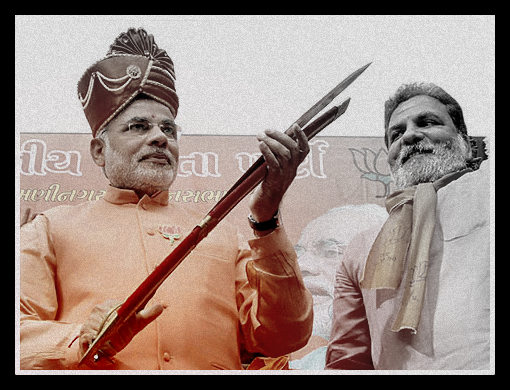
But then we are reminded of a very real fear. A genocidal fascist is making his way to the throne in Delhi. In the heart of the world’s largest democracy, a mass slaughterer, Narendra Modi, is not only the strongest candidate for the PM’s office but is also the blue-eyed boy of the corporate world. He offers a lot of promise. To the corporate world that is. Under his watch, the world tolerated a systematic pogrom against the Muslim community of Gujrat. Rape, torture and slaughter were orchestrated openly in the streets while Modi justified it in an terrifying action-reaction logic.

It’s only high time to do away with logics of actions and reactions, and of ‘us’ and ‘them’.  For someone like Modi to become PM only tells how nationalist-conservative rhetorics are so intertwined with capitalism and globalization. The way they get away with all this is through sowing the seeds of hatred.  One may think otherwise but haters are part of the same process; the same ritual; and the same religion—the religion of nationalism.

Live and Let Die!

yin-yang


It was cold. That’s for sure. It was dark- but in dark times, what difference does it make. Two twin boys. Not more than five or six years of age. They were one and apart. They were alone. Perhaps orphans. Their only source of refuge was in each other and the power of imagination only children so young possess. They were all too innocent and all too unprepared. Will they survive? Have they survived? These questions come back to haunt me sometimes. Sometimes.

Only occasionally do my thoughts betray me. Only occasionally do they escape me. My concerns. My worries. My questions. My comments. My consciousness. My being.  And barely do I succeed in bypassing the gate-keeper who is there to stop me from wondering off into the forbidden territories as he directs me back to that deep pit where I am meant to belong. Merely reminding me of the official dogma of the land, he says “Mind your own business”. And I listen. I succumb. I give in. To myself.

And yet, in times like these, when speaking and humanizing an event seems too much a task a sane person can endure, a painful madness is what we fear is in store for us. We are reminded again and again. ‘Live and let live’ goes the conventional wisdom. It has a soothing mesmerizing effect. We know it is a flawed, conveniently distorted rationalization of going out in the world seeking a good ‘normal’ time, but we buy into it. We are sold into it. For convenient and flawed reasons. To unsee what hides in front of us. Behind us. Beneath us. Just a bit tilted towards the invisible side of the lane.

Those two kids. Beautiful kids. I wonder what has become of them. But are we ever the same persons. Am I the same kid who thought Jupiter and Mars were where girls and boys came from? Who argued with so passionate fervor that Karachi is bigger than Pakistan? Who couldn’t help saying ‘Qaizemaizam’ was the founder of our nation? I don’t know what happened to that little kid. I’d love to meet him. All I have are a few memories of him and the exciting world he lived in. I wish I could go back. But could I wish the same for them. Would they like to go back? In that single moment. When history stops and mourns. It mourns existence. Will they like to go back? Will they like to be where they are today? I’ll never truly know.

It was in Quetta. That beautiful valley town enchanted with cherished memories of my childhood. Ziarat, a popular hill station resort, was not far away- a weekend’s distance. My family spent four years in Quetta when I was a kid. But this time I was on a short visit. This isn’t something so ancient. Ancient treasures aren’t very well received anyway. The image of Jinnah’s residency in Ziarat exists today in my ancient imagination. But so does this. This moment. This memory. This reflection. This guilt.

It was two or three years ago. I met up with old friends. We hanged out in different places across the city. The freezing night was begging for a heavy garma garam (freshly hot) meal. We decided to have some juicy seekh kebabs of the Lazzat Kadda (House of Taste), a small celebrated restaurant near Liaquat Market. It was late when we got there. It gets late pretty early in Quetta. We laughed off the evening.

It was when we were leaving that a friend directed our attention towards those two young invisible boys. Two intensely shivering, identical souls were sleeping on the side of the footpath. They had grabbed on to each other viciously and tightly. As if their young lives depended on it. As if the universe was hanging in balance. They were using each other’s bodies as blankets. They were both only wearing the thinnest of shalwar kameez outfits. They were fighting a battle against an obscenely cold-hearted weather in an obscenely cold-hearted world. Alone. Scared. Resilient. Powerful.

There are times. Sometimes. When I escape myself.  That shivers go down my spine. Not from feeling cold but from feeling overwhelmed by horror. The horror of the event is unspeakable. But what is terrifying to me most is not the event. It is not the scene of seeing two chipmunks left alone in the tragedy of existence. It’s those words that give me nightmares. It’s those words that are truly breathtaking. They force me to self-reflection. They allude me to the society I live in. They push me to myself. They ask me whether I am still there. As a person. As a feeling being. As there. Available. To not ‘live and let die’. To care enough to ‘live and not let die’.

Those words were uttered by a shopkeeper. He said ‘they’re used to it. No worries’.


The Cost of Caring

CareWe live in a world of horror. A world of trembling despair. Of playful murder. Of playful strategy. Of senseless, random, vague bombing from a remote control held by someone taking incessant breaks between his munching of doritos and sipping of diet coke.  Of someone saying that others are the cause of our problems as he ignites fear, steals our sense of empathy, and appeals to the monster that hides in the scariest locked-up parts of our souls- and then we hurt others; and we feel nothing. We know this. We ignore this. We see. We pass by.

Being passive onlookers is abruptly convenient. It is an exercise in sleeping a dreamless sleep. It is an exercise in fearing that which cannot escape the sight our eyes have held in store for our awaken selves. It is to run away from the risk of seeing and of knowing and of feeling. It is an exercise in sanity. But is it, really?

Are we ready to embark upon the risk of knowing? Are we ready to know that the difference of being labeled a Tutsi rather than a Hutu on a piece on paper can mean being exposed to creative torture, of the worst forms of rape and slaughter, of the sight of seeing one’s whole family being put to rest slowly and painfully. Are we ready to worry less about what movie will be out this summer and worry more about the cries and woes of the families of the many daily ‘targeted’ and killed, and counted. And how can we stay unmoved when fascist governments terrorize thousands and traumatize millions more. And how can we remain calm when the strongest people on earth decide to do some ‘collateral damage’- experienced by the weak, euphemized by the powerful.

It seems as though we are left with the wisdom laden in the phrase ‘Ignorance is Bliss’. But this raises more questions than it answers. Is escaping the problem an actual solution? Is closing the eyes going to stop the inevitable? One can still ask, in further retrospect, can we offer a solution? Can we do anything else other than closing our eyes?

Maybe we can’t do much. But this would be replying to a wrong question. It’s not a question of what we ‘can’ but of what we ‘should’ be doing. Should we do something? And even when we can’t, should we care?

Caring has a cost. To care is to feel and to share. It is also to share feelings. It is to put oneself in another’s place. It may come in feeling the happiness and excitement others enjoy in those all too small things. But it also means that you have to feel the dread and blunt pain that someone else is put through. To care is not something to do, but something to be. To be human is to care. To be human is to accept the concept of ‘humanity’ and extending that concept to others.

Humanity is a wholesale concept. You either accept it completely or you simply don’t. You cannot be selective in your humanity. This means to be truly human, you cannot simply enjoy your life while forgetting what others go through. Similarly, you cannot merely welcome the joy in life as you run away from its dark side. This is where the crisis of Capitalism truly lies at. Capitalism tries to steal from us the very notion of what it means to be human.

The culture of Capitalism forces a ‘success model’ down our throat which pretends to be an undisputable fact of life- the only ‘normal’ way of life. Success for us is something of a life purpose. It is the only meaningful pursuit a materialist existence has to offer.  To have a career is something we must all strive to achieve with a narrow and blinded vision. Career is the highest purpose of life, virtually becoming the sole source of meaning- a very meaningless source of meaning.  This is a negation of any pursuit which demands that we help our fellow beings. It is also a negation of caring about our fellow beings. This is because it forces us to empty our minds from all distractions that stop us from focusing on our career.

We are moving towards a world where we function on a need-to-know basis. We must be ignorant to be successful. And we must seek meaning in a pursuit of happiness where we are mere functionaries of a production line. We must be productive, efficient and hardworking. The only problem this poses is one of meaning and empathy, of caring and being human.

Humanity at Stake

1157633_289730281164755_734281549_n

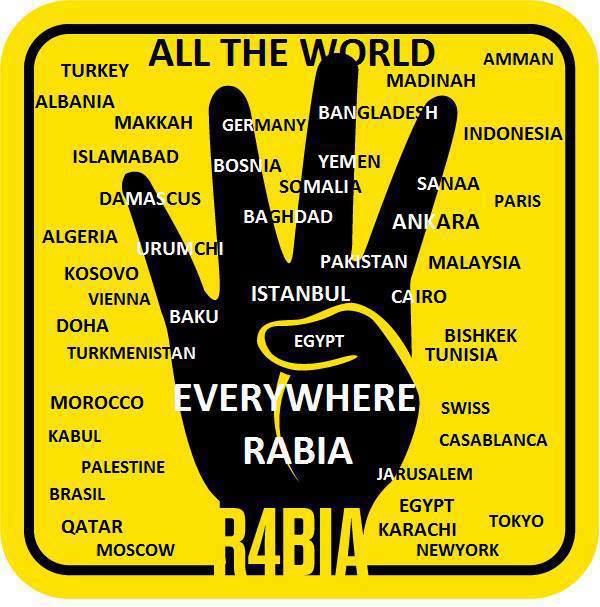
A woman in many women- and children and men- was reported to be rushing back and forth in panic of the gunfire chasing her. A woman- another woman- was seen from her balcony with a portrait of General Al-Sisi; watching, observing, comprehending, and smiling. A grimly smile. This is not fantasy. This is not a scene from a horror movie. This is real life and real humans- or at least, real humanoids!

People are seen enjoying the beach in the scorching heat to get away perhaps from the tense city life. But behind the beach there is a road, and behind that road there are buildings, and behind that building we see smoke, a tense, scorching hot smoke. And we learn that that smoke is the product of chaos, of oppression, of resistance, of subjugation, of panic, of murder, of silence, and of noise. People lie dead on the streets and people lie flat on the beach. Two stories. One city.

Egypt is in crisis. This we are all told. But there is much more to the story. The crisis isn’t merely political. It isn’t merely about who you support. It isn’t about who you don’t support either. It’s not an Egyptian issue anymore. Boundaries don’t make sense now. It’s boiled down to the very essence of what it means to know and love freedom and democracy, to value dignity, to value humans as human subjects, to figure out what it means to be human.

But here is where narratives fail, and collide. The crisis in Egypt has consistently been portrayed as a clash between two parties- or to say, two narratives. This schema has been deliberately consolidated by both the coup-regime, which includes all its functionaries, and forces of the global hegemonic status quo. Locally there is this thing they call ‘the people’- a label created to function as a catchall term for supporters of the illegitimate regime- and then there are ‘terrorists’- a label used to discredit a demonstrably peaceful resistance movement against illegitimate regime change.  The mainstream global media on the other hand adopts a less obvious propaganda model. It divides people into ‘anti-morsy protestors’ and ‘pro-morsy protestors’- or sometimes calls them ‘Muslim Brothers’ straight out- and by doing so it very criminally distorts the picture. In doing so they’re undermining the fact that the ‘pro-Morsy protestors’ are in fact an ‘anti-coup’ and ‘pro-democracy’ movement. But of course, is it really a coup? And yet, it isn’t a matter of what definitions say when it is a matter of what global (western) interests say.

The most vulgar display of this politics of labels and binaries was when the world was watching military men, accompanied by tanks and cheering fascists, firing directly at the Al-Fattah Mosque in Cairo where a few hundred protestors were trapped. The domestic media portrayed it as an operation against anti-state elements and terrorists—one of the old classics- while the global mainstream media portrayed it as a clash between two rival parties- that very workable tactic. By calling it a ‘clash’ or ‘conflict’ of what is clearly obscene violence carried out by the establishment against individuals is the old method deployed in covering the ‘Israel-Palestine conflict’ or what is clearly Israeli repression of Palestinian individuals.

The Egyptian crisis has also become a crisis of confusion in Muslim majority societies. A victim narrative seems to emerge where the culprit is made to be democracy itself. The greatest beneficiary of this narrative is none other than Al-Qaeda itself; just as it was the greatest loser in the Arab Spring where it seemed as though change through peaceful and democratic means was a viable option. This optimism seems to fade away. This is the same optimism that makes sleeping difficult for oppressive regimes; for it’s easier to break bones than minds. The narrative serves both terrorist groups at the fringes of society and the establishment controlling society. But besides the damage that is carried out by this narrative, it is also flatly wrong. What happened in Egypt was not because of democracy but the lack thereof. There was nothing remotely democratic about it. Even the regime of Mubarak retained itself in all spheres of life. Not only was a democratically elected parliament disbanded immediately on a technicality, the democratically elected president was never given any true authority. He was overthrown by anti-democratic means and what is now present in Egypt is the suppression not only of people but of the very notion of democracy and freedom. It is here where the story needs to be squarely put as a matter of democracy, freedom and dignity. To place the problem elsewhere undermines and hurts the broader cause.

What else needs to be understood from the problem in Egypt is the consequences of polarization and uncompromising partisanship. To understand each other, to build on each other’s point of view, to discuss and debate critically are all essential to the health of a given society. A politics of empathy is the need of the hour. Unfortunately, Muslim majority societies are plagued by a clash of uncompromising narratives. The damages have played themselves out it Egypt. Pakistan is also deeply polarized and suffers from a politics of condemnation and ridicule of the other. In Tariq Ramadan’s words, Muslim majority societies need a ‘cultural revolution’ where we can think critically about our current state, be conversant with the challenges of modernity, offer creative solutions to contemporary challenges, as well as be consistent and employed with cultural, religious and civilizational references. This calls for moving beyond binaries and labels, and moving forward constructively and collectively.

But ‘What is MBFC?’

302931_248959945161026_1585264984_nChange is one of the most popular themes in contemporary Pakistan. But what exactly do we mean by ‘change’, and even more importantly, why do we need it so badly? This is something that we should all learn to question. When we demand something, we should be conscious of what it is exactly. This question is even more relevant when it comes to ‘My Bit for Change’. It is common to be asked what we mean precisely by our bit of ‘Change’.  It becomes eerily more difficult to respond to such questions when certain inquirers come with their own framework of change and refuse to take any other possibility as a legitimate concern for social action. I will be trying in the following lines to clarify where we stand when we talk of change.

Most people see change as a one-time event. Many more view change as something that happens, not always something that is done. Others see change as all-encompassing and all-imposing, or to say; what I want for others.  Some people see change as simply to challenge all things upheld in society as good and desirable. Some people see change as refusing anything that challenges established norms and values of society, whether such things are themselves oppressive and condemnatory. Some people don’t see change as anything but a simple slogan behind which the popular trend is going, while others see change as a call for irresponsible and disruptive action geared towards dismantling the social order.

To accommodate all such views under a singular umbrella would be too difficult a task for even the brightest of relativists. We, however, would only consider such an endeavor to be outright pointless and directionless.  Because from our point of view; when you set your eyes in every direction, you’re not heading anywhere. There is a fine line between being accommodative and accepting all opinions as equally valid.

Our conception of change is one that is a life-time endeavor; a struggle; a jihad; a constant effort to improve ourselves and the world around us. There is no permanent state of perfection, at least not in this world, and we believe in relentlessly looking within ourselves critically and engagingly, and continuously improving ourselves and coming out as better human beings.

We endorse Rumi’s conception of change from the depths of being, who said, “Yesterday I was clever, so I wanted to change the world. Today I am wise, so I am changing myself.” And just as Gandhi put it, “Be the change you want to see in the world.”

We also believe that change doesn’t come, it is something you have to bring, or to invent, or to create. One should be in charge of destiny and fate, and not the other way around.

As Iqbal would suggest, “Khudi ko kar buland itna ke har taqdeer se pehle, Khuda banday se khud pooche, bata teri raza kiya hai.”  (“Rise above yourself so high that even God, before deciding upon your fate, should ask you: Tell me, what would you like?”), and also, “Na Tu Zameen Ke Liye Hai Na Aasmaan Ke Liye. Jahaan Hai Tere Liye, Tu Nahin Jahan Ke Liye” (You are neither for the earth nor for the heaven: The world is for you, and not you for the world.)

We want the world to be a better place, a more peaceful and tolerant place, for all human beings whether they live in the ‘developed’ world or the ‘developing’ world; whether they belong to the majority or minority; or whether they belong to one so-called civilization or the other. Our call is a call to be human, and humanity begins at empathy; and realizing that persons other than you also feel, desire, and think, that they too have an existence as much valid as yours.

We don’t consider MBFC to be an ‘Islamic’ forum, if by doing so one is dividing a Muslim population and society across lines of ‘Islamic’ and ‘Non-Islamic’, or between acts of ‘Deen’ (religion) and acts of ‘Duniya’ (this world). For the first matter, we don’t believe Muslims can be categorized against a scale telling them who is how much ‘Islamic’. It is not our job to say who is more or less Islamic, or Muslim, as this is a matter of individual conscience, as well as one’s private relationship with the Almighty. It is not in our jurisdiction, but God’s alone, to judge other peoples religiosity. Secondly we don’t believe in the duality of our faith with the matters of this world. We believe that faith is as much a matter of this world as it is of the Hereafter. From our perspective, while praying is an act of worship so is earning an honest living or spending quality time with one’s family. In this sense, we consider ourselves ‘Islamic’ not as separate, but as part of the broader Muslim society. This is not to say that we exclude the non-Muslim voice either. A non-Muslim perspective has its own validity and legitimacy in a fully functioning Islamic society.

What one should grasp from the above description is that we want to bring people closer and not further apart. We are staunchly against sectarianism but also strongly against extreme polarization in society. We feel that extreme positions often fail to take the existence of another perspective into account. While religious extremism has been condemned and spoken of in media discourse; an opposite extremist discourse is also a common sight. Both depend on each other, as without the presence of the opposite, there would be little for either to say. To be exact, both speak in absolute and exclusivist terms; they talk about each other but never to each other. It should not come as a surprise that both sides have tried to attack our forum, either in the form of hate-mail to some of our writers or through certain reason-free writings.

This may be taken as a cost for trying to be moderate. To be moderate, of course, is not to merely take a balanced position in the middle of two extreme discourses; it is to refuse to fall prey to either. Some may not realize this but sometimes a loud call for moderation may be the most radical attack on extremists. To refuse to fight them is to defeat them.

But this is not where we end. We have continuously adopted an anti-imperialist, anti-hegemonic and anti-oppression stance. We have been very vocal against the drone attacks, as well as persons undermining their brutality, and such horrifying incidents as an American spy killing innocent civilians in the daylight of one of our major cities. We have spoken against outright human rights violations, such as the illegitimate kidnapping of our citizens, especially the case of Afia Siddiqui, and calling them ‘missing persons’. We have voiced concern for the brutal attacks on the Shia Hazara community in Quetta, as well as the tragic Badami Bagh incident. We have also spoken against various oppressive measures of state institutions and the state itself.

We have also been firm believers in accelerating the process of decolonization. We believe that has yet to end. The legacies of colonization are strongly visible even today, some more tangible than others. We have spoken against the usage of a certain language and traits that show of a false ‘superiority’. We have advocated pride in our own national, cultural and religious heritage. We have promoted such figures as Iqbal and Malcolm X for this very reason. And to quote our favorite activist for change, the latter of the two,

“A race of people is like an individual man; until it uses its own talent, takes pride in its own history, expresses its own culture, affirms its own selfhood, it can never fulfill itself.”


A Colonized Ridiculousness

923412_10151587868230239_1296821611_n

How many times do we actually sit down and ask ourselves how ridiculous we sound? And how ridiculous we should sound? And how we are indoctrinating this ridiculousness to our coming generation?

Now let me be the odd one, the strange one, the party pooper, the nonsensical one, and let me tell you that there is something very ridiculous at the sight of seeing a mother struggling phonetically with her child to explain to him that he must use words of a language foreign to him and remain a constant rebel to his comfort and nature by staying as far away from those inferior, those desi, those Urduish words that his mind uses to make sense of the world.  But alas, it is that mother who is being scorned by the child’s so-called educator that it is in fact her job to make sure that the child is surrounded by as much words loaded with declamations of inferiority, of psychological bullying, of an age-old legacy telling the child that he is still a colonized subject- that it is that legacy of his oriental heritage, all of Indian and Arabic literature, which is intrinsically inferior to any good shelf of a British library.

And yes there is a contradiction at work here. You may ask why is it that I use the same language I speak of so badly to speak of it so badly. Well, I see no problem here. There is no problem in using any language. The language is not the problem. You can and should use the English language. And the same can be said for Saraiki, French, Urdu, German, Pashto or Arabic. The only condition is that they are just languages- means of communicating what we have in our minds with other people-and nothing more. They are to serve the same purpose and are little different in this sense. They should not be a sign of superiority, of intellect, of status, of class, and of all such non-sense we have come up over the years. After all, how is a thought expressed in one language, any better than a thought- a mere concept- expressed in any other language.

Then why is it that poor and helpless human beings are told in our sad state of a country that they have to learn a language before they can actually learn something concrete- like to say knowledge itself.  As weird and shocking to our English-is-a-global-language enthusiasts as it may sound, these humans- these lower-class nobodies, these forgotten proletariats of our forgetful socialists,  these mechanics and drivers and maasis and cooks- already know a language. Why should they learn another language to start learning something if they already know a language? Why can’t they be taught in the language they speak and think in?

But doesn’t everyone know why? Will these people, who we throw so much pity on, not become a threat to ourselves? And will we not have to compete with ‘them’. We know we can afford a quality education in a language foreign to our whole continent. But these wretched of the earth cannot. We can secure for our children the privilege of remaining in our beloved elite class, while ‘their’ whole generations would grow up serving ours- never to escape this vicious cycle we have so ingeniously created.

Our ridiculousness then is only a cover for preserving our class interests. We make fun of people who cannot speak the language properly even when the content of his or her proposition may actually be beyond the capacity of our own intellect. We consider those who cannot speak fluently to be lower and inferior human beings. When we want to tell someone that we are something- such insecure people we are- we immediately code-switch to the English language.

We refuse to see the ridiculousness behind all this madness. Far from it we don’t even realize how much damage we are doing to ourselves. It is unhealthy and sickly what we are doing. To be someone you are not is only an insult to who you are. But who are you and who am I.

Why be ashamed of our own cultural and religious heritage, of centuries of civilization, of literature, of creativity and of art. Why be a lower quality of somebody else by voluntarily accepting his superiority and by giving in our own sense of being? Why this ridiculousness?

The Color of the Painting

The painting was absolutely stunning. It carried a latent meaning which was profound and deep. It was both intriguing and complex. No single narrative or interpretation could really sum-it-up. It was colorful; you could see all sorts of colors of all sorts of variations and shades.

And there stood the painter gazing at his work and wondering how complex the human mind could really be. It was then that a rather blunt man walked right in the gallery. He saw how people were being fascinated at the sight they were beholding. He too looked at the painting, and, wondering what was so special about it, asked, “Umm… what color is this painting?”

How exactly was the painter supposed to answer this query? Well, he chose not to entertain a question that destroyed the purpose of discourse.  But then his “ignoring” started to be confused with “ignorance”. People started to doubt the validity of his work. Someone from the crowd stood up and with an inspecting look in his eyes, proposed “I think it’s blue”. “Nah… It looks green to me” commented another. And as soon as you knew it, the audience was arguing about the color of the painting. The painter realized soon enough that joining the conversation would be the worst way to tackle the matter. He knew quite well that when you argue with idiots, they bring you down to their level and beat you with experience. So the painter decided to leave the place quietly and search an audience elsewhere.

The states of affairs that run our everyday discourses are not so much different at times. ‘Keeping things simple’ as it goes. We want to see the world in binary terms; true and false, good and evil, us and them, and so on. Boring descriptions of things that take place around us don’t do much entertaining. So we choose to overdose reality with a lot of perspective, and a lot of they-are-out-to-get-us and we-are-the-center-of-the-world narratives.

This has led us to conveniently create a world around us that explains everything easily. The world becomes an obvious statement as soon as it is revealed to us. We know that the world is full of conspiracies and plots, and a whole bunch of stuff, and all the while these conspirators and plotters are busy in their twenty-four hour meticulous schemes just to make sure we can do nothing about it.

But alas, it is the notion that ‘nothing can be done about it’ that leads us to a state that we desire most; a state of zero action. We are betrayed by ourselves into a seat of passivity and helplessness. We are then silent spectators of history waiting for it to unfold as time passes by as if some script has been pre-written by “them”, and everything has already been decided by the big guns.

So why not, I ask, should we indulge ourselves in conspiracy theories, simplistic formulas, and populist rhetoric. After all, it suits our inherently lazy character. Taking charge of our destinies, being participants in a greater scheme of things, and, most of all, being responsible for our fate, aren’t things that one would actually want to do. They require too much blood and sweat.

But all the while that we layback and create convenient narratives about the world, we are also inflicting harm upon others and ourselves. By conceiving enemies we are also creating hate. And worse still, we let ourselves be defined by that enemy and by that hate.

One just has to look at the walls of our cities to see such slogans that say “What relationship do we have with India, but of hatred and revenge” (Bharat saye rishta kiya, Nafrat aur Inteqam ka). But really, can we consider this a healthy attitude? Does our religion teach us to hate other human beings from the bottom of our hearts and hope that they end up with the worst of fates? Is this the message of peace and compassion, as well as universality that our religion teaches?

In the process of our hate-generation, we often forget, as Muslims, that we are actually losing subjects of dawah. Human beings, despite their beliefs, or historical-cultural presence, are all common creations of the Almighty. None are creations of Satan. Neither is anyone essentially evil, as we are all human and the Almighty hasn’t made us that way.

Now enemies need not be looked only for outside, but even in our surroundings, and within ourselves. Have you heard of the Yahood-o-Nasaara theory which can be applied to everything you can put your eyes on? I heard it from a friend. I was wearing this shirt that said ‘Smile it’s a Sunnah’, and I asked his opinion on it. His response was that I was being misled by the Jewish lot as they must be laughing their heads off now that I fell to their diabolical scheme of having me wear a shirt that will sooner or later get dirty and hence insult the Islamic message it portrays.

This line of thinking stems from superficiality and results in irresponsibility. Such irresponsibility is equally demonstrated when we start talking of politics in utopian terms. We start looking for a savior of some sort or a newer ‘system’ based on some fancy word we learnt. And then we talk of change.

Talk of radical “Change” and “Revolution”, and thinking that all out of nowhere, and with the help of one person, party, political movement and so on, things would all become A-OK, is fundamentally misleading and inherently irresponsible.  It’s irresponsible because we shift the focus from ourselves and portray the responsibility on others. Others here being all those things stated above.

To take hold of our destiny and our persons, we must put some responsibility on ourselves. Iqbal talked of the Khudi, or the Self, but have we ever realized such a thing. Is it not an appeal to the individual to change and overcome himself? But be not confused for I’m not talking about the ‘individual’ in the superficial sense. I talk of the individual in the all-encompassing sense; the personal individual, the social individual, the economic individual, the political individual, and so on.

It is the individual who matters. If he decides to make a contribution then it is he who is making a difference. He has to take hold of all spheres of life and reach out to many other individuals. He must learn to be an active participant of history. But all this requires for him to look at the world more deeply. It requires for him to ask the right questions even more so than to reaching the right answers. He must realize that the color of the painting cannot be changed from green to blue. He must realize that if he likes blue that much he must add it to the color of the painting.

Because the Ugly Combination Sells

So Ladies and Gentlemen, contrary to all expectations and despite the ever strong social media activism, Veena Malik is back in full swing to help people get over their sins -and hers- and plead and beg to the Almighty Lord to forgive them -and her- for their sins -and hers- for the moment so they can get back to what they were doing as soon as they change the channel.

For some, the whole controversy was a rather new one. The media has crossed all limits. Vulgarity and obscenity is one thing, as it goes, but associating people related with obscenity with issues that we hold sacred, like Ramadan, was just wrong, and out of the blue. It’s just not nice.

While this represents the popular sentiment regarding the issue, I tend to see the whole drama in a rather broader sense. While the whole Veena Malik episode, a populist stunt of sorts, was definitely the last straw, and off limits as it was, fails still to be the problem itself. The problem in my opinion is the Capitalist nature of the media whereas everything that can be sold is sold, and customized to suit the commercial agenda.

This one-dimensional, or profit-dimensional, Capitalist mindset, that sees not the ethics, responsibility, values, and morals, that come in its way, has but one problem; it’s not human. In fact, it’s satanic. Greed is its ultimate value, where all things through which humans derive meaning and purpose are utilized and customized for ends that make mockery of human existence.

So what sells? Ratings!!

Oh, and who knows what gets ratings better than the media itself. Apparently, the screen is not a big fan of serious real-life engagement with the audience. Such an enterprise would first need pretty cutting and editing to get some real applause from the audience. After all, the people don’t want to see things as they actually are, but rather in ways that suit their deepest imaginations and fantasies; that shine and dazzle, and look good to the eye. And what they want to see is on-screen; so what happens off it is none of their business.

Nonetheless, religious broadcasting in our country, especially in times of Ramadan like these, is quite a money making enterprise.  One mustn’t forget, however, that religion is, in fact, serious business; we look at religion for things like social and moral guidance, spiritual emancipation and intellectual enlightenment. More simply, religion is not a consumer product.

But what we see on our television screens is just outright deplorable. Actors and televangelists are busy reading from pre-determined scripts to people expecting a ‘religious transmission’. We know for a fact that some of these performers are completely different people off screen. In fact, when the masks are taken off, no humility is spared. Leaked videos then lead, not only to controversy, but also to a deep sense of shame on our miserable state.  “Online Aalims” with huge followings display how low they can really go; but it doesn’t stop there. They make returns, ever afresh; blaming their previous employers and other conspirators with all the credibility that comes from consecutive calls from Mecca and Madina.

My actual concern is on how Islam is trimmed and framed into a collage for the masses that is highly superficial, populist, symbolic, theatrical and even, hypocritical.   The media knows well how to manipulate popular imagination. Just put the “Aalim” in the grave and make him cry to a live audience; what a show, what a show indeed! But even more, Islam is in the process stripped from its essentially profound nature. On the other hand, cultural aspects associated with religion, like the ‘Kurta Shalwar’, are made essential. Programs devoid of any moral and spiritual nature may easily be Islamized by symbolic gestures alone.

So to be honest, the media crossed the line ages ago when it decided to treat religion only to ends that met its commercial agenda. Today, the media has become a power house. But power necessitates responsibility. While we may criticize the government and the politicians, the bureaucracy, and the military, and not to forget the judiciary and all other stake holders of power for being involved in projects based on personal greed, we must also make the media accountable for its actions. The media isn’t just a bunch of corporations seeking to get a share of the market; the media is a pillar of society that exercises a significant amount of influence on people’s lives. The satanic obsession it may have with money should not result in the mockery of our values and faith. It’s high time to bring it to order and make it realize its boundaries.


Islam and Rule of the People – III

The instinctual problem that arises with democracy is the belief that democracy originated in the west. The history of democracy is therefore presented as troublesome. The Ancient Greeks, who are told to be the founders of “democracy”, would probably be shocked and be dismissive of modern democracies. As modern representative governments are radically different in nature than the democracies of Greek city-states where all citizens would gather to make decisions. Democracy is a very fluid concept with radically different forms; direct, representative, functional, parliamentary, republican, federal, proletarian, and so on.

Modern democracy, however, from a conceptual standpoint, has a troublesome dynamic. In the west, it evolved in the background of the renaissance and the revolt against the authority of the church. It was in this sense a blow against religion and the ecclesiastical order. It was also a revolt against the European Monarchies, those of which claimed that they had the divine right to rule. While in actuality, as the slogan of the French Revolution went “We want neither a Lord nor a master”, the struggle was one of the masses against oppression of monarchy and theocracy at the same time, it became expressive in a revolt against the justifications presented by the regimes; Divine right and representation.  Hence, against the claim of the church of ‘the rule of God’, the movement demanded ‘the rule of man’.  The revolutionary notion of man’s independence from God manifested itself in form Secularism, Nationalism and Western Democracy.

Fortunately, however Islam does not endorse any religious class to begin with. While Islam does value knowledge and deeds, it does not give monopoly to either a scholarly or holier-than-thou class on the power-centers of society. Popular participation is a fundamental aspect of the Islamic socio-political order.  In this sense, an Islamic state is a civil state against what is understood as a “religious state” (a theocracy).

According to reputable Islamic scholar, Syed Maududi (RA), the Islamic ideal is unique in itself. But to describe it in its nearest terms for understanding and categorization, it can be called a “Theo-democracy”.  This is because while Islam recognizes the sovereignty of God alone, it gives the people the right to choose their rulers and be consulted.

The whole concept of Bay’et, or pledge of allegiance, in Islamic history, is a perfectly appropriate methodology to establish legitimacy based on public consent. The ballot system, and the whole electoral process, is just a more advance and modern way to achieve the same principle. For it’s time and circumstances, the Bay’et system was most suited and applicable. Now we simply have a more advanced and modern method to achieve the same end. Unfortunately, even this Bay’et system was misused by despotic rulers in our history. Forced Bay’et, or consent, became a method to justify monarchal rule in Islamic terms, which faced resistance, starting with the revolt of Imam Hussain(RA), from time to time. In modern times too, despotic rulers have used similar methodologies to justify their tyrannies by the illusion of consent, from Hosni Mubarak to Pervez Musharaf.

There are two main contentions left with the anti-democracy argument. The first refers to the failures of most Western democracies. The ‘corporations’ and ‘lobbies’ are the true parties that hold the strings in such so-called democracies, while public opinion is manipulated through mass media. While this may be true, there is an inherent admission of these democracies not being the real thing; a scam of sorts. In further response, one has to say that within an Islamic framework, monopolistic tendencies in corporations or interest groups are both to be contained. While an explanation of Islam’s socio-economic ideals and characteristics are too detailed to accommodate in this essay, one has to simply understand that they’re different from those of Western capitalist societies.

The second contention refers to the failures and the shape of democracies as ours in Pakistan. People at large are blamed for choosing the corrupt people again and again. This may be true but many other factors are involved, including the incessant shifts between dictatorships and democracies, the general moral and intellectual degeneration of our society, the gap between the elite and the masses, the colonial legacy, and the feudal structure of most of Pakistan. If we find the people today to be ignorant at large than it is the responsibility of the responsible few to create a critical mass that would reach out to the people. While this is another topic, I believe that the elite in Pakistan must take responsibility to engage with the masses. The professional and educated elite have generally been apolitical, while leaving the masses vulnerable to demagogues.

Democratization and Islamization in the Muslim world go together. This fact must be realized. For in true democracy, the consent, traditions, values, approval, customs and religion of the people must all be reflected. On the other hand, secularism in Muslim societies can, and has always, been imposed by force at the hands of despotic rulers. We must also understand that the greatest opponent to democracy in the Muslim world has always been the Western hegemonic powers. If true representatives of the people come to power, there is always the chance that they’ll reflect public aspirations.


Click here for Part I and Part II