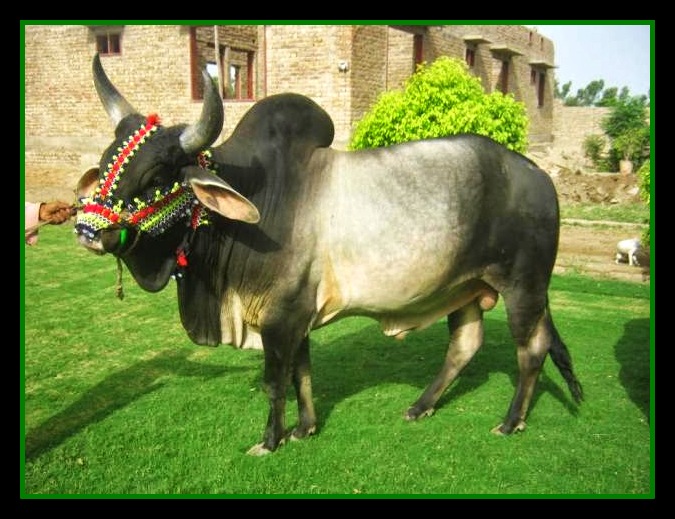
 Depression and psychological complex amongst sacrificial animals would be highest during Zilhaj if they could comprehend the criteria of ‘khoobsurat janwar’ which Pakistanis have created. Similar to how the advertisements make us believe that we need products to look good and for example, men and women who use fairness creams excel both in professional and personal life because of their fair skin tone, even the animals have to undergo a strict regime in order to become beautiful.
They are given the best diet which includes butter, milk, etc. As a result of which they grow up to be superior and bulkier than the rest and also are really heavy on the pockets of those purchasing them. However, it is surprising how the demand for these ‘khoobsurat janwars’ has increased even with the high inflation, escalating poverty and low employment and growth rates in Pakistan. Not only is poverty increasing, but so is social inequality. The phrase ‘the rich get richer and poor poorer’ fits our situation completely. If one were to look at the lavish lifestyle and expenditures of the elite Pakistanis, they might think that Pakistan has a really small fraction of people living in poverty. Because of the fact that it is an ‘Islamic Republic’ after all and if the rich are rolling in money then obviously their taxes and charities must easily be able to help the underprivileged section of the population. But unfortunately due to the lack of a proper system and trust in the government these funds are not efficiently allocated and spent. If people could trust the state they would pay taxes and in return the State would provide basic facilities to the population, like it happens elsewhere in the world where countries are governed with the idea of justice and honesty.
Interestingly, our tax authorities endorse the slogan of, ‘See no evil’, and there is nobody to question how people who go at lengths to make sure that they find a way to hide their true incomes and declare their incomes to be as low as possible can afford such expensive animals and various other commodities for that matter.
Amidst the huge tents, posing for pictures with the animals, flashy lights and various other pompous activities, we fail to realize how miserable we make those who are less fortunate than us feel. What goes through the mind of the chowkidaar or the man who takes care of the animal which cost almost about seven to eight years of his earnings is something we cannot fathom, that is if we ever bother. The increasing disparity is one of the root causes of crimes in a society. Plato warned of this evil “There should exist among the citizens neither extreme poverty nor, again, excessive wealth, for both are productive of great evil . . . Now the legislator should determine what is to be the limit of poverty or of wealth.” One of the main reasons behind social chaos which leads to the weakening of the state is imbalance of wealth.
While there is nothing wrong in spending a million or more on the purchase of sacrificial animals, what I fail to understand is why one cannot buy ten cows for a million instead of buying one? This way, there would be more meat to consume and distribute amongst relatives, neighbours, friends and the needy. Is it because sacrificial animals have become a status symbol? If yes, then the purpose of sacrifice is lost because it is not just the sacrifice of the animal but what the example of Hazrat Ibrahim and Hazrat Ismail (A.S.) in its true essence teaches us is that we should defeat our ‘Nafs’ and be ready to sacrifice all our desires for Allah. Then is not the desire to show off dominating us? Is it not ignoring the purpose of sacrifice? Allah says in the Holy Quran:
‘It is not their meat nor their blood, that reaches Allah: it is your piety that reaches Him’.
So if the blood and meat do not reach Allah but piety, then we really need to contemplate if we really are pious and if not, then nothing at all is reaching Allah.
Our Holy Prophet (PBUH) has taught us that actions are judged by intentions. There is no use of following rites and customs blindly if we do not completely embrace the true meaning of Islam. Islam is not just limited to rituals and the five pillars. It places utmost importance on the principles of social justice, welfare, fairness and protection of human rights. Eid is to be celebrated with the entire Muslim Ummah and therefore it is incumbent upon us to make sure everyone enjoys this occasion.
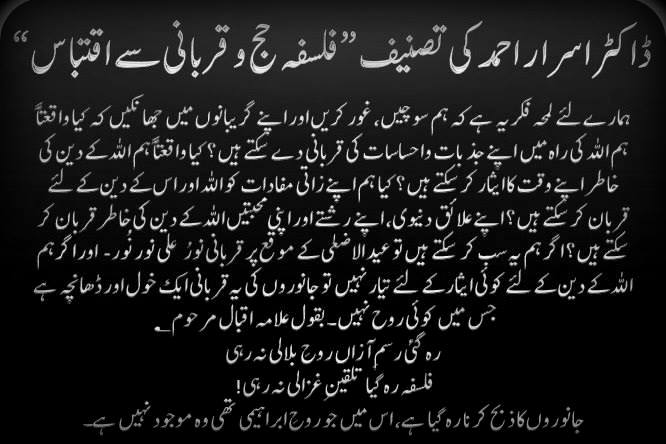
I leave you with the words of Dr. Israr Ahmed who has put this social problem eloquently that we have lost the spirit of sacrifice when it comes to following the ‘Deen’ of Allah. We are not ready to sacrifice our time, our comfort and our desires in the way of Allah. We do slaughter animals but we are completely devoid of the spirit of Ibrahim (AS) and the lesson his life teaches us.