Down to Earth – With a Bump

laurenbooth_profileIt doesn’t happen quickly, it takes time.

For a long time you can’t imagine it happening at all.

Then one morning, you wake up and it’s living within you. A spiky, pebble in the midst of joyous certainty; disappointment.

Disappointment in the Ummah, you are now a part of.

For ‘born Muslims’ the acknowledgement that those who try to follow the teachings of the Prophet of Mercy, (May Allah The Most Merciful bless him) always fall short, comes with the territory. If you are from Pakistan or Bangladesh or Egypt or Palestine, or any other majority Muslim nation, you will have most likely experienced all manners of corruption from the political level down.

Family members, being human beings after all, will have done as we all do; raised their voices, gossiped (probably), missed Fajr and failed in a thousand, small, yet visible ways, to fully embody the teachings we are directed to follow in the Quran. Teachings that if taken to heart, absorbed into the very core of our understanding and then translated into our daily lives, would make this testing reality, dunya, so much easier to bear.

‘Born Muslims’ inevitably try and warn those of us who take testimony of faith as adults, in a variety of ways about the disappointment to come:

“Not all Muslims are good, be careful”; “We don’t keep our promises, pray for us.”

And always my favourite: “Facial veil is no guarantee of piety!”

New Muslims can’t and don’t listen. It is as if our eyes only seek out the good in our brothers and sisters. We are blinded by love, filled with joyous hope.

Finding Islam through the Kindness of People

This apparent ‘naiveté’ seems to jar many brothers and sisters. It is almost as if they can’t wait to burst the bubble of our new found admiration for this community. This family-in-faith, remain stunned, as I announce in lectures that: “I came to Islam through the incredible character and kindness of the people.”

Yet, it’s true.

In 2005, I first set foot in the Holy Land, Palestine. There, in homes, of which the wealthiest I was invited to would be considered the poorest in the West, I learnt about love, patience and generosity; And how to host guests; And how to bring up children; And how to be a good human being.

Time and again, I would make excuses to go back to Falastin, treading the fertile grounds of Jenin, Nablus, Bethlehem. All because my heart yearned to spend time with the most remarkable people I had ever met.

After one such visit to the Gaza Strip, I experienced the terrible humiliation visited upon Palestinians, even in old age, at the Israeli ‘Crossing’ known as Erez; Half a mile of concentration camp style watchtowers, barbed wire, concrete and turnstiles cruel for livestock – terrible for human beings.

An elderly Gazan grandmother, traveling to America for a spinal operation, was turned back time and again at the crossing, without explanation, until she missed her flight and her operation. It took the rest of us; UN workers, Fatah government ministers, business men, five hours to pass through the hellish process.

I had booked a Palestinian taxi driver, Jamal, to collect me at around 11:00 am. It was now past 5:00 pm, dark, winter. My mobile battery had long ago died.

Suddenly a car sped towards me in the empty parking lot. It was my taxi.

“I booked you for 1:00 pm” I said aghast.

“Yes” replied Jamal “I waited from then”.

“For five hours?” His response made me weep all the way to Jerusalem, Al Quds.

“A Muslim man would never leave a woman on her own in danger.”

Subhan Allah!

These inspiring moments have not been limited to a land under occupation, nor to those whom hardship and poverty has cleansed of arrogance.

From Palestine to the UK

Back in London, my path continued to cross gentle women, whose manners were unlike any I had encountered before, with sweetness from another, purer, age and time. Women who despite working in highly regarded professions, as lecturers, doctors and teachers, greeted me, an unbelieving stranger, with greater love than many I had known all my life.

Then I took my shahadah and I waited for the change (that all my born Muslim friends warned me) was certain to happen.

One morning, in February this year I woke up to find that it had arrived. Suddenly, not everyone around me was shiny, amazing. Everywhere I looked Muslims were bragging, lying, gossiping, drinking alcohol, stealing, flirting and every other sin, major and minor.

What happened guys?

On reflection, two realizations occur within the revert that finally bring this grim moment to fruition. The first is that we, ourselves, start to fail more and more. In our ibadah, in our speech, in our deeds. From those glorious first days and months when we are immersed in learning Islam, where constant dhikr creates something like an invisible force-shield, around the believer who practices. It keeps us in check, protects us from harm.

Oh how we fill our waking hours with the Quran, reading books on Hadith and downloading inspirational lectures by people of knowledge. A person, who accepts Islam wholly and completely, cannot be late for prayer. It is unthinkable. Clutching a sheet of paper or a donated book, the newbies nervously, cautiously, hearts swelling with love, work the way through Salah. They will painstakingly mouth each alien vowel, respecting every sacred syllable. How direct is the unwavering gaze downwards – which is an imitation of the blessed Prophet’s own concentrated eye line during prayer. How the grateful, saved heart cries towards Allah, The Merciful, who has cleared away all our previous sins.

“Ihdinas Sirat al Mustiqeem”

 Do we seek shortcuts in our wudhu? No!

Do we watch TV shows which may show kissing or drinking alcohol? No!

Do we hang out with chatty (gossipy) friends – No!

This is the moment born Muslims may see us as ‘extreme’ in our practice.

This is the moment too when our ‘khushoo’, sincerity in seeking Allah’s face, is at its highest peak. Love is everywhere, peace is possible, and faith is all.

As I say, then we begin to falter. You know how it goes. First you drag your feet a little, to the prayer mat. A week later, barely noticed, all your prayers are last minute and rushed. Soon after that Fajr is done ‘before going to work’ and not pre-dawn. And here we all are together at last in our weakened, stumbling, frail, version of faith.

A second powerful blow is delivered as experience means we must realign our expectations of our community. What I mean is this.

You are Already a Kinder Person 

Compared to the world outside the Ummah; great sections of our community are and always will be, inshaAllah, amazing. Whole villages are known in far flung places to be beacons of hope to the traveller and seeker of knowledge. Whilst in every city in every nation on every continent, humble servants of The One, quietly support friends, neighbours and strangers as best they can, even if it means personal hardship.

 ‘They (the true believers) give food, out of love for Allah, to the poor, the orphan and the slave, saying: We feed you only for Allah’s pleasure – we desire from you neither reward nor thanks.’ (Al Qur’an 76:89)

 Coming from the cold, hard, materialistic, half drunken, non-Muslim world, I can tell you that thanks to the teachings of Prophet Muhammad (peace upon him) you are already a kinder person than you otherwise would be. How quickly sisters jump to one another’s aid where children are concerned for example. I never had the kind of support I now have, outside the Ummah. How quickly we rally together to help a family if a member falls ill and times are hard. Did I see this so routinely outside? Not at all!

In February the differential, the gap between how good we all manage to be and what we should be, was simply made clear. The natural goodness of those around me has become something I now take for granted.

Yusuf Islam is famously credited as saying: “Thank God I learned about Islam before I met Muslims”. I can understand that.

The question we must answer as disappointment in everyone else pecks at the grains of our faith. Have we already become one of ‘those’ Muslims – more likely to put others off this complete way of life, than be an example of its high principles?

Also published on OnIslam.net

Muslim Schools, Hijab and the Media

laurenbooth_profile‘I’m not wearing that!’ My 12 year old daughter winces as we examine the bathing suit she must wear for swimming lessons at her private girls school in Manchester. A whole section is cut away from rear ribs to the (very) lower spine. As for the front, well, the thighs of the suit are so high cut the overall effect is less year 8 swim club, than a Rihanna photo-shoot. It serves me right – for not sending my daughter to a Muslim secondary school.

Despite the negative press you may have read about (dread phrase) ‘Muslim Schools,’ both my daughters and I have found the establishments near us to be welcoming, inspiring and (as a mum of teenage girls), with a dress code that is refreshingly, modest.

Our views, based on solid experience of local Muslim schools, are far from the media portrayal of the norm. Just take a look at the headlines. In recent days, two Islamic schools have featured unfavourably. Al-Madinah in Derby, a new 4 -16 Muslim Faith state school, opened just a year ago has been temporarily shut down after its first Ofsted report, closed the gates due to a “health and safety issue.

At the same time one of the only other state Muslim schools in the country, Tauheedul Islam Girls’ High School has been criticised in the press for its dress code. Girls who attend Tauheedul Islam’s High are expected to wear a headscarf to school. And it is this uniform code which has incited negative coverage against this otherwise highly successful state, establishment.

Whilst the mainstream media were seeking a way to tarnish Tauheedul Islam’s Highs excellent reputation, the school, quietly, at the same time, topped a league table of 3,000 UK state establishments. Trinity Mirror’s data unit, backed by academics compiled the list seeking to give a ‘comprehensive’ view of the quality of schools UK wide. The data focused on academic results, teaching quality, and – crucially – the behaviour and prospects of its pupils. Tauheedul ranked the best in ALL these departments.

It is a sign of the mainstream media’s political agenda that to date no daily paper has followed up this story with a positive request (as would usually be the case) for glossy interviews with faculty staff and headteachers.

Thus British readers of anything but a single newspaper are unaware that an Islamic School in Britain currently ranks as the best in the country according to the most recent and very comprehensive study, a school that also has the highest approval of parents, pupils, local government and policy makers in Whitehall. No mean feat in the current climate.

Bizarrely, when I speak to a department editor she insisted that; That league table was from years ago. It’s not recent. It’s old. But I’ll check.’

I call back sometime later and point out that the report was printed two days earlier and is new.

‘Hmm, still can’t verify it’ which is odd as the page is easily found via a way out new-fangled gizmo called Google. Why is she so reticent to repeat the findings? What she said next was both offensive and revealing We just don’t believe everything that head teacher tells you, Lauren, so make sure you check these things carefully.’

Hinting that a head teacher is massaging figures that have been released in a national daily independently of the school is a stunning insult. One I cannot imagine being made of any other head teacher of high standing. Or anything bar criminal standing for that matter.

In the end it took a personal interview, to accompany the article I wrote – recognising the legitimacy of Tauheedul’s great results, to push the Sunday Times to revisit the theme of modesty in school uniforms for girls. Oh and my actual piece? In the end did not appear in the actual paper but only in the online edition and even then it is only available to subscribers. Meanwhile, my interview on girls modesty in schools being a positive was published in the corner of a page whose main story was British imams willing to marry girls of 14 in secret.

British papers want readers to fear the ‘spectre’ of  Islam. Yet, the argument for firm moral guidance and a sense of community, being central to schools is completely ‘on message’ with current government thinking.

Michael Gove the Education Secretary has spoken clearly about the role of schools in effecting positive changes in students’ lives beyond the national Curriculum norms and well into the realms of social mentoring. He has insisted that schools have a major role to play in “promoting stability” in children’s lives.

“There’s nothing worse if you’re a child than not knowing when bedtime and meal time is, not knowing where mum and dad will be at a particular time,” he said.

“But if you are in a school that’s well run then people insist on discipline and timeliness and they insist that you are polite in the lunch queue and eat with your friends.

“And that discipline is evidence of someone really taking an interest in you; they care enough about you, enough to want you to be part of that community and part of that ordered life.”

During my research it became clear that newspaper editors are using the governments agenda for ‘inclusiveness’ try to focus fury on this element in relation to Muslim schools.

‘After all Lauren, which non-Muslim girl will wear a headscarf?’ asked the editor of an educational supplement.

Certainly inclusion for all who wish to enter a school is an important marker for the right of a faculty to receive state funding and must be observed.

It is not the right of local children to attend the best school whatever their faith I question here. After all Muslim children in the UK have gone to CofE schools and continue to do so. But if we are talking about fairness then let us look at the coverage another faith school received when it was found to have a clearly non inclusive policy. Yesodey Hatorah Senior Girls School in Hackney is a state funded Jewish school. In a recent survey it was found that whilst 37.82 of local community children are amongst the poorest (in need of free school meals). This state school has a quotient of just 1.62 per cent at this level of need, a clear example of selection by stealth – The media response to this scandal?
Silence!

Meanwhile the schools website states that: Charedi homes do not have TV or other “inappropriate media”, such as the internet. Families will also dress in accordance with the strictest standards of modesty’. Now let’s hear what the media had to say about Tauheeduls dress code and pupil expectations.

The Daily Mail, following the lead of the Sunday Times, wrote (Sept 29th 2013); ‘Pupils have to wear hijabs in and OUT of class for the first time at a state-backed school in Blackburn.

The cover-up was ordered at the 800-pupil Tauheedul Islam Girls’ High School where students already have to dress in long purple tunics over black trousers to ensure flesh is not seen. Under the rules, pupils must ‘wear the hijab outside the school and home, recite the Koran at a least once a week’ and not have stationery which shows ‘unIslamic images’ like pictures of pop stars’.

Sounds terrifying right? Let’s break this down.

Pupils must wear hijab at school and home. The school dress code includes hijab, a legally acceptable requirement for a faith school. But no one at the school or on its literature makes the outlandish claim that they would somehow ‘police’ girls once they leave school premises. The school brochure merely states that it is a hope, an expectation that good school practise travels into the home environment. A far softer statement than that made by Yesodey Hatorah Senior Girls School in Hackney which makes it clear that the homes its girls come from shun TV and the internet. A statement of certainty, not of expectation, regarding the way its pupils live outside school.

Tauheedul Islam’s Head teacher Mr Hamid Patel denies the accusations regarding what pupils wear outside school saying ‘This story is wrong. It is totally incorrect to say that pupils are ‘forced’ to wear hijab outside of school.’ And.
‘We are extremely sorry that despite repeated attempts by us to make sure the Sunday Times got their facts right, this newspaper chose to wilfully misrepresent our school.’

Meanwhile, British children are crying out for greater guidance and support. A report released this week reveals a 30 per cent rise in 10-14 year olds who self-harm. Let’s be clear what this means; a growing number of our teenagers are taking sharp objects and gouging their skin in an attempt to cut away psychological misery. Young people in the UK are, the report finds, traumatised by a maelstrom of modern pressures. These are listed by the children’s organisations responsible for the report to include; Cyber bullying on social networking websites ‘sexting’ and sexual relationships. The director of campaigns at the Young Minds charity calls the emotional climate our children live in “unprecedentedly toxic” with ever younger children being affected.

There is no doubt that the pressures on girls to be ‘hot’; to wear ever skimpier clothes in order to impress hormonal boys (and male teachers), plays a large part in this environmental disaster. We, as parents, play our part, when we ignore or even endorse this sense that school must be cool, including the uniforms.

My girls and I accepted Islam as our religion, three years ago. And after watching me change from a mother, who drank alcohol to a parent at peace (and teetotal), and with their own growing understanding of the basic tenets of Islam (the essential one being that; ‘God is One) both Alex and Holly embraced, this lovely, clean living, faith. My 10 and 12 year old daughters have before (and particularly since) revealed a natural instinct – and a confidence – in their preference, towards covering themselves up in public. Walking down the high street yesterday, Alex noted the school girls with skirts hiked up mid-thigh. Instead of envying the girls physically she said;

The poor things, how horrid to feel you have to be half naked to impress boys.’

As the Northern drizzle pounds our car, Holly puts it more simply. ‘That looks stupid AND cold.’
Sounds weird to our ears doesn’t it? Like our grandmothers speaking rather than modern adolescents. And that’s the point.

The strength of my daughters views on the subject of modesty. A theme of contention in homes, which causes parents either agony or outrage – has surprised me. In a society where so much of ourselves is wrapped in how we are ‘packaged’ or how much ‘beauty’ we can create with modern hair and make-up products. Children are increasingly the victims of a culture that creates female insecurity and sexual victimhood whilst dressing it up as ‘freedom’ and ‘liberation.’ But isn’t it us, and our weak institutions, who put them at risk first?

Instead of being repelled at the idea of modesty at girls schools, British parents should be welcoming a return to uniforms which, to be frank, are not so far off what we ourselves were ‘forced’ to wear.

It is Islamic schools which are a part of a growing positive march towards greater sartorial modesty for girls at school. And they are far from alone. The grotesque pressure on young women to adopt the ‘sexy schoolgirl’ look now a fashion staple from pop videos to men’s magazines has secondary and even primary head teachers making radical uniform amendments. This summer, parents nationwide cringed at the case of Jeremy Forest and the 15 year old pupil he seduced. Now the school he taught in, Bishop Bell Church of England School, East Sussex, wants pupils to have the ‘highest standard’ of appearance. We aren’t talking a new school badge here we are talking about a ban on make-up for girls below school year 10 (ages 14 to 15). And further, a directive to parents from the school office read: “Figure-hugging tight, skinny-fitting styles are not acceptable. Trousers are required to be loose around the ankles without Lycra or similar.”

Nail varnish, body piercings and most items of jewellery have also been deemed ‘not acceptable’.

Yet should a Muslim school outline such a dress code, there is an attempt to create a public and a political outcry

Far from being outraged, a growing number of parents will agree that there are ethical, moral reasons for strict clothing rules for secondary school girls. Indeed skirt bans currently exist in 63 secondary schools nationwide. The overwhelming majority NOT Islamic.

When I was at Copthall Girls school, sometime in the last century, I remember being sent home by Deputy dragon Mrs Wilson for ‘not wearing a skirt but a PELMET Booth!’ I also remember the girls flirted so much with the Sting lookalike Geography teacher he had a nervous breakdown.
In hindsight, how innocent our hitched skirts and batted (bare) eyelashes seem to the hyper sexy looks adopted by this generation. Aided and assisted not only by peer pressure but a weakened sense of social morality across the board in our society.

As for my daughters.
The eldest has chosen to wear hijab to her non Muslim secondary school. Teh faculty of which are very receptive to girls religious choices. Alex says the hijab makes her feel ‘clean and protected.’ My youngest, Holly, is keen to attend the Manchester Muslim High school and currently wears hijab at the Islamic Prep she attends – as part of the uniform.
At the end of the day, back at home, they both take them off to do their homework changing into sweat pants and t shirts.
We are all delighted that no one outside the family will see their knobbly knees or any other part of their girlishness in the coming years and certainly NOT on school grounds where the institution has a duty to protect both their wellbeing.

My Response to Inaccuracies About Islam in ‘The Hindu’ Article

laurenbooth_profileThis is my response to an article on The Hindu which has several inaccuracies about Islam.”Dear Editor of The Hindu,
In the Name of Allah the Most Beneficient the Most Merciful,As a Muslim convert featured in your article, I would like to request an explanation for several statements which appeared alongside my photo;In your editorial, on UK converts to Islam, you claimed that ; ‘Most converts were particularly critical of the concept of Sharia Council or courts operating in Britain, seeing them as a threat to women’s rights.’

In response, I refer you to the following substantive report issued in 2011 by Faith Matters. The first section of the Faith Matters report clearly states; ‘The majority of converts feel that there is no natural conflict between being a devour Muslim and living in the UK’. Also, ‘The vast majority of women changed their appearance after conversion with a significant majority adopting the hijab (either straight away or after some time)’. These findings are at odds with your spurious claim that ‘we’, as converts to Islam, fear our new faith and reject Sharia-based concepts. I have never met a convert to Islam to state such a thing and would request the basis on which you make such a statement.

At the start of your article you also make this claim ;..‘the fact is that Muslim women are more vulnerable to misogyny and cultural prejudices of their menfolk than women of any other faith. The more “Islamic” a society, the fewer individual freedoms its women enjoy’.The Quran remains the only scripture to categorically and comprehensively assert a wide ranging and comprehensive series of protections for women in relation to property, inheritance, marriage and divorce.In the area of economic rights, we have to remember that in Europe until the 19th century, women did not have the right to own their own property. When they were married, either it would transfer to the husband or she would not be able to dispense of it without permission of her husband. More than 1300 years earlier, that right was clearly established in Islamic law.

“Whatever men earn, they have a share of that and whatever women earn, they have a share in that.” [Noble Quran 4:32]Please note the word ‘earn’ here clearly denoting a woman’s right to employment.
By definition, in a truly Islamic society, there must be women physicians, women nurses, women teachers, because it’s preferable also to separate teenagers in the volatile years in high school education. And if she chooses to work, or if she’s married with the consent of her husband, she’s entitled to equal pay, not for equal work, but for work of equal worth.At the time of marriage, it is the duty of the husband, not the bride’s family, to pay for a marital gift. The Quran called it a gift, and it is exclusively the right of the woman. If the woman happened to own any property prior to marriage, she retains that property after marriage. It remains under her control.As far as treatment of daughters is concerned, Prophet Muhammad (peace and blessings be upon him) said, “Anyone who has two daughters, and did not bury them, did not insult them and brought them up properly, he and I will be like this,” holding his two fingers close together. Another version adds, “And also did not favor his sons over daughters.”

For many more Quranic examples of women’s rights please follow the relevant link below from Islamswomen.com.

It is necessary, as you have chosen to falsely assert that Muslim women suffer more misogyny ‘than women of any other faith’ to point out a series of online reports into Hinduism.

Lipika Sharma states in her academic piece; ‘Since time immemorial the framing of all laws (Hinduism) have been exclusively for the benefit of man, and woman has been treated as subservient. the Hindo Succession Act of 1956 is one of the living examples of the fact that laws are Patriarchal in nature.’

Whilst, the following research article of 2012 which appeared in the New England Journal of International and Comparative Law found;

‘The status of women in India is both poignant and paradoxical. There exists a wide chasm between the de facto and de jure position of women. From cradle to grave, the violence, abuse, and exploitation that girls and women encounter, both in the private and public realms, remain unparalleled and largely unaddressed. The reasons are multifaceted. The age old feudalistic and patriarchal underpinnings of the Indian societal, communal, and familial life have been the primordial causes for this subordinate and secondary status, as women within this framework are viewed as property of men’. 

In an especially disturbing article a young, female, Indian writer goes into detail about traditional Brahmic and Hindu teachings about such horrors as ‘wife burning’ ‘bride burning’ and the slaughter of baby girls.

‘BRIDE-BURNING 
…The extent of bride-burning is astonishing. ” Government figures show that at least 7300 women were killed by their in-laws in the first nine months of 1995 for bringing inadequate dowries.” [ 2 Men ] This custom of dowry has divine sanction, since the Ramayana explicitly mentions that Sita brought a huge dowry for Rama. Worse still is the custom of consuming the flesh of the burnt brides according to the Vedic `purushamedha’. After the helpless brides are burnt alive, their bodies are cooked as if they were some animal and their flesh consumed by the pious Hindu family of the bridegroom. In addition to destroying evidence of any crime, the pious Hindus also `gain merit’ by performing the `holy’ Vedic purushamedha (human sacrifice). This custom, more than any other, reveals the beastly nature of the Hindu male’.

Now I wish to state very clearly that the articles I relate to here are merely part of a 20 minute online search. They should therefore in no way clearly be seen as a comprehensive summary of the role – or status- enjoined by Hindu teachings relating to women. I put them here merely to show how simple it is provide unknowing readers a limited – or even misleading – view of a faith.

Thus, Hasan Suroor’s assertion that Islam does not provide women with either protection or rights when compared with other faiths, can only be viewed two ways; either as poor research or as a deliberate attempt to present a false and negative image of Islam to your readers. I would like my photo removed from the said article. In the interests of good journalism I suggest you either remove or rewrite the incorrect sections.

If you need help in your research into Islam, I will be happy to put you in touch with several renowned scholars to assist in this matter.

I ask Allah to forgive any errors I have made in this and all matters and All Praise is for Him alone.

Yours Sincerely,

Lauren Booth
Journalist and Broadcaster

My Journey to Islam and Reaction of My Family

Lauren Booth, broadcaster and journalist, is former British Prime Minister Tony Blair’s sister-in-law, who converted to Islam in 2010. Here below is her journey to Islam and the heart-warming reaction of her family in this translated version of a recent interview:

I thank Allah for giving me the chance to spend a month with the greatest Muslims alive in this Ummah today.
At the end of Ramadan, I went to a family home in Rafa one of the poorest refugee camps in the poorest areas, of the over populated city in the entire world. I had iftar with a family there who had about 16 mats, which were used at night to sleep on. In the middle of this tent area the mother places the meal if she has any for her children to eat.
This lady greeted me at the door and it was as if she was welcoming me to the Taj Mahal not a hellhole in the Gaza strip. ”Sallam alaykum!” she says with a smile that lights up the whole area. I asked her: “What is it like in Rafa at Ramadan with very little food?” She said: ‘Alhamdulillah!’ with such joy I couldn’t help but smile. And as I sat there on the floor of this home eating what little leaves that they had; a bit of hummus, a pita bread that was our Iftar.
I got angry … really angry! I thought what is this God That makes hungry people even hungrier? What is this God Who creates a fast for the poorest of the oppressed people in the world. So, I turned to this sister and I said: “With all due respect I want to ask you, why does your God starve you in Ramadan? Why do you fast in Ramadan…sister, just explain to me?” This lady who never owned a handbag, whose children didn’t have, never had shoes. Whose children I was sitting with didn’t have pen or paper to do any drawings, she said to me: “Sister we fast in Ramadan to remember the poor.” And a key went to my heart and unlocked it.

But of course Islam wasn’t for me that was for somebody else so I put the thought of how great Islam was to one side and said so what I like the Palestinian people but it has nothing to do with Islam.
Then last year in Ramadan again I went to Iran as a journalist and I visited a mosque there, it’s the Bibi Fatima Mosque and I made wadu because I knew how to do it and I put on a shadur and I made a simple prayer: Allah … and I used the word Allah. “Allah, don’t give me anything. I have everything. Thank you for this journey, but Allah, don’t forget the people of Palestine.” Then I sat down in this busy mosque with women feeding their children, pilgrims coming and going; but when I sat down, this immense feeling of peace came over me. Peace and tranquility that I never knew before, such a calm that the tension in my heart went. There was no sound in my head for the first time in my life as an adult … just deep, deep joy and calm. I sat there for a long time in this place of calm knowing that somewhere in the universe everything is like this. Over the course of that evening women kept coming over to me holding me by the shoulders and saying: “I love you.” At one point a child came over and held my hand and just said in Farsi (Persian): “I love you.” I said to my friend Nadia, “Is this what it is like in the mosque?” She said, “Not really. I think something is happening.”

I slept that night on the floor of the mosque with a lot of other pilgrims and the next morning, Fajr sounded and I was inside the mosque and I prayed Fajr. Then I came outside and had a cup of chai and the sun was coming up and I had one very specific thought. “O, no… not Islam, please not Islam.”

I just want to say that a couple of strange things happened to me after that. I took the plane back to London from Tehran. As the plane was coming into London the pilot said: “Thank you for flying Tehran airways we’ll be in London in 20 minutes.” And at that point every Iranian Muslim woman took off the hijab and made out like she was from Sex in the City even showing some cleavage. I thought great. Thank goodness, my hands wouldn’t take off the hijab. My hands wouldn’t take off the hijab and I thought I was having a nervous break down.

Seven days later I said my Shahada in a London mosque and it was time for me to return to the Qur’an. This time I opened the Qur’an, and Surah Al-Fatiha (the opening chapter) look like saying to me: ‘Hello Sarah where have you been, welcome to the religion of peace, joy and tranquility,’ and I couldn’t put it down. Someone once told me — and I feel much like that before Islam — I had given up on God but God never gave up on me. Alhamdulillah.

The question everyone wants to know is how did your family or children react. My two daughters who are very practical and are aged 8 and 10. They came to me with three questions:

Mummy when you’re a Muslim will you still be mummy?

I said: When I am a Muslim you know what, I will be a better mummy, they said: “Horrayyy!

Mummy will you drink alcohol?

I said: When I am a Muslim I will never drink alcohol again and they said “Horrayyy!”

When you’re a Muslim will you show your chest?

I said why would you ask such a question? They said when you come to the school and your chest is showing we are embarrassed and we hate it and we want you to stop it.
I said: When I am a Muslim I will cover all this area and to which they said:

We love Islam.”

It was that easy. When you look at those 3 questions the basic female womanhood is summarized in those 3 questions from the purity of children.

Question no. 1. Will you be the center of our household? Can we rely on you as a mother to be there for us rather than putting your work, your colleagues/friendships or the bar in front of us?
Question no. 2. Will you remain in the limits that Allah has described for all of us in behavior?
Question no. 3. Will you be a modest dignified woman in Islam?

Alhamdulillah that is all I have to say. What I have learnt this year in being a Muslim is this, when you have problems don’t tell to your friends or family …if you can read the Qur’an every night or read 10 min. everyday your Imaan is much, much higher. If you live in a non-Muslim country those of us who do it can go very low very quickly, you must read the Qur’an.
If those who are not on the path of Islam if they come to Islam like me; or, if you’re a Muslim … you are on the path as well, so make sure that you don’t miss those signs in everyday life. All praise is to Allah (Almighty).

Courtesy: Islamic Bulletin


Heroes of Gaza – III

Thanks to a Manchester Masjid’s fund raising in the UK, the children now have shoes footballs, table tennis kits, new tracksuits for the boys and the father. The girls have a new abaya each. The mothers are given tapestry and sewing materials to teach the girls the beloved Palestinian artistry of sewing. The family has a hot meal during our visit and is provided with wood for cooking in the coming weeks. Israel’s illegal witholding of essential supplies such as enough gas, oil and the components to maintain the utility works here means that Gaza is being pushed back to the time before electricity existed.When the power is cut, families must cook using gas from canisters. When the gas runs out – and right now, even the smallest gas ration means an eight to ten hour wait – families scavenge for twigs and light fires inside their apartments to try and cook what food they can afford to buy. It is becoming the norm for children to miss meals entirely. In this Beit Hanoun family, I ask the youngest boy of four, what his dream is, what he wants to be; “ I want to eat’ he says. “Somehow. Somehow.” This makes all the family laugh.

Next stop, Jaffa Street, Gaza city. The smart home of Mohammed Ajur, 25. He is a handsome young man with the sweet smile of faith (emaan) on his lips. He happily greets his friend who has brought me to meet him and myself and we are seated in the family salon. Mohammed was in his uncle’s home when a rocket hit during what Israel proudly calls operation Cast Lead. He woke up in hospital in Egypt having been in a coma for four days. His family were around him weeping.

What happened?’ he asked.

Habibi, you have lost both your legs’ he is told. His eyes shine with light and he smiles (smiles!) at the memory.

What did you say?’ I ask. Although by his contentment I already know the answer.

‘I said “Thanks be to God’ he replies.

I was so grateful to Allah for saving my eyes and my hands and giving me so many chances to continue my life in a good way. Many, many others in Gaza lost their sight and their hands from the attacks. Alhamdulillah, I have those. Alhamdulillah!’

Mohammed has since completed his university degree in sports education.

He laughs at this ‘yes I know sports education right! But I can do anything and I will succeed in this life, with God’s blessing, inshaAllah. My life is only beginning. I am now looking for a wife. There is so much I have to do now and I will!

He is the kind of man that makes you smile just being around him. On the middle of the table between us is a stunning urn, in copper glaze with rose workings and Arabic lettering across it. I admire it. ‘I made it’ he says shyly. He is also a talented artisan. ‘Do you like this jug?’ He asks me. I do. ‘Take it’ he says. I offer to pay but he refuses to sell it to me. It is a gift. Because I came to see him.

One final visit must be made this evening to a man whose livelihood mattered so much to my dear friend Vittorio Arrigoni; a fisherman. This father of six is in his late forties and hasn’t fished for two months. He explains that under the Oslo accord it was agreed that Gaza fisherman could sail up to 25miles from their coastline in order to fish. But Israel never honored this agreement. At first their naval forces forced the fisherman back to just six miles from the coast, then in recent years, to just three miles from the shore. There are no fish in this depth any longer due to over fishing and pollution. So, this fisherman took his boat, within his rights, to six miles and began to fish. The Israelis – as is a daily occurence for fishermen – attacked. At gunpoint he was told to strip naked and jump into the freezing February water where he was made to say for some time. Then still naked and humiliated he was handcuffed and taken to Ashdod for questioning. In the meantime the navy shot his boat so full of holes it is too damaged to repair. The livelihoods of four brothers and their thirty plus dependants – destroyed. Thanks to the same UK Masjid for donating the money to keep these families fed for the next month. After that, what will happen to them? Who knows?

As I type these words Israeli fighter jets are buzzing overhead jangling my nerves. They can be flying just for that effect or to launch yet another deadly attack on Gaza. It is 6am. The time when children are having breakfast and getting ready for school. Besides the night, this is the hour most favoured by Israel to inflict emotional terrorism on the population here. Driving through Gaza and seeing the queues of gas and petrol, I mentally titled my writing today as – Gaza’s suffering. But now the title has changed to ‘Gaza’s heroes’.


Previous links:

Heroes of Gaza – I

Heroes of Gaza – II

Heroes of Gaza – II

I, a stranger here in Beit Hanoun, walk down this road at dusk. Every window with a face in offers me ‘Salam.’ The doorway of the sole shop has a family sitting in it, I wave.

Assalamu Alaykum’, they shout at me – cheerily. Yes cheerily, I feel the lump in my throat that I carry inside forming again. “Peace’ they offer to the stranger in their midst, as they bathe me in smiles of instant friendship. On the corner two young guys come over and greet me as if I am a long lost cousin. There welcome is so warm that I wonder for a moment if we have met on a previous visit to Gaza.

“Okay’ says the tallest brother, after introducing himself.
‘Nice to meet you now you come to our home to spend the evening, First tea, then you stay with us. Yalla come!’..

I laugh..

‘Why you laugh?’ asks the other boy in his late teens or early twenties.

‘We don’t joking – you come for tea now, really, Fadal.’

These boys are brimming with life. Their eyes have energy and hope in them that is utterly at odds with the grim landscape they live in. They are heroes of Gaza, the next generation of hope, the ones who will not be broken.

We can’t take tea with them and are eventually allowed to leave only with sincere promises to return to their home as soon as possible.

We have come to visit, amongst this needy populace, a family in dire need.

Through a broken wooden gate, behind a crumbling stone wall, my friend Yassir, silent and grim faced, points me into a cement building that has no right to be standing. It was once a PLO prison. Now it is ‘home’ to a family of one father, his two wives and their seventeen children. Before the second intifada the father used to work in Israel and he had enough money for his growing family. After the blockade, it stopped. So he worked as taxi driver. And that income was just enough to get by on for his growing family. Then the siege came. Food prices have shot up to parity with those in European nations whilst incomes here are Third World low. His car began to have small problems which he couldn’t afford to repair, which led to worse ones which killed it. I pass its rotting carcass and enter a large unplastered room with a cement floor. There is no furniture, no pictures, no adornments of any kind. Besides, two plastic chairs, the freezing space is utterly empty except for a small TV, on a crate in one corner. Children with hollow eyes, mill about, expressionless, wide eyed at the surprise visit of so many unknown faces. They look (and are) shell shocked.

One of the wives makes an attempt to smile. The husband in his shame at the poverty of his family mutters ‘salam’ and looks at the ground. Their sixteen year old son has a limp, I ask what the matter is, ‘has he hurt himself playing?’.

His trouser leg is pulled up and a large plaster ripped off revealing a fresh ten inch wound with stitches. His ankle is also bandaged. Two years earlier the boy (then 14) had been collecting rubble in the wasteland, once orchards that Israel has now stolen as its ‘buffer zone.’ His job was to sell the rock for whatever he could, to scavenge then, in the hope of some money for the hungry family. An Israeli sniper at a long distant shot him in his leg, shattering the bone. He has finally after years had the pins put in his shin. It is likely he will limp for the rest of his life.

A smaller boy of around ten is brought over. His dirty tracksuit bottoms are pulled above the knee to reveal strange white patches. White phosphorous, the napalm of the 21st century was blown across this area when Israel rained it, by the ton, onto one of the most densely populated cities in the world.

Another son of around seven, shoeless and silent clings to his father’s legs.
This boy’ he tells me, ‘has developed mental problems since the attack in 2009. The soldiers came many times into our home and wake the children up, shouting. Now he doesn’t talk and doesn’t act normally. Doctors can’t help him.

Cooking is being done in the kitchen i.e. an empty cement space with a fridge that is empty except for four cauliflowers of questionable age. Due to the ‘cuts’ – twelve hour electricity blackouts – no family can chill or freeze food anymore. Fridges are just storage cupboards in Gaza. There is nothing else in the room except on the dirty floor, a single, ancient electric ring on which, now, a pan of chips is cooking. Chips that are enough for perhaps three children in the UK would here feed a family of 20.

It is Salah (prayer) time. The smaller of the wives takes me to another empty room. This one is called a bedroom because it has blankets in it. She lays out a prayer mat for me.

As I pray, I can see my own home, my own happy, educated, well fed, daughters. All the luxuries of London flood my sight and tears come. Besides me the mother makes her prayer. Behind me one of her daughters hold a torch on me as the room has no lights and no electricity anyway. It’s not the poverty that gets me it’s the evil of humanity that pours agony on almost two million Gazans, year in year out for 63 years. It is so much worse here than when I came four years ago, that words can barely describe the new cruelties Israel has designed to torture the people in this vast concentration camp.

Habeebiti’ says the mother beside me. ‘Please don’t cry.’

Her concern for me makes me sob even more. I can’t speak with the weight of my grief. ‘Oh God’, I think to myself. ‘Don’t let her be kind to me, please, I can’t take it’.

But she is. Of course she is. She is Palestinian.

‘My dear, why do you cry? Are you alright?

I…I..hate this for you...’ is all I manage to utter.

She looks into my eyes. Mother to mother.

What? Don’t cry for us, it’s okay, you can stop now, shhh’.

Then, she says the words that almost break me, words that make me feel so humble. I fear, I may never stop crying. Tears that begin as frustration and sadness -become tears of love and respect.

We are so happy. We are Muslims, we know this is our test and we must be patient. We are happy, really sister, we are. Allah will reward us if we can just be patient’.

These are the exact words I have heard in EVERY home I have entered in Gaza at this terrible time.

Continue to  Heroes of Gaza – I

or Heroes of Gaza – III


Heroes of Gaza – I

I write this from a freezing, dark hostel room in the centre of Gaza. This area is now in a twelve hour blackout, so there will be no hot water to shower with this morning and no internet. After three days here, I feel, dirty, tired and emotionally wrung out. Yet, I know that in 48 hours, when the time comes to leave, I will not want to go. For Gaza’s incredible people have again overwhelmed a visitor with their warmth, their ability to offer friendship on a first meeting and their absolute resilience and faith in a Divine plan.

Yesterday, driving around was a stark reminder of just how serious the fuel shortage is here. At regular intervals the roadside becomes jammed with many hundreds of battered, near death, vehicles, stalled. Men sit at the wheels or smoke leaning against them, faces grim. They are locked into an 8 hour wait for just 100 shekels of fuel. Not enough for a quarter of a tank in the larger cars. When the fuel at the pumps becomes perilously low, each driver may buy just 50 shekels. As a result, cars are becoming if not quite a rarity, then certainly for a city with a population the size of Gaza – a luxury. Roads that were once jammed with the honking life typical of all major Middle Eastern cities are silent. The silence is not a blessing either; don’t think that for a moment! I remember when Diana died and cars were banned from the city centre for her funeral, what a beautiful day that was. Citizens could reclaim the streets and remember what it was to stroll in peaceful, bliss.

This is different. This silence is morbid and desperate. For alongside the near empty roads, are shops boarded up. And the pavements which you’d think would be jammed with people are empty too. There is simply no way to get to work – if you have it. Many shops simply close down due to the blackouts. This silence is the quiet of despair.

My bodyguard Mr Falafel (his nickname) and my friend Yassir, drive me to Beit Hanoun to visit a family living on the edge of one of Israel’s infamous and ever expanding buffer zones. On our way out of the main city, Yassir shouts,

Stop, Lauren let us get out and see this.’

It’s not clear what he wants me to see, As I get out there are men and boys milling everywhere, hundreds. There is shouting. Then I see them. A yellow, mountainscape of plastic containers piled four high in some places and stretching from one end of the road to the other. We follow the line of boys and are shocked to see the queue is the same length around the corner.

What is your name!?” shout boys of all ages
How are you today?’
Where you come from?’

The foreign lady in the hijab provides a welcome distraction from their miserable duty and Yassir and I are quickly embroiled in a human maelstrom of faces and laughter. We squeeze away from the youngsters towards a father in his fifties who is near the front of the queue. I ask him what he needs.

Fuel for the generator. We have no light. No electricity. We can’t eat. The children are cold.

He has six children. That is a small family here. Looking at the thousands of containers waiting to be filled, each powering a generator that has become the only (ir) regular source of power for Gaza homes, I realise that each one represents a family of ten or more.

In a week, they say, even the fuel at these stations will run out. Then what?…

It is dusk, Maghrib prayer time, as we reach Beit Hanoun. An area that was, not too long ago, a place of farming. Of vast orchards stretching as far as the eye could see, where adults worked and children sheltered from the heat of the sun, playing the games that only children understand.

This evening the sun sets over what’s left; a sealed off scrubland of weeds and thorns.

We get out of the car. “Israel sent bulldozers and destroyed everything, all the trees; old trees, old orchards.’ I learnt.

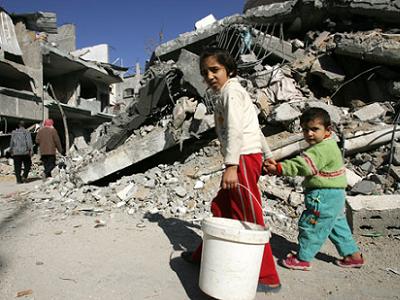
Such is the sight to my right. To my left across the pot holed ‘road’ is Gaza’s frontline with Israel. The enemy that it fears so much are families in roughshod apartment blocks. No frills here. No trips to Ikea for little home touches. Here ‘home’ is a cement block low rise, half finished, slum. There are so many children here it’s hard to fathom for the first time visitor. Large families are the norm in Palestine and in Gaza, a pride. Each window of the hundreds I pass can represent easily five children within. Beside each and every window are dozens of Israeli bullet holes or the larger impact damage from shells of all variety. Hard to imagine the international reaction if a family suburb in Tel Aviv were attacked like Beit Hanoun is attacked by the IOF, over not just days, not even months – but years.

I remember once asking a very poor mother in Gaza why she had so many children.

We need atleast seven children to each family here’, she said

Why? Because atleast two will be killed by Israel. Two more, Israeli will take to prison for a long time or cripple with rockets. Two may (may) have a chance to get educated and they will leave Palestine and never return, which leaves just one child to look after us in our old age...’


Continue to Heroes of Gaza – II