I Know Why the Caged Bird Sings – Final Thoughts on Junaid Jamshed

jjI know why the caged bird sings, ah me,

When his wing is bruised and his bosom sore,

When he beats his bars and would be free;

It is not a carol of joy or glee,

But a prayer that he sends from his heart’s deep core,

But a plea, that upward to Heaven he flings –

I know why the caged bird sings

Sympathy, Paul-Laurence Dunbar


I was a year younger than my son when I first got to know him. “Why can’t he come over to our house?” was the unreasonable question. Four year olds are, after all, unreasonable. And sometimes inconsolable. I was both. Still am, thirty years later. It’s good to keep that child stubbornly alive in you. It’s good to keep something pure and simple in you. And a lot of that comes with memory. The past never lets you rest in peace. And that was Junaid Jamshed’s tragic flaw. As a nation, we mourn the loss of an icon that represented an entire generation. But most of us have unfortunately not forgiven him. Some for the past he chose to walk away from; some for making that choice; some for the alternative he chose. There was something fireworkish about his life. And now that he’s gone, he has left behind a strange silence, the kind of emptiness that gets more pronounced when fireworks that are gasping for breath, are still engulfed by darkness. From Dil, Dil Pakistan to Dil Badal De – what a complete and calculated life. And to those of us who subscribe to the choice he unabashedly embraced – what a complete and calculated death.

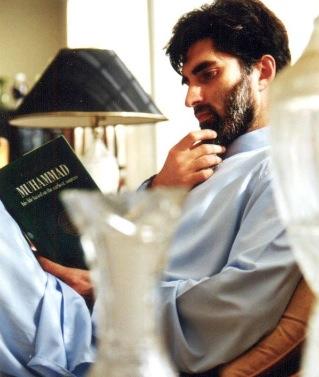
Out of the four Vital Signs, he always shone as the brightest. The looks, the voice, the charisma. His songs cannot be forgotten. And he was always a figure who aroused attention. I had seen him perform only once. Not as Vital Signs, but as Junaid Jamshed the solo artist. And then slowly and strategically, he delved deeper into his choice of being alone. His journey as an individual is incredible. Why are we all upset? Because he was a heartthrob. He was a celebrity who was celebrated by all for his music, and by some who could feel the difference. He deliberately chose to be different. The good looking, tall guy who befittingly sang poignant ballads and national songs somehow grew that long, dark beard. Then the cap followed. Then the long robes followed. And the songs changed. The Beloved now was different. For him it was an active choice, a shift from the ridiculous to the sublime, from the profane to the sacred. But somehow – apart from a very tiny minority that enjoys its fair share of hostility in this divided nation – he was never embraced for it. He was always a troublesome figure. He would always blurt out something inappropriate. He would always be questioned. Why was his business a success? Ufff he’s such a misogynist. God, these mullahs are hypocrites. He’s just a commercial sell-out. He has three wives. He’s such a party animal…..And the verbal bashing for some religiously fervent even resulted in literal bashing.

We as a nation are deeply dissatisfied. We are increasingly becoming a nation of nitpickers. We are deeply unkind to each other. Life is another matter, we are ruthlessly unforgiving in death. It’s not a matter of a caustic comment. It’s not a matter of a crass dismissal. It’s not a matter of cynicism and wit that we laud as good journalism or regurgitate as drawing-talk. It shows how deeply divisive our biases are. And yet we profess to be rational, logical, intellectual, and – I daresay – liberal. It’s grim irony to see how those who preach tolerance are the most intolerant of us all. A singer turned televangelist who has a beard: obviously he’s a woman-hater, and so has three wives whom he subjugates in his home and so makes clothes for women as a commercial business. What a loss. What a loser. Why oh why did he go to that super brainwasher of a man who sits in the no-man’s land of Raiwind who (oh em gee) doesn’t sport a cap but a turban! Why doesn’t he go back to music? And so he dared not to. And we have not forgiven him. The most common observation I came across was how almost everyone was lamenting over how Junaid Jamshed was an integral part of their childhood. Some even went so far as to say that they would never forget who he was “before”, and would never forgive who he became “after.” As a public figure who was constantly under the litmus of limelight, this was obviously part of the package. Such is the curse of being famous. But if we see a little more closely, it unveils this troubling truth: either, how we whitewash all religious figures (and may the Lord help them if they are religious icons) as demonic and dangerous misogynists using miswaks, or how we elevate all religious figures to the divine status of being infallible, and therefore Prophet-like, completely free of all possible human weakness. What a tug of war. And perhaps no public figure could feel this friction more than Junaid Jamshed. His death has unearthed this friction. As a friend noted, the secular celebrate his songs, the religious celebrate his naats, and both continue to hate each other.

I have a major regret that I missed an opportunity to hear this man speak (rather than sing), twice. I too was unsure of his faithfulness, perhaps. I too believed that he’s just a sham who’s taking advantage of his fortunate fame. I too was divided. But only until I rediscovered the singer just like he rediscovered himself. I listen to his naats on repeat while driving. I sing his new songs to my son who knows both Dil, Dil Pakistan and Dil Badal De. I had always taken him and his presence for granted. Even when I was told about the deadly crash, my initial reaction was dismissal: of course he’ll survive. But he didn’t. And it’s haunting to hear someone’s voice talking to you, and you suddenly realize that they’re gone. They’re gone away. And only a meteor shower of memories remain. There was a time when his songs would make me sway. There is a time when his songs still make me sway, but to a different tune. I remember his songs. I remember his nasheeds. I sing them both. I’m sure he did too.

And that’s why I am inconsolable about this loss: because in Junaid Jamshed I see my own struggles. I witness the outward and inward tug of war. The choice to change. The attendant backlash. The dismissals. The sticks, the stones, and the words that ever hurt. And then there’s the slippery slope of spiritual strife. The anger. The envy. The arrogance. The ingratitude. The lack of forbearance. The entire catalogue of spiritual ailments that make you a “bad” person when you look like a “good” one. He left a lot behind when he made his choice to rethink his life. And he would stumble. And so, to me, he humanized this lofty claim to be an invincible Muslim. His friends and followers remember him for the goodness he had in him, which was aplenty. His haters and skeptics remember only the bad, or the good that once was and that is why he must be moaned. But a life cannot be celebrated in parts. Life is an uneasy mix. I for one will remember him for selfish reasons alone: how we are fallible and faltering individuals, fumbling on a path of becoming something that we feel to be better. And therefore, right. And judgment is no-one’s business, save One.

Chalo ishq ka kaha maan kar,

Apna Sanam pehchaan kar,

Kisi aisay Rang rang jaayein

Sab se juda nazar aayein…


Hum kyun chaleyn uss rah par

Jis rah par sab hee chaleyn;

Kyun na chuneyn Woh Raasta

Jis par nahin koi gaya…


The Second Coming

Father of Boys Killed by IsraelTurning and turning in the widening gyre

The falcon cannot hear the falconer;

Things fall apart; the centre cannot hold;

Mere anarchy is loosed upon the world,

The blood-dimmed tide is loosed, and everywhere

The ceremony of innocence is drowned;

The best lack all conviction, while the worst

Are full of passionate intensity.

                                                                        –W.B. Yeats, The Second Coming, 1921

This was the first poem I had ever read as a Literature student. And this was about thirteen years ago. I distinctly remember the words of our teacher who said, “Yeats takes strange apocalyptic delight in these words.” Then, while simply making class-notes, the words just sounded cool. Today, after thirteen years, I recall them now with strange apocalyptic dismay. I just read an acquaintance’s post off Facebook – something about detention camps and the systematic (um, strategic?) exit of the Palestinians from their own home. On a permanent basis. I offhandedly posted a comment on the post about how I thought that “history repeats itself” is an obsolete cliché. In this poem, the word “gyre” was Yeats’s philosophical concoction: that history repeats itself every two thousand years. Or something. He obviously had The Great Apocalypse in mind. But how wrong was he. History repeats itself sooner than what he had perhaps calculated.

I will not say that Israel is the new Hitler. That’s been done. I will not say that the suffering of the Jews at the hands of Hitler with his premise to purify the Aryan race was justified. I will not say that the Jews of that unfortunate time were not oppressed. I will not even say that all Jews should now be condemned simply because they are Jews. Thankfully, I choose not to be anti-Semitic. However, what we are seeing today is a telling commentary of profound racism, discrimination, otherization, profiling, stereotyping, ethnic cleansing, apartheid or whatever anthropological/political label you want to choose for convenience. I faintly recall one of the slides from a popular apocalyptically delightful documentary called ‘The Arrivals’ that came out in 2008. No, I am not a conspiracy theorist; however, the documentary had some certain truths. One of them being how The Arab has been systematically and strategically been represented as the convenient villain, the sub-human, the barbarian, the uncouth monster who is incapable of sensitivity that is otherwise so intrinsic to the rest of the human race. How – by that very fact – we feel no sympathy when we see images of the horrors of Abu Ghraib, of Gitmo, of Palestinians or anyone who could be linked in any way to the desolate desert of Hijaz. Who are we kidding? Islamophobia was present even Sayyidna Muhammad (peace and blessings be upon him) shocked the world with his arrival. The Final One came from Ismail, not Ishaq (blessings upon them both), much to everyone’s surprise. He was an Arab. He was not from Jerusalem, as was the case otherwise with the rest who came before him. He came and changed the way things were done and to be done, forever. And those who rejected him simply because he was unlike them were deeply and detrimentally racist. But some like Sayyidna Salman bin Farsi’ who were out to root for the truth saw the difference. And accepted him.

Yet as time has gone by, the Arab – now loosely seen as the Muslim – is a potential threat. We have all heard of, and some have possibly read, Edward Said’s Orientalism in which he carefully dissects this ambivalent relationship between the Self and the Other. Again, context is an important factor in determining the content of any author’s work. Perhaps seeing himself as a Palestinian, Said’s own analysis can now be dismissed as being prejudiced. But it would be quite disingenuous for us to conveniently disregard his work which offers an incisive introspection of the West’s gaze on the other side of the globe: how is difference viewed – to be fascinated by, and to be feared, and to be controlled. Maybe even conquered. This fear did not just erupt with the tragic events of 9/11. Again, a convenient trump card to look at the Bedouin beast under the microscope.

Islamophobia today – in our very own backyard – is demonstrating itself in the most strange and silly of ways showing how deeply entrenched we are with our fears and prejudices. From people getting so upset by the trivial semantics of sehri versus suhoor and Khuda versus Allah Hafiz, to an entire population that is being bull-dozed and droned and dimed into annihilation, the Arab is an intruder, that “little snake” that has crept into not just our preciously paak Pakistani culture, but is somehow going to take control of the world. We get uncomfortable when we see any woman dressed like an Arab, or any man who is looking like one, or a child who doesn’t say “Hey” but rather says “salaam” even to kids of his own age. We feel and take offence at it as if our own national integrity is at stake. That is why whenever you talk about Palestinian suffering at least in the drawing rooms of Pakistan, what you inevitably get to hear is: oh what about our IDPs? What about our minorities? Hamas is a terror organization like the Taliban; and other such half-baked tautologies. Extend this same dynamic of discourse and thought to the larger drawing rooms of the globe: oh what about animal rights? What about global warming? All these terror organizations are a menace that must be removed – after all, we are the defenders of humanity. Yes, IDPS are a huge and pressing concern for our nation – much more pressing than “suhur” and black abayas; Yes, if we don’t care enough about global warming there won’t be any Maldives for us to party away in the summers and we may just be living off an iceberg. I am deliberately being sarcastic, if not entirely cynical. These issues are grave. But graver still has been the utter apathy of the entire global community over a people that has been duped, manipulated, marginalized, bombed, beaten up, massacred, shot, imprisoned, and now potentially going to be expelled from its own soil. Why: they’re Arabs, why not?

 Thankfully, many are not tuning into mainstream newsrooms to see what is really going on, as was the case before. Little did we know that we had been warned before, long, long ago:

O you who believe, if an evildoer comes to you with a report, look carefully into it, lest you harm a people in ignorance, then be sorry for what you have done! Al-Qur’an(49:6)

Now most of us are quite sorry for our chosen ignorance. Perhaps, we chose not to believe. Finally, due to social media, after nearly a century of silence the world has seen some semblance of the truth. Not perhaps as true as Salman bin Farsi’, but many are getting there. The conflict effectively began as early as 1897 when the Zionist Organization, now ironically known as the WZO (W, stands for World) rose to full throttle in 1948 and now simmers and seethes to this day. And the battle is not perhaps on the face of it about God, the Promised Land, or the Dangerous Neighbor. As Robert Fisk has stated, “as usual, it’s about land.” Veni, vidi, vici. Wonder why the Arabs said, “You’re welcome,” in the first place. A fitting remix of Caesar’s words have now retuned in a rap song.

I came, I saw, I conquered, I shot you down

Your brain no have no conscious, don’t make a sound

I came, I saw, I conquered, what you do now?

Your brain no have no conscious, what you do?

Don’t make a sound…

But social media finally helped the hitherto silent global community speak, and shout. Protests are being raged, petitions are being signed, boycotts are being advocated, webpages are being designed, images, stories, videos are being shared. But many mouths are left gaping in silence. How could someone bully a people like that? How could anyone stand up and root for such bullies? How can anyone not say a word? How can an oppressed people not react? The fact that Protective Edge is a retaliation for the kidnapping and killing of three Israeli teenagers is not new news. What happened to the boys was wrong, unacceptable, and unsavory. And so, IDF killed not three, but four boys playing football on a beach. If simply, and callously, mere numbers are looked at, and the Jewish and Islamic principle of lex talionis – eye for an eye, or qisas – which both religious communities (among other things agree on) is followed, retribution has been grossly served. But the IDF is not winning by just one number, but by a hundred. The retribution is being unleashed on thousands, and nearly 600 have already paid for it, of which 76% are civilians, and 45% women and children, according to the UN’s Coordination of Humanitarian Affairs. Yet still protocol demands that this just may be amounting to war crimes. And finger-pointing is always convenient: “ask them, they started it.” But the Arabs can turn around and make the same claim when the conflict began to take its monstrous form nearly half a century ago.

“With the establishment of a relationship of oppression, violence has already begun. Never in history has violence been initiated by the oppressed. …There would be no oppressed had there been no prior of violence to establish their subjugation.” – Paulo Freire.

Both nations have met with oppression in their religious history. Both nations have met with oppression in their recent living history. How can they not understand what it means, and what it entails? How can Hamas’s reaction be simply dismissed as terrorism? How can a home-made rocket be the same as DIME munitions? How can a one-minute warning phone-call be adequate for an entire home to wrap up, pack up, and run for their lives? How can a stone stand in the way of a tank ready to bulldoze? How can the global audience not stir and shout? How can those who have the reins of power wear blinders themselves? As journalist, Ferrari Sheppard noted during his recent trip to Israel-Palestine,

“Zionism has convinced many Jews that they are preserving themselves. The common thought is that if the “savage” Palestinians stop resisting, stop shooting rockets, stop fighting Israel’s inevitable domination, there can be peace. I find this peculiar because during my visit, I felt no danger from Palestinians, only from Israeli soldiers. Perhaps it’s because I’m accustomed to being hunted in America. There is no Palestinian-Israeli conflict; there is only oppression.”

This is a lopsided war. There is no contest really between unequal players. The Nazis were no match for the Jews. The Israel State is no match for a marginalized Palestinian group. The issue of Palestine is not just about a people being wronged and punished for being different. It’s not just about power either anymore. It’s a tug of war for survival, with millions that have been swept away in the struggle. The Jews who have witnessed the horror of the Holocaust have seen how generations have been wasted, never to recover. And the same fate and horror awaits the Palestinian people. Gideon Levy, a survivor of the Holocaust and a prominent literary figure of the Israelite community, poignantly points out:

“I am amazed again and again at how little Israelis know of what’s going on fifteen minutes away from their homes,” he says. “The brainwashing machinery is so efficient that trying [to undo it is] almost like trying to turn an omelette back to an egg. It makes people so full of ignorance and cruelty.”

Yeats was wrong. It really does not take a gyre to unspiral itself through the ages to show how history recklessly regurgitates. History is ruthless in its repetition. We see it every day now on our Facebook pages and our tweets, unravelling as a protracted and pathetic global human tragedy. And we, as the audience, wait yet again – to see what happens next.

Surely some revelation is at hand;

Surely the Second Coming is at hand.

The Second Coming! Hardly are those words out

When a vast image out of Spiritus Mundi

Troubles my sight: a waste of desert sand;

A shape with lion body and the head of a man,

A gaze blank and pitiless as the sun,

Is moving its slow thighs, while all about it

Wind shadows of the indignant desert birds.

The darkness drops again but now I know

That twenty centuries of stony sleep

Were vexed to nightmare by a rocking cradle,

And what rough beast, its hour come round at last,

Slouches towards Bethlehem to be born?

Losing Our Religion

Losing Our Religion

 That’s me in the corner

That’s me in the spotlight

Losing my religion

Trying to keep up with you

And I don’t know if I can do it

Oh no, I’ve said too much

I haven’t said enough…

(R.E.M., Losing My Religion)

 The meandering mythologies of the Greeks have some insightful truths that are relevant even today. Take Narcissus, handsome and definitely hard-to-get, but really a lonesome fellow. His raison d’être was solely gazing at his own image in a still pond. And then he fell for himself – quite literally – and was transformed into a flower. Poor beautiful flower with such an arrogant name. Narcissus was not the only one condemned to become something else. Races before him were condemned to become monkeys. Races after are further at risk of losing their real selves should they choose not to mend their ways. Glory and its grandeur never truly last. In Narcissus’s case, glory, which was the cause behind the condemnation was nothing but delusion.

Self-love is the first ‘lesson of life’ we teach ourselves. “I come first.” “I matter.” “I’m special.” “Why should I care?” The culture around us is no different from what Echo would do for Narcissus. It resonates a subtle and subliminal, almost hypnotic allure, telling us how unique we are: “Because you’re worth it.” “You should be happy.” “Be what you want to be.”  We hear such feel-good phrases all the time. The curse of our time is nothing but the nuisance of narcissism. Celebration and promotion of the self is the rule of thumb for being a happy ‘you.’ Rooted behind this hubris is a deep and mocking truth: the other is nothing, because I am everything.

 Sayyidna ‘Umar bin Khattab (RA), came to the Prophet (SAW) and openly confessed his self-love despite his submission to the faith. And the Prophet told him that you cannot have complete faith unless you love me more than you love yourself. In effect, the Prophet was trying to weed out self-love from Sayyidna ‘Umar’s personality. Why would he do that? Because self-love is the final hurdle towards fully submitting to faith. It’s our self that becomes the ultimate ‘ghuroor’, the ultimate delusion.

 Those of us who claim to have full faith in our faith are deeply and darkly in love with our own selves: our narcissism lies in this claim that we have full faith. And these Words should really put our faith in place and perspective:

Say, You have not [yet] believed; but say [instead], ‘We have submitted,’ for faith has not yet entered your hearts. [49:14]

The same message is echoed in the opening lines of the said chapter: “O you who have believed, do not put [yourselves] before Allah and His Messenger but fear Allah” [49:1] 

Today none of us who believe will have the brash honesty to say that we love our selves (two separate words) more than Allah and His Messenger. No one will have the audacity to even believe in that. So shameful. Unthinkable. Hurmat-e Rasul par jaan bhi qurbaan. But here’s how the dark truth becomes a deeper darkness: because we have believed, we have a right to be in love with our selves even more. I read the Qur’an every day. I take the hijab. I keep my trouser above my ankles. And then we point our finger of shahadah like a dart on to the ‘other’: tsk tsk, look at her in that skimpy top, look at him chatting away with that girl, sigh, you can only pray for them, he’s just a lost cause… on the surface we are innocently indulging in what may think is sorrow for the heedless ummati. But deeper inside, there is less sorrow but more satisfaction – rather schadenfreude – that I’m not in that skimpy top, I’m not with some random girl, I’m not a lost cause. Poor them, but at least it’s not me. I’m (therefore) better than them. This is our delusion, this is our ghuroor, this is our hubris. Our arrogance for our own selves at the expense of our fellow Muslims’ apparent outlook is not just irksome. It’s infectious and injurious for the general well-being of ‘our’ ummah as a whole.

We feel satisfied by the well-known fact that so many people are coming to the deen. But the real sorrow is the ignored fact that so many people are leaving the deen, because of this narcissism of ours. We, who claim to be religious people, are making our fellow ummatis lose their religion. We conveniently forget that we all took our sweet, slow time to stumble towards to the deen, understand it, and then fully submit to it. Or so we believe. Yet we are in this rash rush to make all those around us magically and miraculously ‘come back to the deen’, usually with just one polemical discussion focusing on what we think is right and wrong. Usually such discussions are tempered with a strange, evangelical zeal which somehow is used to justify the admonition. We are so frantic and desperate for the ‘other’ to leave the dark side and come to the light (in which we fortunately bask) that we forget to use an important and integral principle: wisdom. So many people simply reject the idea of faith because they are ‘put off’, or rather ‘told-off’ by religious people. And rightly so; religious people do put people off by showing off this evangelical zeal. One inspiring book, one heartening lecture, one exemplary person is not enough for me to become a master of a truth as complex as faith. With my new-found inspiration, I set out on a mission to call others to my side. But my inspiration is nothing but this: new-found and therefore, half-baked. But more importantly (and I would say detrimentally) it’s not just that my message is not motivating enough because of its inadequacy; my message very soon leaves all motivation behind and becomes nothing more but a play of power: I am right, you are wrong, and only one of us can win. It’s a match of wills. Each will as undefeatable and indefatigable as the other.

 This play of power is what is putting even religious people off by religion. Claimants of religious truth in our day and age range from Dr. Amir Liaquat to Dr. Tahir ul Qadri, and a mass array in between. Each is claiming the truth for their own self. Each is claiming – therefore – that I am better than you. One clarification is necessary: the infamously famous Sunni versus Shia, Salafi versus Sufi, Deobandi versus Barelvi schisms and other such various dichotomies are not the focus of the present discussion. This power-play is ironically running deep within each of these schisms themselves: Sunnis lashing against Sunnis, Shias against Shias, Salafis belitting Salafis, Sufis mocking Sufis and the battle goes relentlessly on… the truth now is not about ideology. It’s about power. “My” truth should triumph. And this truth is nothing but an empty and usually an autonomous assertion. And an assertion can never wholeheartedly convince and give comfort. And truth – Islam – is a matter of the heart, and should bring comfort.

An ummah is in his own right, Sayyidna Ibrahim – peace upon him – is one of the many from whom we – his greatest grand-children, his ummatis – can find valuable lessons on how to monitor ourselves from this power-play which has developed into narcissism. In the 26th chapter of the Noble Qu’ran, The Poets, Sayyidna Ibrahim in his signature style makes the most comprehensive of prayers beginning from the eighty-third to the eighty-ninth verse. The opening and closing of this discourse is most pertinent to us today.

My Lord, Grant me knowledge/authority/wisdom/ and join me with the righteous. [26:83]

Islam was never of a case of winning others over through assertion.

And had your Lord willed, those on earth would have believed, all of them together. So, will you then compel mankind, until they become believers? [10:99]

Here, Allah is advising His Prophet that as much as he would love to have every single soul seek peace in faith, compelling them would not work. With some, even sensible arguments never helped. They don’t even now. Again and again in the Noble Qu’ran, we are told that for some of those who do believe, faith has not ‘yet’ entered your heart. And no one, none of us, can have the authority to truly and rightly know which heart is true and right enough to have itself submitted peacefully in the peaceful submission of Islam.

Islam, like love – is a matter of the heart. The Prophet (SAW) knew this all too well. Several narrations that were voiced for us – the careless caretakers of the deen – focus on this idea and goal that faith dwells in the domain of the heart. The Prophet did not need to make prayers for purifying his heart. He, like Sayyidna Ibrahim, already had that. He phrased those prayers so that we could also aim to attain a detoxified heart. It is narrated by Sayyidna ‘Abdullah bin ‘Umar, may Allah be pleased with him, that the Prophet, Allah’s peace and blessings upon him, said, “Verily the hearts of Adam’s progeny lie between the two Fingers of Ar-Rahman, just as one man’s heart, and He makes the heart turn in whichever direction He Wills.” And then the Prophet made this prayer – “O Allah, the Turner of hearts, turn our hearts towards Your obedience.” [Muslim].

In another narration, Sayyidna Usama bin Zayd, may Allah be pleased with him, says, “The Messenger of Allah – peace and blessings upon him – sent us to [fight] a group of people from the Juhayna tribe. I came across a person and was about to spear him, when he shouted, ‘There is no deity but Allah.’ [without paying any heed] I speared him and killed him. When I returned and informed the Prophet, he said, ‘You killed him even though he testified that there is no deity but Allah?’ I said, ‘O Messenger of Allah, he did that only to save himself.’ He asked, ‘Why did you not split his heart [to verify your assumption]?’” (Bukhari, Muslim). Commentators claim that the last part of the narration expresses a tone of censure and indignation. Sayyidna Usama offers a perfectly logical justification for killing the man. But the Prophet condemns the act by saying that if the tribesman had made the declaration of shahadah, who were you to mock the authenticity or the validity of his declaration by killing him? Did you tear open his heart to verify if he was telling the truth? So even if the tribesman said the shahadah, in the very last minute of his life, who were you to judge? This narration shows us that faith is a choice made by the heart, and it is the heart, the qalb-e saliim, that can vouch for its truth.

If Allah has therefore made our other fellow ummatis declare the shahadah, if most of us by sheer accident of birth have been born into Muslim households, who are we to judge the state of anyone else’s heart? Before we are quick to judge – making the slip from righteousness to self-righteousness – we should remember that faith was given to us by Allah in the first place: whether by making us being born into families whose forefathers were fortunate enough to take up the faith, or by making us get in touch with that one inspiring book, lecture, person, or incident that moved us enough to get back to the faith. We all are reverts, in one way or the other. And this reversion of heart was nothing but an endowment from Allah. We didn’t do anything to deserve this endowment. It was Allah’s choice for us. And we must remember also that Ibliis was the right-hand man, long, long ago. His devotion and worship was unprecedented. As was his slip from righteousness to self-righteousness: I am better than him. From being “Taoous al Malaikah” – the Pride of the Angels – he literally descended to the level of being “Rajiim” – the Disgraced. The pride and plume of the peacock – the literal meaning of the word ‘Taoous’ – his hubris, was the very reason behind the disobedience, and the concomitant and consequent disgrace. We too should be aware of this narcissistic tendency lest we lose the glory of Guidance and Grace given to us, and become disgraced and misguided. Why do we forget that we all take our time to get to what WE believe is immaculate faith. So why the rush to make the “lesser” others revert with a wink of an eye or a raise of an eyebrow? Why the smugness that our faith is so immaculate that we challenge the faith of another?

A contention now might rightly arise about the commandment in our deen to Command Good and Forbid Wrong. How can one just stay quiet when s/he can see a fellow believer blatantly in error? Is that not selfish that you are in a state of salim satisfaction and you let others suffer in their ignorance? The real concern should be to remember:

O you who believe! Let not a group scoff at another group, it may be that the latter are better than the former… How bad is it, to insult one’s brother after having Faith [i.e. to call your Muslim brother (a faithful believer) as: ‘O sinner,’ or ‘O wicked’]. And whosoever does not repent, then such are indeed Zalimun (wrong-doers) [49:11] 

Clearly, such condescending attitude has no place in the deen. If one admittedly believes, then s/he cannot and should not be belittled by another. Forbidding wrong and commanding good is all-good. But the way it is done today, the demeanor in which it is conducted is problematic. We are so quick to label the other person as “misguided”, “sinner”, “deviant”, and as we do that, we are reflexively comparing ourselves with the other. What we are essentially saying is this: you are not as guided as I am. Therefore you are misguided. And I am oh-so-well-guided. We project our preferences for others, meaning good, but we really mean to feel empowered. This polemical and often belligerent approach needs to be corrected. For those of us who subscribe to such a demeanor are being narcissistic about their belief. Ironically, we sought to correct someone’s faith; however, the attempt was not really to correct. But simply to feel good about the tenacity of our own faith. And during this whole process, we ended up making the other question their faith, and by looking at the face of religion that we are putting up so proudly, we have made the subject who was put under our omniscient microscope lose faith in religion, and in their self – even if it’s just a bit. Interestingly, even when Sayyidna Musa and Harun – peace upon them – were sent by Allah to correct Fir’aun, they were categorically asked to speak gently to him:

Go, both of you, to Fir’aun, verily, he has transgressed.

And speak to him with gentle speech that perhaps he may be reminded or fear [Allah]. [20:43-44] 

Prophets were being told to speak gently and not to get combative with a tyrant like Fir’aun. We need to exercise greater caution, care and comfort in how we deal with others whose hearts we are seeking to win over. Several narrations from the Prophet – peace and blessings upon him – focus on the same idea: care and concern for fellow believers. This narration from Sayyidna ‘Abdullah bin ‘Umar cannot be emphasized enough:

The Prophet of Allah – peace and blessings upon him – said, “The perfect Muslim is that from whose tongue and hand another Muslim is safe.” [Bukhari, Muslim]. It would be instructive to note that the words used for ‘safe’ in actual text of the narration are ‘salima’, and the mention of the tongue precedes that of the hand.

We are living in an age and time in which the easiest and most expedient thing to do is set yourself apart from the rest. In one way or the other, we are being compelled to focus on our differences. And this focus is doing nothing more but making the Muslim world and all its voices divisive and defiantly defensive. In the finality of the final analysis, what matters now is that Muslims really need to engage with Islam at a personal level, and focus on what unites us as Muslims – not what separates us. The hackneyed saying that Islam is perfect, Muslims are not is awfully trite, but also awfully true. Islam is correlated with clichés like terrorism, extremism, conservatism. Hardly anyone talks about the face of Islam which is caring and comforting. No one talks about Islam and love, Islam and care, Islam and peace, perhaps because Muslims are showing none to each other. Charity, really begins at home. We are just comfortable with our own self-celebration. And, like pretty much everything else, even Muslims are picking petty battles of power. That really was not the point of Islam and its spread. The goal of Islam – the ultimate and immaculate Favor of Allah – was to spread peace through submission. If Islam is the Favor of Allah, and this submission is to Him alone, then why the fuss?

Allah has not put for any man two hearts inside his body…[33:4] 

Narcissist was condemned to become a flower only after he stooped so low in his self-love. He deluded himself into believing that he alone mattered, he alone was enough. His desperate attempt to love his own image brought about his own downfall. Shaytan had the same fate. As did Fir’aun. As did Bani Israeel. As do Muslims now. Rooted in narcissism is arrogance. And arrogance was the first wrong which could never set things right again. And from it rippled the whole pool of what we call wrong.

In Islam, like in love, there is no room for self-love. Either you love Allah, or you love another – and in most cases, you love your ‘self’. The heart can just house One Love. No other. And all of us who claim to be Muslims, who claim to believe and be faithful to our faith, have already made that precious claim to love no other but Him.
Tug Of War – Lord Of The Rings

Ah, why

Should life all labor be?

Let us alone. Time driveth onward fast,

And in a little while our lips are dumb.

Let us alone. What is it that will last?

All things are taken from us, and become

Portions and parcels of the dreadful past.

Let us alone. What pleasure can we have

To war with evil?

The Lotos-Eaters, Alfred Tennyson


I find “A Game of Thrones” to be such an interesting phrase. A good friend (a hard-core loyalist) really insisted that I read the book as it would really make me renew or rather, review my reverential love for “Lord of the Rings.” I dismissed the claim before even touching the former, saying that just the author’s name (R.R. Martin) is a pathetic rip-off of R.R. Tolkien. Both, however, have other similarities I’ve been told. The biggest similarity – as I understand through my extremely biased point of view – is that they both tell a story that we find ourselves plotted in: the story of power. We read this story every day. We see ourselves, and other characters like us caught in a relentless tug of war. We yearn to have ourselves heard. And we feel so good when we are heard. We feel proud. We feel empowered.

Sauron had the same problem. He wanted to feel empowered. So did Shaytan. The former came up with a brilliant idea to fool everyone, all races, to feel empowered. With their own token rings to cherish, they felt secure. But Sauron was deceptively clever. “One ring to rule them all.” And they became pawns. The latter wanted to feel empowered too. And he made such a compelling case. “I am better than him.” And although his statement was perfectly logical, he failed the test. Because he was too sure, too secure about his worth. And to this day he tries and sometimes tries very hard to feel empowered. And every time we become his pawns, this sense of empowerment is given to him. And like the nine ring-wraiths, who were once men, we fall into the trap.

All of us think that we are better than someone else. Smarter, prettier, richer. In one way or the other, we feel that because we are better than someone else out there, we have more power. And because we truly believe that we have that power, we translate that into control, and that makes us feel that we are right, above all and everyone else. I am better than you. Therefore, you are nothing. This was Shaytan’s logic. This was Sauron’s rationale. And this is the game-plan that runs our show, all our affairs: from belittling our helping hands (whom we call ‘naukars’), to bossing our children around, to killing people because they believe different to what we do, to calling others terrorists or infidels, to making fun of people who mispronounce McDonald’s, to raping women, to mauling boys to death. We all follow that game-plan. Because we all want to feel empowered. We feel smug. In control. So sure. But it’s pathetic really. Why feel so good about yourself when you know that the match is unfair? A man with a gun in his hand is no match for a child with tears of fear in his eyes. The rules are lopsided. And the rules are always with the rulers. The rest must simply obey. Or no dice.

But here’s where this power-play gets painfully intriguing. “Security,” Hecate, the Queen crone in Macbeth says to her prentices, “is mortals’ chiefest enemy.” So the more power we begin to wield, the more desperate and greedy we get for it, the more we feel the compelling need to have ourselves asserted, affirmed and that furthers our pride which we mistake as faith in ourselves. But what is really happening behind the walls of this fanciful fortress is that we are becoming more and more insecure. Hence the need to have ourselves asserted. And proven right. The fortress is nothing but a house of cards. Why is democracy the way to go? Because those on the top assert it to be so. Why is that man with a beard a terrorist? Because those on the top claim it to be so.

And the rest must follow. And we do because it’s the easier thing to do. Why should we go through the toil and trouble of challenging status quo? It wasn’t my father that was shot? It wasn’t my sister who was raped? Why should I care? I am still alive, and I have my iPhone 5, and I’ll make it to my friend’s wedding after-party on time despite being late for my blow-dry appointment. It is but convenient to not be bothered. The problem is not with the Saurons that we are surrounded by. Nor with Shaytan who plays the Pied Piper. We want others to feel empowered at our expense. We let them feel empowered. We prefer to remain silent and let things be because we cannot be bothered, enough.

“God is dead. God remains dead. And we have killed him. Yet his shadow still looms. How shall we comfort ourselves, the murderers of all murderers? What was holiest and mightiest of all that the world has yet owned has bled to death under our knives: who will wipe this blood off us? What water is there for us to clean ourselves? What festivals of atonement, what sacred games shall we have to invent? Is not the greatness of this deed too great for us? Must we ourselves not become gods simply to appear worthy of it?” – Friedrich Nietzsche.

It all boils down to this. Many proponents of Friedrich Nietzsche attribute these memorable words from “The Madman” to the idea of the utter rejection of God and – taking that to its logical and dangerous conclusion – to negate any agent of authority premising order. And it has all come down to ‘invention’. Power has now been relocated.

We are too comfortably dumb and preferably numb about the world around us. And we have made it this way as Nietzsche is rightfully claiming. Outsourcing responsibility and sensitivity is the new fad. We don’t want to be disturbed. We continue to take orders because we feel securely empowered in our own limited loci of control. We want to, and continue to feel good about ourselves and that gives us a false, almost petty sense of power. And the tragically ironic part of this whole story is that we are indifferent. We are letting the plot of this power-play sway us from one narrative to the other. We all are playing this tug of war. We all trying to prove that we are better than the rest.

Sauron and Shaytan are perhaps merely characters on yellowed paper for most people nowadays. And who cares about boring stories anyway as they lack spice. Stories are just stories. And all that happens around us: the boy who is bullied in school just because he is short, the girl who just turned 35 and is still not married just because she’s not “gori” enough, the nameless child who died in a drone attack, the fruit vendor who was hanged some time back, the maid who got abused because she put less salt in the haandi…are simply stories for us, interesting to talk about over our evening tea. But as the conversation ends these stories are stacked away. And as rats, or pawns – whatever we may prefer to be – we enjoy our own private games of thrones in which we are kings and queens. The rest – like us – are simply ruled upon. And the pull of power reigns us all.

To cover or not to cover – That’s the question!

Lately, I have read at least two well-written articles on the ‘hood and hijab’ issue, or the choice to cover and how that head-covering can lead to many conclusions: freedom, oppression, discrimination, objectification, and in some cases even death. The topic to cover or not to cover, to cover partially, to cover completely, to uncover partially, to uncover completely is a hot and debatable one; clearly, because there are at least five options to answer this elusive multiple choice question (MCQ). Everyone seems to look at this question with an objective stance, but strangely so, objectivity is a slippery slope, and somewhere down the journey to the summit of being purely reasonable, one slips into subjectivity. That is normal for everyone to have a bias. A choice indicates a bias. But when it comes to answering this MCQ, something more than a choice is needed to motivate any of those five options. And this is where the fallacy of the argument lies. To cover or not to cover (and other branching shades of opinion) is really not a matter of choice. It is a matter of belief.

Anything that is a matter of belief, quite simply put, cannot be and should not be evaluated through logic, although many people believe that all beliefs are logical, or should be proven through logic. Belief, however, is something purely emotional, and through the certainty of that emotion it might ascend to logic, or rather logical justification, but that in itself begs the question. An argument between an atheist and a theist is doomed to fail. They cannot be objective about their claims. An atheist believes that there is no God; a theist believes otherwise. And then they build their house of cards in which logic is appealed to, to justify and substantiate their beliefs. It is a matter of belief that God had a conversation with Moses. It is matter of belief that Jibrail had, and continued to have conversations with Muhammad (SAW). It is matter of belief that Holy Scriptures are not just stories written by idle minds and eloquent hands. It is a matter of belief that for someone they are just stories written and read to be inspired, or to inspire fear or love, that angels and God don’t exist and it is all a huge delusion of comfort and convenience. But even the delusionary are now questioning the authenticity of their claims, and so are recruiting to the idea of agnosticism, not either-or, but neither-here-nor-there. It all boils down to belief, and the conviction of that belief.

Now, the argument for the whole covering up issue is that it is professed as a matter of choice. Some can best define it as a moral choice. But then again who defines morality? Those who don’t do it think that it gives them liberation. Those who do it think it’s liberating. I came across a cartoony rendering of this idea: there are two women, one is dressed in a burqa with only her eyes visible, the other in a bikini, with only her eyes covered by sunglasses, and each looking at the other feeling sorry, the burqa-clad saying, “nothing covered but her eyes, what a cruel, male-dominated world”, and the bikini-clad saying, “everything covered but her eyes, what a cruel, male-dominated world.” The choice therefore is an either-or, and the denomination, as claimed by one writer who wrote vehemently against covering up (while thinking all along how objective the analysis was): it’s a cruel, male-dominated world that motivates or compels a woman to cover. Well, there is no doubt that the world is cruel and male-dominated. But the motivation and/or compulsion felt by a woman to observe purdah is what really needs to be analyzed. In actuality for those who believe in the idea and the act of covering up, it’s not a matter of choice, even though it is now construed as such due to convenience (on part of the construer). It might become that, but the choice is rooted in a belief in the idea that morality is not secular, that morality comes from some direction, that direction has to be perfect, and that perfection cannot come from man who is fallible and is known to err, but from the Divine that is infallible, and is known to forgive.

I am not going to present elaborate and innumerable religious citations to justify this point of contention. But I will present a secular maxim that is quoted often enough: when in Rome, do as the Romans do. Now if we are to extend this maxim to a metaphor, and equate the idea of Rome to the faith Islam, then the principle that becomes operative is to do as the Muslims do. And those who believe in the idea, ideology and idealism that Islam has offered, achieved and sought would agree that the best and real Muslims were those when Islam actually came into being, historically speaking. And as it’s best to lead and easy to follow by example, we had Prophet Muhammad (SAW) demonstrate the faith in every way and form. And just as some things never change, we had a cruel, male dominated society even back then – that’s why it was called the Age of Ignorance that the ‘new’ faith sought to enlighten. But it was not the male voice of that enlightenment that asked the women to hush up their individuality, sit in a dark corner and cover up. The commandment, however, was just the last bit: to cover up. Hence it was not, and never a matter of convenient choice. The women heard not the voice of the man who forwarded this commandment, but the commandment itself. The women never followed the man in action; they had their own models and examples to follow and be led by i.e. the Prophet’s wives. So this current claim that covering up should be contextualized as being historically relevant with no place in current times and therefore should be shelved itself at least for those who believe in Islam, and the application of the Roman maxim.

And, now comes the troubling and ever-elusive subject of modesty – the rationale behind covering up. One of the authors expressed her disapproval by stating that modesty cannot and should not be achieved through covering up. I cannot agree more – at least with the former claim. Modesty is a state of mind, a humble mind. But that state of mind is purely subjective, like a bias. A woman from a Muslim nation can put up naked pictures of herself on her blog to reveal her justified rebellion. Her intention in her mind at least is perfectly noble. However, someone who is viewing her nakedness and reveling in what she is revealing renders the protest redundant: she is seeking to inform others of how she was objectified and sexually assaulted, but someone is just pleasing their virility by simply not lowering their gaze and looking at her. The sexual assault and objectification that she was protesting against is being repeated. Not physically of course. But mentally – and the mind knows no inhibitions especially when the stimulus is so graphic. Those who fuel the porn industry can testify to this. So, a pure intention is being marred by the action. You can cover or not cover, but you cannot guarantee what the onlooker is thinking or feeling or imagining. Wearing a burqa (or not) does not guarantee that you are exempted from being an object. That’s why men were asked to lower their gaze first, an expression that was to achieve modesty of the mind and body, intention and action. And the culmination of that claimed modesty – if it was there in the first place – should be manifested in totality, in all four: mind, body, intention and action. You can intend that my intention is not to arouse, but if you’re giving them something to look at (or even nothing to look at for that matter), they’ll still get aroused – a simple biological reflex, stronger in some than in others, but present nevertheless. The burqa can be considered as a necessary and convenient filter. But there are no guarantees.

To cover or not to cover, that is the question! That’s a matter of belief and your choice to subscribe to that belief – and its own package deal. Covering up does not guarantee that you’re ending up in heaven. Neither does not covering up. It’s a popular understanding, that those who cover their faces with a cloth or a beard are the most corrupt and vindictive scum of the earth, or even terrorists for that matter – a hasty generalization of course, as was the case with Travyon Martin and Shaima Alawadi. But the resentment is justified, for those who do cover in the name of faith are bearing an emblem of piety, and to not fully meet the standards of the piety that that emblem should’ve intended to generate in the first place is a mockery of both the emblem and the professed piety. And piety is a private matter of the heart. No human can or should be a judge of that. Piety cannot be achieved by merely donning a garment, or shunning it. One has their whole life to practice the part and to perform. The applause (or the boos) will follow later. And the choice to agree to the metaphor and be convinced of its truth is an open question: a matter of belief.