Humanity at Stake

1157633_289730281164755_734281549_n

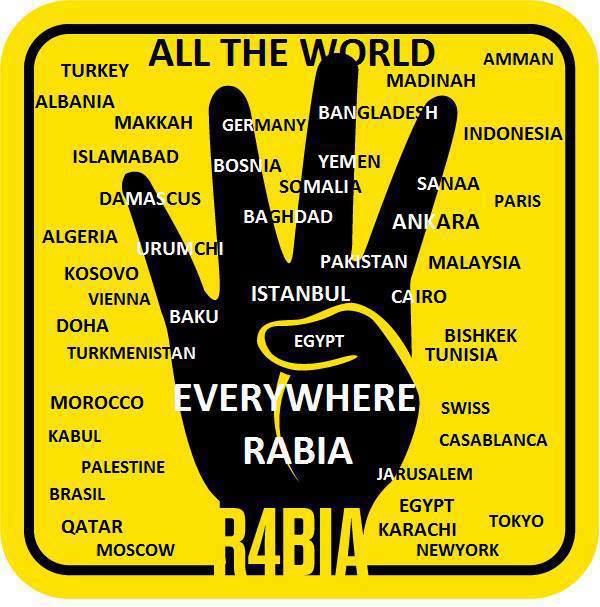
A woman in many women- and children and men- was reported to be rushing back and forth in panic of the gunfire chasing her. A woman- another woman- was seen from her balcony with a portrait of General Al-Sisi; watching, observing, comprehending, and smiling. A grimly smile. This is not fantasy. This is not a scene from a horror movie. This is real life and real humans- or at least, real humanoids!

People are seen enjoying the beach in the scorching heat to get away perhaps from the tense city life. But behind the beach there is a road, and behind that road there are buildings, and behind that building we see smoke, a tense, scorching hot smoke. And we learn that that smoke is the product of chaos, of oppression, of resistance, of subjugation, of panic, of murder, of silence, and of noise. People lie dead on the streets and people lie flat on the beach. Two stories. One city.

Egypt is in crisis. This we are all told. But there is much more to the story. The crisis isn’t merely political. It isn’t merely about who you support. It isn’t about who you don’t support either. It’s not an Egyptian issue anymore. Boundaries don’t make sense now. It’s boiled down to the very essence of what it means to know and love freedom and democracy, to value dignity, to value humans as human subjects, to figure out what it means to be human.

But here is where narratives fail, and collide. The crisis in Egypt has consistently been portrayed as a clash between two parties- or to say, two narratives. This schema has been deliberately consolidated by both the coup-regime, which includes all its functionaries, and forces of the global hegemonic status quo. Locally there is this thing they call ‘the people’- a label created to function as a catchall term for supporters of the illegitimate regime- and then there are ‘terrorists’- a label used to discredit a demonstrably peaceful resistance movement against illegitimate regime change.  The mainstream global media on the other hand adopts a less obvious propaganda model. It divides people into ‘anti-morsy protestors’ and ‘pro-morsy protestors’- or sometimes calls them ‘Muslim Brothers’ straight out- and by doing so it very criminally distorts the picture. In doing so they’re undermining the fact that the ‘pro-Morsy protestors’ are in fact an ‘anti-coup’ and ‘pro-democracy’ movement. But of course, is it really a coup? And yet, it isn’t a matter of what definitions say when it is a matter of what global (western) interests say.

The most vulgar display of this politics of labels and binaries was when the world was watching military men, accompanied by tanks and cheering fascists, firing directly at the Al-Fattah Mosque in Cairo where a few hundred protestors were trapped. The domestic media portrayed it as an operation against anti-state elements and terrorists—one of the old classics- while the global mainstream media portrayed it as a clash between two rival parties- that very workable tactic. By calling it a ‘clash’ or ‘conflict’ of what is clearly obscene violence carried out by the establishment against individuals is the old method deployed in covering the ‘Israel-Palestine conflict’ or what is clearly Israeli repression of Palestinian individuals.

The Egyptian crisis has also become a crisis of confusion in Muslim majority societies. A victim narrative seems to emerge where the culprit is made to be democracy itself. The greatest beneficiary of this narrative is none other than Al-Qaeda itself; just as it was the greatest loser in the Arab Spring where it seemed as though change through peaceful and democratic means was a viable option. This optimism seems to fade away. This is the same optimism that makes sleeping difficult for oppressive regimes; for it’s easier to break bones than minds. The narrative serves both terrorist groups at the fringes of society and the establishment controlling society. But besides the damage that is carried out by this narrative, it is also flatly wrong. What happened in Egypt was not because of democracy but the lack thereof. There was nothing remotely democratic about it. Even the regime of Mubarak retained itself in all spheres of life. Not only was a democratically elected parliament disbanded immediately on a technicality, the democratically elected president was never given any true authority. He was overthrown by anti-democratic means and what is now present in Egypt is the suppression not only of people but of the very notion of democracy and freedom. It is here where the story needs to be squarely put as a matter of democracy, freedom and dignity. To place the problem elsewhere undermines and hurts the broader cause.

What else needs to be understood from the problem in Egypt is the consequences of polarization and uncompromising partisanship. To understand each other, to build on each other’s point of view, to discuss and debate critically are all essential to the health of a given society. A politics of empathy is the need of the hour. Unfortunately, Muslim majority societies are plagued by a clash of uncompromising narratives. The damages have played themselves out it Egypt. Pakistan is also deeply polarized and suffers from a politics of condemnation and ridicule of the other. In Tariq Ramadan’s words, Muslim majority societies need a ‘cultural revolution’ where we can think critically about our current state, be conversant with the challenges of modernity, offer creative solutions to contemporary challenges, as well as be consistent and employed with cultural, religious and civilizational references. This calls for moving beyond binaries and labels, and moving forward constructively and collectively.

Worshiping Idols

While reciting Kalma-e-tayyaba, every Muslim knows that he is negating all idols and testifying that he will worship none other than Allah (SWT).

But do we negate all the idols in our life? Especially those hidden modern day idols which we worship knowingly or unknowingly.  Love for anything blown out of proportion is start of idolism.  At times we are not even aware of these invisible idols. Here are few of them.

Capitalism is the main idol we are worshiping. Our entire economy is revolving around and worshiping this idol.  The fact is that the wealth itself is one of the blessings of God, the problem is with capitalistic mindset. One of the main concepts in capitalism is ‘self interest’ instead of mutual interest. Adam Smith, while giving this concept of self interest, argued that it will increase the efficiency and productivity; but actually it paved the way for cut-throat competition and criminal attitude towards humanity. Another concept of capitalistic economics is to manage the scarcity of resources to fulfill unlimited wants. Every Muslim believes that Allah has ensured his ‘rizq’, capitalism make him strive for capturing and accumulating the resources to have an absolute control over them. Capitalism has inculcated the phenomenon in the hearts and minds of the people that ‘money is power’, no matter how it is accumulated. The merit for honour, dignity and influence is the amount of capital one possess. And the aftermath of this capitalism is that UNDP reports that more than a quarter of the inhabitants of developing countries still have nothing to live on and 20% of the world population in industrialized countries account for 86% of the world consumption. The gap between haves and havenots is widening and Occupy Wall Street movement is one reaction to it.

The problem with the idol of Capitalism is that people are trying to ‘islamize’ this concept of sheer oppression and brutality. Capitalistic economy is snatching bread n butter from the poor while the rich elite is enjoying their lives to the fullest. Islam has clearly forbidden interest and usury, which is the basis of capitalistic economy. Islam discourages accumulation of wealth and usage of unfair means to earn money. Also, the system of Zakat is given in Islam to help the poor and take them out of their miseries. So the philosophy of Islamic economic system is entirely different from capitalism.

Careerism is another significant idol and focus of all of our efforts. Its related with capitalism, but more importantly, its related to our lust for money and worldly desires. Islam has given prime importance to the teaching that this life is temporary and a testing field for the permanent hereafter; yet all of our efforts are directed towards achieving a wonderful career with a bright future and healthy fortunes. The career we pursue pretty much decides what sort of a life we will lead and whom will we marry.  Earning ‘rizq-e-halal’  through fair means is strongly appreciated in Islam; but running  blindly after the worldly career is problematic. We tend to spend the best of our time in building a career and in the meanwhile we forget how to live a life. Bill Gates and Steve Jobs are ideals for a vast majority and are actually idols being worshiped. The purpose of life for a Muslim is to please Allah almighty. If career becomes the purpose of life, it is surely turning into an idol.

Media has become an idol itself. Media portrays itself as a holy cow which is above all ethical and moral standards. It propagates whatever the corporate giants (capitalists) dictate and then people believe it as if it’s a word of God. It is the media which has objectifyed women as a sellable commodity and people have started believing in it. Labeling anyone as terrorist and sparing anyone else is their major contribution towards spreading hate and earning money. Electronic media in specific is a massive propaganda machine. It is badly affecting the lifestyles of the people. Advertisements worth billions of dollars only focus to tell people what do they need which infact they do not need.

Freedom is another one. Capitalistic economy and media has influenced us so much that we want to twist the religion as per our own desires. Unfortunately, a lot of muslims want to defy every order of Quran and Sunnah, and yet they want to be champion of faith.  While its mentioned categorically in Quran that don’t cherry pick the issues and accept the religion in a holistic manner; yet people want to blindly follow their desires in the name of personal freedom. It must be clear that after reciting the Kalima, we have surrendered the freedom to Allah (SWT) and now every muslim has to live in the framework of Quran and Sunnah. Once a person exercises his freedom to choose Islam, then he must follow Islam in its true letter and spirit. Thus the liberty for every muslim is limited and not absolute, therefore, those who recite Kalima and choose to be Muslims, should follow Islam, instead of following their own desires and twisting the religion for their own wishes.

Last but not the least, our so called leaders are idols in most cases. The followers won’t listen even a single word against their leader no matter how corrupt or unethical he or she is.  This is worst form of slavery we are facing in Pakistan. Be it any fake ‘pir/fakir’ or a party leader, almost everyone has his quota of blind followers. This creates a chaotic situation when people do not listen to any argument against their favourite personality. Specifically on social media, if you dare touch the holy cows, their followers will be at you, using all the abusive language they can. This is worst form of mental slavery and unfortunately, alot of our countrymen are slaves mentally.

Having testified Kalma, It’s a commitment that we will get rid of all these idols from our lives and only bow in front of Allah. They are present in our daily lives, invisible though and most often they are unknown. May Allah help us to get rid of these idols (ameen).