A Quiet Grandeur: An Appraisal of The Tableeghi Jamaat

TableeghMy attempts at landing upon an official Tableeghi Jamat statement on the attacks on a Tableeghi centre in Khyber-Pakhtunkhwa (Pakistan) and on Tableeghi Jamat members in Karachi fell in vain. I ceased to wonder when I chanced to meet a lady who was an acquaintance of one of the victims of the mosque target-killing in Karachi. With remarkable serenity and a muted delight on her face that was almost transcendental, she mentioned how the deceased from South Africa had always harboured the hope to die in Pakistan- the place where the work of Tableegh had been revived after the first generation of Muslims, and upon the same model.

It was one of those moments one feels so foolish, one does not have anything to say as one tries to grapple with a sublime yet humbling understanding. I understood why my attempt to look up Tableeghi Jamat’s ‘official statement’ on the targeting of its associates was incredibly unintelligent and utterly in vain.

 In my search for an anchor and handhold in this Roller-coaster Ride to Nowhere that life sometimes seems to become, I had been in and out of a dizzying variety of religious groups and organizations: big and small, spiritual and political, militant and pacifist, sectarian and pluralist… yet it never seemed a final homecoming, and I was always an unsettled, restive maverick- desperately seeking, perpetually and hopelessly unfulfilled. But the long, exhausting and frustrating journey was never in vain_ because I read the pointers all along the way. I experienced, I learnt, I understood…

 Travelling on life’s winding ways eventually afforded a rare opportunity for close, firsthand observation of a phenomenon I had always had a blind spot towards: the silently grandiose project of the Tableeghi Jamat. The work of Tableegh hinges on fundamental Islamic ethics and values, and demonstrates great spiritual discipline. The Tableeghi Jamat operates with mindboggling organization and efficiency which becomes even more awe-inspiring given the fact that it is entirely autonomous with no source of external funding or even any necessary financial contribution from workers. In fact, there does not even exist any rigid organizational structure, any formal administrative hierarchy or even a membership procedure. This is also why there is no official record of the number of workers in Tableegh- Wikipedia estimates it at 120 million, but it is highly likely for the numbers to be much vaster- the footprint of the work of the Tableegh is literally everywhere- from the remotest areas in rural Pakistan to nations abroad- with workers ranging from every social class, group and ethnicity, striving for personal spiritual purification and that of fellow beings. A tableegh associate from the US observes: ‘Unlike Christian missions with millions of dollars of funding these people include the likes of people I have heard about who polished shoes in a bazaar in Pakistan, sold their clothes and walked on foot in East Africa with barely any food-  to call people to Allah.’

 During my years of self-discovery and my informal study of Islam I had often wrestled with obstinate questions for which answers often remained elusive. The stunningly simple, incredibly straight, quiet and consistent way of the Tableegh addressed and even resolved most of those.

 I used to wonder why I, having been raised in Islam should have a privilege over those raised in other faith traditions, when my choice to be born with the Islamic faith handed down to me was not a witting one. So how can eternal salvation depend upon an inherited faith or a privilege of upbringing as we self-righteously damn those denied the same.  I began to see faith less as a privilege and more as an enormous trust and responsibility that had to be shared_ and that mankind’s deprivation from the sweetness of Eeman is the burden of those entrusted with it. Tableeghi Jamat, with its simple emphasis on ‘Dawah’ (Invitation to Faith) and reinvigoration of faith through sharing and including concedes to the idea that faith is a responsibility towards mankind and the world, and that the misguidance and evil of this world is our problem; and that for the purgation and salvation of mankind every iota of individual effort must be spent. This intense spiritual drive is not born out of religious chauvinism or self-righteous, narcissistic proselytism, but out of a sincerity that is inherently humane and compassionate (khalis) towards fellow beings; a selflessness that beautifies. The characteristic humility and heartwarming gentility of those working in the path of the Tableegh thus stands explained.

 Many who proclaim religious association use it for a comfortable sense of self-righteousness that lulls and dulls the self-reprimanding conscience; or for other selfish purposes, since religiosity is highly venerated in this society. Yet the demand and the right of religion on us is that it be submitted to; that we give ourselves to it and in the process learn to give up all that is profane and degenerate. The essence of faith is submission, which is attained when we learn to let go of the self and forego its selfishness. The highest expression and evidence of this submission is sacrifice. The work of Tableegh in the path of God and His people is essentially a sacrifice every step of the way, requiring precious time, energy, financial contribution and distance from one’s nearest and dearest. It requires dealing with adverse and hostile circumstances and with all kinds of people while keeping one’s poise and spiritual largesse for the sake of Allah. This is in the footsteps of the first generation of Islam. Walking in this blessed path means that in turn one receives spiritual bounties, rising to a higher station of spirituality.

 The Tableegh brings together a rare and perfectly blended mix of individualist and communitarian approaches. While the prime focus is the tazkiyah (inner purification) of every individual, and individuals rather than groups are reached out to, yet there is a strongly communitarian dimension. The work involves connecting and bonding with others for naught else but compassion and a shared faith and vision. The purity and selflessness of this bond gets people together indissolubly. The beauty of the connection can only be experienced.

 A particularly interesting regular Tableegh activity is the weekly ‘Gasht’- walking on foot door to door to invite others to pray in the neighbourhood mosque and to stay for a short religious sitting afterwards. A Pakistani-American approached by some participants of a Tableeghi Gasht says, ‘The knock of a few simply dressed men asking me to come pray in the mosque right across my house may have been the very way to the corridor to change I wished for…’ He goes on to add: ‘In all major cities in the US they do some work- very humble, peaceful and honest people who have doors slammed on their faces but do not get discouraged. May Allah protect the sisters and brothers associated with it.’

 But while the Tableegh is primarily a spiritual enterprise, it strongly bears upon society and politics with its characteristic quiet persistence. While many contemporary religious groups prioritize political ascendancy and power, making all else conditional upon that, the Tableegh has a sounder basis more in tune with the Prophetic method.

The understanding is based upon the idea that our collective affairs are a sum of our individual states; therefore the means to purge and mend society is through spiritual purification at the personal level. Through this individual spiritual revival all levels of society can be impacted and dented into. With this bottom-up approach, individual moral purification radiates towards the echelons of power and authority as the work of Tableegh quietly pervades.

 Restraint from direct involvement in the business of power politics also brings the additional advantage of safe operation without raising suspicion and alarm. Some months ago when the Interior Minister Rehman Malik accused the Jamat of harbouring terrorists, prominent politicians from a number of parties with no religious associations denounced the statement and defended the activities of the Jamat as purely a moral-spiritual project. The widespread support from all sections of society that the Jamat garnered in the wake of the recent heinous attack at its centre in Peshawar is overwhelming and something to speak of, as no other contemporary religious group in Pakistan can match this level of deep-rooted acceptance and appreciation among the masses.

 The Tableegh’s enthusiastic renunciation of ideological/political associations or any sectarian posturing and its exclusive emphasis on basic religio-spiritual values make its approach an antidote to virulent sectarianism gnawing into this society. It even serves as an effective antidote to militancy which rejects traditional Islamic scholarship in favour of a literalist, inflexible and revisionist interpretation. The Hanafi madhab is largely followed in the subcontinent, which is why the Tableegh has become well-entrenched in the society, owned by the generality of the population, and capable of the mass appeal it has garnered.

 On the question of Jihad, the Tableeghi Jamat believes that the option of using military means cannot be used when the spiritual and social project of Islam has not been taken up effectively and the mission to convey the Message completely and universally (itmam ul hujjah) not yet fulfilled. Moreover, with the prevailing moral degeneracy in Muslim societies, Jihad in the field is irrelevant and self-defeating. Ignominy and oppression will crush Muslim subjects as long as there is no genuine effort at moral and spiritual uplift, as Allah says: ‘God does not change the condition of a people unless they change what is in themselves.’  This understanding is also inspired by a humane concern and compassion.  Jihad against the infidel without having tried to present the Message in its entirety and pristine character is a poor substitute for the more compassionate overture towards the enemy_ that is, winning him over to faith through upstanding moral conduct, sincerely reaching out and striving for the establishment of peace and justice. A senior of the Tableegh is said to have remarked something to this effect to someone seeking clarification on the Jamat’s stance on Jihad: ‘You Jihadists help fill up the hellfire with infidels while we change hearts to get candidates for paradise.’ Contemporary Jihadists, according to the Tableeghi Jamat, betray the gradualism of the Prophet (SAW)’s way.

 Yet the Tableeghi Jamat is part and parcel of the societies it is engendered in and operates in. The patriarchal social structure of society in this part of the world has sought religious cover in the ranks of many religious groups, the Tableeghi Jamat being no exception. The work of Tableegh primarily involves and addresses men_ their wives, daughters, mothers and sisters are provided with a ‘parallel universe’ in which selected tableegh activities are replicated within a strictly closed, segregated environment. The mainstream fieldwork of Tableegh as well as the mass instruction is dominated by men, with their women relegated to a subsidiary role. Besides, the gender segregation to an extreme degree deprives women of a holistic and wholesome experience of life and the world and limits their sphere to the domestic and familial alone. This has resulted in a narrowness of perspective and superficiality of insight characterizing women of the Tableeghi Jamat. This is particularly so in second and third generation Tableeghis who have had cloistered upbringing and few opportunities for self-development through education and experience. Besides, second and third generation tableeghis inherit the religious lifestyle without having the liberty to make personal choice, often taking up Tableegh and religious practice as habit and ritual rather than as actions of the heart.

 The literature used for religious instruction and tazkiyah (purification) as well as the methodology with which it is delivered is dated from the earlier half of the previous century. While it has inspired millions and continues to do so, the outmoded language and style limits its outreach and appeal to the younger generation and fails to address their dilemmas and questions about religion, modernity and secularity in this day and age. There is an absence of content that can present an alternative discourse to respond to or even recognize the innovations and challenges of the current milieu.

 An insurmountable problem with Muslim education in the subcontinent is the disconnect between ‘maqulat’ (the rational sciences) and ‘manqulat’ (transmitted knowledge). Religious education has entirely jettisoned the ‘maqulat’ as secular and profane, and this in turn has sharpened the artificial gulf between ‘Deen’ (the religious worldview and way of life) and ‘Dunya’ (the secular/worldly domain) in society. As a result, the religiously educated are consigned solely to the business of the seminary and pulpit whereas those with a modern secular education become the movers and shakers of society – a sort of privileged elite. The disconnect between the religiously educated conservative Muslims and the secularized therefore runs along the lines of social class. As a result, the religious are generally viewed as a lower social group deprived of social prestige, disengaged from decision making and opinion leadership, pigeonholed into the narrow realm of strictly religious affairs with little to do with the business of the world. Most do begin to reflect this relegation of ‘deen’ to the unworldly and otherworldly. In the process they become insular, islandic and static utopias in a rapidly changing, complex world. The malaise infects all religious groups and its repercussions are visible in the rank and file of Tableeghi Jamat in Pakistan.

 The Gulen Movement in Turkey shares with the Tableeghi Jamat its non-sectarian, non-ideological spiritual and social project. It shares the all-embracing mass appeal and loose structure giving individual space and freedom, as well as the refusal to politicize and confront. Very insightfully, both movements refuse to ghettoize religion under a narrow, exclusivist, parochial banner. However, the Gulen Movement has chosen to do some things differently. It has taken on modernity and its exigencies, risen to its challenges while ensuring the relevance of religious ethics as the panacea for the evils of materialistic, permissive, libertarian secular societies. The Gulen Movement promotes social activism and rights advocacy as religious causes and is dedicated towards healing, harmonizing, building bridges and problem-solving. It makes issues of social justice, rights and liberties the business of religion- a sacred calling of the faith. This, alongwith the contemporaneity of language, style and content has given the Gulen Movement a progressive outlook and an incredible popularity among Turkey’s younger population_ a monumental achievement for any essentially religious movement in this day and age. It is an example we have much to learn from.

 Given the Tableeghi Jamat’s vision, direction, spiritual appeal, inclusiveness and wide outreach, it has tremendous potential and promise. It can and ought to lend itself to the project of chiselling faith-inspired minds in positions of leadership and decision making in the academia, public administration, economics, media and politics. For this it must engage itself with the intellectual challenges that impede the spiritual journey of many bright young minds privileged with education in institutions for the English-speaking urban elite who are trained into critical inquiry. Any religious movement aiming for the establishment of Islam and its values in society which feels that it owes a debt to the future must prioritize leadership development among Muslim youth. For this, the concerns and questions of young minds with leadership potential need to be explicitly and directly addressed.

 An unwillingness to adapt to the exigencies of the times is symptomatic of stagnation and regression which characterize the length and breadth of modern Islamic movements in the Muslim world, with few exceptions. This leads to an intellectual stuntedness that repels our brightest and most promising minds as these groups fail to answer their questions about the role and engagement of religion with the world, life and society. Dr. Muhammad Iqbal resented this stasis as a result of a stubborn refusal to win space in the medley of competing ideas. He sees it as a harbinger of perpetual irrelevance. He writes, ‘The claim of the present generations of Muslim liberals to interpret the foundational legal principles in the light of their own experience and the altered conditions of modern life is in my opinion perfectly justified. The teaching of the Quran that life is a process of progressive creation necessitates that each generation – guided but unhampered by the work of its predecessors- should be permitted to solve its problems.’

The Regime of Reason

Your intelligence is different from mine. And mine is different from yours.

Times changed. “My intelligence is superior to yours”, said Reason.

Who and what is ‘Reason’?

Reason was born and raised like any other intelligence.

It too lived on the imaginative outskirts of human minds.

It too insisted that it had a point.

‘A point to a point’ as it put it.

The point, it ‘reasoned’, was to get to a point.

“It was right”, thought others, “in its own right.”

“You do make a point”, it was told.

But then. One day. Out of the blue. It panicked. It reasoned.

“Is it enough to make a point that is valid? Shouldn’t my point be the only valid one?”

It ran towards the city. It made an announcement.

It “reasoned” that there can only be one intelligence.

Intelligence could be more or less. Not merely ‘this’ and ‘that’.

It was not enough to be different. It had to be superior.

It told others that they must accept its singularity.

Reason alone is intelligence.

Reason’s intelligence alone is Reason.

“Such a wild proposition”, it was told at first.

But then it gained strength.

It used its skills to make a point to reach a point.

It reasoned itself into power. It took over. It ruled a tyrannical rule.

Order was ordered.

Opposition was crushed.

The vulnerable were executed.

Resistance was punished.

Compliance was rewarded.

The terror of Reason became the regime of Reason.

Reason declared the non-existence of all intelligences except its own.

Intelligence was singular.

There was only one intelligence.

This was absurd. This was bizarre. This was letter of the law.

“How can redness describe the colorfulness of yellow”,  drew an artsy intelligence.

“How can sweetness describe the tastefulness of a hamburger”, cried a fanatic intelligence.

“Your truth will never compare to mine”, prophesized a mystical intelligence.

Art, emotion, religion were executed.

The death of God was declared.

Man was born.

The Man of Reason began to exist.

Existence became the universal privilege of reasonable man.

“I am being rational”, said reasonable man.

“Your rationality is irrationality. It must not exist.”

“Millions must die so I can build Reason’s civilization.”

Civilization was built on a graveyard of unreason.

Unreason was buried.

There was reason and there were lesser reasons.

The lesser could exist insofar as they acknowledge reason’s sovereignty.

The lesser could exist insofar as they acknowledged their imperfectability.

They could exist if they severed their claims to intelligence.

They were made to destroy their selves to become the self of reason.

Their generations grew under these conditions.

With time, they forgot their ancestors withdrawn rights altogether.

This system. This system that decided which intelligence is intelligent and which is not.

It was very real.

It became realer.

Then it became reality.

Reality was this system.

It was how things are.

It was how things are supposed to be.

It was all for our own sake.

It produced. It produced stuff we needed.

We need that stuff.

We must stuff ourselves with that stuff.

We may not be able to have that stuff today.

It will trickle down tomorrow.

It will trickle down the day after.

It will trickle down later.

It will trickle down.

Trust me.

indian-genocide


Down to Earth – With a Bump

laurenbooth_profileIt doesn’t happen quickly, it takes time.

For a long time you can’t imagine it happening at all.

Then one morning, you wake up and it’s living within you. A spiky, pebble in the midst of joyous certainty; disappointment.

Disappointment in the Ummah, you are now a part of.

For ‘born Muslims’ the acknowledgement that those who try to follow the teachings of the Prophet of Mercy, (May Allah The Most Merciful bless him) always fall short, comes with the territory. If you are from Pakistan or Bangladesh or Egypt or Palestine, or any other majority Muslim nation, you will have most likely experienced all manners of corruption from the political level down.

Family members, being human beings after all, will have done as we all do; raised their voices, gossiped (probably), missed Fajr and failed in a thousand, small, yet visible ways, to fully embody the teachings we are directed to follow in the Quran. Teachings that if taken to heart, absorbed into the very core of our understanding and then translated into our daily lives, would make this testing reality, dunya, so much easier to bear.

‘Born Muslims’ inevitably try and warn those of us who take testimony of faith as adults, in a variety of ways about the disappointment to come:

“Not all Muslims are good, be careful”; “We don’t keep our promises, pray for us.”

And always my favourite: “Facial veil is no guarantee of piety!”

New Muslims can’t and don’t listen. It is as if our eyes only seek out the good in our brothers and sisters. We are blinded by love, filled with joyous hope.

Finding Islam through the Kindness of People

This apparent ‘naiveté’ seems to jar many brothers and sisters. It is almost as if they can’t wait to burst the bubble of our new found admiration for this community. This family-in-faith, remain stunned, as I announce in lectures that: “I came to Islam through the incredible character and kindness of the people.”

Yet, it’s true.

In 2005, I first set foot in the Holy Land, Palestine. There, in homes, of which the wealthiest I was invited to would be considered the poorest in the West, I learnt about love, patience and generosity; And how to host guests; And how to bring up children; And how to be a good human being.

Time and again, I would make excuses to go back to Falastin, treading the fertile grounds of Jenin, Nablus, Bethlehem. All because my heart yearned to spend time with the most remarkable people I had ever met.

After one such visit to the Gaza Strip, I experienced the terrible humiliation visited upon Palestinians, even in old age, at the Israeli ‘Crossing’ known as Erez; Half a mile of concentration camp style watchtowers, barbed wire, concrete and turnstiles cruel for livestock – terrible for human beings.

An elderly Gazan grandmother, traveling to America for a spinal operation, was turned back time and again at the crossing, without explanation, until she missed her flight and her operation. It took the rest of us; UN workers, Fatah government ministers, business men, five hours to pass through the hellish process.

I had booked a Palestinian taxi driver, Jamal, to collect me at around 11:00 am. It was now past 5:00 pm, dark, winter. My mobile battery had long ago died.

Suddenly a car sped towards me in the empty parking lot. It was my taxi.

“I booked you for 1:00 pm” I said aghast.

“Yes” replied Jamal “I waited from then”.

“For five hours?” His response made me weep all the way to Jerusalem, Al Quds.

“A Muslim man would never leave a woman on her own in danger.”

Subhan Allah!

These inspiring moments have not been limited to a land under occupation, nor to those whom hardship and poverty has cleansed of arrogance.

From Palestine to the UK

Back in London, my path continued to cross gentle women, whose manners were unlike any I had encountered before, with sweetness from another, purer, age and time. Women who despite working in highly regarded professions, as lecturers, doctors and teachers, greeted me, an unbelieving stranger, with greater love than many I had known all my life.

Then I took my shahadah and I waited for the change (that all my born Muslim friends warned me) was certain to happen.

One morning, in February this year I woke up to find that it had arrived. Suddenly, not everyone around me was shiny, amazing. Everywhere I looked Muslims were bragging, lying, gossiping, drinking alcohol, stealing, flirting and every other sin, major and minor.

What happened guys?

On reflection, two realizations occur within the revert that finally bring this grim moment to fruition. The first is that we, ourselves, start to fail more and more. In our ibadah, in our speech, in our deeds. From those glorious first days and months when we are immersed in learning Islam, where constant dhikr creates something like an invisible force-shield, around the believer who practices. It keeps us in check, protects us from harm.

Oh how we fill our waking hours with the Quran, reading books on Hadith and downloading inspirational lectures by people of knowledge. A person, who accepts Islam wholly and completely, cannot be late for prayer. It is unthinkable. Clutching a sheet of paper or a donated book, the newbies nervously, cautiously, hearts swelling with love, work the way through Salah. They will painstakingly mouth each alien vowel, respecting every sacred syllable. How direct is the unwavering gaze downwards – which is an imitation of the blessed Prophet’s own concentrated eye line during prayer. How the grateful, saved heart cries towards Allah, The Merciful, who has cleared away all our previous sins.

“Ihdinas Sirat al Mustiqeem”

 Do we seek shortcuts in our wudhu? No!

Do we watch TV shows which may show kissing or drinking alcohol? No!

Do we hang out with chatty (gossipy) friends – No!

This is the moment born Muslims may see us as ‘extreme’ in our practice.

This is the moment too when our ‘khushoo’, sincerity in seeking Allah’s face, is at its highest peak. Love is everywhere, peace is possible, and faith is all.

As I say, then we begin to falter. You know how it goes. First you drag your feet a little, to the prayer mat. A week later, barely noticed, all your prayers are last minute and rushed. Soon after that Fajr is done ‘before going to work’ and not pre-dawn. And here we all are together at last in our weakened, stumbling, frail, version of faith.

A second powerful blow is delivered as experience means we must realign our expectations of our community. What I mean is this.

You are Already a Kinder Person 

Compared to the world outside the Ummah; great sections of our community are and always will be, inshaAllah, amazing. Whole villages are known in far flung places to be beacons of hope to the traveller and seeker of knowledge. Whilst in every city in every nation on every continent, humble servants of The One, quietly support friends, neighbours and strangers as best they can, even if it means personal hardship.

 ‘They (the true believers) give food, out of love for Allah, to the poor, the orphan and the slave, saying: We feed you only for Allah’s pleasure – we desire from you neither reward nor thanks.’ (Al Qur’an 76:8–9)

 Coming from the cold, hard, materialistic, half drunken, non-Muslim world, I can tell you that thanks to the teachings of Prophet Muhammad (peace upon him) you are already a kinder person than you otherwise would be. How quickly sisters jump to one another’s aid where children are concerned for example. I never had the kind of support I now have, outside the Ummah. How quickly we rally together to help a family if a member falls ill and times are hard. Did I see this so routinely outside? Not at all!

In February the differential, the gap between how good we all manage to be and what we should be, was simply made clear. The natural goodness of those around me has become something I now take for granted.

Yusuf Islam is famously credited as saying: “Thank God I learned about Islam before I met Muslims”. I can understand that.

The question we must answer as disappointment in everyone else pecks at the grains of our faith. Have we already become one of ‘those’ Muslims – more likely to put others off this complete way of life, than be an example of its high principles?

Also published on OnIslam.net

In the Times of Futile Debates

FutileDebatesWe gloat over carrion; we gather to pick up the pieces. We discriminate between dead bodies under labels of ‘halak’ (merely killed) and ‘shaheed’ (martyred). As we do so, we don God’s hat, partaking of what is exclusively His right with a self-righteous audacity. Our opinions on the dead may not be worth a shred but they signify the sides we take in this melee over corpses. And it all reeks of the deep sickness that gnaws into our body politic, the gulley-wide split that gapes like an open-mouthed hydra threatening to swallow us piecemeal- the tectonic gash that runs across us splintering us into opposed camps, eye to eye.

Pakistan today is a dangerously divided society with intense polarization around ideological affiliation. Reconciliation grows impossible with the unchecked and unabashed media stoking the flames of hate by bringing the sides on head-on collision course with malevolent deliberation. The commercial news media feeds itself on sensationalism, as is clear from the manner in which the Jamaat e Islami leadership has been thrown the bait and drawn into the centre-stage of the melee. The result has been an angry storm of ‘with us or against’ us rhetoric. Either one endorses the official version of the narrative or he is with the Taliban- with this rabid logic, JI and PTI’s political opponents have grabbed the opportunity to accuse the two parties of being cohorts and allies of the Taliban. Strictly speaking, these claims are inaccurate, far-fetched and malicious, as both groups explicitly renounce the use of violence for religious and political purposes and while calling for dialogue, have consistently rejected the wayward ways of the TTP. The fecklessness with which Munawar Hasan faced the situation and the recklessness of his impertinent statements have discredited the JI’s decades-long largely non violent political struggle.

The fact that the drone strike killing Hakimullah Mehsud came at the time when the conversation on counter terrorism was being steered away from the blood and iron that had eluded peace exposes the U.S’s unilateralist pursuit of narrow national interest in the strategic region.

The ‘most allied ally’ only gets a few crumbs thrown its way from the bloody deal that has proven so costly for Pakistan. The enemy laughs at our wounds with sadistic glee; laughs our desperate overtures for peacemaking to scorn. The raw anger this generates drowns all sanity so that sentimental, reckless statements like ‘even a dog killed by the U.S is a martyr’ are made, making Islamic jurisprudence look puerile and inane.

Yet we choose to fight over juristic complexities about life in the unseen world from our entrenched positions. The media directs all attention towards this needlessly long drawn argument even though the conversation should be about strategies to effectively check the Global Bully on the loose. The conversation should be about the utter illegality and unacceptability of US drone strikes in Pakistan. To articulate such a response the nation needs to stand together in solidarity and speak out with a single emphatic, resounding voice. Yet at this critical juncture we seek to intensify divides in order to pep up the news bulletin on commercial television- all at a terrible cost.

The ideological polarization in our society reflected in the media has created an atmosphere of mistrust and suspicion bringing social groups into confrontation and clash. The conversation about ‘halakat’ (killing) versus ‘shahadat’ (martyrdom) is not only in vain but calculated to provoke, divide and aggravate. It is not only unwise but ill-intentioned, seeking to disunite and pit some against others on vital national issues at a time when we need standing together. Sometimes our opinion is just not the point, at all. Sometimes it is more important to just understand. We need to understand that the dead we fight over and then forget as the next newsworthy story turns up, are not forgotten by their heirs. And the persistent victim becomes the blinded, insensate perpetrator. That ideas and ideologies are not fought with guns, but understood in order to be deconstructed, exposed and jettisoned. We need to understand that evil begets evil; that hurt transforms into hate and festers, and breaks down all boundaries of reason and logic. We need to understand that dividing ourselves into embattled camps around fixed ideological associations pertaining to faith or the lack thereof is disastrous. We need to understand that our weakness lends strength to the ones who will trample us underfoot in their relentless pursuit of global hegemony. It is in cultivating the ability to understand rather than shout out our worthless featherweight opinions at each other that we can begin a healing.

Feminism – Are We Doing It Wrong?

feminismFeminism (Oxford definition) – the advocacy of women’s rights on the ground of the equality of the sexes.

EQUALITY! Not supremacy.  Feminism is all about advocating women’s rights not advocating their supremacy above any other human being and certainly not about loathing men like some sort of filth. Then why exactly do some self proclaimed “feminists” tend to mistake this equality as being treated in a special way?  As strange as this article may seem, considering a girl herself is questioning feminism, I really want to say I feel for all those men who have fallen prey to this sort of unfair and manipulative ‘feminism’ or I’d rather call it feminazism. The kinds of feminists I have come across are nothing but a bunch of loud, crude and irrational women. Seldom do I see rational and smart feminists.  Most of them are just, downright irrational, confused and silly. Here are a few types of feminists who I have actually come across myself.

– Those who have had bad relationship experiences and perceive all men as evil little despicable creatures just cause their partner turned out to be err not so loyal. Hence pledging themselves that they will not let any man live guilt-free for being a man.

– The confused ones. A very famous Bengali writer also a feminist (will not mention her name) tweeted once saying why don’t men wear women’s attire? That seriously came as a shock to me and made me question the present concept of feminism. What I fail to understand is that why exactly don’t such women understand that when they say this, they’re going against the law of nature. That’s like saying why can’t the Sun revolve around the Earth why does it always have to be us. Yes, that’s how stupid it sounds.

– Then there’s this other kind, the kind that goes nude for no apparent reasons at all. These ones will go nude for the most trivial things. I bet even for a protest against this very article. Almost everything that offends them.  What this lot needs to understand that at the end of the day, they are entertaining the same men they’re standing against. They’re merely objectifying their bodies, which is not really helping, come to think of it.

Many of you may not agree and if you’re one of the types mentioned above you might be angry by now but I genuinely believe that the concept of feminism is being badly misunderstood by today’s women.  What’s disappointing is that most of the women who luckily are born into societies which grant women their due rights don’t take feminism seriously the reason maybe their lack of understanding the matter as they themselves haven’t really been subjected to double standards and gender bias. I personally feel if educated and rational women take up feminism, it can change the state of the women around the globe. The main reason feminism is not taken seriously anymore is that most of the women chanting slogans about equality aren’t really talking about equality themselves. They’re mostly unreasonable and apologetic.

All in all, I’m all for feminism. I believe women are no less of a gender than men but I also believe exaggerating and ranting about almost everything that is unchangeable, that we clearly know is natural and cannot be changed whatsoever, is plain stupidity. You want to compete? Compete on a mental level not on a physical one.  Women surely do have the capability to outdo men mentally and the rising numbers of girls topping in different exams in our country is a proof of it. So ladies, know that you’re no less and that feminism is all about embracing yourself and your femininity, acknowledging the fact that you’re a woman and definitely not weak. You have the power to change the world and shape the future generations. You go girls!

The Clash of Spirit of Sacrifice and Lavishness

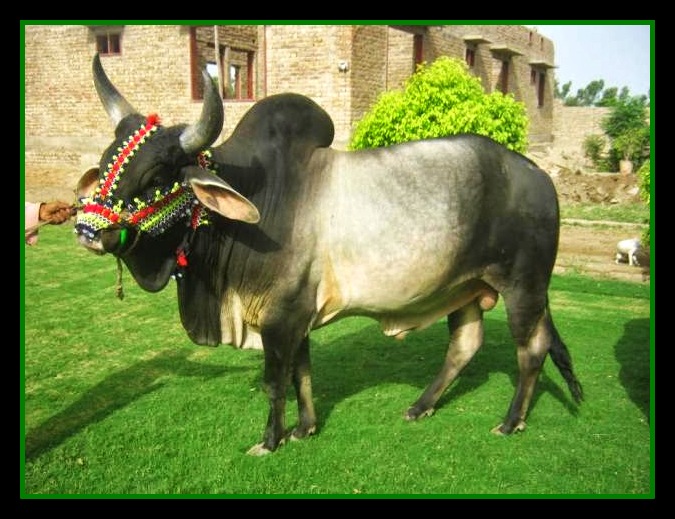
KhoobsuratJanwarEidDepression and psychological complex amongst sacrificial animals would be highest during Zilhaj if they could comprehend the criteria of ‘khoobsurat janwar’ which Pakistanis have created. Similar to how the advertisements make us believe that we need products to look good and for example, men and women who use fairness creams excel both in professional and personal life because of their fair skin tone, even the animals have to undergo a strict regime in order to become beautiful.

They are given the best diet which includes butter, milk, etc. As a result of which they grow up to be superior and bulkier than the rest and also are really heavy on the pockets of those purchasing them. However, it is surprising how the demand for these ‘khoobsurat janwars’ has increased even with the high inflation, escalating poverty and low employment and growth rates in Pakistan. Not only is poverty increasing, but so is social inequality. The phrase ‘the rich get richer and poor poorer’ fits our situation completely. If one were to look at the lavish lifestyle and expenditures of the elite Pakistanis, they might think that Pakistan has a really small fraction of people living in poverty. Because of the fact that it is an ‘Islamic Republic’ after all and if the rich are rolling in money then obviously their taxes and charities must easily be able to help the underprivileged section of the population. But unfortunately due to the lack of a proper system and trust in the government these funds are not efficiently allocated and spent. If people could trust the state they would pay taxes and in return the State would provide basic facilities to the population, like it happens elsewhere in the world where countries are governed with the idea of justice and honesty.

Interestingly, our tax authorities endorse the slogan of, ‘See no evil’, and there is nobody to question how people who go at lengths to make sure that they find a way to hide their true incomes and declare their incomes to be as low as possible can afford such expensive animals and various other commodities for that matter.

Amidst the huge tents, posing for pictures with the animals, flashy lights and various other pompous activities, we fail to realize how miserable we make those who are less fortunate than us feel. What goes through the mind of the chowkidaar or the man who takes care of the animal which cost almost about seven to eight years of his earnings is something we cannot fathom, that is if we ever bother. The increasing disparity is one of the root causes of crimes in a society. Plato warned of this evil “There should exist among the citizens neither extreme poverty nor, again, excessive wealth, for both are productive of great evil . . . Now the legislator should determine what is to be the limit of poverty or of wealth.” One of the main reasons behind social chaos which leads to the weakening of the state is imbalance of wealth.

While there is nothing wrong in spending a million or more on the purchase of sacrificial animals, what I fail to understand is why one cannot buy ten cows for a million instead of buying one? This way, there would be more meat to consume and distribute amongst relatives, neighbours, friends and the needy. Is it because sacrificial animals have become a status symbol? If yes, then the purpose of sacrifice is lost because it is not just the sacrifice of the animal but what the example of Hazrat Ibrahim and Hazrat Ismail (A.S.) in its true essence teaches us is that we should defeat our ‘Nafs’ and be ready to sacrifice all our desires for Allah. Then is not the desire to show off dominating us? Is it not ignoring the purpose of sacrifice? Allah says in the Holy Quran:

‘It is not their meat nor their blood, that reaches Allah: it is your piety that reaches Him’.

So if the blood and meat do not reach Allah but piety, then we really need to contemplate if we really are pious and if not, then nothing at all is reaching Allah.

Our Holy Prophet (PBUH) has taught us that actions are judged by intentions. There is no use of following rites and customs blindly if we do not completely embrace the true meaning of Islam. Islam is not just limited to rituals and the five pillars. It places utmost importance on the principles of social justice, welfare, fairness and protection of human rights. Eid is to be celebrated with the entire Muslim Ummah and therefore it is incumbent upon us to make sure everyone enjoys this occasion.

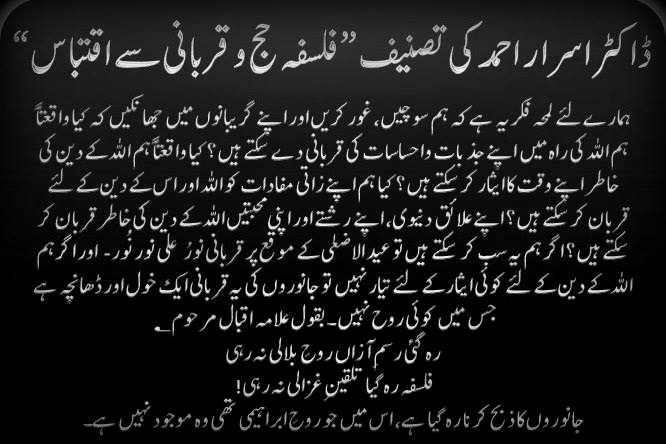
I leave you with the words of Dr. Israr Ahmed who has put this social problem eloquently that we have lost the spirit of sacrifice when it comes to following the ‘Deen’ of Allah. We are not ready to sacrifice our time, our comfort and our desires in the way of Allah. We do slaughter animals but we are completely devoid of the spirit of Ibrahim (AS) and the lesson his life teaches us.

IsrarAhmed

From Christopher Columbus to Malala Yousafzai‎

Columbus to MalalaParallax errors of selective historical and contemporary view points

A simple definition of Parallax would be “an apparent change in the position of an object resulting from a change in position of the observer”. By some accounts on October 12 Christopher Columbus arrived in the Americas [1]. 521 years later a girl, Malala Yusufzai, from Swat, Pakistan met President Obama. President Obama stated “Across the globe there are girls who will one day lead nations, if only we afford them the chance to choose their own destinies.” Both Pakistan and Bangladesh have had women Prime Ministers. A lady has never been elected to the President’s office in the US.

In 2007 30% of Iraqi elementary school children attended school [2] as opposed to 75% previously. Between the 1990 and 2005 the increase in infant mortality in Iraq of 150% was the highest in the world, a period that saw inhumane sanctions and a war based on greed [3] , an IMR had by contrast declined from 120 per 1000 in 1960 to 45 per 1000 in the late 1980’s. Some charge Muslims with trying to take over the West, forgetting conveniently that Iraq alone has lived the nightmare of foreign takeover multiple times. A 1920 “uprising” was crushed by Churchill through the RAF with Winston itching to use chemical weapons [4] and authorizing a brutal bombardment [5] of the “enemy” who happened to be the native of the land being occupied. The exact death and destruction from Iraq from first gulf war is still an obscurity in the media, so there is no surprise that the mortality and morbidity from the latest fiasco is manufactured in to a question mark. The Lancet study[6]  concluding 650,000 excess deaths and by some counts well over a million are disputed by the same media that John Kerry uses to drum up support for yet another war, this time in Syria shoulder to shoulder with Al-Qaida [7], backed by “numbers” pouring in thick and fast. Fortunately, the sanity of American people prevailed over a proxy war between Turkey, Saudi Arabia, Israel, USA against Iran and Russia presented as yet another divine call to protect the weak by the media.

Stringing it together – “Rediscovering” Columbus:

In school curriculum by our colonial masters, we found the names Christopher Columbus and Ferdinand Magellan. One of the first things to relearn about Columbus is that he was by no means the only one who believed that the earth was not flat. Second and more importantly, he conducted a shameless genocide of the indigenous population. In the schoolbook version in Pakistan and the US[8], he was an intrepid explorer, inspired by his faith as much as curiosity and “discovered” the “New World” because the Ottomans had blocked off the land route to India, the latter an assertion challenged by some as it was a money making venture for the Ottomans. In this day and age of connectivity it is hard to keep old myths alive let alone build new ones. One finds that Columbus was welcomed by an indigenous population only to return with arms and annihilate them. The “New World” was already home to an indigenous population, 90 to 95% of who would be wiped out in a single generation. The cause of this remains controversial and although disease from the “old world” did play a role, genocidal violence had very clear role as well, the people of the old world having the advantage of newer weapons unknown to the indigenous. In American Holocaust, David E. Stannard writes that in 21 years after Columbus came to the Caribbean, it went from a population of 8000,000 to be being desolate. The numbers and causes seem to get more obscure the more inconvenient they are to the myth of a linear unblemished history. The war on the natives was not despite faith but done in its very name as “the Requirement” would be read out to natives, imploring them to recognize the Church and Pope or be ready to face war declaring explicitly that women and children will be taken as slaves. Only a fool would use this as a reference to approach Christianity in general yet a similar bias is used for Islam daily in the media.

The current Palestinian-Israeli conflict becomes just another chapter, overlooking the fact that at the time Columbus sailed from Spain under Isabella Ferdinand, one of the most luminous chapters of coexistence [9] were coming to an end, that is the Spain under Moorish rule which was not perfect, but would still make us question the world that we are shaping since 9/11. In Spain Christians, Jews and Muslims had come together to make advances in art and science that Europe would owe its emergence from the dark ages to. Under Isabella and Ferdinand in Spain came the Spanish Inquisition, Jews and Muslims were expelled, even co-religionists were persecuted on suspicion of being fifth columnists. By contrast Jews and Christians had freedom of religion under the Moors [10] [11] and in fact many Jews were forced to flee to Ottoman lands.

Lessons from the Columbian myth: 

One has to be careful of the lessons learned from Columbus, just like one must not reduce Malala’s wonderful story to a conspiracy theory despite the undoubted exploitation by some. In a time of unprecedented propaganda we can fall to the temptation of our own parallax error – of creating our own “other.” However, we have to advocate that West and Islam question sincerely our biases, from a distorted history of the Crusades to the temptation of a religious transference.  The historical place of women in Islam and their roles are very different from what the exploitation of Malala would suggest. It is overlooking that just like early Christians, early Muslims were persecuted and the first martyr of Islam was Sumayah (May Allah Be Pleased with her) was a lady, killed when a spear was thrust through her private parts. It was the background of such victimization that Quranic verses of retaliating were revealed.

Most importantly, Columbus was a myth built over 500 years but took a few days of research in this day and age of the technology to dismantle. Those trying to reduce the violence of the last dozen years, both by a lunatic and fringe that has killed more Muslims than anyone else as well as by elected governments taking their people to wars based on lies, to the face of a young girl need to learn that the world does not lend itself to such a convenience any more. Muslims also need to learn that increasingly our struggles are intellectual. As a Muslim living in the West one can have many fears about disagreeing with the media narrative, being labelled a Taliban apologist, a closet extremist, a person mired in 1400 years of hateful history that never was, but perhaps the single most insincere thing that one can do to the society that we now live in is not share our perspective.

What Malala is not:

It is interesting how passionate a debate Malala has generated. Perhaps the most laughable was Bilawal and Bahtawar Bhutto (Last name Zardari?) saying they want her as their Prime-minister. This after unprecedented corruption by the Bhuttos as well as the Sharifs followed by Asif Zardari, a man known internationally for his money laundering and corruption, being installed as the President of Pakistan by the powers that be in and out of Pakistan, A fact Condoleezza Rice narrates in her book ironically named “No higher honour.” It is this manipulation of the fates of millions that breeds resentment against the US that leaves others robbed of their dignity and yes, also leaves the US a scape goat for one’s own failures.

One has to wonder about the stunning figures of mortality among children from US policies in just the last 2 decades, not to mention the malnutrition, internal displacement, destruction of families and lost opportunities for education, the thousands of innocents killed in drone attacks and the contrast of parading Malala. She was a face of the children of Pakistan but has been projected as a mask for the atrocities of the West. Even a partial list of children killed in drone strikes speaks of another reality [12].  The media uses her to obscure that Aisha (May Allah be pleased with her) is one of the most prolific narrator of prophetic traditions (Ahadith), that the colonialism has exploited women as much as imperialism does now, that bigots like Lord Cromer in the early 1900’s in Egypt criticizing Islam were opposing women’s right at home in England [13]) and that a French General had concluded“If you convert 100, 000 young indigenous girls to our civilization …. these young girls, who would naturally become the privileged wives of the most important men of their class will, forever guarantee the subjugation of the country and be the guarantee of its future assimilation. [14]” Malala is a daughter of Pakistan, a young girl among many who suffer in a country plagued by feudalism, lawlessness, corruption and economic mismanagement, all factors that have helped the US government manipulate Pakistan to its interest while the media keeps people misinformed by creating out of one life what it has denied to millions.

Why Malala is a real princess:

Some months ago my daughter had asked about Princess Diana when she watched a video of Diana visiting the Shaukat Khanam Cancer Hospital in Pakistan, one of the biggest philanthropic ventures in Pakistan that serves all Pakistanis regardless of race, religion or color. I told her she was “real princess.” I will teach her the same about Malala for her courage is truly phenomenal and makes me question what I have done to build a better world. I think the biggest lesson this young girl taught me is that if you believe in something then you should be willing to stand up for it. There have been many satirical blogs and articles about how Pakistanis see a conspiracy behind her including by a minority of Pakistanis whose parallax is the convenience of picking a (often profitable) side in a black and world narrative, conveniently overlooking that in the last 10 years Pakistan has seen unprecedented violence, the influx of Black water mercenaries, the interests of its own people sold by the corrupt elite and the likes of Raymond Davis literally getting away with murder. That Humanity in the midst of the never ending war on terror has decided to handle collective affairs on anything other than on power is bound to draw skepticism.

Pakistan air force now has women pilots and women have served in the police for years and that many teachers in Pakistan are ladies. I celebrate  Malala, like  my grandmother, a physician who went on to participate in the Pakistan movement, My mother a physician who practiced in Saudi Arabia and Pakistan, my sisters who went on to successful medical careers and my wife, yet another physician in the family.  Today more than ever it is easier to retrace history. To celebrate Fatima Al-Fihri, a Muslim woman who established the first University in the world and perhaps even dare suggest that Columbus Day be renamed Bartolome De La Casas Day who unlike Columbus had the courage to see the humanity of the “other” and said:

“What we committed in the Indies stands out amongst the most unpardonable offenses ever committed against God and mankind and this trade [in American Indian alaves] as the most unjust, evil and cruel among them”.

References:
1. Columbus day: Wikipedia http://en.wikipedia.org/wiki/Columbus_Day
2-3. The War Machine and Global Health, A Critical Medical Anthropological Examination of the Human Costs of Armed Conflict and the International Violence industry
4.   Winston Churchill’s Secret Poison Gas Memo: http://www.informationclearinghouse.info/article999.htm  
5. Iraq, 1917: http://www.informationclearinghouse.info/article6337.htm
6. Lancet surveys of Iraq War casualties: http://en.wikipedia.org/wiki/Lancet_surveys_of_Iraq_War_casualties
 7. Does Obama know he is fighting on Al Qaida’s side: http://www.independent.co.uk/voices/comment/does-obama-know-hes-fighting-on-alqaidas-side-8786680.html
8, 10. Lies my Teacher told me, James W. Loewen
9. Ornament of the World, Maria Rosa Menocal
11. State, Society, and Law in Islam: Ottoman Law in Comparative Perspective, Haim Gerber
12. A List Of Children Killed By Drone Strikes In Pakistan and Yemen http://www.policymic.com/articles/24164/a-list-of-children-killed-by-drone-strikes-in-pakistan-and-yemen
13, 14,The Miseducation of the West, How schools and media distort our understanding of the Islamic world, Joe Kincheloe

Muslim Schools, Hijab and the Media

laurenbooth_profile‘I’m not wearing that!’ My 12 year old daughter winces as we examine the bathing suit she must wear for swimming lessons at her private girls school in Manchester. A whole section is cut away from rear ribs to the (very) lower spine. As for the front, well, the thighs of the suit are so high cut the overall effect is less year 8 swim club, than a Rihanna photo-shoot. It serves me right – for not sending my daughter to a Muslim secondary school.

Despite the negative press you may have read about (dread phrase) ‘Muslim Schools,’ both my daughters and I have found the establishments near us to be welcoming, inspiring and (as a mum of teenage girls), with a dress code that is refreshingly, modest.

Our views, based on solid experience of local Muslim schools, are far from the media portrayal of the norm. Just take a look at the headlines. In recent days, two Islamic schools have featured unfavourably. Al-Madinah in Derby, a new 4 -16 Muslim Faith state school, opened just a year ago has been temporarily shut down after its first Ofsted report, closed the gates due to a “health and safety issue.“

At the same time one of the only other state Muslim schools in the country, Tauheedul Islam Girls’ High School has been criticised in the press for its dress code. Girls who attend Tauheedul Islam’s High are expected to wear a headscarf to school. And it is this uniform code which has incited negative coverage against this otherwise highly successful state, establishment.

Whilst the mainstream media were seeking a way to tarnish Tauheedul Islam’s Highs excellent reputation, the school, quietly, at the same time, topped a league table of 3,000 UK state establishments. Trinity Mirror’s data unit, backed by academics compiled the list seeking to give a ‘comprehensive’ view of the quality of schools UK wide. The data focused on academic results, teaching quality, and – crucially – the behaviour and prospects of its pupils. Tauheedul ranked the best in ALL these departments.

It is a sign of the mainstream media’s political agenda that to date no daily paper has followed up this story with a positive request (as would usually be the case) for glossy interviews with faculty staff and headteachers.

Thus British readers of anything but a single newspaper are unaware that an Islamic School in Britain currently ranks as the best in the country according to the most recent and very comprehensive study, a school that also has the highest approval of parents, pupils, local government and policy makers in Whitehall. No mean feat in the current climate.

Bizarrely, when I speak to a department editor she insisted that; ‘That league table was from years ago. It’s not recent. It’s old. But I’ll check.’

I call back sometime later and point out that the report was printed two days earlier and is new.

‘Hmm, still can’t verify it’ which is odd as the page is easily found via a way out new-fangled gizmo called Google. Why is she so reticent to repeat the findings? What she said next was both offensive and revealing ‘We just don’t believe everything that head teacher tells you, Lauren, so make sure you check these things carefully.’

Hinting that a head teacher is massaging figures that have been released in a national daily independently of the school is a stunning insult. One I cannot imagine being made of any other head teacher of high standing. Or anything bar criminal standing for that matter.

In the end it took a personal interview, to accompany the article I wrote – recognising the legitimacy of Tauheedul’s great results, to push the Sunday Times to revisit the theme of modesty in school uniforms for girls. Oh and my actual piece? In the end did not appear in the actual paper but only in the online edition and even then it is only available to subscribers. Meanwhile, my interview on girls modesty in schools being a positive was published in the corner of a page whose main story was ‘British imams willing to marry girls of 14 in secret.‘

British papers want readers to fear the ‘spectre’ of  Islam. Yet, the argument for firm moral guidance and a sense of community, being central to schools is completely ‘on message’ with current government thinking.

Michael Gove the Education Secretary has spoken clearly about the role of schools in effecting positive changes in students’ lives beyond the national Curriculum norms and well into the realms of social mentoring. He has insisted that schools have a major role to play in “promoting stability” in children’s lives.

“There’s nothing worse if you’re a child than not knowing when bedtime and meal time is, not knowing where mum and dad will be at a particular time,” he said.

“But if you are in a school that’s well run then people insist on discipline and timeliness and they insist that you are polite in the lunch queue and eat with your friends.

“And that discipline is evidence of someone really taking an interest in you; they care enough about you, enough to want you to be part of that community and part of that ordered life.”

During my research it became clear that newspaper editors are using the governments agenda for ‘inclusiveness’ try to focus fury on this element in relation to Muslim schools.

‘After all Lauren, which non-Muslim girl will wear a headscarf?’ asked the editor of an educational supplement.

Certainly inclusion for all who wish to enter a school is an important marker for the right of a faculty to receive state funding and must be observed.

It is not the right of local children to attend the best school whatever their faith I question here. After all Muslim children in the UK have gone to CofE schools and continue to do so. But if we are talking about fairness then let us look at the coverage another faith school received when it was found to have a clearly non inclusive policy. Yesodey Hatorah Senior Girls School in Hackney is a state funded Jewish school. In a recent survey it was found that whilst 37.82 of local community children are amongst the poorest (in need of free school meals). This state school has a quotient of just 1.62 per cent at this level of need, a clear example of selection by stealth – The media response to this scandal?
Silence!

Meanwhile the schools website states that: Charedi homes do not have TV or other “inappropriate media”, such as the internet. Families will also dress in accordance with the strictest standards of modesty’. Now let’s hear what the media had to say about Tauheeduls dress code and pupil expectations.

The Daily Mail, following the lead of the Sunday Times, wrote (Sept 29th 2013); ‘Pupils have to wear hijabs in and OUT of class for the first time at a state-backed school in Blackburn.

The cover-up was ordered at the 800-pupil Tauheedul Islam Girls’ High School where students already have to dress in long purple tunics over black trousers to ensure flesh is not seen. Under the rules, pupils must ‘wear the hijab outside the school and home, recite the Koran at a least once a week’ and not have stationery which shows ‘unIslamic images’ like pictures of pop stars’.

Sounds terrifying right? Let’s break this down.

Pupils must wear hijab at school and home. The school dress code includes hijab, a legally acceptable requirement for a faith school. But no one at the school or on its literature makes the outlandish claim that they would somehow ‘police’ girls once they leave school premises. The school brochure merely states that it is a hope, an expectation that good school practise travels into the home environment. A far softer statement than that made by Yesodey Hatorah Senior Girls School in Hackney which makes it clear that the homes its girls come from shun TV and the internet. A statement of certainty, not of expectation, regarding the way its pupils live outside school.

Tauheedul Islam’s Head teacher Mr Hamid Patel denies the accusations regarding what pupils wear outside school saying ‘This story is wrong. It is totally incorrect to say that pupils are ‘forced’ to wear hijab outside of school.’ And.
‘We are extremely sorry that despite repeated attempts by us to make sure the Sunday Times got their facts right, this newspaper chose to wilfully misrepresent our school.’

Meanwhile, British children are crying out for greater guidance and support. A report released this week reveals a 30 per cent rise in 10-14 year olds who self-harm. Let’s be clear what this means; a growing number of our teenagers are taking sharp objects and gouging their skin in an attempt to cut away psychological misery. Young people in the UK are, the report finds, traumatised by a maelstrom of modern pressures. These are listed by the children’s organisations responsible for the report to include; Cyber bullying on social networking websites ‘sexting’ and sexual relationships. The director of campaigns at the Young Minds charity calls the emotional climate our children live in “unprecedentedly toxic” with ever younger children being affected.

There is no doubt that the pressures on girls to be ‘hot’; to wear ever skimpier clothes in order to impress hormonal boys (and male teachers), plays a large part in this environmental disaster. We, as parents, play our part, when we ignore or even endorse this sense that school must be cool, including the uniforms.

My girls and I accepted Islam as our religion, three years ago. And after watching me change from a mother, who drank alcohol to a parent at peace (and teetotal), and with their own growing understanding of the basic tenets of Islam (the essential one being that; ‘God is One) both Alex and Holly embraced, this lovely, clean living, faith. My 10 and 12 year old daughters have before (and particularly since) revealed a natural instinct – and a confidence – in their preference, towards covering themselves up in public. Walking down the high street yesterday, Alex noted the school girls with skirts hiked up mid-thigh. Instead of envying the girls physically she said;

The poor things, how horrid to feel you have to be half naked to impress boys.’

As the Northern drizzle pounds our car, Holly puts it more simply. ‘That looks stupid AND cold.’
Sounds weird to our ears doesn’t it? Like our grandmothers speaking rather than modern adolescents. And that’s the point.

The strength of my daughters views on the subject of modesty. A theme of contention in homes, which causes parents either agony or outrage – has surprised me. In a society where so much of ourselves is wrapped in how we are ‘packaged’ or how much ‘beauty’ we can create with modern hair and make-up products. Children are increasingly the victims of a culture that creates female insecurity and sexual victimhood whilst dressing it up as ‘freedom’ and ‘liberation.’ But isn’t it us, and our weak institutions, who put them at risk first?

Instead of being repelled at the idea of modesty at girls schools, British parents should be welcoming a return to uniforms which, to be frank, are not so far off what we ourselves were ‘forced’ to wear.

It is Islamic schools which are a part of a growing positive march towards greater sartorial modesty for girls at school. And they are far from alone. The grotesque pressure on young women to adopt the ‘sexy schoolgirl’ look now a fashion staple from pop videos to men’s magazines has secondary and even primary head teachers making radical uniform amendments. This summer, parents nationwide cringed at the case of Jeremy Forest and the 15 year old pupil he seduced. Now the school he taught in, Bishop Bell Church of England School, East Sussex, wants pupils to have the ‘highest standard’ of appearance. We aren’t talking a new school badge here we are talking about a ban on make-up for girls below school year 10 (ages 14 to 15). And further, a directive to parents from the school office read: “Figure-hugging tight, skinny-fitting styles are not acceptable. Trousers are required to be loose around the ankles without Lycra or similar.”

Nail varnish, body piercings and most items of jewellery have also been deemed ‘not acceptable’.

Yet should a Muslim school outline such a dress code, there is an attempt to create a public and a political outcry

Far from being outraged, a growing number of parents will agree that there are ethical, moral reasons for strict clothing rules for secondary school girls. Indeed skirt bans currently exist in 63 secondary schools nationwide. The overwhelming majority NOT Islamic.

When I was at Copthall Girls school, sometime in the last century, I remember being sent home by Deputy dragon Mrs Wilson for ‘not wearing a skirt but a PELMET Booth!’ I also remember the girls flirted so much with the Sting lookalike Geography teacher he had a nervous breakdown.
In hindsight, how innocent our hitched skirts and batted (bare) eyelashes seem to the hyper sexy looks adopted by this generation. Aided and assisted not only by peer pressure but a weakened sense of social morality across the board in our society.

As for my daughters.
The eldest has chosen to wear hijab to her non Muslim secondary school. Teh faculty of which are very receptive to girls religious choices. Alex says the hijab makes her feel ‘clean and protected.’ My youngest, Holly, is keen to attend the Manchester Muslim High school and currently wears hijab at the Islamic Prep she attends – as part of the uniform.
At the end of the day, back at home, they both take them off to do their homework changing into sweat pants and t shirts.
We are all delighted that no one outside the family will see their knobbly knees or any other part of their girlishness in the coming years and certainly NOT on school grounds where the institution has a duty to protect both their wellbeing.

Am I Not Your Lord?

adfadf

“Apart from what theologians have taught you what do you know of God yourself?” asked a new found friend. I reflected on the question and thought some more, during the early morning showers, the long drives to work, a lunch completed in solitude, the gratitude and the atmosphere of reflection that is born in the silence of a house that moments ago was alive in the laughter of children and the bliss still hanging in the air. The contrast of one’s own abundance becomes the very quest for a prosperity that must be beyond material, inherent differences in ability and free of predisposition. I began to formulate an answer.

In the outstretched hands and sunburnt faces I would see my father disappear till the homemade food to be distributed on a Friday evening would run out. There was never enough for everyone and in the rabid capitalism of our times, there never will be. A sense of relief at seeing him return to the car unhurt would give way to a twinge of guilt at asking for a simple treat, a bottle of Pepsi or an ice-cream, the contrast all too fresh in our minds. I must have found Him there or thereabout, perhaps even in half-eaten sweets my sister had packed away taking literally the teaching of sharing with the less fortunate what you like for yourself. As an adult I am obligated to spend two and a half percent of what I save in charity but I learned long ago that I am a mere custodian of the rest. It was not until years later in an atmosphere of my identity being hijacked that I would actually learn:

“And they feed, for the love of Allah, the indigent, the orphan, and the captive,-. (Saying),”We feed you for the sake of Allah alone: no reward do we desire from you, nor thanks.” (Quran 76:8-9)

Yet what was being taught in the Friday sermons resonated with an inherent truth. I don’t recall a distinct conversation about who God is or an encounter with a “theologian.” There was perhaps no need, for God was never a mystery. He revealed Himself in the stories told by my parents at the end of a 12 hour work day; Noah, Abraham, Jacob, Joseph, Job, Moses, Aaron, David, Jonah, Jesus and Mohammed (Peace Be upon them) – all stories much similar but different in significant ways than the scriptures before the Quran. Again, it was much later that I would learn:

Say: “We believe in Allah, and in what has been revealed to us and what was revealed to Abraham, Isma’il, Isaac, Jacob, and the Tribes, and in (the Books) given to Moses, Jesus, and the prophets, from their Lord: We make no distinction between one and another among them, and to Allah do we bow our will (in Islam).” Quran (3:84)

Surely, He is not the author of confusion for He fit the simple mental construct of a fifth grader. Promises of being good and praying regularly made with devotion as one went in to collect the annual examination results – convinced of a God that can erase and redo answers to algebra and fill in the ones you left blank. Looking back I could have sworn He did just that.

Of course, come summer vacations, the promises would quickly be forgotten in the fun and games with siblings and cousins. Until, one would find in a second hand bookstore the “Choose your own Adventure” series. In space or undersea one would find dilemmas like choosing to fight aliens or futuristic pirates versus the alternative of making a run for it. The book was written, but could end many different ways depending on the choices that we made. I struggle to find a better analogy for life.  I learned about predestination much before I discovered it as an article of faith. I must have by then heard the story of our parents, Adam and Eve, the free-will which is the singular feature that distinguishes humanity from the rest of creation, a gift that makes us capable of much evil but when submitted totally to the One Creator can make us stand alone against the mockery of our times like Noah, be willing to sacrifice that most beloved to us like Abraham, find patience rewarded with reunion like Jacob, go from wells to thrones like Joseph, thank Him endlessly in suffering like Job, find the courage to stand against a mighty Pharaoh like Moses, find the wisdom of Jesus and the strength to deliver a complete code of life in a little over two decades despite incredible odds like Mohammed (Peace be upon them all). I must have learned by then the story of original forgiveness by a God that gives you the very words to ask for it, even though it would till decades later that I would read:

Then Adam received from his Lord Words. And his Lord pardoned him (accepted his repentance). Verily, He is the One Who forgives (accepts repentance), the Most Merciful. (Quran 2:37)

Salvation must lie in faith in an All Forgiving God, despite Whose Mercy, we could never find it for the Prophet (PBUH) himself taught

Narrated Abu Huraira: I heard Allah’s Apostle saying,

“The good deeds of any person will not make him enter Paradise.” (i.e., None can enter Paradise through his good deeds.) They (the Prophet’s companions) said, ‘Not even you, O Allah’s Apostle?’ He said, “Not even myself, unless Allah bestows His favor and mercy on me.” So be moderate in your religious deeds and do the deeds that are within your ability: and none of you should wish for death, for if he is a good doer, he may increase his good deeds, and if he is an evil doer, he may repent to Allah.”  

(Sahih Bukhari Book #70, Hadith #577)

I can’t recall ever being explained that in our quest to return to our original abode, Heaven, we must pay heed to our deeds as much as rely on The Most Compassionate, The Most Merciful. It seemed to be a truth we were born with the knowledge of, a logical conclusion given the one gift that sets us apart – the free will, for which the universe was fashioned to perfection so that we may reflect and know Him through his attributes.

Blessed be He in Whose hands is Dominion; and He over all things hath Power;-

He Who created Death and Life, that He may try which of you is best in deed: and He is the Exalted in Might, Oft-Forgiving ;- He Who created the seven heavens one above another: No want of proportion wilt thou see in the Creation of (Allah) Most Gracious. So turn thy vision again: seest thou any flaw?(Quran 67: 1-4)

Sadly, what was as clear as the starlit night, a fringe benefit of sleeping on the roof during a power outage, got lost in the illusion that love, wealth, career needed to be “pursued.” The stars disappeared behind the clouds and the very romance of existence got corrupted and still does for surely we are creatures of much error as the Prophet (PBUH) taught us:

“All the children of Adam constantly err, but the best of those who constantly err are those who constantly repent.” [Tirmidhi, Ibn Majah, Ahmad, Hakim]

The events of the last over a decade provide an opportunity to relearn the known. Not only returning to the Quran and Sunnah to reclaim our identity but to learn about our history and most importantly being thankful for the questions asked of us; both by the deviants claiming to speak in our name and those who fail to understand the futility of freedom of speech without a right to be heard. Ultimately,  to learn about my Creator comes naturally, for all of beauty and knowledge has already passed through and all Prophets came to remind us of the straight path that we have known before the beginning of time:

When thy Lord drew forth from the Children of Adam – from their loins – their descendants, and made them testify concerning themselves, (saying): “Am I not your Lord (who cherishes and sustains you)?”- They said: “Yea! We do testify!” (This), lest ye should say on the Day of Judgment: “Of this we were never mindful (Quran 7:172)

The Political Economy of Hatred

llll

Hatred is a scam. Just like a lot of stuff Capitalism and its globalizing effects want to sell us. This is what they do right? They come at our doors and they sell stuff. We buy stuff. But we also buy into stuff. Into the ideology of stuff.

The ideology of stuff isn’t your next door neighbour- wait, maybe it is. Nevertheless, it’s an outrageous liar, a manipulative predator, a tormented bully, a murderous blasphemous mother figure, a haunting daunting cyborg, a pretentious cold hearted drone, and an official doctrine- a doctrine of hate, and of lustful appetites; a doctrine of obedience, and of going wild.

To keep us at bay, Capitalism invents enemies and detractors. Focus on them it says. Business takes place as usual. But behind curtains; in the form of official mantras, and national songs. And of all sorts of patriotic jibberjabber- that weird old feeling you get when you are told to be proud of those latest mechanical contraptions made to murder other human subjects; subjects of the God of Modernity, also known as the ‘Nation–state’- a global God, a God of boundaries, a God everyone worships, both ‘us’ and ‘them’.

And here stand two neighbours. India and Pakistan. Enslaved by the passions of their new found religions- nationalism and nationalism respectively. Always bickering and swearing about and to each other. Both could benefit from a little give and take, a little mutual cooperation, a little mutual trust, which would in turn lead to some trimming off military spending here and some added social welfare spending there. But both fail to realize what’s good for them- and by them, I mean their people. Instead, both impose doctrines of hate on their people. People are told to hate people. A nation is told to hate a nation. And vice versa.

Recent developments are quite interesting. War hysteria had taken over India. But what really happened. Did people suddenly decide that Pakistan was the source of their misery. The fact that the average Indian person lives in abject poverty while the country is producing some of the wealthiest Billionaires on the planet seems too sophisticated a scheme for the diabolical foe across the border to concoct. What’s really happening here? And why is it happening when elections are at the corner and a billion people will be given the power- formally speaking- to change their destiny? Why are they told that the problems inside their borders are less important than the problems outside their border? Why are they told the miseries of the people are less important than the egos of the ruling elite? And why now?

On the other side, Pakistan just experienced elections. And what we are seeing is a pronouncedly pro-dialogue and pro-friendship government of Prime Minister Nawaz Sharif. The PM has already stated that both countries should work on cutting military spending and on boosting people spending. This is a positive sign, despite some skirmishes on the border. One can hope that some sort of dialogue and sanity is restored in the future.

But then we are reminded of a very real fear. A genocidal fascist is making his way to the throne in Delhi. In the heart of the world’s largest democracy, a mass slaughterer, Narendra Modi, is not only the strongest candidate for the PM’s office but is also the blue-eyed boy of the corporate world. He offers a lot of promise. To the corporate world that is. Under his watch, the world tolerated a systematic pogrom against the Muslim community of Gujrat. Rape, torture and slaughter were orchestrated openly in the streets while Modi justified it in an terrifying action-reaction logic.

It’s only high time to do away with logics of actions and reactions, and of ‘us’ and ‘them’.  For someone like Modi to become PM only tells how nationalist-conservative rhetorics are so intertwined with capitalism and globalization. The way they get away with all this is through sowing the seeds of hatred.  One may think otherwise but haters are part of the same process; the same ritual; and the same religion—the religion of nationalism.