Who is Behind the Bloodbath?

bloodbathThe catalogue of bloodbath in the Muslim world is harrowing and sickening. I want to know who is responsible for it all. It has been a bloody week – the Westgate shopping centre massacre in Nairobi that left 67 people dead, the killing spree of students in North Eastern Nigeria has left 50 students dead, the bomb blast has left 40 people dead in Peshawar in Pakistan and another bomb in Baghdad has taken the lives of 47 people. I want to know who is behind it all.

While the media and pundits brandish “Islamist terrorists” as the key culprits the more serious questions does not even get discussed. They get buried under the hysteria of the Islamist threat. I would like to know who these people are. What is their true identity? Who is funding them? Where are they getting their weaponry and technical support? Why are they hell bent on doing it in the name of Islam and not Christianity, Judaism or other faiths?

We all know that no true Muslim would ever carry out such atrocious and heinous massacres. Yet they are promoted as the true representatives of Islam and the Muslims by the media; their actions are labelled as Islamic and terroristic at the same time. I want to challenge those who are making a living out of pretending to be an Islamic terrorism expert by posing a few simple questions:

1. They are well aware of the fact that terrorism can never be Islamic but knowingly they make the association. This remains registered in the conscious and sub-conscious minds of people. When they think of Islam they think of bombs, killings and terror. Why do these experts deliberately conceal the truth and make these false associations?

2. By making Islam synonymous with terrorism what do they intend to achieve apart from fanning the fuel of Muslim hatred and discord? They know Islam could end terror and tyranny instantly if the Muslim world was truly free.

3. Why call terrorism, Islamic?

The Muslim world is sick and tired of more and more frontiers being thrust on their faces. They have the internal dictators and despots to fight in their respective homes. They have to struggle against imperialism and neo-colonialism. They are now facing a new menace; unknown people and groups are popping up everywhere and carrying out indiscriminate attacks and massacres using crude bombs with devastating consequences. Whose agenda are these murderous mischief-makers serving?

We all know that according to Islam killing one innocent person is tantamount to killing the entire humanity. In Islam life, intellect, property, family and faith of people are the most basic rights that must always be preserved. Yet, there are people who are randomly picking shopping centres, targeting markets, selecting schools and even choosing mosques to kill Muslims. There are those who are attacking the non-Muslims and their places of worship. A true Muslim would never do anything like that! A genuine Muslim would naturally be deterred by God consciousness, the inevitable consequence of the Hereafter and their scared commitment to fairness and justice.

The truth of who is pulling the strings and who are the real masterminds behind these attacks needs to be uncovered. Who are the paymasters of these bloodthirsty monsters need to be unveiled? Who are the real terrorists?

Anyone who believes in the God, most Merciful and most Kind and the last day would never attack innocent people or kill. These are the works of some dreadful people whose only motive is to demonize Islam and destabilize the Muslim world. A free and modernized Muslim world, embedded in Islam would pose a huge challenge to the interest of these ghastly people. I eagerly wait for that day when the Muslim world would be truly free and Islamic.

My all-time favourite chapter of the Quran summarizes the true character of Muslims in the following timeless words:

“CONSIDER the flight of time!
Verily, humanity is bound to lose
Except those who attain to faith, and do good works, and enjoin upon one another the keeping to truth, and enjoin upon one another patience in adversity.” (Chapter – The Time)

Murder, mayhem and terror has no place in Islam and please do not attribute it to Islam either.

Reclaiming Rainbows

rainbow

Human thought finds a rather romantic metaphor in a rainbow. With reflection one may find more in it than a fleeting comfort. Perhaps find even a way to reconnect with our purpose and reassurance that God ordered the perfection of Angels to bow to the ‘imperfection’ of humanity.

“Behold, thy Lord said to the angels: “I will create a vicegerent on earth.” They said: “Wilt Thou place therein one who will make mischief therein and shed blood?- whilst we do celebrate Thy praises and glorify Thy holy (name)?” He said: “I know what ye know not.” Quran Surah Al-Baqarah (The Cow): Ayat 30

The majestic arch across the horizon is a reminder of the futility to reduce the expanse of the earth in to one thought for it was never meant to be such. Our essential task is to outdo each other in good and being in a state of constant ‘dawah’

“If Allah had so willed, He would have made you a single people, but (His plan is) to test you in what He hath given you: so strive as in a race in all virtues. The goal of you all is to Allah; it is He that will show you the truth of the matters in which ye dispute” Quran Surah Al-Maeda (The Table Cloth): Ayat 48

Rainbows beg the question, “If all are wronged who is right?” They set a deep contrast to the black smoke billowing from towers reduced to rubble in the west or houses turned to ash in the lands where the Abraham walked, oblivious of whether it marks the loss of material or a child. A proud Afghan standing in a queue for ‘compensation’ becomes as irrelevant to peace as those led to believe in moral wars on ideological evils, for self-righteousness comes in many guises, the absoluteness of dogma, conviction of being free from it or more still, having defeated the eternal conflict between physical temptations and spiritual quests through absolute sincerity to a constitution.

One man’s righteousness can be another’s white-washed tomb and vice versa. This is why ultimately one understanding of faith and its place in society cannot be imposed universally.

“Woe to you, teachers of the law and Pharisees, you hypocrites! You are like whitewashed tombs, which look beautiful on the outside but on the inside are full of the bones of the dead and everything unclean” Matthew 23:27

“For I tell you that unless your righteousness surpasses that of the Pharisees and the teachers of the law, you will certainly not enter the kingdom of heaven.” Matthew 5:20

The rainbow is not an ascetic argument. Beauty is really in the eyes of the beholder. The Unseen is infinitely beautiful to all of us and should be the very reason to neither oppress nor be oppressed. God, may therefore, be sought individually in some societies and collectively in others but all too often we lose sight of this Rainbow. Ethnocentricity brings with it a religious ‘transference’ and a complex world of hate and greed becomes an a half-sincere call for ‘reformation’ not willing to understand that there is no central authority or hierarchy for a Muslim Martin Luther to abolish material exploitation through ‘indulgences’. For the very same reason there is no ‘ex-communication’ of terrorists – simply because there is nothing to excommunicate them from, their actions are sufficient to identify their deviousness. Yet, hypocritical cries of ‘Muslims not denouncing terrorism’ emanate from our TV screens while by and large simultaneously denying any forums to people who don’t fit in to a ‘this or that’ classification.

The world gets ugly in monochrome. The diversity of a rainbow promises otherwise, where we can differ on everything including happiness being an overstocked refrigerator or a stomach half empty, a house by the lake or a modest abode, the enjoyment of losing ourselves to head banging in a concert or the content of a prayer said in solitude. Whether it is religions inspired by scripture or systems such as socialism or capitalism to manage our collective affairs, our inspiration or intent should not be questioned, nor reduced to a black and white convenience. Helen Keller for instance is remembered for what she taught us rather than her sympathy for communism.

Ultimately, the truth is not something to be imposed, nor can it be denied by a nation to another, a religion to another religion. Reducing a faith to distortions on a select few issues like Jizya, treatment of women or status of minorities is seeking refuge in a black and white for we cannot acknowledge the good in others. It is the self-deception of setting conditions for dialogue after a monologue with our own bias. The general good in us becomes a crowd in a company of extremes. But the good in us is unmistakable despite our ability to be incredibly wrong, for he breathed his spirit in us

“Then He fashioned him in due proportion, and breathed into him the soul (created by Allah for that person); and He gave you hearing (ears), sight (eyes) and hearts. Little is the thanks you give!” Quran Surah As-Sajda (The Prostration) Ayat 9

We deny this goodness to ourselves when we assume reasons for our choices are universal truths that apply most to those who disagree. It for this reason that we point to the inheritance of women but fail to take in to account that the same faith granted inheritance rights to women 1200 years before England and that the very same faith allows the women to keep the inheritance for their own business or pleasure without needing to pledge any part of it to the household. Jizya becomes an evidence of discrimination when we do not acknowledge it as part of a collective social security system and in lieu of the 2.5% of savings Muslims would give to charity, including equal protection under the state.

Religion is a sensitive subject but not in the sense of banning crosses, skull caps and head scarves. For secular extremism of this sort is a return to first century Rome, as decades after Jesus PBUH walked the earth and some years after the destruction of the second temple, Josephus Flavius (Yusuf ben Matityahu), a Jewish man who after the second destruction of the temple of Solomon (PBUH) became a Roman citizen through a peculiar set of circumstances wrote

“Antiochus …. He compelled the Jews to dissolve the laws of their country, and to keep their infants uncircumcised, and to sacrifice the swines flesh upon the altar, against which they all opposed themselves and the most approved among them were put to death.”

The hate-mongers of our age are like mercenaries that ambush the values of others but hide behind the general good of the religion they claim to represent, at times mere convenience and at times a very deliberately measured act. The worlds turns black and white as explanations and accusations are exchanged and anger rises, just the way a few among us wish it to be. For instance, when one mentions the massacre in Jerusalem of 1099, the role of the church in the Holocaust, that about 3% of Muslim men are polygamous and that the average sexual partners in the US alone for men is 7, that the ottoman empire under the millet system allowed personal laws to govern affairs of minorities, this seems to split the world further in to an “us” and “them.” We instantly become parties in a conflict that had seemed distant. The clash of civilizations narrative continues at a time when faiths have no distinct borders. To justify wrong’s of our age on the basis of history is to not know our own past. Humans have hard enough time agreeing on the present let alone over 1400 years of history which has seen war, peace and even luminous coexistence such as La Convivencia .

What is just and right is not divine violence, nor a nations interests over others but a signature of monotheism that guides us to treating others justly, perhaps related to the concept of Carl Jung’s collective unconscious that has been expounded by some to represent a collective ‘known’ truth.

“When thy Lord drew forth from the Children of Adam – from their loins – their descendants, and made them testify concerning themselves, (saying): “Am I not your Lord (who cherishes and sustains you)?”- They said: “Yea! We do testify!” (This), lest ye should say on the Day of Judgment: “Of this we were never mindful” Quran Surah Al-Araf (The Heights) Ayat 172.

In seeking moral superiority or denying others the right to differ, we return to a pitch dark. We become exceptional for some tough questions follow if we have to follow what the scriptures teach us.

“So in everything, do to others what you would have them do to you, for this sums up the Law and the Prophets.” Matthew 7:12

“Nor can goodness and Evil be equal. Repel (Evil) with what is better: Then will he between whom and thee was hatred become as it were thy friend and intimate!” Quran Surah Fussilat: Ayat 34

The rainbows become a rarity in the polluted skies of our times, not just because of obscure hate filled videos from fringe elements hiding in mountains and killing more of their coreligionists than the “evil” they claim to be battling, but a very systemized narrative of convenience unleashing overt wars or covert subversion in the name of an equal conviction of being the keepers of “the way.” The irrationality of being absolutely right and absolutely wrong has played out all too long. Yet, the gray clouds, the thunder and lightning at times, are the very harbingers we hope for. It is in our children’s eyes that the secrecy of tomorrow will reveal itself. We owe them  rainbows – for they are a rather romantic metaphor.


Losing Our Religion

Losing Our Religion

 That’s me in the corner

That’s me in the spotlight

Losing my religion

Trying to keep up with you

And I don’t know if I can do it

Oh no, I’ve said too much

I haven’t said enough…

(R.E.M., Losing My Religion)

 The meandering mythologies of the Greeks have some insightful truths that are relevant even today. Take Narcissus, handsome and definitely hard-to-get, but really a lonesome fellow. His raison d’être was solely gazing at his own image in a still pond. And then he fell for himself – quite literally – and was transformed into a flower. Poor beautiful flower with such an arrogant name. Narcissus was not the only one condemned to become something else. Races before him were condemned to become monkeys. Races after are further at risk of losing their real selves should they choose not to mend their ways. Glory and its grandeur never truly last. In Narcissus’s case, glory, which was the cause behind the condemnation was nothing but delusion.

Self-love is the first ‘lesson of life’ we teach ourselves. “I come first.” “I matter.” “I’m special.” “Why should I care?” The culture around us is no different from what Echo would do for Narcissus. It resonates a subtle and subliminal, almost hypnotic allure, telling us how unique we are: “Because you’re worth it.” “You should be happy.” “Be what you want to be.”  We hear such feel-good phrases all the time. The curse of our time is nothing but the nuisance of narcissism. Celebration and promotion of the self is the rule of thumb for being a happy ‘you.’ Rooted behind this hubris is a deep and mocking truth: the other is nothing, because I am everything.

 Sayyidna ‘Umar bin Khattab (RA), came to the Prophet (SAW) and openly confessed his self-love despite his submission to the faith. And the Prophet told him that you cannot have complete faith unless you love me more than you love yourself. In effect, the Prophet was trying to weed out self-love from Sayyidna ‘Umar’s personality. Why would he do that? Because self-love is the final hurdle towards fully submitting to faith. It’s our self that becomes the ultimate ‘ghuroor’, the ultimate delusion.

 Those of us who claim to have full faith in our faith are deeply and darkly in love with our own selves: our narcissism lies in this claim that we have full faith. And these Words should really put our faith in place and perspective:

Say, You have not [yet] believed; but say [instead], ‘We have submitted,’ for faith has not yet entered your hearts. [49:14]

The same message is echoed in the opening lines of the said chapter: “O you who have believed, do not put [yourselves] before Allah and His Messenger but fear Allah” [49:1] 

Today none of us who believe will have the brash honesty to say that we love our selves (two separate words) more than Allah and His Messenger. No one will have the audacity to even believe in that. So shameful. Unthinkable. Hurmat-e Rasul par jaan bhi qurbaan. But here’s how the dark truth becomes a deeper darkness: because we have believed, we have a right to be in love with our selves even more. I read the Qur’an every day. I take the hijab. I keep my trouser above my ankles. And then we point our finger of shahadah like a dart on to the ‘other’: tsk tsk, look at her in that skimpy top, look at him chatting away with that girl, sigh, you can only pray for them, he’s just a lost cause… on the surface we are innocently indulging in what may think is sorrow for the heedless ummati. But deeper inside, there is less sorrow but more satisfaction – rather schadenfreude – that I’m not in that skimpy top, I’m not with some random girl, I’m not a lost cause. Poor them, but at least it’s not me. I’m (therefore) better than them. This is our delusion, this is our ghuroor, this is our hubris. Our arrogance for our own selves at the expense of our fellow Muslims’ apparent outlook is not just irksome. It’s infectious and injurious for the general well-being of ‘our’ ummah as a whole.

We feel satisfied by the well-known fact that so many people are coming to the deen. But the real sorrow is the ignored fact that so many people are leaving the deen, because of this narcissism of ours. We, who claim to be religious people, are making our fellow ummatis lose their religion. We conveniently forget that we all took our sweet, slow time to stumble towards to the deen, understand it, and then fully submit to it. Or so we believe. Yet we are in this rash rush to make all those around us magically and miraculously ‘come back to the deen’, usually with just one polemical discussion focusing on what we think is right and wrong. Usually such discussions are tempered with a strange, evangelical zeal which somehow is used to justify the admonition. We are so frantic and desperate for the ‘other’ to leave the dark side and come to the light (in which we fortunately bask) that we forget to use an important and integral principle: wisdom. So many people simply reject the idea of faith because they are ‘put off’, or rather ‘told-off’ by religious people. And rightly so; religious people do put people off by showing off this evangelical zeal. One inspiring book, one heartening lecture, one exemplary person is not enough for me to become a master of a truth as complex as faith. With my new-found inspiration, I set out on a mission to call others to my side. But my inspiration is nothing but this: new-found and therefore, half-baked. But more importantly (and I would say detrimentally) it’s not just that my message is not motivating enough because of its inadequacy; my message very soon leaves all motivation behind and becomes nothing more but a play of power: I am right, you are wrong, and only one of us can win. It’s a match of wills. Each will as undefeatable and indefatigable as the other.

 This play of power is what is putting even religious people off by religion. Claimants of religious truth in our day and age range from Dr. Amir Liaquat to Dr. Tahir ul Qadri, and a mass array in between. Each is claiming the truth for their own self. Each is claiming – therefore – that I am better than you. One clarification is necessary: the infamously famous Sunni versus Shia, Salafi versus Sufi, Deobandi versus Barelvi schisms and other such various dichotomies are not the focus of the present discussion. This power-play is ironically running deep within each of these schisms themselves: Sunnis lashing against Sunnis, Shias against Shias, Salafis belitting Salafis, Sufis mocking Sufis and the battle goes relentlessly on… the truth now is not about ideology. It’s about power. “My” truth should triumph. And this truth is nothing but an empty and usually an autonomous assertion. And an assertion can never wholeheartedly convince and give comfort. And truth – Islam – is a matter of the heart, and should bring comfort.

An ummah is in his own right, Sayyidna Ibrahim – peace upon him – is one of the many from whom we – his greatest grand-children, his ummatis – can find valuable lessons on how to monitor ourselves from this power-play which has developed into narcissism. In the 26th chapter of the Noble Qu’ran, The Poets, Sayyidna Ibrahim in his signature style makes the most comprehensive of prayers beginning from the eighty-third to the eighty-ninth verse. The opening and closing of this discourse is most pertinent to us today.

My Lord, Grant me knowledge/authority/wisdom/ and join me with the righteous. [26:83]

Islam was never of a case of winning others over through assertion.

And had your Lord willed, those on earth would have believed, all of them together. So, will you then compel mankind, until they become believers? [10:99]

Here, Allah is advising His Prophet that as much as he would love to have every single soul seek peace in faith, compelling them would not work. With some, even sensible arguments never helped. They don’t even now. Again and again in the Noble Qu’ran, we are told that for some of those who do believe, faith has not ‘yet’ entered your heart. And no one, none of us, can have the authority to truly and rightly know which heart is true and right enough to have itself submitted peacefully in the peaceful submission of Islam.

Islam, like love – is a matter of the heart. The Prophet (SAW) knew this all too well. Several narrations that were voiced for us – the careless caretakers of the deen – focus on this idea and goal that faith dwells in the domain of the heart. The Prophet did not need to make prayers for purifying his heart. He, like Sayyidna Ibrahim, already had that. He phrased those prayers so that we could also aim to attain a detoxified heart. It is narrated by Sayyidna ‘Abdullah bin ‘Umar, may Allah be pleased with him, that the Prophet, Allah’s peace and blessings upon him, said, “Verily the hearts of Adam’s progeny lie between the two Fingers of Ar-Rahman, just as one man’s heart, and He makes the heart turn in whichever direction He Wills.” And then the Prophet made this prayer – “O Allah, the Turner of hearts, turn our hearts towards Your obedience.” [Muslim].

In another narration, Sayyidna Usama bin Zayd, may Allah be pleased with him, says, “The Messenger of Allah – peace and blessings upon him – sent us to [fight] a group of people from the Juhayna tribe. I came across a person and was about to spear him, when he shouted, ‘There is no deity but Allah.’ [without paying any heed] I speared him and killed him. When I returned and informed the Prophet, he said, ‘You killed him even though he testified that there is no deity but Allah?’ I said, ‘O Messenger of Allah, he did that only to save himself.’ He asked, ‘Why did you not split his heart [to verify your assumption]?’” (Bukhari, Muslim). Commentators claim that the last part of the narration expresses a tone of censure and indignation. Sayyidna Usama offers a perfectly logical justification for killing the man. But the Prophet condemns the act by saying that if the tribesman had made the declaration of shahadah, who were you to mock the authenticity or the validity of his declaration by killing him? Did you tear open his heart to verify if he was telling the truth? So even if the tribesman said the shahadah, in the very last minute of his life, who were you to judge? This narration shows us that faith is a choice made by the heart, and it is the heart, the qalb-e saliim, that can vouch for its truth.

If Allah has therefore made our other fellow ummatis declare the shahadah, if most of us by sheer accident of birth have been born into Muslim households, who are we to judge the state of anyone else’s heart? Before we are quick to judge – making the slip from righteousness to self-righteousness – we should remember that faith was given to us by Allah in the first place: whether by making us being born into families whose forefathers were fortunate enough to take up the faith, or by making us get in touch with that one inspiring book, lecture, person, or incident that moved us enough to get back to the faith. We all are reverts, in one way or the other. And this reversion of heart was nothing but an endowment from Allah. We didn’t do anything to deserve this endowment. It was Allah’s choice for us. And we must remember also that Ibliis was the right-hand man, long, long ago. His devotion and worship was unprecedented. As was his slip from righteousness to self-righteousness: I am better than him. From being “Taoous al Malaikah” – the Pride of the Angels – he literally descended to the level of being “Rajiim” – the Disgraced. The pride and plume of the peacock – the literal meaning of the word ‘Taoous’ – his hubris, was the very reason behind the disobedience, and the concomitant and consequent disgrace. We too should be aware of this narcissistic tendency lest we lose the glory of Guidance and Grace given to us, and become disgraced and misguided. Why do we forget that we all take our time to get to what WE believe is immaculate faith. So why the rush to make the “lesser” others revert with a wink of an eye or a raise of an eyebrow? Why the smugness that our faith is so immaculate that we challenge the faith of another?

A contention now might rightly arise about the commandment in our deen to Command Good and Forbid Wrong. How can one just stay quiet when s/he can see a fellow believer blatantly in error? Is that not selfish that you are in a state of salim satisfaction and you let others suffer in their ignorance? The real concern should be to remember:

O you who believe! Let not a group scoff at another group, it may be that the latter are better than the former… How bad is it, to insult one’s brother after having Faith [i.e. to call your Muslim brother (a faithful believer) as: ‘O sinner,’ or ‘O wicked’]. And whosoever does not repent, then such are indeed Zalimun (wrong-doers) [49:11] 

Clearly, such condescending attitude has no place in the deen. If one admittedly believes, then s/he cannot and should not be belittled by another. Forbidding wrong and commanding good is all-good. But the way it is done today, the demeanor in which it is conducted is problematic. We are so quick to label the other person as “misguided”, “sinner”, “deviant”, and as we do that, we are reflexively comparing ourselves with the other. What we are essentially saying is this: you are not as guided as I am. Therefore you are misguided. And I am oh-so-well-guided. We project our preferences for others, meaning good, but we really mean to feel empowered. This polemical and often belligerent approach needs to be corrected. For those of us who subscribe to such a demeanor are being narcissistic about their belief. Ironically, we sought to correct someone’s faith; however, the attempt was not really to correct. But simply to feel good about the tenacity of our own faith. And during this whole process, we ended up making the other question their faith, and by looking at the face of religion that we are putting up so proudly, we have made the subject who was put under our omniscient microscope lose faith in religion, and in their self – even if it’s just a bit. Interestingly, even when Sayyidna Musa and Harun – peace upon them – were sent by Allah to correct Fir’aun, they were categorically asked to speak gently to him:

Go, both of you, to Fir’aun, verily, he has transgressed.

And speak to him with gentle speech that perhaps he may be reminded or fear [Allah]. [20:43-44] 

Prophets were being told to speak gently and not to get combative with a tyrant like Fir’aun. We need to exercise greater caution, care and comfort in how we deal with others whose hearts we are seeking to win over. Several narrations from the Prophet – peace and blessings upon him – focus on the same idea: care and concern for fellow believers. This narration from Sayyidna ‘Abdullah bin ‘Umar cannot be emphasized enough:

The Prophet of Allah – peace and blessings upon him – said, “The perfect Muslim is that from whose tongue and hand another Muslim is safe.” [Bukhari, Muslim]. It would be instructive to note that the words used for ‘safe’ in actual text of the narration are ‘salima’, and the mention of the tongue precedes that of the hand.

We are living in an age and time in which the easiest and most expedient thing to do is set yourself apart from the rest. In one way or the other, we are being compelled to focus on our differences. And this focus is doing nothing more but making the Muslim world and all its voices divisive and defiantly defensive. In the finality of the final analysis, what matters now is that Muslims really need to engage with Islam at a personal level, and focus on what unites us as Muslims – not what separates us. The hackneyed saying that Islam is perfect, Muslims are not is awfully trite, but also awfully true. Islam is correlated with clichés like terrorism, extremism, conservatism. Hardly anyone talks about the face of Islam which is caring and comforting. No one talks about Islam and love, Islam and care, Islam and peace, perhaps because Muslims are showing none to each other. Charity, really begins at home. We are just comfortable with our own self-celebration. And, like pretty much everything else, even Muslims are picking petty battles of power. That really was not the point of Islam and its spread. The goal of Islam – the ultimate and immaculate Favor of Allah – was to spread peace through submission. If Islam is the Favor of Allah, and this submission is to Him alone, then why the fuss?

Allah has not put for any man two hearts inside his body…[33:4] 

Narcissist was condemned to become a flower only after he stooped so low in his self-love. He deluded himself into believing that he alone mattered, he alone was enough. His desperate attempt to love his own image brought about his own downfall. Shaytan had the same fate. As did Fir’aun. As did Bani Israeel. As do Muslims now. Rooted in narcissism is arrogance. And arrogance was the first wrong which could never set things right again. And from it rippled the whole pool of what we call wrong.

In Islam, like in love, there is no room for self-love. Either you love Allah, or you love another – and in most cases, you love your ‘self’. The heart can just house One Love. No other. And all of us who claim to be Muslims, who claim to believe and be faithful to our faith, have already made that precious claim to love no other but Him.

Ghazali Premier College – An Untold Story

gps

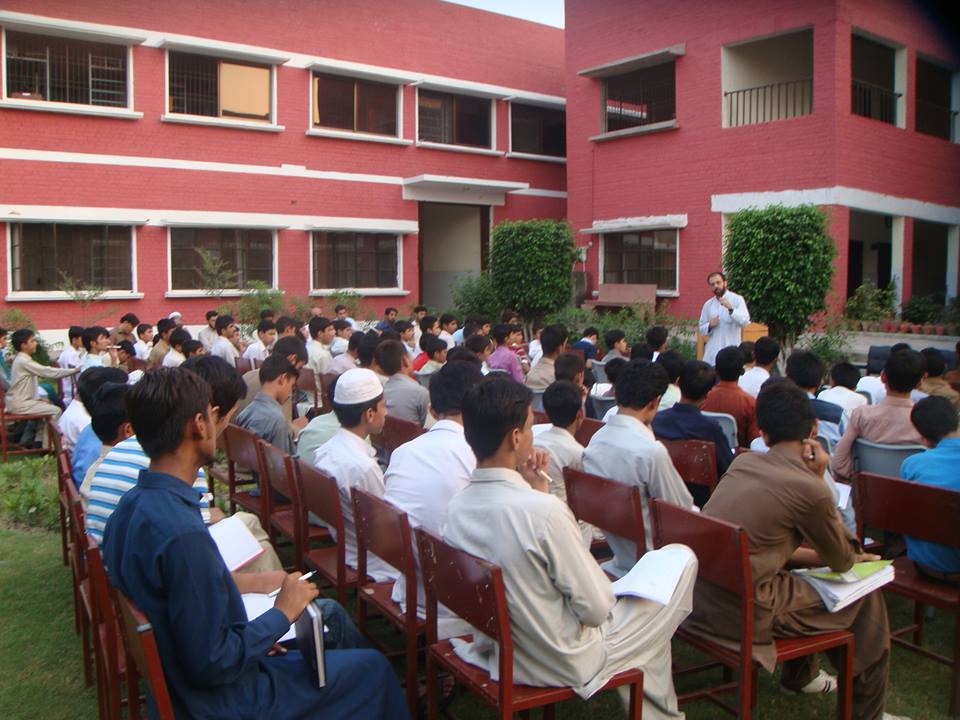
I was invited for a talk to Ghazali Premier College  (GPC) and I was very surprised when I visited the place.  Without any doubt, it was one of the best institutions I had seen in years. GPC immediately became an inspiration for me.
Muhammad Tariq, the director of GPC left a lucrative job in Dubai and came back to Pakistan to play a positive role. It was always on the back of his mind to contribute towards the society. Ghazali education trust took him on board and they went on to acquire this new boarding school which was going to house talented students from all across the country.  Students from 354 schools of Ghazali education trust were selected and Ghazali Premier college came into being. One year onward, its something worth visiting.

The facility is located in suburbs of Lahore on Multan road. It is a purpose built campus with attached mosque and hostel in one campus, housing 118 students. These students are selected from all over Pakistan. I was delighted to know that six students from Balochistan are also in this campus. Many of the enrolled kids belong to poor families and quality education is a distant dream for them. GPC provides free education, boarding and lodging to all the students. It is difficult to think about a free boarding school which intakes underprivileged students from all over the country and gives them free education and boarding without any compromise on the quality of education. GPC is certainly a shinning star on the dark horizon of Pakistan.

The focus in GPC  is on inculcation of Islamic ethical values along with contemporary education.  The schedule of students start with Fajar prayers at the mosque and then they are taught lessons from holy Quran. Entire day activities are thoroughly planned which includes studies and co-curricular activities. Weekends are reserved for social activities and guest lectures.  Typically I got impressed with the social activities of students when I was told that currently these students have planted 4000 trees in the nearby locations of the campus. I was told  that students are very keen in social activities which is actually a missing aspect in typical Pakistani education system.
My lecture was on contribution of Muslims towards science and how can we get back on track. I tried to involve the kids and was stunned to see their IQ level. The knowledge level of 7th and 8th graders was amazing.  Their knowledge was also certainly above the text books.  They were very energetic and confident. I was amazed by the quality of their questions. Given the scenario that these kids belong to remote areas of the country, their participation in my talk reflected the hard work of their teachers.
During the interaction with the teacher, I came to know that most of them are highly qualified, with some having their Masters from abroad and all of them joined hands to contribute towards the betterment of the society. Ghazali Premier Trust is planning to open many colleges in far flung areas of Pakistan to spread education in remote areas. The beauty of this project is that it is entirely free and the students have to pay nothing. The quality of education is comparable to any best system  just because of the dedication of the team.

Resources are key to such projects. The team of GPC is trying its level best to raise donations so far. They are also thinking about expanding this project and plan to open other such boarding schools in remote areas of the country. I hope that people like these will continue their efforts. It is our job to help them in every sense so that they succeed in their mission of making Pakistan a better society.

Live and Let Die!

yin-yang


It was cold. That’s for sure. It was dark- but in dark times, what difference does it make. Two twin boys. Not more than five or six years of age. They were one and apart. They were alone. Perhaps orphans. Their only source of refuge was in each other and the power of imagination only children so young possess. They were all too innocent and all too unprepared. Will they survive? Have they survived? These questions come back to haunt me sometimes. Sometimes.

Only occasionally do my thoughts betray me. Only occasionally do they escape me. My concerns. My worries. My questions. My comments. My consciousness. My being.  And barely do I succeed in bypassing the gate-keeper who is there to stop me from wondering off into the forbidden territories as he directs me back to that deep pit where I am meant to belong. Merely reminding me of the official dogma of the land, he says “Mind your own business”. And I listen. I succumb. I give in. To myself.

And yet, in times like these, when speaking and humanizing an event seems too much a task a sane person can endure, a painful madness is what we fear is in store for us. We are reminded again and again. ‘Live and let live’ goes the conventional wisdom. It has a soothing mesmerizing effect. We know it is a flawed, conveniently distorted rationalization of going out in the world seeking a good ‘normal’ time, but we buy into it. We are sold into it. For convenient and flawed reasons. To unsee what hides in front of us. Behind us. Beneath us. Just a bit tilted towards the invisible side of the lane.

Those two kids. Beautiful kids. I wonder what has become of them. But are we ever the same persons. Am I the same kid who thought Jupiter and Mars were where girls and boys came from? Who argued with so passionate fervor that Karachi is bigger than Pakistan? Who couldn’t help saying ‘Qaizemaizam’ was the founder of our nation? I don’t know what happened to that little kid. I’d love to meet him. All I have are a few memories of him and the exciting world he lived in. I wish I could go back. But could I wish the same for them. Would they like to go back? In that single moment. When history stops and mourns. It mourns existence. Will they like to go back? Will they like to be where they are today? I’ll never truly know.

It was in Quetta. That beautiful valley town enchanted with cherished memories of my childhood. Ziarat, a popular hill station resort, was not far away- a weekend’s distance. My family spent four years in Quetta when I was a kid. But this time I was on a short visit. This isn’t something so ancient. Ancient treasures aren’t very well received anyway. The image of Jinnah’s residency in Ziarat exists today in my ancient imagination. But so does this. This moment. This memory. This reflection. This guilt.

It was two or three years ago. I met up with old friends. We hanged out in different places across the city. The freezing night was begging for a heavy garma garam (freshly hot) meal. We decided to have some juicy seekh kebabs of the Lazzat Kadda (House of Taste), a small celebrated restaurant near Liaquat Market. It was late when we got there. It gets late pretty early in Quetta. We laughed off the evening.

It was when we were leaving that a friend directed our attention towards those two young invisible boys. Two intensely shivering, identical souls were sleeping on the side of the footpath. They had grabbed on to each other viciously and tightly. As if their young lives depended on it. As if the universe was hanging in balance. They were using each other’s bodies as blankets. They were both only wearing the thinnest of shalwar kameez outfits. They were fighting a battle against an obscenely cold-hearted weather in an obscenely cold-hearted world. Alone. Scared. Resilient. Powerful.

There are times. Sometimes. When I escape myself.  That shivers go down my spine. Not from feeling cold but from feeling overwhelmed by horror. The horror of the event is unspeakable. But what is terrifying to me most is not the event. It is not the scene of seeing two chipmunks left alone in the tragedy of existence. It’s those words that give me nightmares. It’s those words that are truly breathtaking. They force me to self-reflection. They allude me to the society I live in. They push me to myself. They ask me whether I am still there. As a person. As a feeling being. As there. Available. To not ‘live and let die’. To care enough to ‘live and not let die’.

Those words were uttered by a shopkeeper. He said ‘they’re used to it. No worries’.


The ‘Begum’ and ‘Saheb’ Culture

Come, visualize with me..

Sakeena, a 10 year old who has never been to school, never enjoyed playing with dolls let alone the funky hi-tech gadgets,  is carrying a 1 year old in her lap, sitting on a table distant to begum saheba’s. Her dull glitterless clothes, unadorned arms and ears tell us, she’s the odd one. Sakeena’s job is to take care of the child who she can hardly carry, feed him, change his nappy and make sure he doesn’t cry while begum saheba enjoys her lavishly decorated table and socialising exercise. Sakeena has no right to run around, play or enjoy with her age-mates at the dinner and absolutely no sharing the table. She may get some food though.

Najma, a 28 year old who looks to be 40, skinny and dark is sweeping the floor of a ‘bangla‘ (a huge mansion). Her two-year old has an ear infection and she does not have money for antibiotics. Her concentration is everywhere. She has to finish work and get her child’s ailment sorted somehow. She takes a day off next day to see the doctor and to take care of her child who does not have proper clothes on his body and no footwear whatsoever whether it’s summer or winter. She gets told off as there was a grand dinner at saheb’s place and begum saheba was in thick soup when Najma didn’t turn up as there was a big mess in the kitchen to be sorted after dinner. She was scolded, insulted and eventually fired.

A child surrounded by a garbage heap, sorting paper and recyclables and eating our rotten left-overs from it at the same time – A child covered with houseflies sleeping on a pavement outside a jeweller’s shop (where jewellery of millions of rupees is being chosen). He dozed off while waiting for his father to go home, who sells Kulfi outside a popular shopping centre – A child who sits outside a fast-food restaurant and begs usfor roti and cannot afford a chicken wing let alone a mighty burger – A child who cleans our windscreen for a few rupees and we shun him away because his water is dirty and would ruin our car – A baby sleeping in the lap of a begging mother unaware of the cruel world he has come to. She covers his face to avoid bright headlights of the cars passing by but we can see his beautiful but muddy feet sticking out of her chaadar – A child who sells a rose bud outside a restaurant where we spent thousands of rupees for what? Yes, one meal –

A woman who washes our expensive branded and imported (etc.) dinnerware, breaks a small chip and is shouted at, beaten and declared unfit for her job – A woman who cleans our extravagant dining table, but is never allowed to share it, dusts our sofa but can’t sit on it and we love it when she sits on the floor near our feet – A driver who drives our luxurious car but waits for a bus for hours around midnight to get home and see his children on the weekend – The guard/chowkidar who sleeps outside on the next door plot under a tent or in our car porch while we sleep in our air-conditioned room away from heat and mosquito bites – The labourer who builds our beautiful house in scorching sun, just to sleep in a place one can hardly call a room, but it’s all-in-one home for him (kitchen, bedroom, lounge etc.).

Close your eyes..

Imagine the muddy feet, the dirty smelly clothes, no surety of food for the day, no money in the pocket, let alone banks, no transport. Recall their mistakes and shortcomings; recall our anger, lack of forgiveness, zero tolerance, and humiliation they face every day. And now, switch sides.Imagine they were us and we were them. Scary thought, isn’t it? They didn’t choose their fate neither did we. So why not fear the Creator who put us in a MORE difficult test than them by giving us authority over them.

The dehumanization of the society has reached its limits. The above examples are complacently accepted. Humans are not equal. They are unequal just because they were born to parents of different social statuses. And the one who has money and authority is superior. The kings and queens found everywhere in our society show their grandeur with harshness and humiliation towards the subordinates at home as well as the less fortunate outside home. Softness, empathy and forgiveness are considered weaknesses.

But this is not what we were taught, is it? ‘We are Muslims and we are proud’, ‘we love the Prophet (SAW)’ and ‘we are ready to die for him’ etc., but are we ready to live in a way he taught us to and follow his footsteps if it kills our big ego? Forgiveness, controlling anger and ignoring mistakes were compared by the Prophet (SAW) with strengths of a wrestler. He taught us that superiority came with piety and not money. Do we think that the mighty and wealthy Arab leaders who lashed and tortured the bodies of Khubab and Bilal (RA) were superior to them? No! Bilal, the black, the poor, the slave, the worthless was the most precious in the eyes of the Prophet (SAW). Did he eat in a separate corner, in different plates, a left-over food? Dig out something that supports us doing so with our servants. But, sharing tables is probably too much to ask for as far as our magnificence is concerned.

“When the slave of anyone amongst you prepares food for him and he serves him after having sat close to [and undergoing the hardship of] heat and smoke, he should make him [the slave] sit along with him and make him eat [along with him], and if the food seems to run short, then he should spare some portion for him [from his own share]” (Muslim).

Remember, Zaid Ibn Harith (RA) who was a slave and the Prophet (SAW) freed him and gave him the choice to go with his father, who had come, to take him, but he refused to go with his father and preferred to stay with the Prophet just because he was loved and cared for. He says he was never told his mistakes and the Prophet (SAW) used to cover what he did wrong without even mentioning it to him.

Once the Prophet (SAW) reprimanded a companion like this,

 ‘O Abu Dhar! Did you abuse him (your slave) by calling his mother with bad names. You still have some characteristics of ignorance. Your slaves are your brothers and Allah has put them under your command. So whoever has a brother under his command should feed him of what he eats and dress him of what he wears. Do not ask them (slaves) to do things beyond their capacity (power) and if you do so, then help them.’(Sahih Bukhari)”

Gentleness and kindness are rare traits, very valuable in the scales of Allah. They are not weaknesses. They are actually extremely difficult traits to stick to in this materialistic world where everyone can get their mission accomplished at the point of a gun, money or a big tongue which cause similar damage to the weak ones. Kindness is a forgotten virtue. To kill an enemy might be easy in the current times, but killing ego is a hard job. But it raises us in the eyes of Allah and we are actually following the Prophet (SAW) when we do it. What a deal and what a surely victorious way. He went on to say, ‘Seek me among your weak ones, for you are given provision (or help) only by reason of the presence of your weak ones’.

Once a man came to Prophet Muhammad (saw) and said, “O Allah’s Messenger! How many times should I forgive the mistakes of slaves?” The Prophet (SAW) kept quiet. The man repeated his question three times, and the Prophet replied at the third time, “Forgive them seventy times every day.”

We are in a more difficult test than they are. Their hereafter is easier, while we have to answer for every word that we uttered that broke them, every opportunity that we missed to help them and every action that we did to look down upon them as inferior human beings.  It was the equality, justice and liberty Islam talked of that attracted the poor and slaves to the call of the Prophet (SAW). We must correct ourselves and create a society that cares, loves and forgives shortcomings of each other.

“O God, grant me life as a poor man, cause me to die as a poor man and resurrect me in the company of the poor.” His wife asked him why he said that, and he replied: “Because (the poor) will enter Paradise (before) the rich. Do not turn away a poor man even if all you can give is half a date. If you love the poor and bring them near you, God will bring you near Him on the Day of Resurrection.” – Al-Tirmidhi, Hadith 1376

Goodbye Mr President

GoodbyeZardariGood Bye Mr.President. Those who announced to drag you on streets gave you an honourable farewell in the end. Five years of Zardari regime will be remembered in the history of Pakistan. Corruption, incompetency, lawlessness and ‘mofahimat’ (reconciliation) are the ‘golden’ words of Zardari’s era. If our memory is not too short, we must not forget the long list of corruption scandals PPP government got on its credit. It can easily be marked as the most incompetent government of all times which failed to solve any crisis whatsoever. Rather, it made everything worse. No doubt, it inherited a lot of issues from the regime of Musharraf but it is also a reality that people think of Musharraf era, a’ lesser evil’ in comparison with Zardari tenure.

When Zardari came into power after assassination of his wife, he raised the slogan ‘Pakistan khappey’ which was welcomed across the board. But his decisions/actions were contrary to his slogans. Main goal of the regime was to install Jiyalas on every post and reward PPP stalwarts as if Pakistan was their inherited property.
Incompetency to solve the economic, energy and security issues proved to be disastrous for Pakistan. They raised the slogan that Democracy is the best revenge and indeed the nation felt the revenge. Moreover, murderers of Mohtarma Benazir Bhutto remained at large throughout PPP era.

It’s easy to criticize a government which is gone now. Especially when people have given them a real life feedback for their bad governance in the recent years, yet we should not forget that Pakistan touched all lows in Zardari’s era. Zardari has left the office thinking about reorganizing the party to get the next turn or may be bringing Bilawal Bhutto forward to take the next turn. But political legacies and their alternating turns should come to an end now.

PM Nawaz Sharif bade farewell to Zardari in a cordial manner. Nawaz Sharif and Shahbaz Sharif must be reminded of their speeches of the election days when they were openly abusing Zardari. That’s the dilemma of Pakistani politics. The language of public gathering is totally different from drawing room meetings for our politicians. Whatever they promise with public, they easily forget it behind the close doors.

Will Sharif’s be any different in the office? We have to see carefully. They have installed a puppet in the President house. PM holds key ministries of Foreign Affairs and Defence with him and Finance ministry is already out for loans. But I hope that they work responsibly towards national issues. The government has five years to go and I believe they should be given a fair chance to show their real face or service. I believe if Pakistan can survive the disastrous era of Zardari, it will be able to survive the era of Nawaz Sharif also and then people will realize that they are two sides of the same coin.
Zardari era is gone, but the memories will chase us even in the nightmares.

The Morning Show Circus

morningshowpakistanA while back, I was watching a morning-show when one of the guests on the show compared two very famous morning show hosts to Oprah Winfrey and called them the Oprah Winfreys of Pakistan. The next minute, I was cleaning the tea I had spilled on the table. As much as I wish with all my heart that, that statement was true but unfortunately those two morning show hosts are not even an iota of what Oprah Winfrey is all about.

For starters, Oprah Winfrey show does not have ‘Wedding Weeks’. Yes, weddings are an integral part of our culture, we are a nation which loves festivals and celebrations and marriage is a beautiful bond but that being said it does not mean that being unmarried is a disease or a taboo. Morning shows have an anti-dote for this ‘disease’ too, just by the way. The ‘matchmaking aunties’ are frequent guests on these shows to conduct ‘workshops’ on how a girl should carry herself and the tray when the potential in laws come to scrutinize her

Pakistani morning shows are on a mission to get the entire nation married before the world ends. It is about time they start to do shows on contraceptives as well before the population of Pakistan has doubled due to the weddings arranged by these shows. Or wait, they cannot really dare to do a show on contraceptives because that would upset  us and PEMRA. But why don’t we ever raise a voice against the extravagance showcased on these shows and why does not PEMRA ever object to the crime shows which air forced confessions of alleged criminals? For how long will we continue to pick and choose to condemn or disregard the evils?

The shows portray their tactics of generating maximum revenue as a service to humanity. I have never been able to understand what joy does the couple from an under-privileged household get from watching people from the entertainment industry dance around in expensive couture. By doing all this, the morning shows are just demarcating the line between the rich and poor and making it more obvious than before. Showing the majority of Pakistanis who belong to middle, lower-middle and low classes, almost about everything they cannot afford just creates resentment.

An all-time favorite segment of these shows is about supernatural creatures and spirits and black magic. The morning show hosts ooh and aah every time a different ‘Aalim‘ tries to exorcise someone by sprinkling water on them, cutting lemons, lighting candles etc. It is actually painful to watch this and frustrating at the same time to witness different ‘Babas‘ torture people when in fact all they usually need is a good psychiatrist and therapy!

These shows have also really abused the concept of ‘Oprahfication’, that is, if that is what they try to imitate. While Oprah coined this term to describe public confession as a therapy and talked about various issues in her life, in our morning shows it is the other way around. The morning show hosts never talk about their failures, shortcomings, mistakes and life experiences but they invite people and cash on their misery by shedding a tear or two at their heart-breaking stories. While it has its advantages, we are still not ready for it. Inviting people to confess their secrets and discuss their personal and intimate issues on live television without  a psychologist or psychiatrist being present is not only harmful but can have long term effects on the lives of these people as we are a part of an extremely judgmental society .

The morning show hosts are usually very active about speaking against domestic violence and gender-issues. But those issues set aside, what do they have to say about how they let themselves and other females on the morning shows be used as eye-candy? It’s not really hard to get why majority of the morning show hosts are females. A single female host carries the weight of dozen of labels and sponsors. Clothes, shows, make up, accessories and the list goes on. The more, the merrier.

These hosts constantly endorse the view that it is of utmost importance to fit in the society and for that you have to look a certain way. Whereas Oprah showed the world how a black woman with a voluptuous body can look so elegant, beautiful and charismatic only if she believes in herself. Almost every day at least one morning show has a make-up competition, which is fine but what is not okay is when the beauticians apply a foundation ten shades lighter to the model’s skin tone in order to make her look fair. This is very rare though, because most of the models chosen are fair-skinned anyway. What message are they conveying by this?

The most disappointing thing about these shows is the guests who are invited. There are few guests, couples to be specific who are permanent guests. They come, they dance, and they laugh out loud, go on and on about their recent vacation in Dubai or Thailand, gossip about other celebrities, display a lot of public affection and leave. From the guests lists of these shows it almost looks like as if half of the Pakistani nation is a part of the show business and the other half is trying desperately to be a part of it.

How often do we see Pakistanis who have excelled in other fields as guests on these shows? The shows endorse lawn brands but never speak up against the low wages the factory workers are paid. We are told about who wore who at the red carpet but we are never told who won the Booker or the Pulitzer prizes. Dramas and movies are reviewed and recommended but books are never talked about. Fashion designers, models, actors and singers are treated as if they are gods and goddesses with magical powers but scientists, economists, thinkers, social and human rights activists are never mentioned. Achievements of Dr. Abdu’s Salam, Prof. Atta-or-Raman, Mahbub-ul-Haq, etc. are never recognized and appreciated. They portray the Pakistani woman as a materialistic human being who has no business other than wearing designer clothes, expensive make up and brewing up facial masks in order to look at least ten years younger than her age. Why cannot the average Pakistani woman be portrayed as somebody who wants to fly a plane, be an astronaut, mountain climber or a F1 racer?

The media tries to get away with all this by using the excuse that it is broadcasting what people like to watch.  But that is not a legitimate excuse. Yes, people have grown accustomed to watching trash because it’s the only thing that is aired these days. However that does not mean that we Pakistanis love to watch Turkish couples somersault around on our television screens. We are a nation who loved and appreciated 50-50, Angan Terha, Dhoop Kinaray, Loose Talk. We have been shown great things, so I do not know why the media thinks that all we deserve are dubbed foreign dramas and cheesy morning shows.

The Cost of Caring

CareWe live in a world of horror. A world of trembling despair. Of playful murder. Of playful strategy. Of senseless, random, vague bombing from a remote control held by someone taking incessant breaks between his munching of doritos and sipping of diet coke.  Of someone saying that others are the cause of our problems as he ignites fear, steals our sense of empathy, and appeals to the monster that hides in the scariest locked-up parts of our souls- and then we hurt others; and we feel nothing. We know this. We ignore this. We see. We pass by.

Being passive onlookers is abruptly convenient. It is an exercise in sleeping a dreamless sleep. It is an exercise in fearing that which cannot escape the sight our eyes have held in store for our awaken selves. It is to run away from the risk of seeing and of knowing and of feeling. It is an exercise in sanity. But is it, really?

Are we ready to embark upon the risk of knowing? Are we ready to know that the difference of being labeled a Tutsi rather than a Hutu on a piece on paper can mean being exposed to creative torture, of the worst forms of rape and slaughter, of the sight of seeing one’s whole family being put to rest slowly and painfully. Are we ready to worry less about what movie will be out this summer and worry more about the cries and woes of the families of the many daily ‘targeted’ and killed, and counted. And how can we stay unmoved when fascist governments terrorize thousands and traumatize millions more. And how can we remain calm when the strongest people on earth decide to do some ‘collateral damage’- experienced by the weak, euphemized by the powerful.

It seems as though we are left with the wisdom laden in the phrase ‘Ignorance is Bliss’. But this raises more questions than it answers. Is escaping the problem an actual solution? Is closing the eyes going to stop the inevitable? One can still ask, in further retrospect, can we offer a solution? Can we do anything else other than closing our eyes?

Maybe we can’t do much. But this would be replying to a wrong question. It’s not a question of what we ‘can’ but of what we ‘should’ be doing. Should we do something? And even when we can’t, should we care?

Caring has a cost. To care is to feel and to share. It is also to share feelings. It is to put oneself in another’s place. It may come in feeling the happiness and excitement others enjoy in those all too small things. But it also means that you have to feel the dread and blunt pain that someone else is put through. To care is not something to do, but something to be. To be human is to care. To be human is to accept the concept of ‘humanity’ and extending that concept to others.

Humanity is a wholesale concept. You either accept it completely or you simply don’t. You cannot be selective in your humanity. This means to be truly human, you cannot simply enjoy your life while forgetting what others go through. Similarly, you cannot merely welcome the joy in life as you run away from its dark side. This is where the crisis of Capitalism truly lies at. Capitalism tries to steal from us the very notion of what it means to be human.

The culture of Capitalism forces a ‘success model’ down our throat which pretends to be an undisputable fact of life- the only ‘normal’ way of life. Success for us is something of a life purpose. It is the only meaningful pursuit a materialist existence has to offer.  To have a career is something we must all strive to achieve with a narrow and blinded vision. Career is the highest purpose of life, virtually becoming the sole source of meaning- a very meaningless source of meaning.  This is a negation of any pursuit which demands that we help our fellow beings. It is also a negation of caring about our fellow beings. This is because it forces us to empty our minds from all distractions that stop us from focusing on our career.

We are moving towards a world where we function on a need-to-know basis. We must be ignorant to be successful. And we must seek meaning in a pursuit of happiness where we are mere functionaries of a production line. We must be productive, efficient and hardworking. The only problem this poses is one of meaning and empathy, of caring and being human.

How I Came to Love the Veil

YvonneRidleyVeilPoliticians and journalists just love to write about the oppression of women in Islam … without even talking to the females beneath the veil.

They simply have no idea how Muslim women are protected and respected within the Islamic framework which was built more than 1400 years ago.

Yet, by writing about cultural issues like child brides, female circumcision, honour killings and forced marriages they wrongly believe they are coming from a point of knowledge.

And I am sick of Saudi Arabia being cited as an example of how women are subjugated in a country where they are banned from driving.

The issues above have simply nothing to do with Islam yet they still write and talk about them with an arrogant air of authority while wrongly blaming Islam. Please do not confuse cultural behaviour with Islam.

I was asked to write about how Islam allows men to beat their wives. Sorry, not true. Yes, I’m sure critics of Islam will quote random Qur’anic verses or ahadith but all are usually taken out of context. If a man does raise a finger to his wife, he is not allowed to leave a mark on her body … this is another way of the Qur’an saying; “Don’t beat your wife, stupid”.

Now let’s take a glance at some really interesting statistics, hmm. I can almost hear the words pot, kettle, black. According to the National Domestic Violence Hotline, four million American women experience a serious assault by a partner during an average 12-month period.

On the average, more than three women are murdered by their husbands and boyfriends every day . . . that is nearly 5,500 women battered to death since 9/11.

Some might say that is a shocking indictment on such a civilized society, but before I sound too smug, I would say that violence against women is a global issue. Violent men do not come in any particular religious or cultural category. The reality is that one out of three women around the world has been beaten, coerced into sex or otherwise abused during her lifetime. Violence against women transcends religion, wealth, class, skin colour and culture.

However, until Islam came on the scene women were treated as inferior beings. In fact we women still have a problem in the West where men think they are superior. This is reflected in our promotion and wages structure right across the spectrum from cleaners to career women who make it into the boardroom.

Western women are still treated as commodities, where sexual slavery is on the rise, disguised under marketing euphemisms, where women’s’ bodies are traded throughout the advertising world. As mentioned before, this is a society where rape, sexual assault, and violence on women is commonplace, a society where the equality between men and women is an illusion, a society where a women’s’ power or influence is usually only related to the size of her breasts.

I used to look at veiled women as quiet, oppressed creatures and now I look at them as multi-skilled, multi-talented, resilient women whose brand of sisterhood makes Western feminism pale into insignificance. My views changed after the truly terrifying experience of being arrested by the Taleban for sneaking into Afghanistan in September 2001 wearing the burka.

During my 10-day captivity I struck a deal that if they let me go I would read the Quran and study Islam. Against all the odds, it worked and I was released. In return I kept my word but as a journalist covering the Middle East I realized I needed to expand my knowledge of a religion which was clearly a way of life.

And no, I’m not a victim of Stockholm syndrome. To be a victim you have to bond with your captors. During my imprisonment I spat, swore, cursed and abused my jailers as well as refusing their food and going on hunger strike. I don’t know who was happier when I was released – them or me!

Reading the Quran was, I thought, going to be a very simple academic exercise. I was stunned to discover that it clearly stated women are equal in spirituality, education and worth. A woman’s gift for child birth and child-rearing is very much recognised as a quality and attribute. Muslim women say with pride they are homemakers and housewives.

Furthermore The Prophet (pbuh) said that the most important person in the home was The Mother, The Mother, The Mother. In fact he also said that heaven lies at the feet of the mother. How many women make it into the top 100 power lists for simply being a “great mother”?

With Islam choosing to remain at home and raise children takes on a new dignity and respect in my eyes, similar to those sisters among us who choose to go out to work and have careers and professions.

I then began looking at inheritance, tax, property and divorce laws. This is where Hollywood divorce lawyers probably get their inspiration from. For instance the woman gets to keep what she earns and owns while the man has to stump up half his worth.

Isn’t it funny the way the tabloid media gets very excited over the prospect of some pop or film stars pre-nuptial wedding agreement? Muslim women have had wedding contracts from day one. They can choose if they want to work or not and anything they earn is theirs to spend while the husband has to pay for all the household bills and the upkeep of his family.

Just about everything that feminists strived for in the 70s was already available to Muslim women 1400 years ago.

As I said, Islam dignifies and brings respect to motherhood and being a wife. If you want to stay at home, stay at home. It is a great honour to be a home maker and the first educator of your children

But equally, the Quran states if you want to work, then work. Be a career woman; learn a profession become a politician. Be what you want to be and excel in what you do as a Muslim because everything you do is in praise of Allah (swt).

There is an excessive, almost irritating concentration or focus on the issue of Muslim women’s’ dress particularly by men (both Muslim and non-Muslim).

Yes, it is an obligation for Muslim women to dress modestly but, in addition, there are many other important issues which concern Muslim women today.

And yet everyone obsesses over the hijab. Look, it is part of my business suit. This tells you I am a Muslim and therefore I expect to be treated with respect.

Can you imagine if someone told a Wall Street executive or Washington banker to put on a t-shirt and jeans? He would tell you his business suit defines him during work hours, marks him out to be treated seriously.

And yet in Britain we have had the former Foreign Secretary Jack Straw describing the nikab – the face veil revealing only the eyes – as an unwelcome barrier. When, oh when, will men learn to keep their mouths shut over a woman’s wardrobe?

We also had Government Ministers Gordon Brown and John Reid express disparaging remarks about the nikab – both these men come from over the Scottish Borders where men wear skirts!!

Then we had a series of other parliamentarians enter the fray describing the nikab as a barrier for communication. What a load of nonsense. If this was the case can anyone explain to me why cell phones, landlines, emails, text messaging and fax machines are in daily use? Who listens to the radio? No one switches off the wireless because they cannot see the face of the presenter.

The majority of sisters I know who choose to wear the nikab are actually white, Western reverts who no longer want the unwelcome attention of those few leering men who will try and confront females and launch into inappropriate behaviour. Mind you, there are a couple of London sisters I know who say they wear the nikab at anti-war marches because they can’t stand the smell of spliffs.

I am afraid Islamophobia has become the last refuge of the racist scoundrel. But the cowardly, chauvinistic attacks launched – largely by men – is unacceptable to Muslimahs as well as their secular, female sisters from the left.

I was a feminist for many years and now, as an Islamic feminist, I still promote women’s’ rights. The only difference is Muslim feminists are more radical than their secular counterparts. We all hate those ghastly beauty pageants, and tried to stop laughing when the emergence of Miss Afghanistan in bikini was hailed as a giant leap for women’s liberation in Afghanistan.

I’ve been back to Afghanistan many times and I can tell you there are no career women emerging from the rubble in Kabul. My Afghan sisters say they wish the West would drop its obsession with the burka. “Don’t try turning me into a career woman; get my husband a job first. Show me how I can send my children to school without fear of them being kidnapped. Give me security and bread on the table,” one sister told me.

Young feminist Muslimahs see the hijab and the nikab as political symbols as well as a religious requirement. Some say it is their way of showing the world they reject the excesses of Western lifestyles such as binge drinking, casual sex, drug-taking etc.

Superiority in Islam is accomplished through piety, not beauty, wealth, power, position or sex.

Now you tell me what is more liberating. Being judged on the length of your skirt and the size of your cosmetically enhanced breasts, or being judged on your character, mind and intelligence?

Glossy magazines tell us as women that unless we are tall, slim and beautiful we will be unloved and unwanted. The pressure on teenage magazine readers to have a boyfriend is almost obscene.

Islam tells me that I have a right to an education and it is my duty to go out and seek knowledge whether I am single or married.

Nowhere in the framework of Islam are we told as women that we must do washing, cleaning or cooking for men – but it is not just Muslim men who need to re-evaluate women in their home. Check out this 1992 excerpt from a Pat Robertson speech revealing his views on empowered women. And then you tell me who is civilized and who is not.

He said: “FEMINISM ENCOURAGES WOMEN TO LEAVE THEIR HUSBANDS, KILL THEIR CHILDREN, PRACTICE WITCHCRAFT, DESTROY CAPITALISM AND BECOME LESBIANS”.

Here is an American man living in a pre-Islamic age who needs to modernize and civilize. People like him are wearing a veil and we need to tear that veil of bigotry away so people can see Islam for what it is.

Yvonne Ridley