The Political Economy of Hatred

llll

Hatred is a scam. Just like a lot of stuff Capitalism and its globalizing effects want to sell us. This is what they do right? They come at our doors and they sell stuff. We buy stuff. But we also buy into stuff. Into the ideology of stuff.

The ideology of stuff isn’t your next door neighbour- wait, maybe it is. Nevertheless, it’s an outrageous liar, a manipulative predator, a tormented bully, a murderous blasphemous mother figure, a haunting daunting cyborg, a pretentious cold hearted drone, and an official doctrine- a doctrine of hate, and of lustful appetites; a doctrine of obedience, and of going wild.

To keep us at bay, Capitalism invents enemies and detractors. Focus on them it says. Business takes place as usual. But behind curtains; in the form of official mantras, and national songs. And of all sorts of patriotic jibberjabber- that weird old feeling you get when you are told to be proud of those latest mechanical contraptions made to murder other human subjects; subjects of the God of Modernity, also known as the ‘Nation–state’- a global God, a God of boundaries, a God everyone worships, both ‘us’ and ‘them’.

And here stand two neighbours. India and Pakistan. Enslaved by the passions of their new found religions- nationalism and nationalism respectively. Always bickering and swearing about and to each other. Both could benefit from a little give and take, a little mutual cooperation, a little mutual trust, which would in turn lead to some trimming off military spending here and some added social welfare spending there. But both fail to realize what’s good for them- and by them, I mean their people. Instead, both impose doctrines of hate on their people. People are told to hate people. A nation is told to hate a nation. And vice versa.

Recent developments are quite interesting. War hysteria had taken over India. But what really happened. Did people suddenly decide that Pakistan was the source of their misery. The fact that the average Indian person lives in abject poverty while the country is producing some of the wealthiest Billionaires on the planet seems too sophisticated a scheme for the diabolical foe across the border to concoct. What’s really happening here? And why is it happening when elections are at the corner and a billion people will be given the power- formally speaking- to change their destiny? Why are they told that the problems inside their borders are less important than the problems outside their border? Why are they told the miseries of the people are less important than the egos of the ruling elite? And why now?

On the other side, Pakistan just experienced elections. And what we are seeing is a pronouncedly pro-dialogue and pro-friendship government of Prime Minister Nawaz Sharif. The PM has already stated that both countries should work on cutting military spending and on boosting people spending. This is a positive sign, despite some skirmishes on the border. One can hope that some sort of dialogue and sanity is restored in the future.

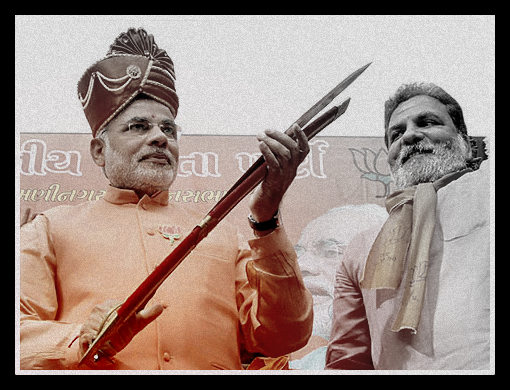
But then we are reminded of a very real fear. A genocidal fascist is making his way to the throne in Delhi. In the heart of the world’s largest democracy, a mass slaughterer, Narendra Modi, is not only the strongest candidate for the PM’s office but is also the blue-eyed boy of the corporate world. He offers a lot of promise. To the corporate world that is. Under his watch, the world tolerated a systematic pogrom against the Muslim community of Gujrat. Rape, torture and slaughter were orchestrated openly in the streets while Modi justified it in an terrifying action-reaction logic.

It’s only high time to do away with logics of actions and reactions, and of ‘us’ and ‘them’.  For someone like Modi to become PM only tells how nationalist-conservative rhetorics are so intertwined with capitalism and globalization. The way they get away with all this is through sowing the seeds of hatred.  One may think otherwise but haters are part of the same process; the same ritual; and the same religion—the religion of nationalism.

The Cost of Caring

CareWe live in a world of horror. A world of trembling despair. Of playful murder. Of playful strategy. Of senseless, random, vague bombing from a remote control held by someone taking incessant breaks between his munching of doritos and sipping of diet coke.  Of someone saying that others are the cause of our problems as he ignites fear, steals our sense of empathy, and appeals to the monster that hides in the scariest locked-up parts of our souls- and then we hurt others; and we feel nothing. We know this. We ignore this. We see. We pass by.

Being passive onlookers is abruptly convenient. It is an exercise in sleeping a dreamless sleep. It is an exercise in fearing that which cannot escape the sight our eyes have held in store for our awaken selves. It is to run away from the risk of seeing and of knowing and of feeling. It is an exercise in sanity. But is it, really?

Are we ready to embark upon the risk of knowing? Are we ready to know that the difference of being labeled a Tutsi rather than a Hutu on a piece on paper can mean being exposed to creative torture, of the worst forms of rape and slaughter, of the sight of seeing one’s whole family being put to rest slowly and painfully. Are we ready to worry less about what movie will be out this summer and worry more about the cries and woes of the families of the many daily ‘targeted’ and killed, and counted. And how can we stay unmoved when fascist governments terrorize thousands and traumatize millions more. And how can we remain calm when the strongest people on earth decide to do some ‘collateral damage’- experienced by the weak, euphemized by the powerful.

It seems as though we are left with the wisdom laden in the phrase ‘Ignorance is Bliss’. But this raises more questions than it answers. Is escaping the problem an actual solution? Is closing the eyes going to stop the inevitable? One can still ask, in further retrospect, can we offer a solution? Can we do anything else other than closing our eyes?

Maybe we can’t do much. But this would be replying to a wrong question. It’s not a question of what we ‘can’ but of what we ‘should’ be doing. Should we do something? And even when we can’t, should we care?

Caring has a cost. To care is to feel and to share. It is also to share feelings. It is to put oneself in another’s place. It may come in feeling the happiness and excitement others enjoy in those all too small things. But it also means that you have to feel the dread and blunt pain that someone else is put through. To care is not something to do, but something to be. To be human is to care. To be human is to accept the concept of ‘humanity’ and extending that concept to others.

Humanity is a wholesale concept. You either accept it completely or you simply don’t. You cannot be selective in your humanity. This means to be truly human, you cannot simply enjoy your life while forgetting what others go through. Similarly, you cannot merely welcome the joy in life as you run away from its dark side. This is where the crisis of Capitalism truly lies at. Capitalism tries to steal from us the very notion of what it means to be human.

The culture of Capitalism forces a ‘success model’ down our throat which pretends to be an undisputable fact of life- the only ‘normal’ way of life. Success for us is something of a life purpose. It is the only meaningful pursuit a materialist existence has to offer.  To have a career is something we must all strive to achieve with a narrow and blinded vision. Career is the highest purpose of life, virtually becoming the sole source of meaning- a very meaningless source of meaning.  This is a negation of any pursuit which demands that we help our fellow beings. It is also a negation of caring about our fellow beings. This is because it forces us to empty our minds from all distractions that stop us from focusing on our career.

We are moving towards a world where we function on a need-to-know basis. We must be ignorant to be successful. And we must seek meaning in a pursuit of happiness where we are mere functionaries of a production line. We must be productive, efficient and hardworking. The only problem this poses is one of meaning and empathy, of caring and being human.

Love in The Time of Narcissism

Arguably, love is the highest sentiment the human spirit is capable of. In essence, it is selfless, generous, liberating, sublime. It purges one of all that holds one down to the mundane and earthy. Kahlil Gibran famously writes:

“Love gives naught but itself and takes naught but from itself.
Love possesses not nor would it be possessed;
For love is sufficient unto love.
And think not you can direct the course of love, if it finds you worthy, directs your course.”

The contemporary world is characterized by the ascendancy of materialism that has banished the spiritual and hence objectified, commercialized and marketized some of the most sublime values. The sacred sentiment of love has not been spared from being grotesquely tainted by it- so that we have it ‘expressed’ in expensive, stark-red balloons, roses, chocolates on sale all over shops in Pakistan. The local florist explained to an appalled me that the reason why the flowers were so shockingly costly was on account of something called ‘Vanteen Day.’

The hyped up, almost frenzied festivities on Valentine’s Day depict this cult of hedonistic Narcissism that has gripped us in its monstrous clutches. This makes our deepest and most sacred, private sentiment be expressed with a loud, bawdy exhibitionism that denigrates its sublimity and reduces it to a hollow shell painted in gaudy hues. This overzealous celebration of carnal passion symbolizes the perversion of the sacred that is an inevitable result of materialism.

We are taught to express and exhibit passion to satiate our own selfish lusts- spend enough to ‘prove’ our love, fall in love with ‘love’ romanticized by the popular media; to breathlessly pursue romantic love, chase it, possess it, flaunt it and gloat over it lecherously.
In a recent video released by a Pakistani band known for its mock-satiric music, the chorus goes, ‘Sub Paisey ki game hai’ (It is all a game of money). The circus on Valentine’s Day is driven by imperatives of the capitalistic marketplace ordering us to ‘shop till you drop’ to ‘prove’ you love ‘enough.’ This ‘commodification’ of love exploits a basic human emotion in order to make big business. In the process, love is reduced to chocolate bars, rosebuds, balloons- or diamond rings and designer dresses- according to income bracket, social class and of course, taste.

In a class discussion when I mentioned to my students how Valentines Day goes against the spirit and ethos of Islam, a student candidly retorted, ‘But it does not harm anyone’. Certainly it does not, at a fleeting look. However, deep within, when we partake of it, we concede that love is a ‘thing’ to be flaunted and bought with money, not made out of real, lived experience of sharing, giving, forbearing, forgiving, growing, treading life’s jagged paths together with a hand to hold, a shoulder to lean on. We negate the fact that love is made and found and relished everyday through little things you cannot buy with money; garnered painstakingly through smiles and tears and wounds and fears. In the process of celebrating this ‘harmless’ festivity, we actually condone the cruel, horrible things that go on outside the gates of girls’ colleges in the city, and inside young lonely hearts. I remember how in my college days girls used to talk of the surprise gifts from ‘secret’ or ‘known’ admirers and the less ‘fortunate’ ones shrank into themselves with shame and a haunting sense of loneliness and inferiority- often in physical terms. I found it heinous. The balloons and red-shirted urchins rampaging the streets and marketplaces tell me it is far worse for young people today.

Mark Vernon writes in his remarkable article, ‘Is Romantic Love a Bad Thing?’:

“I suspect that the desire for a peak experience of love has eclipsed the fact that love is primarily about others. The romantic myth would have us fall in love with love, paradoxically not with another. This twisted love whispers that it does not much matter who you fall for, only that you fall in love.

There is a spiritual dimension to this romantic addiction too. The philosopher Simon May has proposed that while many have given up on God in the West, we still long for the unconditional love that God used to offer.

But godless, we seek instead unconditional love from our fellow humans. We make them gods, and of course they fail us. And then love turns to hate. It’s a desire that, because of the excess, destroys love.”

“Ibrahim A.S- seeking spiritual fulfilment and coming to rest in the embrace of the Divine- had declared, “I love not that which fades away.” (The Noble Quran).

Selfless love that heals and gives and forgives arises out of this complete self-surrender encountering and recognizing the Perfect, Absolute Truth. This is why the festivals of Islam include compulsory charity and sharing of joy with the less privileged.

Modesty, said the Prophet (PBUH) is the distinguishing trait of Islam. Modesty implies revulsion towards exhibitionism and obscenity; it implies protection of the private, it implies dignity, humility, quietude, sincerity, purity. It is the crowning glory of a believer. The uproarious celebration of Valentine’s Day betrays the essence of modesty. It is a mindless aping of a culture entrenched in the Overblown but Minimal Self.

EPILOGUE:
The age demanded an image
Of its accelerated grimace,
Something for the modern stage,
The “age demanded” chiefly a mould in plaster,
Made with no loss of time,
‘All things are a flowing’,
Sage Heracleitus says;
But a tawdry cheapness
Shall outlast our days.
Decreed in the market place.
(Ezra Pound: Hugh Selwyn Mauberley)

Worshiping Idols

While reciting Kalma-e-tayyaba, every Muslim knows that he is negating all idols and testifying that he will worship none other than Allah (SWT).

But do we negate all the idols in our life? Especially those hidden modern day idols which we worship knowingly or unknowingly.  Love for anything blown out of proportion is start of idolism.  At times we are not even aware of these invisible idols. Here are few of them.

Capitalism is the main idol we are worshiping. Our entire economy is revolving around and worshiping this idol.  The fact is that the wealth itself is one of the blessings of God, the problem is with capitalistic mindset. One of the main concepts in capitalism is ‘self interest’ instead of mutual interest. Adam Smith, while giving this concept of self interest, argued that it will increase the efficiency and productivity; but actually it paved the way for cut-throat competition and criminal attitude towards humanity. Another concept of capitalistic economics is to manage the scarcity of resources to fulfill unlimited wants. Every Muslim believes that Allah has ensured his ‘rizq’, capitalism make him strive for capturing and accumulating the resources to have an absolute control over them. Capitalism has inculcated the phenomenon in the hearts and minds of the people that ‘money is power’, no matter how it is accumulated. The merit for honour, dignity and influence is the amount of capital one possess. And the aftermath of this capitalism is that UNDP reports that more than a quarter of the inhabitants of developing countries still have nothing to live on and 20% of the world population in industrialized countries account for 86% of the world consumption. The gap between haves and havenots is widening and Occupy Wall Street movement is one reaction to it.

The problem with the idol of Capitalism is that people are trying to ‘islamize’ this concept of sheer oppression and brutality. Capitalistic economy is snatching bread n butter from the poor while the rich elite is enjoying their lives to the fullest. Islam has clearly forbidden interest and usury, which is the basis of capitalistic economy. Islam discourages accumulation of wealth and usage of unfair means to earn money. Also, the system of Zakat is given in Islam to help the poor and take them out of their miseries. So the philosophy of Islamic economic system is entirely different from capitalism.

Careerism is another significant idol and focus of all of our efforts. Its related with capitalism, but more importantly, its related to our lust for money and worldly desires. Islam has given prime importance to the teaching that this life is temporary and a testing field for the permanent hereafter; yet all of our efforts are directed towards achieving a wonderful career with a bright future and healthy fortunes. The career we pursue pretty much decides what sort of a life we will lead and whom will we marry.  Earning ‘rizq-e-halal’  through fair means is strongly appreciated in Islam; but running  blindly after the worldly career is problematic. We tend to spend the best of our time in building a career and in the meanwhile we forget how to live a life. Bill Gates and Steve Jobs are ideals for a vast majority and are actually idols being worshiped. The purpose of life for a Muslim is to please Allah almighty. If career becomes the purpose of life, it is surely turning into an idol.

Media has become an idol itself. Media portrays itself as a holy cow which is above all ethical and moral standards. It propagates whatever the corporate giants (capitalists) dictate and then people believe it as if it’s a word of God. It is the media which has objectifyed women as a sellable commodity and people have started believing in it. Labeling anyone as terrorist and sparing anyone else is their major contribution towards spreading hate and earning money. Electronic media in specific is a massive propaganda machine. It is badly affecting the lifestyles of the people. Advertisements worth billions of dollars only focus to tell people what do they need which infact they do not need.

Freedom is another one. Capitalistic economy and media has influenced us so much that we want to twist the religion as per our own desires. Unfortunately, a lot of muslims want to defy every order of Quran and Sunnah, and yet they want to be champion of faith.  While its mentioned categorically in Quran that don’t cherry pick the issues and accept the religion in a holistic manner; yet people want to blindly follow their desires in the name of personal freedom. It must be clear that after reciting the Kalima, we have surrendered the freedom to Allah (SWT) and now every muslim has to live in the framework of Quran and Sunnah. Once a person exercises his freedom to choose Islam, then he must follow Islam in its true letter and spirit. Thus the liberty for every muslim is limited and not absolute, therefore, those who recite Kalima and choose to be Muslims, should follow Islam, instead of following their own desires and twisting the religion for their own wishes.

Last but not the least, our so called leaders are idols in most cases. The followers won’t listen even a single word against their leader no matter how corrupt or unethical he or she is.  This is worst form of slavery we are facing in Pakistan. Be it any fake ‘pir/fakir’ or a party leader, almost everyone has his quota of blind followers. This creates a chaotic situation when people do not listen to any argument against their favourite personality. Specifically on social media, if you dare touch the holy cows, their followers will be at you, using all the abusive language they can. This is worst form of mental slavery and unfortunately, alot of our countrymen are slaves mentally.

Having testified Kalma, It’s a commitment that we will get rid of all these idols from our lives and only bow in front of Allah. They are present in our daily lives, invisible though and most often they are unknown. May Allah help us to get rid of these idols (ameen).

Money, Money, Money..

History itself is the best teacher for mankind. People, who learn from it, record their names in the history as successful. These lessons and the examples keep on cumulating day by day as the time waits for none and keeps on flowing like water streams endlessly by turning future into present and the present into a past.

Nowadays we are so busy in making money that we even forget the people who surround us and complete our lives. Our busy schedule only incorporates workplace as the highest priority where we try to make our wealth multiply every day and never are satisfied with what we have. But after decades trying to earn money, we see a completely changed scenario. We are wrinkled, weak, dependable and needy of care and comfort and everyone else is running on the same path like we did years ago. In Quran, Allah says

“Man is, indeed, very ungrateful to his Lord” (Surah Al-Adiyat Ayat:6).

I was once told a fable about a king and a saint. The king out of his pride orders the saint, standing in front of him, to ask whatever he desires. The saint moved the mystical bowl towards the king and asked the king to fill it. The king tried to fill the bowl. He emptied his pockets filled with gold and silver coins, took out his gold chain and all the rings from his fingers but wasn’t able to fill the bowl completely as the bowl was big. He immediately asked the royal treasurer to bring the complete wealth to him and fill the mystical bowl. The order was obeyed but the bowl was still not filled completely. The king, to avoid further embarrassment, asked his ministers to contribute but the bowl remained empty as there was nothing in it. One by one the whole city’s wealth was poured into the bowl but that too was of no use. Finally, the king accepted his defeat. The Saint turned the bowl upside down and to everyone’s astonishment, it was empty. The saint smiled and moved towards the gates of the palace. The king rushed towards saint and asked him about the mystery of the bowl and that what it was made up of? The saint smiled and replied to the king that the bowl is made of human wishes and can only be filled through the sand of the grave.

In 1923, the eight richest people of the world met and combined their wealth which happened to be more than the wealth of the government of America at that time. They were at their best in the art of doubling the money. But they forgot that they were created by their creator who has also created declines after every escalation. They impaired their relations for the sake of earning money. Within the very next 25 years of time span, they became a history to the world and majority of us don’t even know them.

Charles Schwab, president of largest steel company died bankrupt. The president of largest gas company Howard Hubson went insane. Arthur Cutton, known as one of the most famous future commodity trader died bankrupt. Richard Whitney, who was known as the president of NY Stock Exchange of his time was sent to jail. Albert Fall, the secretary of interior became the victim of Teapot Dome scandal and held guilty for conspiracy & bribery, died after long illness. Jesse Livermore known as the famous stock speculator after a crash of 1929 fell into the well of financial crises and committed suicide. Ivar Kreger, known as the Match king & Leon Fraser the president of Bank of International Settlement, both committed suicide. They all are mostly known as an unsuccessful person rather than their wealth.

Life is same as a ship and the sea water surrounding it is the wealth required by the life to float. If the water of wealth enters into the ship then the ship of life will start sinking. So take some of your precious moments from the busy life and ask yourself repeatedly if the sea of wealth has started to sink the ship of life?