Still, I Rise: Reflections on the Massacres in Egypt

In the Name of Allah, the Beneficent, the Merciful.

“By the sky containing great stars. And by the Promised Day. And [by] the witness and what is witnessed, Woe to the makers of the pit (of fire)! Fire supplied (abundantly) with fuel: When they were sitting near it. And they witnessed (all) that they were doing against the Believers. And they ill-treated them for no other reason than that they believed in Allah, Exalted in Power, Worthy of all Praise!- Him to Whom belongs the dominion of the heavens and the earth! And Allah is Witness to all things.

Indeed, those who have tortured the believing men and believing women and then have not repented will have the punishment of Hell; they will have the punishment of the Burning Fire.

Lo! those who believe and do good works, theirs will be Gardens underneath which rivers flow. That is the Great Success.

Truly strong is the Grip (and Power) of thy Lord. It is He Who creates from the very beginning, and He can restore (life). And He is the Oft-Forgiving, Full of Loving-Kindness, Lord of the Throne of Glory, Effecter of what He intends. Has the story reached thee, of the forces- Of Pharaoh and the Thamud? Nay, but those who disbelieve live in denial. But Allah doth encompass them from behind!”

(Surah Burooj: Chapter 58)

———————————————————-

1376490683000-AP-Mideast-Egypt-009Hope is a stubborn thing. From the blood and gore, the spine-chilling images of charred bodies clinging to the pages of the Quran, there still rises hope.

History’s verdict is unforgiving. Pages of history are reddened with massacres, genocide, killing of innocents: but at the end of the day what matters is whose side we were on, or whether we chose to be passive bystanders in a time of crisis.

Echoes from Egypt shall ring on for a long time to come, the images shall remain etched in memories. And the lessons we learn shall endure, reshaping our narrative, our destinies.

And that is the most crucial point: the lessons we learn. For one, the events in Egypt have exposed the hypocrisy of the secular-liberal elite that has proven itself to be a bedfellow of the military junta, the ruling oligarchies. We have all learned the terrifying truth, as Peter Galey puts it, that

“many would rather see a military junta rule with impunity and autocracy than see a democratic administration govern with fecklessness and error. Many people who call themselves revolutionaries and advocates of democracy simply hate Islamism more than they love freedom. That people are fully prepared to welcome the army back to political life, with a cheer, two fingers up to those killed since 2011, and a good riddance to Egypt’s first experiment with democracy.”

There is hope for the future of political Islam as the terrible events necessitate a soul-search, reflection and engagement with the daunting socio-political issues and realities we face. Such a soul-search took a long time in coming, but it will help us make vital conclusions for steering the course of the journey.

The more simplistic and superficially drawn lesson will be to abandon democratic process- but it will not hold because the victim for whom sympathy is understandably high, was committed to democratic process; while the brutal perpetrators subverted the democratic process- even though the rhetoric of democracy was shamelessly used for the purpose. Only a very superficial understanding would consider this to be the death-knell for Islam’s democratic experiment.

But to ensure the right lessons are learned, Muslim scholars, writers, academics and ulema have a crucial role to play: to rescue the narrative from those who would use it for subversive ends calling for rejecting the democratic project.

Muslim scholarship must also recognize, following the events in Egypt, Syria, Bangladesh, Pakistan- the terrible danger of schisms and ideological polarization within Muslim societies- the widening rift between the secular and the religious, the cleavages of sect, denomination, ethnicity, nationalism. Understanding the gravity of this danger, they must become active agents of reconciliation- mending the cracks and helping the healing process by empowering the voices of ‘middleness’ that refuse to take sides, except as supporters and advocates for the sinned-against, the sufferers, the anonymous victim.

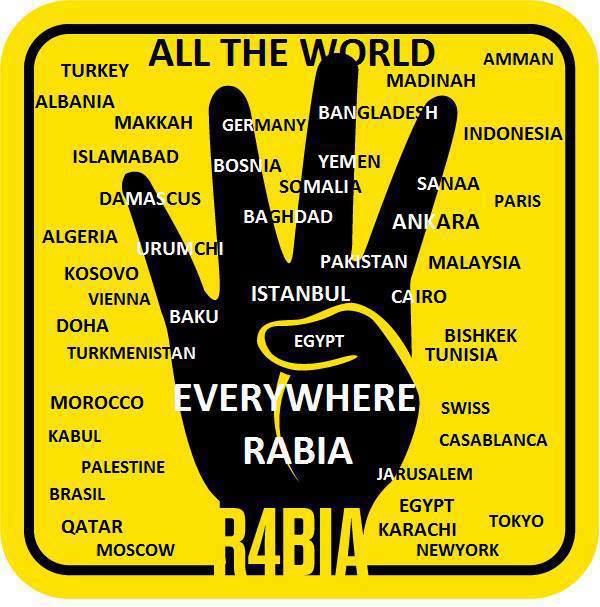
It is heartening to see the black-n-yellow image signifying solidarity with the victims of the Rabia massacre going viral on facebook profiles. It is in our capacity for empathy that our humanity lies. The symbolism of it is remarkably suggestive and layered, too: with the resistance bearing the name of a Muslim woman (Rabia Al Adawiyyah). It has in it the makings of a fresh and brand new Muslim feminism articulated as a response to the savage use of chauvinistic power: military and political.  The fact that Rabia Al Adawiyyah was an icon of Islamic spirituality- a tradition ignored and eclipsed as we embroiled ourselves in the battle for temporal power- is significant too. Salvation lies in rediscovering and reviving that spiritual tradition- not as a clever antidote to the socio-political struggle; not as a ploy to neutralize, but as a means to return the soul to that struggle; to inspire and revitalize and direct the course; and render that struggle meaningful.

Blood has been shed- but not in vain, inshaAllah. It must water the springtime- which may not reach its blossoming in our lifetimes, but we must sow the seeds and water it with sacred blood and tears. We must stand on the right side of history, realizing that we owe this to the future. Or we shall never be forgiven as History pens down its verdict in eternal stone.

“You may write me down in history

With your bitter, twisted lies,

You may trod me in the very dirt

But still, like dust, I’ll rise.

Just like moons and like suns,

With the certainty of tides,

Just like hopes springing high,

Still I’ll rise.

Out of the huts of history’s shame

I rise

Up from a past that’s rooted in pain

I rise

I’m a black ocean, leaping and wide,

Welling and swelling I bear in the tide.

Leaving behind nights of terror and fear

I rise

Into a daybreak that’s wondrously clear

I rise

Bringing the gifts that my ancestors gave,

I am the dream and the hope…

I rise

I rise

I rise.” (Maya Angelou: Still I Rise)
 

Humanity at Stake

1157633_289730281164755_734281549_n

A woman in many women- and children and men- was reported to be rushing back and forth in panic of the gunfire chasing her. A woman- another woman- was seen from her balcony with a portrait of General Al-Sisi; watching, observing, comprehending, and smiling. A grimly smile. This is not fantasy. This is not a scene from a horror movie. This is real life and real humans- or at least, real humanoids!

People are seen enjoying the beach in the scorching heat to get away perhaps from the tense city life. But behind the beach there is a road, and behind that road there are buildings, and behind that building we see smoke, a tense, scorching hot smoke. And we learn that that smoke is the product of chaos, of oppression, of resistance, of subjugation, of panic, of murder, of silence, and of noise. People lie dead on the streets and people lie flat on the beach. Two stories. One city.

Egypt is in crisis. This we are all told. But there is much more to the story. The crisis isn’t merely political. It isn’t merely about who you support. It isn’t about who you don’t support either. It’s not an Egyptian issue anymore. Boundaries don’t make sense now. It’s boiled down to the very essence of what it means to know and love freedom and democracy, to value dignity, to value humans as human subjects, to figure out what it means to be human.

But here is where narratives fail, and collide. The crisis in Egypt has consistently been portrayed as a clash between two parties- or to say, two narratives. This schema has been deliberately consolidated by both the coup-regime, which includes all its functionaries, and forces of the global hegemonic status quo. Locally there is this thing they call ‘the people’- a label created to function as a catchall term for supporters of the illegitimate regime- and then there are ‘terrorists’- a label used to discredit a demonstrably peaceful resistance movement against illegitimate regime change.  The mainstream global media on the other hand adopts a less obvious propaganda model. It divides people into ‘anti-morsy protestors’ and ‘pro-morsy protestors’- or sometimes calls them ‘Muslim Brothers’ straight out- and by doing so it very criminally distorts the picture. In doing so they’re undermining the fact that the ‘pro-Morsy protestors’ are in fact an ‘anti-coup’ and ‘pro-democracy’ movement. But of course, is it really a coup? And yet, it isn’t a matter of what definitions say when it is a matter of what global (western) interests say.

The most vulgar display of this politics of labels and binaries was when the world was watching military men, accompanied by tanks and cheering fascists, firing directly at the Al-Fattah Mosque in Cairo where a few hundred protestors were trapped. The domestic media portrayed it as an operation against anti-state elements and terrorists—one of the old classics- while the global mainstream media portrayed it as a clash between two rival parties- that very workable tactic. By calling it a ‘clash’ or ‘conflict’ of what is clearly obscene violence carried out by the establishment against individuals is the old method deployed in covering the ‘Israel-Palestine conflict’ or what is clearly Israeli repression of Palestinian individuals.

The Egyptian crisis has also become a crisis of confusion in Muslim majority societies. A victim narrative seems to emerge where the culprit is made to be democracy itself. The greatest beneficiary of this narrative is none other than Al-Qaeda itself; just as it was the greatest loser in the Arab Spring where it seemed as though change through peaceful and democratic means was a viable option. This optimism seems to fade away. This is the same optimism that makes sleeping difficult for oppressive regimes; for it’s easier to break bones than minds. The narrative serves both terrorist groups at the fringes of society and the establishment controlling society. But besides the damage that is carried out by this narrative, it is also flatly wrong. What happened in Egypt was not because of democracy but the lack thereof. There was nothing remotely democratic about it. Even the regime of Mubarak retained itself in all spheres of life. Not only was a democratically elected parliament disbanded immediately on a technicality, the democratically elected president was never given any true authority. He was overthrown by anti-democratic means and what is now present in Egypt is the suppression not only of people but of the very notion of democracy and freedom. It is here where the story needs to be squarely put as a matter of democracy, freedom and dignity. To place the problem elsewhere undermines and hurts the broader cause.

What else needs to be understood from the problem in Egypt is the consequences of polarization and uncompromising partisanship. To understand each other, to build on each other’s point of view, to discuss and debate critically are all essential to the health of a given society. A politics of empathy is the need of the hour. Unfortunately, Muslim majority societies are plagued by a clash of uncompromising narratives. The damages have played themselves out it Egypt. Pakistan is also deeply polarized and suffers from a politics of condemnation and ridicule of the other. In Tariq Ramadan’s words, Muslim majority societies need a ‘cultural revolution’ where we can think critically about our current state, be conversant with the challenges of modernity, offer creative solutions to contemporary challenges, as well as be consistent and employed with cultural, religious and civilizational references. This calls for moving beyond binaries and labels, and moving forward constructively and collectively.

Independence Day – Why Must I Celebrate?

pakistan-is-a-strange-country-1024x640

My home, my country is 66 years old today. Come August and we start gearing up to celebrate Pakistan’s birthday, if we can call it that.  The emotional patriot that I am, the whole “green” thing works for me. It is my time to re-visit the qaumi taraanaas (patriotic songs) and hoist a flag on my roof and go all teary when I see Quaid e Azam on the TV screen. In August, basically, I am having a crash course in patriotism. Like a 2nd or 8th or 16th honeymoon of a couple who over the years have forgotten what they mean to each other. So they take a trip down memory lane and sit and watch their shaadi movie and leave the kids with the grandparents and take a trip together to rekindle what’s left.

In most cases, this stuff works. As in the case of me and Pakistan.

But one minor issue. Let’s go back to the weird example about the couple. So imagine this. They have a great “re-kindle the romance” tryst at a far-eastern island resort, have spent a week together, and love is in the air. But then reality sets in once they return. The honeymoon fever starts subsiding. They slide back into the old pattern. The wife nags, the husband is indifferent and insensitive. She’s obsessed with her clothes and her family, he is a workaholic who gives her no time. Honeymoon goes down the drain.

That might be, sadly, the problem with how we look at 14th August, or any ritual in any relationship for that matter, whether it is our relationship with a person, a country, an idea or even God. When we indulge into something without thinking and without reflection and introspection, all that remains is hollow and outward expressions of a love that is shallow.

In a love that is deeper and more real (and most of us claim to love Pakistan), we must give back in return. The truest relationships are those that stand the tests of time. Relationships in which you feel an urge to do for your beloved anything that makes him/her happy. What can I do that would make Pakistan happy, I wonder?

For sure, Pakistan LOOKS happy today. Celebration’s in the air. Fireworks marked the grand entry of the 66th birthday of my homeland at midnight. Everyone will be dressed in green (yes, me too, I confess!). Flags, songs, chants, slogans of hope, of better tomorrow.

So yeah, sure, Pakistan looks all happy. Just like that couple looks happy in the 2nd honeymoon pictuers they post on facebook. But are they, really? And is Pakistan happy? Really?

A REGISTERED 23% (almost) living below the poverty line, a dismal literacy rate, a non-existent state emphasis on health and education when compared to what we spend on defense, ethnic prejudice and violence, killing in the name of caste and creed, extremism, huge economic disparity, an increasing tendency of polarization in society; a society divided between liberal extremists and religious extremists, persecution of minorities; the list is endless. Poverty in the land of the pure forces people to commit suicide. Women are raped and silenced. Our government’s corruption has assumed legendary proportions. While minorities are persecuted, we, the Muslim majority (with all due respect) is essentially clueless about the true nature of Islam. We have not yet met Islam one on one, most of us. A reflection of us not knowing Islam is evident in tiny things like breaking the traffic signal and littering and losing tempers in Ramadan and also in bigger things like killing our fellow Muslims and Pakistanis.

In a nutshell, Pakistan is not happy, really.

Like a cynical but forthright friend’s tweet said, “I am not a proud Pakistani. With this mess I can’t be. Seriously. But I promise to work towards it.”

Yet, I still DO celebrate the 14th of August. Not just because I am an emotionally labile person who reaches out for her tissue to wipe tears when she hears “Khayal Rakhna” by Alamgir and the Benjamin Sisters. Not just because I am in the 14tn August honeymoon zone. No. I have given it careful thought.

And the reason lies in the last part of my friend’s tweet:”….I promise to work towards it”.

With all the mess that it is in, when I look at that white-haired old man called Dr Adeeb Rizvi serving at SIUT, and I see people believing in him, I know there is something worth celebrating. When I look at the work Imran Khan has done at Shaukat Khanum and the work Edhi has done, I know there is hope. And not just the very known heroes. At grass root level, I meet a woman in Heera Mandi Lahore, running a school for literacy of her children. In the dangerous Lyari, a man is teaching children peace-skills in his school. My nephew is working with his group of friends as a small initiative to spread literacy among under-privileged children. At an even smaller level, my mother always would teach the children of domestic staff to read and write. She was a member of the National Women’s Guard in the years around independence, a fierce patriot, who still in spite of her dementia sings patriotic songs and tells stories of how she saw Quaid e Azam. History repeats itself when my daughter teaches an underprivileged child in her summer holidays. I land at Jinnah International and with all the negatives, the positive is that the chivalrous men of my nation will still help me with my luggage, and the poor fruit vendor may give me an extra banana free of charge. We still cherish good values. We are a poor nation (not talking about the ruling elite right now!) but one of the most charitable nations in the world. We have been through hell and Pakistan is a dangerous country to live in, but we are resilient, and all this “mess” is bringing out the best in us in art, literature, and very importantly in humour – yes, Pakistanis know how to have a good laugh at themselves.

Deep down, somewhere, Pakistan is happy.

But the emotionally charged paragraph I have written above still does not fully justify why I celebrate 14th of August. For me, the reason is multifold. Patriotism, unless ill-founded and leading to anger and an “us versus them” psyche, can be and is a positive force if used correctly. It re-kindles the spirit of volunteerism, a sense of responsibility towards one’s country and one’s nation. If coupled with a bit of reflection and awareness, it can remind us of important lessons long-forgotten. A small example would be that if we take a careful look at the flag of Pakistan, the white reminds us of the presence of minorities as equal citizens of the state. Disrespecting or persecuting innocent minorities is tantamount to disrespecting the basic ideology on which this nation was formed. Celebrating this day, as my daughter has made me understand, is important to her generation who have sadly grown up in a time where most of what they hear about their country is negative, skeptic and disillusioned. The new generation must thrive on a sense of hope and a sense of pride.

So let’s give a careful thought today, each one of us, to what we are doing to make Pakistan happy. If we are positive contributors to the well-being of this nation, we have every right to celebrate the Independence Day, sing the national anthem and say Pakistan Zindabad.

🙂 If you’ll excuse me, I gotta go iron my green dress now.

Loving Pakistan Against the Odds

LovingPakistanPakistan- a word I’ve been hearing since my first day but every single time I hear it and interpret it, the familiar sense of belonging and feeling of love is rejuvenated. I’ve heard it under muffled voices as my grandparents would narrate their childhood stories; we would squeeze beside them under the blankets and awe at the thrilling events of 1947 while we munched peanuts and walnuts. I, then grew up and with time the voices spelling out Pakistan changed as well. I remember the gasp which would travel around the class every time our teacher shared an unusual fact regarding Pakistan. Then, I heard some people pronouncing it spitefully, executing particular stress on it during their heated debates. At times, the word reflected hopelessness and despair while at others it spoke of elation, pride, enthusiasm and determination. The tones and speakers were of great variety but a single thing remained unimpeded- the name never ceased to leave an impact on my heart. Either I speak of it in a mediocre manner or chant “Pakistan Zindabad”. I speak of it as one would speak of a cherished family member.

It wasn’t I who chose Pakistan as an identity, culture, lifestyle or a possession. Instead, Pakistan chose me to breathe in its air and walk upon its soil; I was invited to experience the feeling of being at home and being loved at this part of the world.

Since my young days I have been witnessing argument about Pakistan and its issues but all along I’ve been no more than a reticent listener. People are prepared to alienate their homeland and consider a single ticket, a single flight to be their key to success because it’s hard for them to see this country prosper. However, amidst this devastation I see a smile. I see it beaming through the tears and scars and just when I have been disheartened enough to turn around and join the crowd I see a glisten in those sorrowful eyes. The eyes have put behind the grievances as they stare at me hopefully. I see trust and belief in them, an unhampered belief that if not this time then the next or maybe some other time Allah would help and heal those scars. And, despite the disappointments it has had to face it still believes the people are worthy enough to be relied upon. I cannot abandon my idealism after finding life beneath the dead.

It will be hard to believe if you claim to have never lost anything because of Pakistan or to Pakistan. There were times when I stumbled and I, too lost my confidence in this country but when I stood up I had even greater zest because I realized it were my hopes which still give the green-white flag a reason to stand tall. It’s your ideology and vision which will help Pakistan to overcome the tribulations, thrive and rise to the long forgotten glory, it’s actual destination.

Prophet (SAW) is reported to have said,

“And know that victory comes with patience, relief with affliction, and ease with hardship.” (Tirmidhi-Saheeh)

Quran Journey series – Reflections on Quranic verses – X

justice-peace


In the Name of Allah, the Beneficent, the Merciful

“Allah forbids you not, with regard to those who fight you not for (your) faith nor drive you out of your homes, from dealing kindly and justly with them: for Allah loveth those who are just.

Allah only forbids you, with regard to those who fight you for (your) faith, and drive you out of your homes, and support (others) in driving you out, from turning to them (for friendship and protection).”  (60:8-9)


Islam is about submission to the Divine Will in order to attain peace, and this works both at the individual level as well as for the community. Muslims are supposed to seek to acquire peace within and strive to establish it in society. However, the establishment of peace at the communal level is only possible through the provision of justice. The central principle around which the socio-politico-economic system of Islam is built is Justice.

Islamic Justice is all-embracing and universal, to be extended to all mankind, regardless of any distinction of race, creed, nationality and even faith/religion. It is a fundamental human right. Islam asserts justice in dealing with those belonging to other faiths, whether they be citizens of the Islamic state or members of other communities and nations. The rights of non Muslims in a Muslim state have been clearly outlined by the Shariah_ they are entitled to all rights of citizenship and complete freedom of belief:

Non-Muslims are to be protected by the Muslims, as the Prophet Muhammad (SAW) himself said:

“Whoever harasses a dhimmi I shall be his adversary, and of whomever I become the adversary, I shall prosecute him in the Doomsday” (At Tabrani, 65).

Again: “He who harms a non-Muslim who keeps a peace treaty with Muslims has harmed me, and he who harms me has harmed Allah” (At-Tabarani in Al-Awsat).

In support of the Prophet’s view, an orthodox caliph stated that the blood of the dhimmi is “like our blood and his religion is like our religion” so that “they are entitled to what we are entitled to…” 

As is made clear by the verse, all non Muslims be they citizens of the Islamic state or not, must be dealt with justly: this justice is to be waged universally and unconditionally, even in case of hostility. The Quran says:

“O you who have believed, be persistently standing firm for Allah , witnesses in justice, and do not let the hatred of a people prevent you from being just. Be just; that is nearer to righteousness. And fear Allah ; indeed, Allah is Acquainted with what you do.” (5:8)

In fact, the Quran takes it a step further by adding to it the element of kindness. Muslims must deal with non Muslims who possess no explicit aggressive designs with kindness, forbearance, gentleness. This is built on the Islamic concept of the entire creation of God being His ‘family,’ all being the ‘sons and daughters of Adam (A.S).’  It is this kindliness of demeanour in dealing with those not yet Muslim that earns us the Love and pleasure of Allah.

However, it is a demand of justice that wrong be redressed, that evil be confronted, oppression be resisted and defended against. Muslims must be active agents of justice and peace on earth. In order to attain justice and root out injustice, Muslims have to exert themselves, through force if need be. Only through the readiness to establish justice with might and main can peace prevail, and History is a witness to this_ the might of Goliath was shattered through the courage, valour and strength of David (Daud A.S). Those who are unwilling to strive with physical strength and force for the establishment of a just order will be trodden on and vanquished by the forces of evil as it pervades, unresisted. Hence, the Quran instructs, Muslims must act with firmness against those who have evil designs against Islam; who oppress human beings, who spread evil (fitnah) in the land and assist the forces of injustice and evil. That too is the example provided by the seerah of Muhammad (SAW) who exerted himself in the Way of Allah through waging military struggle against the enemies who had persecuted believers for their faith, and who had taken away the freedom of belief that is a God-given right of all human beings.

The verse above is a radiant example of the middle position of Islam and its great emphasis on the principles of justice and peace, its firm insistence on the rights of human beings; it highlights Islam’s rejection of all forms of discrimination and its insistence on absolute justice  for all. Islam, in the light of this and other verses of the Quran and statements of the Prophet (SAW), stands tall as an egalitarian system of life with a universal vision of justice and peace.

Muslims must be just and kind towards fellow human beings regardless of faith-based (or other) distinctions. However, those who violate the rights of others, oppress and persecute are to be defended against with firmness, strength and might. Only thus can a just order be established that facilitates the attainment of a peaceful society.


Quran Journey Series- Reflections on Quranic verses: IX

2

In the Name of Allah, the Beneficent, the Merciful


(Say: “O ‘Ibadi (My slaves) who have transgressed against themselves (by committing evil deeds and sins)! Despair not of the Mercy of Allah, verily Allah forgives all sins. Truly, He is Oft-Forgiving, Most Merciful.) [Surah Al-Zumar, verse 53]


One of the greatest blessings bestowed upon errant fumbling slaves like us all is Allah’s promise of forgiveness which comes from His all-encompassing, inexhaustible mercy. In the very first verse of the Quran at the beginning of Surah Fateha, we are told of two of the primary attributes of Allah: Ar Rahman and Ar Raheem. Although both have the same root of  ‘rahm’ that bears the connotation of the mother’s womb and hence signifies tenderness, care, protection, nourishment, gentleness and ‘the love of seventy mothers and more…’ ; yet there are some important distinctions . ‘Ar Rahman’  means the One with the Highest, the most Extreme, Intense and Infinite Mercy. ‘Ar Raheem’  on the other hand, means the One whose Mercy is constant, endless, undimmed, ceaseless and eternal. Allah alone combines both these attributes to the degree of perfection_ He is Extremely Merciful, consistently.

For us_ too prone to sinning and forgetfulness_ this is good news. It gives hope, it lifts the spirits up, it promises us deliverance and salvation through His Mercy, it reassures us we can still start afresh, and that

`He who comes closer to Me one span, I come closer to him a cubit; and he who comes closer to Me a cubit, I come closer to him a fathom; and if he comes to Me walking, I come to him running”. [Al-Bukhari and Muslim].

Forgiveness is the most beautiful aspect of Allah’s Mercy, and we all stand in greatest need of it. The promise of His Mercy even as we sin repeatedly comes as a cool draught in a day of heat and thirst; a healing, comfort and a soft balm on a wounded, sinned-against soul; a beacon of light at the end of a long dark tunnel. Alhamdulillah. For, where would we be without it?

“And if Allah had destroyed men for their inequity, He would not leave on the earth a single creature, but He respites them…” (Surah an-Nahl 16:61)

The Quran demonstrates a deep and insightful understanding and appreciation of psychology with all its vicissitudes. Allah knows our innate propensity for sin . Allah knows we are forgetful by our very natures. He knows we are liable to err and fall into sin, as was illustrated by the first sin of Adam (A.S). Just as Adam (A.S) was given hope of forgiveness through Allah’s Grace and Mercy, so are we blessed and delivered out of darkness and sin through His Mercy that lies in wait for us, and welcomes us with open arms, only if we relent, feel the twinge of guilt and remorse, realize our mistake and regret it.

The verse and its themes of Mercy and Forgiveness are particularly relevant with the commencement of the last ten days of Ramadan, when the Mercy of Allah is at its highest, its most intense, ready to be showered on those who seek it through worship, remembrance and repentance. Ramadan is a yearly season of forgiveness, a yearly flowering of faith, a yearly opportunity to reflect, to purify ourselves, to cleanse our spirits from too much of the temporal and worldly that smothered it the rest of the year; and a yearly high-tide of Allah’s forgiveness that we must make the best of. It is recommended to spend the odd nights of the last ten days of Ramadan in intense prayer, seeking Allah’s forgiveness, with the following recommended prayer:

Aisha (RA) said: I asked the Messenger of Allah (PBUH): ‘O Messenger of Allah, if I know what night is the night of Qadr, what should I say during it?’ He said: ‘Say: O Allah, You are pardoning and You love to pardon, so pardon me.’ “
(Ahmad, Ibn Majah, and Tirmidhi). “Allahumma innaka ‘afuwwun tuhibbul ‘afwa fa’fu ‘annee”

Those who miss the opportunity to make the best of it are unfortunate indeed:

Kaab Ibn Ujrah (RA) relates that Rasulullah (SAW)  climbed the first step of the pulpit, He (SAW) said “Aameen”, When He (SAW) ascended the second step, He (SAW) said “Aameen”, When He (SAW) climbed the third step, He (SAW) said “Aameen” When He (SAW) came down, We said “O Rasool of Allah (SAW), we have heard from you today something which we never heard before” He (SAW) said When I climbed the first step, the angel Jibraeel (A.S.) appeared before me and said “Destruction to him who found the blessed month of Ramdhan and let it pass by without gaining forgiveness.” Upon that I said ‘Aameen’.  (Haakim, Baihaqi)

———————————————–

Abu Hurairah (May Allah be pleased with him) reported: Messenger of Allah (PBUH) said, “Allah says: `I am just as My slave thinks of Me when he remembers Me.’ By Allah! Allah is more pleased with the repentance of His slave than one of you who unexpectedly finds in the desert his lost camel. `He who comes closer to Me one span, I come closer to him a cubit; and he who comes closer to Me a cubit, I come closer to him a fathom; and if he comes to Me walking, I come to him running”.
[Al-Bukhari and Muslim].

Ali (RA) – My Eternal Hero

aliFor me, he is the emblem of heroism, of wisdom, of passion, of love of Allah.

He accepted Islam as ten year old child, when very few were willing to risk their lives. He grew up, literally, in the house of Allah’s beloved (Salallaho Alaihi Wasalam -SAW). He resembled Rasool Ullah (SAW) in mannerism and action. On the night of the migration from Makkah, he slept in the bed of the Prophet (SAW) with the risk that the enemies may kill him in place of the Prophet (SAW).

Our beloved (SAW) trusted Ali (RA) with his treasure, his youngest daughter Fatima (RA). He was the Prophet’s (SAW) kin.

While Rasool Ullah (SAW) breathed his last on the chest of our mother Ayesha (RA), Ali (RA) was the one to bathe Rasool Ullah (SAW) after his death.

Ali was a lion in the battlefield and most humble in private life. In worship, such was he that he told people to pull out an arrow lodged in his body during salaat (namaz) because when in the presence of his Rabb in prayer, he focussed on nothing else.

Ali (RA) is my hero, forever.

They are all my heroes: Abu Bakr (RA) and Umar ibn Al-Khattab (RA) and Uthman bin ‘Affan (RA) and Ali (RA). Each a sparkling gem warding away darkness and showing rays of light. Each with their own beautiful unique personalities. Each chosen by God for special work. Each guiding us in their own way.

Yet, with the mention of Ali (RA) the heart softens with the realization of how beloved he was to the Prophet (SAW) of Allah. He is the father of Hasan (RA) and Hussain (RA), and the love of Fatima’s (RA) life.

These glimpses from ahadith and seerah remind me even more why Ali (RA) is who he is to me:

 Abu Turaab

So many incidents are recorded about the beautiful way the Prophet (saw) used to solve disagreements between Ali and Fatima.

One such incident resulted in Ali getting the title Abu Turaab – “The man covered with dirt” – this title was one of the dearest to Ali. For once the Prophet went to visit his daughter Fatima & he did not find Ali home. He asked about him, so Fatima told her father that she had some argument with her husband so he left home angry in the afternoon without taking his usual nap. The Prophet told someone to go & look for Ali. He came back saying that he is in the mosque. The Prophet went to him to find him lying on the floor with his dress falling off his flank which was covered with dirt. The Prophet woke him up clearing the dirt off his body & addressing him with a smile: “Wake up you who is covered with dirt”.

The Prophet’s Kin

When the verse 3:61 was revealed to the Prophet (SAW): “Now that you know the facts, say to them ‘Come, let us summon our sons and your sons, our women and your women and ourselves and yourselves and pray Allah and beseech Him to accurse those who intentionally assert falsehood’ ; he summoned Ali, Fatima, Hassan and Hussain and said: “O God, & these are my kin”.

How can a believer not love Ali (RA)

Zirr reported: ‘Ali observed: By Him Who split up the seed and created something living, the Apostle (may peace and blessings be upon him) gave me a promise that ‘No one but a believer would love me, and none but a hypocrite would nurse grudge against me.’
Reference: Book 001, Number 0141: (Sahih Muslim) 

The strength of Ali – in fighting the enemy and fighting anger

I love the incident where Ali (RA) was fighting with a man on a battlefield. Ali was about to thrust his sword into his heart when all of a sudden the he raised his head and spat at him. Ali immediately dropped his sword, took a deep breath, and walked away. This man was stunned. He ran after Ali and asked him why he was letting him go. “Because I’m very angry at you,” said Ali. “Then why don’t you kill me?” hel asked. “I don’t understand.”

Ali (RA) explained, “When you spat on my face, I got very angry. My ego was provoked, yearning for revenge. If I kill you now, I’ll be following my ego. And that would be a huge mistake.”

So Ali set the man free. The man was so touched that he became Ali’s friend and follower, and in time he converted to Islam of his own free will.

He whom Allah and His Messenger (SAW) love

Narrated Salama: ‘Ali happened to stay behind the Prophet (SAW) and (did not join him) during the battle of Khaibar for he was having eye trouble. Then he said, “How could I remain behind Allah’s Apostle?” So Ali set out following the Prophet . When it was the eve of the day in the morning of which Allah helped (the Muslims) to conquer it, Allah’s Apostle said, 

“I will give the flag (to a man), or tomorrow a man whom Allah and His Apostle love will take the flag,” or said, “A man who loves Allah and His Apostle; and Allah will grant victory under his leadership.”

 Suddenly came Ali whom we did not expect. The people said, “This is ‘Ali.” Allah’s Apostle gave him the flag and Allah granted victory under his leadership.’ Reference: Volume 5, Book 57, Number 52: (Sahih Bukhari)

He was to the Prophet (SAW) what Haroon (AS) was to Musa (AS)

Sa’d reported Allah’s Apostle (may peace be upon him) as saying to ‘Ali: Aren’t you satisfied with being unto me what Aaron was unto Moses?
Reference: Book 031, Number 5916: (Sahih Muslim)

For whosoever is Prophet (saw) Mawla, Ali is Mawla

Sayyidna Abu Sarihah (Radhi Allah) or Zayd ibn Arqam (Shu’bah is uncertain about it) said that Prophet (SAW) said: He for whom I am Mawla (friend, beloved, helper), Ali is Mawla
Reference: Sunan al Tirimdhi Hadith No. 3733 – Imam Abu Isa Tirimdhi (rah) said: This Hadith is “HASAN SAHIH”

Quran Journey Series: Quranic Reflections- VIII

ocean_hope_wallpaper-HD

In the Name of Allah, the Beneficent, the Merciful


‘Whoever should hope for the meeting with Allah – indeed, the term decreed by Allah is coming. And He is the Hearing, the Knowing.’ (29:5)


The concept of the Hereafter ought not to arouse fear alone, but also, as said in this verse, a promise and a hope in the  ‘Meeting’ with the Lord of the Universe; a hope to attain the object of all your love, adoration, worship, devotion, obedience through the Pleasure of Allah; to reach the Sought, and to witness the coming true of the Greatest Promise. The Hereafter is a comforting promise of hope for the sinned against, the oppressed, the victimized_ a promise of Perfect, Absolute Justice:

“So whosoever does an atom’s weight of good shall behold it.” (Surah Zilzal) 

No good deed shall go unrewarded, no iota of pain suffered shall go unhealed but that Allah shall recompense it with the Best Recompense.

Narrated ‘Aisha:  Allah’s Apostle (SAW) said, “No calamity befalls a Muslim but that Allah expiates some of his sins because of it, even though it were the prick he receives from a thorn.” (Sahih Bukhari, 544). 

Were it not for the Promise of His Mercy and the redressing of all wrong, the establishment of the Balance that men transgressed, where would we be?

The word ‘Meeting’  implies intimacy, love, closeness, personal confidential exchange, sharing, pouring forth in a special and private one-on-one with Allah. Allah privileges and honours His slaves with the promise of a meeting with Him, the Majestic, Glorified Lord of all existence. It beckons us with hope- the hope of coming to rest and satiety in the ‘Home of Peace.’

The concept of the establishment of perfect justice in the after-life is immensely hope-giving to those who strive to do good. In a world where acts of kindness often goes unrewarded, where rights are trampled upon, where true sincerity and goodness goes unrecognized, where the innocent suffer unjustly and the oppressors rule the roost, the hope of Divine Justice comes as glad tidings, as a healing for the wounded heart, as a promise of deliverance. Allah also tells us that with Divine Justice also comes Mercy, without which we stand no chance. It is by His Mercy alone that our tainted souls are salvaged. His reward is never deserved, it is bestowed out of His Benevolence to the unworthy slaves who in their humanness always fall short. But Allah forgives, loves, blesses the sincere ones, even as they fumble. This makes the believers take heart, hoping in the Meeting with the Lord. It gives enormous strength and patience in bearing the calamities of this world_ a privilege of the Faithful ones:

“How wonderful is the situation of the believer, for all his affairs are good. If something good happens to him, he gives thanks for it and that is good for him; if something bad happens to him, he bears it with patience, and that is good for him. This does not apply to anyone but the believer.” (Sahih Muslim #2999)

The tone of the verse is reassuring, solicitous, uplifting. It lifts one above the mire of the injustices of this world, on the wings of Hope in Allah’s Justice and Mercy, and most of all, in the Meeting with the Eternal Beloved, Who rewards more than what human imagination is capable of, Who is the True Valuer, the Subtle and All-Aware.

Quran Journey series: Reflections on Quranic verses- VII

126693614128GrOd


In the Name of Allah, the Beneficent, the Merciful

‘They made not a just estimate of Allah such as is due to Him.’ (39:67)

——————————————–


The man whispered ‘God, speak to me!’ 

And a meadowlark sang. 
But the man did not hear. 
So the man yelled ‘God speak to me!’ 
And the thunder rolled across the sky. 
But the man did not listen. 
The man looked around and said ‘God let me see you’ 
And a star shone brightly. 
But the man did not notice. 
And the man shouted ‘God show me a miracle’ 
And a life was born. 
But the man did not know. 
So, the man cried out in despair.

‘Touch me God and let me know that you are here!’ 
Whereupon a butterfly brushed past him. 
But the man brushed the butterfly away and walked on.

This very often quoted anonymous piece of writing illustrates how man turns away from the ayat (signs) of Allah in the universe, is ungrateful for the innumerable blessings that encompass us, unmindful of the grace, bounty and glory of Allah that pervade and animate the universe.

The verse hits home hard- the Lord of the universe laments over how man has debased himself by not giving to his Creator what he owes Him: the exclusive devotion, adoration, self-surrender that was due only to Him, and through which man discovers and lives out his own true potential.

In surah Yasin in a similar vein Allah says,

‘Ya hasratan ilal ibaad!’ (Alas for mankind),

that they wronged themselves by refusing to acknowledge the One they owe their existence to, who calls to Sakeenah (restful Peace, Godliness) through His love; who calls to the Truth that sets us free from bondage to falsehood, deception and evil.

Man has been ennobled by Allah through the ‘Ruh’ He breathed into the human nafs from His own spirit. Humanity is a gift bestowed by Allah through the crowning glory of divinely inspired Ilm and the nobility of the ‘fitrah’ on which man has been created.

‘Verily, We have honoured the sons of Adam…’ (17:70) 

‘Verily, We did offer the trust to the heavens, and the earth, and the mountains: but they refused to bear it because they were afraid of it. Yet man took it up – verily, he has been prone to be most wicked, most foolish.’ (33:72)

Faith in God is a transforming force that makes one transcend above and beyond the confines of the here and now; it raises above the personal, selfish, temporal, material and physical that holds us down to an ephemeral level of existence, caged in the id, embroiled in the pursuit of short-term self-gratifying goals.

Faith makes selflessness possible. It makes forbearance, patience, forgiveness and undaunted courage possible. It makes a deep inner tranquility possible regardless of external circumstance. This inward peace enables the faithful individual to radiate peace around him. It enables one to

‘find the best in others. To leave the world a bit better, whether by a healthy child, a garden patch or a redeemed social condition; to know even one life has breathed easier because you have lived…’ (Ralph Waldo Emerson)

Faith makes possible deeds larger than life, motivated by that mysterious magical thing called love for God which has over millennia driven people to live meaningfully, act nobly and altruistically with an incredible spiritual largesse; which has over history made human beings capable of the most superhumanly heroic deeds for no selfish, worldly, material purpose. It has made faith-driven human beings live meaningful, beautiful lives that have left ‘footsteps in the sands of time…’

 
Lives of great men all remind us  
  We can make our lives sublime,  
And, departing, leave behind us  
  Footprints on the sands of time;  
  
Footprints, that perhaps another,  
  Sailing o’er life’s solemn main,  
A forlorn and shipwrecked brother,  
  Seeing, shall take heart again.  
  
Let us, then, be up and doing,  
  With a heart for any fate;  
Still achieving, still pursuing,  
  Learn to labor and to wait. (Henry Longfellow)
 
 Faith in God has made immortality attainable to the mortal being of man; has made permanence possible through evanescence; it has healed and purged and elevated and delivered. Yet so many, as the verse says, have failed to recognize the sublime beauty and power of faith in God, recklessly turning away from it, bedazzled by the pomp and show of the transient life of this world.
Very broadly, there are two ways in which man fails to make a just estimate of faith in Allah. Man either carelessly disregards the meaning and value of the Divine in his life out of forgetfulness and the lure of the material world; or he distorts, abuses and exploits the faith he verbally professes in the most vile and heinous ways for his own ends.
Crime, war, racism, slavery, conquest, imperialism, colonialism, nationalism, capitalistic exploitation, environmental degradation have all been impelled by lust for worldly benefit, temporal power and material gain- all of which are corollaries of faithlessness and distancing from the Divine.Great crimes and injustices have also been committed in the Name of God, out of an odious sense of being holier than thou by the self-righteous who wittingly or unwittingly sin against God when they use His name for ignoble, unworthy ends. This is contemporary Islam’s greatest challenge. Khalid Abou El Fadl writes,‘the worst injustice, and the one most worthy of Muslim outrage, is that committed by Muslims in the name of Islam, because that is more deprecating to God than any supposed heresy or legal infraction.’ 

Man disparages the meaning of the Divine by his own heedlessness and misdeeds. He sells off his faith for paltry gains and sins against his Loving Maker from Whom he came and to Whom he is bound to return. But in so doing, the greatest harm comes to his own self, against his own God-given nafs… only that he does not recognize it. And the undimmed everlasting Glory of Allah abides and endures forevermore:

‘God will requite them for their mockery, and will leave them for a while in their overweening arrogance, blindly stumbling to and fro.’ (2:15)

‘They want to extinguish the light of Allah with their mouths, but Allah will perfect His light, although the disbelievers dislike it.’ (61:8)

Quran Journey Series: Quranic Reflections- VI

Narcissism-in-leadership

In the Name of Allah, the Beneficent the Merciful

“Have you seen the one who takes as his god his own desire? Then would you be responsible for him? Or think you that most of them listen or understand? They are only like cattle;- nay, they are worse astray in their Path.” (25:43)
One of the most heinous and discreet forms of ‘shirk’ (polytheism) is self-worship, when one begins to deify his own desires, that is one follows the command of his desires to such an extent that he ignores and trespasses every moral restraint that stands in his way. He becomes so obsessed with his self that it turns him blind towards the rights of others, his duties to His Lord and his fellow-beings. He indulges in self-serving pursuits; he seeks power, luxury, wealth, fame, importance, comfort, convenience for himself. ‘God’  is the deity to be obeyed, submitted to, adored, worshipped, loved, venerated etc. When something other than God begins to claim all this and becomes the object of our devotion, attention, worship, it becomes a false deity, a partner in the worship of God. Very often we give this quasi-divine status to our own selves and our desires when we blindly pursue them and forget all limits.

According to philosophers and psychologists, the human personality consists of the ‘id,’ which is the reservoir of animal desires, carnal instincts and physical drives like those of hunger and sex. The id creates strong impulses rooted in desire, which are only held in check by higher human consciousness, the ‘superego’  that internalizes values, morals and norms of behaviour. This control of the id impulses makes us human, and the more we are in command of our id desires, the higher we are on the scale of humanity. The strongest imperative of the superego is Faith that comes through religion. It keeps the animal self (nafs e ammara) in check, allowing it limited permissible means of expression. Animals are entirely id, lacking in the higher spiritual consciousness. This is why animals express and pursue their natural physical impulses freely. Their lives revolve entirely around hunting for food, and procreation. When human beings let the id dominate and give it free rein, they descend to the animal level, a primitive level of existence. However, in sophisticated societies, this is called ‘the libertarian culture’ that celebrates ‘individual liberty.’ However, when individual liberty enslaves one to carnal instincts whose imperious command one blindly follows, it is not true liberty and freedom any more.

Such a self-obsessed person will reflect utterly irresponsible behaviour. He will lose all restraint that comes from higher consciousness and will act with recklessness and irresponsibility. According to Abdullah bin Masood (R.A) the Prophet (SAW) said,

‘If you have no shame, then do what you wish.’ (Bukhari)

Allah says that such lovers of the Self must be left to their own, to be consumed by the fire of their own vain lusts and bestial passions, as they have reached the very depths of degeneracy_ fallen from the glory of  ‘Ahsan i taqween’  (the best of all creation) to the level of  ‘asfalasafileen’ (lowest of the low).’  (reference from Surah Tin)

In their state of intense self-absorption and self-indulgence, their heart and soul becomes deadened, till they can no longer respond to the Call to Faith. The Power of the Revelation goes undetected by them, and does not make any echo in their soul. Their existence becomes comparable to vile beasts who live only through the five external senses. They become what the Quran says

‘ deaf, dumb and blind, so they return not.’ (2:18) 

This is because

‘their hearts have a disease’ (2:10) 

_the disease of self-love. The God-given heart with its capacity for adoration, benevolence, love, gentleness, sacrifice and nobility becomes a piece of flesh.

“And their hearts are sealed,  so that they apprehend not.”  (9:87)

Elsewhere in the Quran Allah has compared their hearts to stones:

‘Then, after that, your hearts were hardened and became as stones or even worse in hardness. And indeed, there are stones out of which rivers gush forth, and indeed, there are of them (stones) which split asunder so that water flows from them, and indeed, there are of them (stones) which fall down for fear of Allah. And Allah is not unaware of what you do.’ (2:74)

Their eyes can no longer see the Signs of God in the universe, and hence they become blind while in possession of physical sight; their ears can no longer register the Call of Allah, and hence they become deaf.

“Such are they whose hearts and ears and eyes God hath sealed. And such are the heedless.”  (16:108).

Their God-given faculties are used only for the lower animal functions of receiving external stimuli; they become caged in the material universe, and make for themselves a paradise out of it_ but it is a temporary paradise of unrestrained exercise of base impulse and desire, destined to eternal perdition.

Narrated by Abu Hurayrah (ra) that Rasulullah صلى الله عليه وسلم said

“The world is the prison of the believer and paradise of the disbeliever.” (Muslim)