Is Islam non-democratic?

It is true that while Islam may not be a proponent of liberal western democracy as we know it, but in its very essence Islam is quite democratic.

“Consultation” is a fundamental concept in Islam. If anything, the Islamic ideal is nearest to a constitutionally restricted democracy whereas democratic principles are ordained under, within and from the principles of the Quran and Sunnah.

The basic flaw is made in understanding as to what democracy essentially means. Contrary to popular belief, democracy is a very fluid concept. For example, if you attempt to understand democracy in its original, and strictly, Greek sense, you’ll be surprised to note that such a concept cannot be applied to ‘modern democracies’. This is because in the Greek city-states, all the citizens would gather in one place to decide their affairs. This is true not only in time but also in space as democracies around the world differ from each other on fundamental grounds. So one must realize that claiming ‘Islam upholds democratic ideals’ doesn’t mean that it also upholds western democratic models; which are based on the premises of secularism and nationalism.

The idea that democracy is the rule of the people while Islam only recognizes the rule of God doesn’t necessarily imply a contradiction. In effect, however, neither God nor His Angels will come down to earth to rule nor has God made anyone His representative (hence closing the doors for theocracy). In fact, it is people who rule and, I argue, by divine decree; as Allah has made man (not a specific man, but meaning all-humanity) His vicegerent (Khalifah) on Earth. Allah says clearly.

“We have honoured the children of Adam” (17: 70); to which the revered Algerian scholar, Malik Bennabi, writes

“The verse was revealed as if to lay the foundations of a democratic model that is above every other model, where the divine element within man is taken into consideration and not just the human and social aspects…”

The following is an excerpt from an English translation of the celebrated ‘Tafheem-ul-Quran’ by Maulana Syed Abul Ala Maududi. It’s the scholar’s commentary on the verse ‘amru-hum shura baina-hum’ (they (believers) conduct their affairs by mutual consultation) (42:38).  An understanding of the following will display that while restricting the negative effects of western democratic models, the Islamic model is yet still more democratic.

‘This quality (of consulting one another) has been counted here as the best quality of the believers and has been enjoined in Surah AI-‘Imran Ayat 159 as well.

‘So by mercy from Allah, [O Muhammad], you were lenient with them. And if you had been rude [in speech] and harsh in heart, they would have disbanded from about you. So pardon them and ask forgiveness for them and consult them in the matter. And when you have decided, then rely upon Allah. Indeed, Allah loves those who rely [upon Him].’

On this basis, consultation is an important pillar of the Islamic way of life. And to conduct the affairs of collective life without consultation is not only the way of ignorance but also an express violation of the law prescribed by Allah. When we consider why consultation has been given such importance in Islam, three things become obvious:

Firstly, that it is injustice that matters of the state be decided on the basis of personal opinions. No one has a right to do as he likes, in matters of common interest. Justice demands that all those whose interests are involved in a matter be consulted, and if it concerns a large number of the people, their reliable representatives should be made a party in consultation.

Secondly, a man wants to usurp the rights of others for selfish ends, or because he looks down upon others and regards himself as a superior person. Morally both These qualities are equally detestable, and a believer cannot have even a tinge of either of these in himself. A believer is neither selfish so that he should get undue benefits by usurping the rights of others, nor he is arrogant and self-conceited that he should regard himself as all-wise and all-knowing.

Thirdly, that it is a grave responsibility to give decisions in matters that involve the rights and interests of others. No one who fears God and knows what severe accountability for it he will be subjected to by his Lord, can dare take the heavy burden of it solely on himself. Such boldness is shown only by those who are fearless of God and heedless of the Hereafter. The one who fears God and has the feeling of the accountability of the Hereafter, will certainly try that in a matter of common interest he should consult all the concerned people or their authorized representatives so as to reach, as far as possible, an objective and right and equitable decision, and if there occurs a mistake one man alone should not be held responsible for it.

A deep consideration of these three things can enable one to fully understand that consultation is a necessary demand of the morality that Islam has taught to man, and departure from it is a grave immorality which Islam does not permit the Islamic way of life requires that the principle of consultation should be used in every collective affair, big or small. If it is a domestic affair, the husband and the wife should act by mutual consultation, and when the children have grown up, they also should be consulted. If it is a matter concerning the whole family, the opinion of every adult member should be solicited. If it concerns a tribe or a fraternity or the population of a city, and it is not possible to consult all the people, the decision should be taken by a local council or committee, which should comprise the trustworthy representatives of the concerned people according to an agreed method. If the matter concerns a whole nation, the head of government should be appointed by the common consent of the people, and he should conduct the national affairs in consultation with the leaders of opinion, whom the people regard as reliable, and he should remain at the helm of affair only as long as the people themselves want him to remain in that position. No honest man can try to assume the headship of a nation by force, or desire to continue in that position indefinitely, nor can think of corning into power by deception and then seek the people’s consent by coercion, nor can he devise schemes so that the people may elect representatives to act as his advisers not by their own free choice but according to his will. Such a thing can be desired only by the one who cherishes evil intentions, and such a fraud against the Islamic principle of consultation can be practiced only by him who does not feel any hesitation in deceiving both God and the people whereas the fact is that neither can God be deceived nor the people be so blind as to regard the robber, who is committing robbery in the bright day light openly, as their well-wisher and servant.

The principle of consultation as enshrined in ‘amru-hum shura baina-hum’ by itself demands five things:

(1) The people whose rights and interests relate to collective matters, should have full freedom to express their opinion and they should be kept duly informed of how their affairs are being conducted; they should also have the full right that if in the conduct of the affairs they see an error, a weakness or a deficiency, they can check it and voice a protest, and if they do not see any change for the better, they can change their rulers. To conduct the people’s affairs by keeping them silent and un-informed is sheer dishonesty which no one can regard as adherence to the principle of consultation in Islam.

(2) The person who is to be entrusted with the responsibility of conducting the collective affairs, should be appointed by the people’s consent, and this consent should be their free consent, which is not obtained through coercion, temptation, deception, and fraud, because in that case it would be no consent at all. A nation’s true head is not he who becomes its head by trying every possible method, but he whom the people make their head by their own free choice and approval.

(3) The people who are appointed as advisers to the head of the state should be such as enjoy the confidence of the nation, and obviously the people who win representative positions by suppression or by expending wealth, or by practicing falsehood and fraud, or by misleading the people cannot be regarded as enjoying the confidence in the real sense.

(4) The advisers should give opinion according to their knowledge and faith and conscience and they should have full freedom of such expression of opinion. Wherever this is not the case; wherever the advisers give advice against their own knowledge and conscience; under duress or temptation, or under party discipline; it will be treachery and dishonesty and not adherence to the Islamic principle of consultation.

(5) The advice that is given by a consensus of the advisers, or which has the support of the majority of the people, should be accepted, for if a person (or a group of persons) behaves independently and acts on his own whims, even after hearing the advice of others, consultation becomes meaningless. Allah does not say: “They are consulted in their affairs”, but says: “They conduct their affairs by mutual consultations”. This instruction is not implemented by mere consultation, but for its sake it is necessary that the affairs be conducted according to what is settled by consensus or by majority opinion in consultation. Along with this explanation of the Islamic principle of consultation, this basic thing also should be kept in view that this consultation is not independent and autocratic in conducting the affairs of the Muslims, but necessarily subject to the bounds that Allah Himself has set by His legislation, and is subject to the fundamental principle: “It is for Allah to give a decision in whatever you may differ,” and “if there arises any dispute among you about anything, refer it to Allah and the Messenger. ” According to this general principle, the Muslims can hold consultations in Shari ‘ah matters with a view to determining the correct meaning of a text or verse and find out the ways of implementing it so as to fulfill its requirements rightly but they cannot hold consultations in order to give an independent judgment in a matter which has already been decided and settled by Allah and His Messenger.”

Budget Simplified

Budget 2012 was being presented in National Assembly and it reminded me about my lab attendant. His newly born daughter died last month during labour at home  in a far flung village of KPK . He was not able to afford the delivery expenses in hospital and therefore he opted for labour at home. I came to know about it when he had already left home after hearing the sad news of demise. When he came back, he told me that he is earning about 10K and the charges of a hospital delivery were not bearable for him as the medical tests and medicines were quite expensive. I was thinking that whats in the budget for him.

Finance minister tried to convince people that they are living in a heaven while when we look around, its totally a different picture.  There is indeed a darker side which does not match with the claims of present regime. Are you confused in the budetary figures? That is why the budget does contain all this fuss. It is an attempt to show the brighter picture when there is dark all around. To cover up the bad governance and corruption of the government, people are trapped in heavy figures to show that the country is in best condition.

So what are these calculations all about? Lets make it simple, consider the following example. If there are only two persons in a place, one has earned Rs 100 and other has not earned anything. Now calculate their GDP, its Rs 100. Their per capita income is Rs 50.  GDP includes the earnings /spending of all, in which the rich elite becomes a significant factor, but poor people contribute little to it. Growth rate of GDP  depends more upon how much ‘richer the rich have gotten’. So even if growth figures are high, they are significant only for the rich elite. The facilities are available, but not affordable for the common people.

What is the real purpose of a budget then? Ideally speaking, the budget is an estimate of how much we are going to earn and how much we should spend. It allocates money for different projects. Its a document which reveals that how much of the previous targets were achieved and what are the new targets; that’s it. But the government tries to cover its ugly face by using heavy terminologies. A lot of time these figures are falsified, their impact is blown out of proportion, just to cover the mess the government has created.

Current budget is again a same budget with false promises. A huge part is being spent on defense, government expenditures etc. 70 billion rupees being spent on Benazir Income support program is a wastage of money. This huge amount could have been used for the better projects related to education, health, infrastructure and energy sector.These figures didn’t mean anything to the poor labourer who is trying hard to make both ends meet. It doesn’t mean anything for the person who is sick and spending all he could to get a proper treatment. Joblessness is becoming a huge problem in the country. Industry is closing down and millions are loosing jobs. Current Budget is in heavy deficit. It simply means that earnings are less and expenditures are more, government will not reduce its expenditures but will borrow more money. Rich industrialists are not paying taxes and common people have to pay tax on everything.

Now lets talk about increase in salaries. When salaries are increased by same percentage for all, it means peanuts for poor (low grade employees) and huge increments for high grade officers. It widens the already huge gap of rich and poor in the country.  A grade 22 officer earning in six figures, with all the benefits and previliages cannot think about the problems faced by a poor. While price hike and inflation is same for all, increase in income is not similar. It makes the poor ‘poorer’ & the rich ‘richer’

So this budget is a budget for elite class. They will get benefited. Poor will not get any benefits unless we change the system. Only one budget so far has ever been termed as a budget for poor people, and that was presented by Liaqat Ali Khan in 1946. Other than that, whichever party was in govt, circumstances were same for ordinary class. The capitalistic economy needs to be uprooted and Islamic system of finance needs to implemented, which ensures flow of wealth from rich to poor; only that is the way out.

Revamping education in Pakistan

I don’t think anyone would deny the fact that we live in a cut throat world where time is money and skill is paramount. The practical life knows just one thing and that is how to live the ‘dog-eat-dog-way’, all the while trying to make one-self indispensable. We all know that it comes down to selling yourself, your personality, your traits and of course your skill. The dilemma is that schools, colleges and universities are not equipping students to face the competitive arena where the dynamics of the job market is constantly evolving and raising the bar for new entrants.  Truth of the matter is bookish knowledge and emphasis on grades is not only useless but also pointless considering the current time.

What we should be focusing now is on changing the way we perceive education. The typical classroom environment is no longer viable if a meaningful education is what we are aiming for, primarily because it has become obsolete. This is the age of information technology where individuals are being bombarded with varying perspectives from a myriad of media and communication outlets. Come to think of it, the privileged lot in our country holds the entire world in their smart phone. They don’t need to cram information from books and lectures that can easily be found over the internet. Instead they need practical hands on knowledge that will prepare them for work life.  I am not suggesting that theoretical knowledge should be neglected altogether, but practical education should be given precedence. One way of doing that is by getting students to attend seminars, arranging field visits, incorporating internships as part of the course and encouraging group activities.

Most educational institutes in Pakistan focus on theoretical rather than practical knowledge and in my opinion this just kills creativity. Memorizing mundane books which have little relevance to the real world are an integral part of the curriculum. Schools function like factories that produce batches and batches of the same product that just do not sell. There is not an inkling of zeal in the Pakistani schooling system. However before we can even talk about changing the curriculum nationwide, we need to realize that no good is going to come if the government continues to spend less than 2% on such a fundamental sector. Perhaps the only good that can come from this dismal situation is that when our dear government does decide to prioritize education they can revamp the entire system and implement it across the country. Simply put, starting from scratch and adopting a model that has worked for other developing countries, Malaysia being a case in point. Truth be told, we don’t need private schools that offer Ordinary and Advanced (O and A ) levels if our own standard of education is up to mark like that of our nemesis India.  Another point I would like to emphasize is the relevance and significance of grades, standardized testing systems and overall academic performance. I believe that a piece of paper depicting class performance proves nothing about an individual’s true potential. Instead having hands on experience, an ability to envision novel ideas and a noteworthy intellect is what education should be honing.

Now more than ever Pakistan must focus on vocational training institutes and help people polish their indigenous skills. We have a huge workforce that has the potential to uplift the country’s economy if it is TRAINED. Our abundant population can become a blessing if every able body is trained and given basic level education.

Not every person is cut out to be a doctor or an engineer some are not even bright enough to finish school but that does not mean that they are worthless and can contribute absolutely nothing to society. Every profession from plumbing to engineering is important and we can’t expect people to acquire these skills on their own. Hence, I believe specialized schools or training centers are a must. Getting women on this bandwagon is also fundamental because believe it or not they can offer so much more than child bearing. Hence the important question to ask is this: we have a workforce so why don’t we make it work?

Studying in East Asia

OK! so you wish to study abroad, and do not have the fortunes to pursue your dreams? Well, it’s not the end of the world for you. When there is a will, there is a way and the way is to get scholarships.

Universities around the world are waiting for scholars to do research but they are not getting enough suitable candidates, reason being the suitable candidates do not  have the information how to get there.
The focus of this article is on getting scholarships in East Asian countries, i.e. Japan, Korea, China, Thailand and Singapore. Countries like Japan and Korea are developing fast and investing a lot in the education sector. Their industries are fully supporting the academia, and it’s very easy to get a scholarship, only if you are persistent.

So let’s go directly to the tricks of the trade.

First step is to search the universities in your desired country on the internet.  Once you go to the website of any university, go to the faculty and see who are the professors and observe what they are doing. Drop an individual email to the professors of your interest. No, they don’t mind you sending them an email directly.  The email should contain your strengths and your desired area in few lines. The rates of response will be slow, one in ten probably, but if you get a response, that’s it!  You are nearly there. Every professor has got industrial and governmental projects in his lab, for which he needs researchers to work upon. If he is interested in you, he will support your studies,  will get the university to waive-off your tuition and will ensure that you are provided a living stipend so that you can simply relax and study!

It’s simple, isn’t it? Now if you want me to type an email for you, sorry I won’t do that for you. If you can read this, then your English is good enough, far better than a lot of Koreans and Japanese. English language is a great barrier especially in research for East Asian countries and they consider Pakistani students as a blessing. They need you to do research for them in English. Some universities like AJOU and KNU will give you direct access to the professors while for others you have to search the university website. Drop emails to the professors and wait for the response. I repeat, consistency and persistence is all that you need.

In each university, professors run labs based on industrial projects, so the funding is not an issue. If professor is interested in you, he will accept you and rest are formalities. For instance, in my lab, my professor accepted a medical student, who was a graduate in ophthalmology, to do PhD in Biomedical Engineering, a totally different field. I have seen people with the background of computer engineering having PhDs in chemical engineering. So it’s all about you, identify your area and locate the professors in those areas. Prefer the professors with more experience and more projects. Labs do have their websites, and it contains emails addresses of the PhD students, drop them an email as well. I know a lot of students who got scholarships by this method. Most importantly, you can find scholarships with living stipend for Masters degree without many prerequisites.
In the process, you might identify certain university scholarships, governmental scholarships, and some industrial scholarships. It was strange for me to see people with all those different scholarships, and their only ability was that they searched for it or someone told them about it. Korean and Japanese governments also give scholarship opportunities to the students of developing world, which need to be searched upon. For some students, even the tickets were paid by the professors. My professor paid my house rent for two consecutive years as I didn’t want to live in a dorm room.

The standard of education in the universities of East Asia, typically in Japan and Korea is getting much better. You can find quite a few of them in top 200 of international rankings. Tokyo University, National University of Singapore, KAIST, SNU and Yonsei are considered top class universities with tangible contribution towards research. One important factor which directly contributes towards the international ranking of a university is the number of enrolled foreign students; thats why the universities of East Asia are interested in attracting foreigners. Therefore, these universities are offering alot of opportunities to the foreign students, especially to those who are from developing world. So if you don’t have the fortunes to study in USA and UK etc, you can certainly utilize the opportunities which are being offered in East Asia.

Having said all this, life is not a piece of cake out there. You have to be strong enough to survive the test of times. If it doesn’t kill you, it will make u stronger. So if u can live alone, and live abroad in a different culture; then you can get the opportunity of studying there.  Most importantly, once you are out and in the open, you learn a lot. The benefit of getting scholarship in East Asia would be that you can quit and move on at any time as there’s very little you have invested in monetary terms. There is no bond and you have free will to carry on or quit. In short, all you need is passion and the doors will open for you InshaALLAH.


Heroes of Gaza – III

Thanks to a Manchester Masjid’s fund raising in the UK, the children now have shoes footballs, table tennis kits, new tracksuits for the boys and the father. The girls have a new abaya each. The mothers are given tapestry and sewing materials to teach the girls the beloved Palestinian artistry of sewing. The family has a hot meal during our visit and is provided with wood for cooking in the coming weeks. Israel’s illegal witholding of essential supplies such as enough gas, oil and the components to maintain the utility works here means that Gaza is being pushed back to the time before electricity existed.When the power is cut, families must cook using gas from canisters. When the gas runs out – and right now, even the smallest gas ration means an eight to ten hour wait – families scavenge for twigs and light fires inside their apartments to try and cook what food they can afford to buy. It is becoming the norm for children to miss meals entirely. In this Beit Hanoun family, I ask the youngest boy of four, what his dream is, what he wants to be; “ I want to eat’ he says. “Somehow. Somehow.” This makes all the family laugh.

Next stop, Jaffa Street, Gaza city. The smart home of Mohammed Ajur, 25. He is a handsome young man with the sweet smile of faith (emaan) on his lips. He happily greets his friend who has brought me to meet him and myself and we are seated in the family salon. Mohammed was in his uncle’s home when a rocket hit during what Israel proudly calls operation Cast Lead. He woke up in hospital in Egypt having been in a coma for four days. His family were around him weeping.

‘What happened?’ he asked.

‘Habibi, you have lost both your legs’ he is told. His eyes shine with light and he smiles (smiles!) at the memory.

‘What did you say?’ I ask. Although by his contentment I already know the answer.

‘I said “Thanks be to God”’ he replies.

“I was so grateful to Allah for saving my eyes and my hands and giving me so many chances to continue my life in a good way. Many, many others in Gaza lost their sight and their hands from the attacks. Alhamdulillah, I have those. Alhamdulillah!’

Mohammed has since completed his university degree in sports education.

He laughs at this ‘yes I know sports education right! But I can do anything and I will succeed in this life, with God’s blessing, inshaAllah. My life is only beginning. I am now looking for a wife. There is so much I have to do now and I will!’

He is the kind of man that makes you smile just being around him. On the middle of the table between us is a stunning urn, in copper glaze with rose workings and Arabic lettering across it. I admire it. ‘I made it’ he says shyly. He is also a talented artisan. ‘Do you like this jug?’ He asks me. I do. ‘Take it’ he says. I offer to pay but he refuses to sell it to me. It is a gift. Because I came to see him.

One final visit must be made this evening to a man whose livelihood mattered so much to my dear friend Vittorio Arrigoni; a fisherman. This father of six is in his late forties and hasn’t fished for two months. He explains that under the Oslo accord it was agreed that Gaza fisherman could sail up to 25miles from their coastline in order to fish. But Israel never honored this agreement. At first their naval forces forced the fisherman back to just six miles from the coast, then in recent years, to just three miles from the shore. There are no fish in this depth any longer due to over fishing and pollution. So, this fisherman took his boat, within his rights, to six miles and began to fish. The Israelis – as is a daily occurence for fishermen – attacked. At gunpoint he was told to strip naked and jump into the freezing February water where he was made to say for some time. Then still naked and humiliated he was handcuffed and taken to Ashdod for questioning. In the meantime the navy shot his boat so full of holes it is too damaged to repair. The livelihoods of four brothers and their thirty plus dependants – destroyed. Thanks to the same UK Masjid for donating the money to keep these families fed for the next month. After that, what will happen to them? Who knows?

As I type these words Israeli fighter jets are buzzing overhead jangling my nerves. They can be flying just for that effect or to launch yet another deadly attack on Gaza. It is 6am. The time when children are having breakfast and getting ready for school. Besides the night, this is the hour most favoured by Israel to inflict emotional terrorism on the population here. Driving through Gaza and seeing the queues of gas and petrol, I mentally titled my writing today as – Gaza’s suffering. But now the title has changed to ‘Gaza’s heroes’.


Previous links:

Heroes of Gaza – I

Heroes of Gaza – II

Heroes of Gaza – II

I, a stranger here in Beit Hanoun, walk down this road at dusk. Every window with a face in offers me ‘Salam.’ The doorway of the sole shop has a family sitting in it, I wave.

‘Assalamu Alaykum’, they shout at me – cheerily. Yes cheerily, I feel the lump in my throat that I carry inside forming again. “Peace’ they offer to the stranger in their midst, as they bathe me in smiles of instant friendship. On the corner two young guys come over and greet me as if I am a long lost cousin. There welcome is so warm that I wonder for a moment if we have met on a previous visit to Gaza.

“Okay’ says the tallest brother, after introducing himself.
‘Nice to meet you now you come to our home to spend the evening, First tea, then you stay with us. Yalla come!’..

I laugh..

‘Why you laugh?’ asks the other boy in his late teens or early twenties.

‘We don’t joking – you come for tea now, really, Fadal.’

These boys are brimming with life. Their eyes have energy and hope in them that is utterly at odds with the grim landscape they live in. They are heroes of Gaza, the next generation of hope, the ones who will not be broken.

We can’t take tea with them and are eventually allowed to leave only with sincere promises to return to their home as soon as possible.

We have come to visit, amongst this needy populace, a family in dire need.

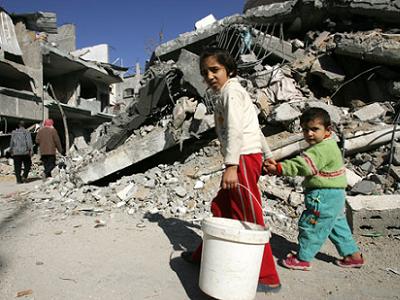
Through a broken wooden gate, behind a crumbling stone wall, my friend Yassir, silent and grim faced, points me into a cement building that has no right to be standing. It was once a PLO prison. Now it is ‘home’ to a family of one father, his two wives and their seventeen children. Before the second intifada the father used to work in Israel and he had enough money for his growing family. After the blockade, it stopped. So he worked as taxi driver. And that income was just enough to get by on for his growing family. Then the siege came. Food prices have shot up to parity with those in European nations whilst incomes here are Third World low. His car began to have small problems which he couldn’t afford to repair, which led to worse ones which killed it. I pass its rotting carcass and enter a large unplastered room with a cement floor. There is no furniture, no pictures, no adornments of any kind. Besides, two plastic chairs, the freezing space is utterly empty except for a small TV, on a crate in one corner. Children with hollow eyes, mill about, expressionless, wide eyed at the surprise visit of so many unknown faces. They look (and are) shell shocked.

One of the wives makes an attempt to smile. The husband in his shame at the poverty of his family mutters ‘salam’ and looks at the ground. Their sixteen year old son has a limp, I ask what the matter is, ‘has he hurt himself playing?’.

His trouser leg is pulled up and a large plaster ripped off revealing a fresh ten inch wound with stitches. His ankle is also bandaged. Two years earlier the boy (then 14) had been collecting rubble in the wasteland, once orchards that Israel has now stolen as its ‘buffer zone.’ His job was to sell the rock for whatever he could, to scavenge then, in the hope of some money for the hungry family. An Israeli sniper at a long distant shot him in his leg, shattering the bone. He has finally after years had the pins put in his shin. It is likely he will limp for the rest of his life.

A smaller boy of around ten is brought over. His dirty tracksuit bottoms are pulled above the knee to reveal strange white patches. White phosphorous, the napalm of the 21st century was blown across this area when Israel rained it, by the ton, onto one of the most densely populated cities in the world.

Another son of around seven, shoeless and silent clings to his father’s legs.
‘This boy’ he tells me, ‘has developed mental problems since the attack in 2009. The soldiers came many times into our home and wake the children up, shouting. Now he doesn’t talk and doesn’t act normally. Doctors can’t help him.’

Cooking is being done in the kitchen i.e. an empty cement space with a fridge that is empty except for four cauliflowers of questionable age. Due to the ‘cuts’ – twelve hour electricity blackouts – no family can chill or freeze food anymore. Fridges are just storage cupboards in Gaza. There is nothing else in the room except on the dirty floor, a single, ancient electric ring on which, now, a pan of chips is cooking. Chips that are enough for perhaps three children in the UK would here feed a family of 20.

It is Salah (prayer) time. The smaller of the wives takes me to another empty room. This one is called a bedroom because it has blankets in it. She lays out a prayer mat for me.

As I pray, I can see my own home, my own happy, educated, well fed, daughters. All the luxuries of London flood my sight and tears come. Besides me the mother makes her prayer. Behind me one of her daughters hold a torch on me as the room has no lights and no electricity anyway. It’s not the poverty that gets me it’s the evil of humanity that pours agony on almost two million Gazans, year in year out for 63 years. It is so much worse here than when I came four years ago, that words can barely describe the new cruelties Israel has designed to torture the people in this vast concentration camp.

‘Habeebiti’ says the mother beside me. ‘Please don’t cry.’

Her concern for me makes me sob even more. I can’t speak with the weight of my grief. ‘Oh God’, I think to myself. ‘Don’t let her be kind to me, please, I can’t take it’.

But she is. Of course she is. She is Palestinian.

‘My dear, why do you cry? Are you alright?’

‘I…I..hate this for you...’ is all I manage to utter.

She looks into my eyes. Mother to mother.

‘What? Don’t cry for us, it’s okay, you can stop now, shhh’.

Then, she says the words that almost break me, words that make me feel so humble. I fear, I may never stop crying. Tears that begin as frustration and sadness -become tears of love and respect.

‘We are so happy. We are Muslims, we know this is our test and we must be patient. We are happy, really sister, we are. Allah will reward us if we can just be patient’.

These are the exact words I have heard in EVERY home I have entered in Gaza at this terrible time.

Continue to  Heroes of Gaza – I

or Heroes of Gaza – III


Heroes of Gaza – I

I write this from a freezing, dark hostel room in the centre of Gaza. This area is now in a twelve hour blackout, so there will be no hot water to shower with this morning and no internet. After three days here, I feel, dirty, tired and emotionally wrung out. Yet, I know that in 48 hours, when the time comes to leave, I will not want to go. For Gaza’s incredible people have again overwhelmed a visitor with their warmth, their ability to offer friendship on a first meeting and their absolute resilience and faith in a Divine plan.

Yesterday, driving around was a stark reminder of just how serious the fuel shortage is here. At regular intervals the roadside becomes jammed with many hundreds of battered, near death, vehicles, stalled. Men sit at the wheels or smoke leaning against them, faces grim. They are locked into an 8 hour wait for just 100 shekels of fuel. Not enough for a quarter of a tank in the larger cars. When the fuel at the pumps becomes perilously low, each driver may buy just 50 shekels. As a result, cars are becoming if not quite a rarity, then certainly for a city with a population the size of Gaza – a luxury. Roads that were once jammed with the honking life typical of all major Middle Eastern cities are silent. The silence is not a blessing either; don’t think that for a moment! I remember when Diana died and cars were banned from the city centre for her funeral, what a beautiful day that was. Citizens could reclaim the streets and remember what it was to stroll in peaceful, bliss.

This is different. This silence is morbid and desperate. For alongside the near empty roads, are shops boarded up. And the pavements which you’d think would be jammed with people are empty too. There is simply no way to get to work – if you have it. Many shops simply close down due to the blackouts. This silence is the quiet of despair.

My bodyguard Mr Falafel (his nickname) and my friend Yassir, drive me to Beit Hanoun to visit a family living on the edge of one of Israel’s infamous and ever expanding buffer zones. On our way out of the main city, Yassir shouts,

‘Stop, Lauren let us get out and see this.’

It’s not clear what he wants me to see, As I get out there are men and boys milling everywhere, hundreds. There is shouting. Then I see them. A yellow, mountainscape of plastic containers piled four high in some places and stretching from one end of the road to the other. We follow the line of boys and are shocked to see the queue is the same length around the corner.

‘What is your name!?” shout boys of all ages
‘How are you today?’
‘Where you come from?’

The foreign lady in the hijab provides a welcome distraction from their miserable duty and Yassir and I are quickly embroiled in a human maelstrom of faces and laughter. We squeeze away from the youngsters towards a father in his fifties who is near the front of the queue. I ask him what he needs.

‘Fuel for the generator. We have no light. No electricity. We can’t eat. The children are cold.’

He has six children. That is a small family here. Looking at the thousands of containers waiting to be filled, each powering a generator that has become the only (ir) regular source of power for Gaza homes, I realise that each one represents a family of ten or more.

In a week, they say, even the fuel at these stations will run out. Then what?…

It is dusk, Maghrib prayer time, as we reach Beit Hanoun. An area that was, not too long ago, a place of farming. Of vast orchards stretching as far as the eye could see, where adults worked and children sheltered from the heat of the sun, playing the games that only children understand.

This evening the sun sets over what’s left; a sealed off scrubland of weeds and thorns.

We get out of the car. “Israel sent bulldozers and destroyed everything, all the trees; old trees, old orchards.’ I learnt.

Such is the sight to my right. To my left across the pot holed ‘road’ is Gaza’s frontline with Israel. The enemy that it fears so much are families in roughshod apartment blocks. No frills here. No trips to Ikea for little home touches. Here ‘home’ is a cement block low rise, half finished, slum. There are so many children here it’s hard to fathom for the first time visitor. Large families are the norm in Palestine and in Gaza, a pride. Each window of the hundreds I pass can represent easily five children within. Beside each and every window are dozens of Israeli bullet holes or the larger impact damage from shells of all variety. Hard to imagine the international reaction if a family suburb in Tel Aviv were attacked like Beit Hanoun is attacked by the IOF, over not just days, not even months – but years.

I remember once asking a very poor mother in Gaza why she had so many children.

‘We need atleast seven children to each family here’, she said

‘Why? Because atleast two will be killed by Israel. Two more, Israeli will take to prison for a long time or cripple with rockets. Two may (may) have a chance to get educated and they will leave Palestine and never return, which leaves just one child to look after us in our old age...’


Continue to Heroes of Gaza – II

And the legacy goes on..


And the legacy goes on.. Part I

Jeay Bhutto!  That was the slogan being heard everywhere in Ghotki on 12th May 2012, when a million people gathered for a PPP rally in which not even a national level leader was present. And mind you, they were no T-shirt/jeans clad Pakistanis on whom everyday problems of load shedding, high fuel prices and unaffordable food don’t make an effect. They were ordinary people most of them from villages who are supposedly hardest hit by the policies of this corrupt and inefficient PPP government. If our biased mainstream media is to be believed, then these very down trodden people are so fed up of this government that they are ready to kick their leaders out into orbit as soon as they get a chance. However, ground realities paint a totally different picture: Just the figure of 1 million far exceeds the ‘Tsunami’ Khan’s all jalsa attendances put together – OK maybe not quite. Add to this most by-elections won by the ‘People’s Party’ in the last 4 years and it will make our media people look like they are reporting from another planet.

We know for sure that the government is corrupt and inept, that everyday items are getting out of reach of the common man, there is no electricity, no gas, no fuel available; so the million dollar question arises that why do people still flock to the Party? Is it still Bhuttoism 33 years after his death that attracts them? We take a critical look.

Zulfiqar Ali Bhutto, the founder of PPP was a very able intellectual.He was a born leader and a shrewd politician. Ok, he came into recognition riding on a dictator’s shoulders but that doesn’t matter because everyone does that in the Land of Pure. After all, dictators have ruled the country – directly or indirectly – for the better part of our country’s existence. But ZAB knew how to get people behind him, he knew the raw nerves of the nation and he knew how to exploit situations to his advantage. As we see here, he was an opportunist.

After remaining in Ayub’s cabinet in important ministries for years, he broke ranks with him when he sensed that the dictator was on a decline and formed his own party. In the 1970 elections, barely 3 years after the creation of the party, he won 81 seats out of 138 on offer in West Pakistan (no mean achievement), while Mujibur Rehman’s Awami League clean swept whole of Eastern Wing by grabbing 160 out of the 162 seats.

There is no doubt that the seeds of hatred with the Bengalis were sown by the military dictator, but Bhutto had the opportunity to save the country had he accepted Awami League’s landslide victory and not refused to attend the inaugural session of the National Assembly in Dhaka scheduled to be held on March 3, 1971. Instead, when military action was ordered against East Pakistan by Gen Yahya Khan, Bhutto supported it and is on record to have said, “Thank God, Pakistan has been saved”. Here is he publicly abusing our Bengali brothers and calling them swine.

The pro-PPP writers and social media people accuse the Army of eating up all the budget of the poor awaam while remaining silent on their own leader’s offspring living in luxurious palaces built by money looted from the same awaam. They say that the nuclear bombs are a waste of money while it was their founder leader who said that “Pakistanis would eat grass but build an atom bomb”.
And grass is what the poor man is eating today.

And the legacy goes on.. Part II

Bhutto’s ouster from power through a military coup in 1977 marked the start of arguably the darkest period of our history. We are still reaping the results of the seeds of blunders sown during those 11 years of Zia-ul-Haq’s rule. But it was ZAB’s politically motivated hanging in 1979 that immortalised his name.  This gave birth to the term ‘siasi shaheed’ – a term which we are still getting to terms with! It is a term which PPP has cashed time and again and still doesn’t hesitate to do whenever the need arises.

ZAB’s heir apparent – yes that’s what happens in our democracy – Benazir Bhutto was again a very intelligent lady. Harvard and Oxford educated, yet not able to speak the national language properly, she after the death of her father went through very tough times languishing in jails all over the country. But ultimately, as all political bigwigs in Pakistan do, she went on her first exile to UK leaving her faithful party workers – the jiyalas – behind to face the wrath of the Monster in Uniform. With opportunism reminiscent of her father, she returned home to a historic reception in Lahore in 1986 when the dictator was on his last legs. The key point here is historic reception by the same very people she had deserted, the same very people who her father had falsely promised with roti, kapra & makaan and the same people who for years to come would still be chanting tirelessly the name of Bhuttos.

The Bhuttos were always feudals and their hold on power hinged on keeping the masses illiterate. More you educate a person, more the chance of him to recognise your true face; that was – and still is – the philosophy of Bhuttoism. Benazir, having studied and lived abroad for a large part of her life had no real connection with the common people. Yet for reasons mentioned above, people still came to her rallies in hordes to listen to her speeches which in reality neither had any substance nor sense. Like her father, she would shout at the top of her voice the same hollow slogans of roti, kapra and makaan and reminded the people of the great sacrifices her father gave for them.

Her two short reigns in power were largely unstable and her Cabinet stank of corruption, particularly her husband Asif Ali Zardari whom she had given a free hand to loot the same awaam that still chanted ‘Jeay Bhutto’. After her second exile lasting 8 years, she returned home through the infamous NRO thus cleansing her and her husband of all the sins they had committed so far. Her death in a bomb blast in Rawalpindi created yet another ‘siaisi shaheed’ to keep the PPP bandwagon rolling. But what about the name ‘Bhutto’ that she was carrying to the grave with her? With her two brothers already dead and her sister Sanam not in politics, Benazir was the last in the clan to bear the infamous name. What would happen to the PPP when the Bhutto dynasty is finished?

But out came a ‘will’ and as we all know where there is a will there is a way! Benazir’s husband, according to the will would become the new chairman of the biggest democratic party in Pakistan – yes, you heard it right: Through a will, not through an election! He quickly adds Bhutto to his son’s name making him Bilawal Bhutto Zardari, makes him the co-chairman of the party and thus the legend lives on. Zardari becomes the President of the Islamic Republic riding on Bhutto’s name and keeps his presidency and government alive with the same old words of roti, kapra & makaan and the sacrifices of the family.

But you’ve got to admit that there is something about these Bhuttos, that X factor that keeps the people mad and flocking to their calls. Bilawal, studying in Oxford and living the better part of his life abroad is just as bad as his mother speaking the language of the land, the language of the people he dreams of leading tomorrow. He is as disconnected from his people as his mother was, yet when you see the following clip, you’ll notice an air of Bhuttoism in him. You’ll notice the same rhetoric repeated again and again like a déjà vu.

Only if our people were educated enough to see the reality through this myth called Bhuttoism!

To cover or not to cover – That’s the question!

Lately, I have read at least two well-written articles on the ‘hood and hijab’ issue, or the choice to cover and how that head-covering can lead to many conclusions: freedom, oppression, discrimination, objectification, and in some cases even death. The topic to cover or not to cover, to cover partially, to cover completely, to uncover partially, to uncover completely is a hot and debatable one; clearly, because there are at least five options to answer this elusive multiple choice question (MCQ). Everyone seems to look at this question with an objective stance, but strangely so, objectivity is a slippery slope, and somewhere down the journey to the summit of being purely reasonable, one slips into subjectivity. That is normal for everyone to have a bias. A choice indicates a bias. But when it comes to answering this MCQ, something more than a choice is needed to motivate any of those five options. And this is where the fallacy of the argument lies. To cover or not to cover (and other branching shades of opinion) is really not a matter of choice. It is a matter of belief.

Anything that is a matter of belief, quite simply put, cannot be and should not be evaluated through logic, although many people believe that all beliefs are logical, or should be proven through logic. Belief, however, is something purely emotional, and through the certainty of that emotion it might ascend to logic, or rather logical justification, but that in itself begs the question. An argument between an atheist and a theist is doomed to fail. They cannot be objective about their claims. An atheist believes that there is no God; a theist believes otherwise. And then they build their house of cards in which logic is appealed to, to justify and substantiate their beliefs. It is a matter of belief that God had a conversation with Moses. It is matter of belief that Jibrail had, and continued to have conversations with Muhammad (SAW). It is matter of belief that Holy Scriptures are not just stories written by idle minds and eloquent hands. It is a matter of belief that for someone they are just stories written and read to be inspired, or to inspire fear or love, that angels and God don’t exist and it is all a huge delusion of comfort and convenience. But even the delusionary are now questioning the authenticity of their claims, and so are recruiting to the idea of agnosticism, not either-or, but neither-here-nor-there. It all boils down to belief, and the conviction of that belief.

Now, the argument for the whole covering up issue is that it is professed as a matter of choice. Some can best define it as a moral choice. But then again who defines morality? Those who don’t do it think that it gives them liberation. Those who do it think it’s liberating. I came across a cartoony rendering of this idea: there are two women, one is dressed in a burqa with only her eyes visible, the other in a bikini, with only her eyes covered by sunglasses, and each looking at the other feeling sorry, the burqa-clad saying, “nothing covered but her eyes, what a cruel, male-dominated world”, and the bikini-clad saying, “everything covered but her eyes, what a cruel, male-dominated world.” The choice therefore is an either-or, and the denomination, as claimed by one writer who wrote vehemently against covering up (while thinking all along how objective the analysis was): it’s a cruel, male-dominated world that motivates or compels a woman to cover. Well, there is no doubt that the world is cruel and male-dominated. But the motivation and/or compulsion felt by a woman to observe purdah is what really needs to be analyzed. In actuality for those who believe in the idea and the act of covering up, it’s not a matter of choice, even though it is now construed as such due to convenience (on part of the construer). It might become that, but the choice is rooted in a belief in the idea that morality is not secular, that morality comes from some direction, that direction has to be perfect, and that perfection cannot come from man who is fallible and is known to err, but from the Divine that is infallible, and is known to forgive.

I am not going to present elaborate and innumerable religious citations to justify this point of contention. But I will present a secular maxim that is quoted often enough: when in Rome, do as the Romans do. Now if we are to extend this maxim to a metaphor, and equate the idea of Rome to the faith Islam, then the principle that becomes operative is to do as the Muslims do. And those who believe in the idea, ideology and idealism that Islam has offered, achieved and sought would agree that the best and real Muslims were those when Islam actually came into being, historically speaking. And as it’s best to lead and easy to follow by example, we had Prophet Muhammad (SAW) demonstrate the faith in every way and form. And just as some things never change, we had a cruel, male dominated society even back then – that’s why it was called the Age of Ignorance that the ‘new’ faith sought to enlighten. But it was not the male voice of that enlightenment that asked the women to hush up their individuality, sit in a dark corner and cover up. The commandment, however, was just the last bit: to cover up. Hence it was not, and never a matter of convenient choice. The women heard not the voice of the man who forwarded this commandment, but the commandment itself. The women never followed the man in action; they had their own models and examples to follow and be led by i.e. the Prophet’s wives. So this current claim that covering up should be contextualized as being historically relevant with no place in current times and therefore should be shelved itself at least for those who believe in Islam, and the application of the Roman maxim.

And, now comes the troubling and ever-elusive subject of modesty – the rationale behind covering up. One of the authors expressed her disapproval by stating that modesty cannot and should not be achieved through covering up. I cannot agree more – at least with the former claim. Modesty is a state of mind, a humble mind. But that state of mind is purely subjective, like a bias. A woman from a Muslim nation can put up naked pictures of herself on her blog to reveal her justified rebellion. Her intention in her mind at least is perfectly noble. However, someone who is viewing her nakedness and reveling in what she is revealing renders the protest redundant: she is seeking to inform others of how she was objectified and sexually assaulted, but someone is just pleasing their virility by simply not lowering their gaze and looking at her. The sexual assault and objectification that she was protesting against is being repeated. Not physically of course. But mentally – and the mind knows no inhibitions especially when the stimulus is so graphic. Those who fuel the porn industry can testify to this. So, a pure intention is being marred by the action. You can cover or not cover, but you cannot guarantee what the onlooker is thinking or feeling or imagining. Wearing a burqa (or not) does not guarantee that you are exempted from being an object. That’s why men were asked to lower their gaze first, an expression that was to achieve modesty of the mind and body, intention and action. And the culmination of that claimed modesty – if it was there in the first place – should be manifested in totality, in all four: mind, body, intention and action. You can intend that my intention is not to arouse, but if you’re giving them something to look at (or even nothing to look at for that matter), they’ll still get aroused – a simple biological reflex, stronger in some than in others, but present nevertheless. The burqa can be considered as a necessary and convenient filter. But there are no guarantees.

To cover or not to cover, that is the question! That’s a matter of belief and your choice to subscribe to that belief – and its own package deal. Covering up does not guarantee that you’re ending up in heaven. Neither does not covering up. It’s a popular understanding, that those who cover their faces with a cloth or a beard are the most corrupt and vindictive scum of the earth, or even terrorists for that matter – a hasty generalization of course, as was the case with Travyon Martin and Shaima Alawadi. But the resentment is justified, for those who do cover in the name of faith are bearing an emblem of piety, and to not fully meet the standards of the piety that that emblem should’ve intended to generate in the first place is a mockery of both the emblem and the professed piety. And piety is a private matter of the heart. No human can or should be a judge of that. Piety cannot be achieved by merely donning a garment, or shunning it. One has their whole life to practice the part and to perform. The applause (or the boos) will follow later. And the choice to agree to the metaphor and be convinced of its truth is an open question: a matter of belief.

A million dollars a day, keep all the worries away

Recently, a news item caught my attention that by opening NATO supply routes, Pakistan will earn $365 million annually. By the time you will be reading these lines, re-opening of supply routes might have been finalized. The issue was a bone of contention in Pak-US relationship since the Salala check post incident on 26th November 2011. The present democratic regime may take the credit for bringing the US administration on table talks which was not the case in Musharraf’s regime, but the decision to re-open the supply routes is an unpopular one and will attract criticism from opposition, religious parties and public alike.

Since 2001, Pakistan has been serving as a front line ally of the US in its War on Terror (read error). In terms of cost-benefit analysis, Pakistan has lost more than it has gained. In monetary terms, we have incurred losses amounting Rs. 68 billion whereas if we talk about human losses it translates to roughly 40,000 precious lives. In this case, the math is simple; earning $365 million per annum at the cost of 24 soldiers. Would this be named as “blood money”?

Talking of blood money reminds me of the famous Lockerbie bombing case, a precedent set by the US itself. If we take into account the money paid by Libya for the loss of life of one US citizen on the hijacked plane then the same value should have been assigned to the human loss that we have incurred in the form of drone strikes and bombings. The US claims that drone strikes are inevitable. Not surprisingly, in order to support their ailing economy, Pentagon has ordered General Atomic to increase their production that makes $4 million on every drone produced.

The ‘war on terror‘ and ‘promoting democracy‘ are the 21st century equivalents of the 19th century British gobbledygook. American Neo-colonialism purveys them as moral justification and uses as political cover for intervening and, where necessary, invading resource-rich and strategic countries to overthrow nationalist leaders, install puppet regimes and ravage the countries’ wealth. And of course, the US is by far the most powerful terrorist force. But the American War in Afghanistan has turned out to be an amazing circus of military ineptitude. NATO’s problem in Afghanistan is how to get out without losing too much face. In this scenario, US needed a scapegoat and who else could be a better one than Pakistan.

Oil lies at the center of the War on (T)error. Failure to recognize this and its full implications has distracted and muddled our thinking and debates into “smoke screen” issues. The real objective of the US is to achieve complete military domination over oil resources and routes. The latest estimate of the US spending on “oil wars” is around $2-2.5 trillion. One has to be completely blind to believe that the US is spending this amount just to fight terrorism or bring democracy in Iraq & Afghanistan. In its pursuit of achieving military primacy, the US has devastated Iraq & Afghanistan. Now, Pakistan is in danger of becoming a “collateral damage” of the US pursuit of global energy control and military domination if Pakistan Army continues to fight its so-called “war on (t)error”. This war has brought Pakistan to the greatest crisis since 1971, a crisis that can result in the disintegration or Balkanization of Pakistan.

The people of Pakistan will not tolerate foreign hegemony under any circumstances. On the basis of the self-same logic, they would never agree to an internal hegemony by any institution of the state. The two hegemonies compliment each other. If our people meekly submit to internal hegemony, they will have to submit to external hegemony. This is so because the strength and power of external hegemony is far greater than that of internal one. If the people are too terrified to resist the weaker force, it is not possible for them to resist the stronger force. Thus the acceptance of internal hegemony means surrender to external hegemony. Fear is no policy, surrender is not an option.

William Francis Butler once said,

“The nation that will insist upon drawing a broad line of demarcation between the fighting man and the thinking man is liable to find its fighting done by fools and its thinking by cowards.”

The saying above aptly describes the situation in Pakistan post NATO killings. I think that the major cause of instability in Pakistan is the American led War on (T) error. Our government should revisit its foreign policy and rely more on regional strategic partners like China and Iran. I think that the US should leave the treachery of aiding us on the face and stabbing us at our backs. It’s time to let them know that we will not tolerate any foreign interventions, in any form whatsoever at all.  If a country like Iran could flout sanctions, why couldn’t we? Boycotting the Chicago Summit could have been our first step in tactfully wiggling out of this alliance by clearly shifting our stance from “Do more” to “No more”.