The Second Coming

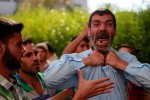
Father of Boys Killed by IsraelTurning and turning in the widening gyre

The falcon cannot hear the falconer;

Things fall apart; the centre cannot hold;

Mere anarchy is loosed upon the world,

The blood-dimmed tide is loosed, and everywhere

The ceremony of innocence is drowned;

The best lack all conviction, while the worst

Are full of passionate intensity.

                                                                        –W.B. Yeats, The Second Coming, 1921

This was the first poem I had ever read as a Literature student. And this was about thirteen years ago. I distinctly remember the words of our teacher who said, “Yeats takes strange apocalyptic delight in these words.” Then, while simply making class-notes, the words just sounded cool. Today, after thirteen years, I recall them now with strange apocalyptic dismay. I just read an acquaintance’s post off Facebook – something about detention camps and the systematic (um, strategic?) exit of the Palestinians from their own home. On a permanent basis. I offhandedly posted a comment on the post about how I thought that “history repeats itself” is an obsolete cliché. In this poem, the word “gyre” was Yeats’s philosophical concoction: that history repeats itself every two thousand years. Or something. He obviously had The Great Apocalypse in mind. But how wrong was he. History repeats itself sooner than what he had perhaps calculated.

I will not say that Israel is the new Hitler. That’s been done. I will not say that the suffering of the Jews at the hands of Hitler with his premise to purify the Aryan race was justified. I will not say that the Jews of that unfortunate time were not oppressed. I will not even say that all Jews should now be condemned simply because they are Jews. Thankfully, I choose not to be anti-Semitic. However, what we are seeing today is a telling commentary of profound racism, discrimination, otherization, profiling, stereotyping, ethnic cleansing, apartheid or whatever anthropological/political label you want to choose for convenience. I faintly recall one of the slides from a popular apocalyptically delightful documentary called ‘The Arrivals’ that came out in 2008. No, I am not a conspiracy theorist; however, the documentary had some certain truths. One of them being how The Arab has been systematically and strategically been represented as the convenient villain, the sub-human, the barbarian, the uncouth monster who is incapable of sensitivity that is otherwise so intrinsic to the rest of the human race. How – by that very fact – we feel no sympathy when we see images of the horrors of Abu Ghraib, of Gitmo, of Palestinians or anyone who could be linked in any way to the desolate desert of Hijaz. Who are we kidding? Islamophobia was present even Sayyidna Muhammad (peace and blessings be upon him) shocked the world with his arrival. The Final One came from Ismail, not Ishaq (blessings upon them both), much to everyone’s surprise. He was an Arab. He was not from Jerusalem, as was the case otherwise with the rest who came before him. He came and changed the way things were done and to be done, forever. And those who rejected him simply because he was unlike them were deeply and detrimentally racist. But some like Sayyidna Salman bin Farsi’ who were out to root for the truth saw the difference. And accepted him.

Yet as time has gone by, the Arab – now loosely seen as the Muslim – is a potential threat. We have all heard of, and some have possibly read, Edward Said’s Orientalism in which he carefully dissects this ambivalent relationship between the Self and the Other. Again, context is an important factor in determining the content of any author’s work. Perhaps seeing himself as a Palestinian, Said’s own analysis can now be dismissed as being prejudiced. But it would be quite disingenuous for us to conveniently disregard his work which offers an incisive introspection of the West’s gaze on the other side of the globe: how is difference viewed – to be fascinated by, and to be feared, and to be controlled. Maybe even conquered. This fear did not just erupt with the tragic events of 9/11. Again, a convenient trump card to look at the Bedouin beast under the microscope.

Islamophobia today – in our very own backyard – is demonstrating itself in the most strange and silly of ways showing how deeply entrenched we are with our fears and prejudices. From people getting so upset by the trivial semantics of sehri versus suhoor and Khuda versus Allah Hafiz, to an entire population that is being bull-dozed and droned and dimed into annihilation, the Arab is an intruder, that “little snake” that has crept into not just our preciously paak Pakistani culture, but is somehow going to take control of the world. We get uncomfortable when we see any woman dressed like an Arab, or any man who is looking like one, or a child who doesn’t say “Hey” but rather says “salaam” even to kids of his own age. We feel and take offence at it as if our own national integrity is at stake. That is why whenever you talk about Palestinian suffering at least in the drawing rooms of Pakistan, what you inevitably get to hear is: oh what about our IDPs? What about our minorities? Hamas is a terror organization like the Taliban; and other such half-baked tautologies. Extend this same dynamic of discourse and thought to the larger drawing rooms of the globe: oh what about animal rights? What about global warming? All these terror organizations are a menace that must be removed – after all, we are the defenders of humanity. Yes, IDPS are a huge and pressing concern for our nation – much more pressing than “suhur” and black abayas; Yes, if we don’t care enough about global warming there won’t be any Maldives for us to party away in the summers and we may just be living off an iceberg. I am deliberately being sarcastic, if not entirely cynical. These issues are grave. But graver still has been the utter apathy of the entire global community over a people that has been duped, manipulated, marginalized, bombed, beaten up, massacred, shot, imprisoned, and now potentially going to be expelled from its own soil. Why: they’re Arabs, why not?

 Thankfully, many are not tuning into mainstream newsrooms to see what is really going on, as was the case before. Little did we know that we had been warned before, long, long ago:

O you who believe, if an evildoer comes to you with a report, look carefully into it, lest you harm a people in ignorance, then be sorry for what you have done! Al-Qur’an(49:6)

Now most of us are quite sorry for our chosen ignorance. Perhaps, we chose not to believe. Finally, due to social media, after nearly a century of silence the world has seen some semblance of the truth. Not perhaps as true as Salman bin Farsi’, but many are getting there. The conflict effectively began as early as 1897 when the Zionist Organization, now ironically known as the WZO (W, stands for World) rose to full throttle in 1948 and now simmers and seethes to this day. And the battle is not perhaps on the face of it about God, the Promised Land, or the Dangerous Neighbor. As Robert Fisk has stated, “as usual, it’s about land.” Veni, vidi, vici. Wonder why the Arabs said, “You’re welcome,” in the first place. A fitting remix of Caesar’s words have now retuned in a rap song.

I came, I saw, I conquered, I shot you down

Your brain no have no conscious, don’t make a sound

I came, I saw, I conquered, what you do now?

Your brain no have no conscious, what you do?

Don’t make a sound…

But social media finally helped the hitherto silent global community speak, and shout. Protests are being raged, petitions are being signed, boycotts are being advocated, webpages are being designed, images, stories, videos are being shared. But many mouths are left gaping in silence. How could someone bully a people like that? How could anyone stand up and root for such bullies? How can anyone not say a word? How can an oppressed people not react? The fact that Protective Edge is a retaliation for the kidnapping and killing of three Israeli teenagers is not new news. What happened to the boys was wrong, unacceptable, and unsavory. And so, IDF killed not three, but four boys playing football on a beach. If simply, and callously, mere numbers are looked at, and the Jewish and Islamic principle of lex talionis – eye for an eye, or qisas – which both religious communities (among other things agree on) is followed, retribution has been grossly served. But the IDF is not winning by just one number, but by a hundred. The retribution is being unleashed on thousands, and nearly 600 have already paid for it, of which 76% are civilians, and 45% women and children, according to the UN’s Coordination of Humanitarian Affairs. Yet still protocol demands that this just may be amounting to war crimes. And finger-pointing is always convenient: “ask them, they started it.” But the Arabs can turn around and make the same claim when the conflict began to take its monstrous form nearly half a century ago.

“With the establishment of a relationship of oppression, violence has already begun. Never in history has violence been initiated by the oppressed. …There would be no oppressed had there been no prior of violence to establish their subjugation.” – Paulo Freire.

Both nations have met with oppression in their religious history. Both nations have met with oppression in their recent living history. How can they not understand what it means, and what it entails? How can Hamas’s reaction be simply dismissed as terrorism? How can a home-made rocket be the same as DIME munitions? How can a one-minute warning phone-call be adequate for an entire home to wrap up, pack up, and run for their lives? How can a stone stand in the way of a tank ready to bulldoze? How can the global audience not stir and shout? How can those who have the reins of power wear blinders themselves? As journalist, Ferrari Sheppard noted during his recent trip to Israel-Palestine,

“Zionism has convinced many Jews that they are preserving themselves. The common thought is that if the “savage” Palestinians stop resisting, stop shooting rockets, stop fighting Israel’s inevitable domination, there can be peace. I find this peculiar because during my visit, I felt no danger from Palestinians, only from Israeli soldiers. Perhaps it’s because I’m accustomed to being hunted in America. There is no Palestinian-Israeli conflict; there is only oppression.”

This is a lopsided war. There is no contest really between unequal players. The Nazis were no match for the Jews. The Israel State is no match for a marginalized Palestinian group. The issue of Palestine is not just about a people being wronged and punished for being different. It’s not just about power either anymore. It’s a tug of war for survival, with millions that have been swept away in the struggle. The Jews who have witnessed the horror of the Holocaust have seen how generations have been wasted, never to recover. And the same fate and horror awaits the Palestinian people. Gideon Levy, a survivor of the Holocaust and a prominent literary figure of the Israelite community, poignantly points out:

“I am amazed again and again at how little Israelis know of what’s going on fifteen minutes away from their homes,” he says. “The brainwashing machinery is so efficient that trying [to undo it is] almost like trying to turn an omelette back to an egg. It makes people so full of ignorance and cruelty.”

Yeats was wrong. It really does not take a gyre to unspiral itself through the ages to show how history recklessly regurgitates. History is ruthless in its repetition. We see it every day now on our Facebook pages and our tweets, unravelling as a protracted and pathetic global human tragedy. And we, as the audience, wait yet again – to see what happens next.

Surely some revelation is at hand;

Surely the Second Coming is at hand.

The Second Coming! Hardly are those words out

When a vast image out of Spiritus Mundi

Troubles my sight: a waste of desert sand;

A shape with lion body and the head of a man,

A gaze blank and pitiless as the sun,

Is moving its slow thighs, while all about it

Wind shadows of the indignant desert birds.

The darkness drops again but now I know

That twenty centuries of stony sleep

Were vexed to nightmare by a rocking cradle,

And what rough beast, its hour come round at last,

Slouches towards Bethlehem to be born?

Israel’s Zionist Foundation and Expansionist Dream – A Short History

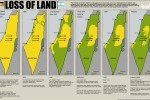
palestine-loss-of-land‘At Basel, I founded the Jewish State. If I said it out loud today, I would be answered by universal laughter. Perhaps in five years, and certainly in fifty, everyone will know it.’[1] ~ (Theodor Herzl writes in his diary about Basel Zionist Conference, 1897 where Zionism was officially coined)

The birth of the State of Israel on 14th May 1948 is a turning point in the history of the Middle East and one of the most significant events of the twentieth century. Based on Zionist ideology, Israel came into being as a ‘fulfilment of the promise of the Jewish scriptures’. Since its inception, Israel centres its relations with the native population and neighbouring countries on an existential threat. Alliances, ties, negotiations and treaties all base on Israel’s so-called security concerns faced from within and outside the country. But Israel’s Zionist foundations and expansionist aims have a major role to play in the volatile situation of the Middle East.

Israel, by definition and by essence is a Jewish state and was formed to give the Jews, living in different parts the world after the Diaspora, a national home. While Zionist ideology laid the foundation stone of the state, the native Arab population and the seemingly mighty neighbours joined by the rhetoric of common Arab roots, language and cultures became the immediate security threat for the country. But very soon Israel’s man and military power was evident to her as well as to the hollow and deeply divided Arab world. The idea that there was no power in the neighbouring world that matched the military strength of Israel became evident after repeated humiliating defeats encountered by Arab forces, but the case built by Israel as, David surrounded by the forces of Goliath, continued to play a significant role in Israel’s expansionist plans based actually on the ideas of Zionism.

ZIONIST FOUNDATIONS OF ISRAEL:

Zion is the biblical name for Jerusalem.[2] Political Zionism is a concept of the late nineteenth century, coined by Theodor Herzl, a Hungarian secular Jew, in the background of strong anti-Semitism in Europe. His book ‘The Jewish State’ provided a detailed plan for a state where Jews, who were not a religious group but a nation in his views, were to live in peace. In 1897, at the Basel Zionist Conference, the idea of Zionism was officially founded i.e. a ‘Jewish national home’ in Palestine. Herzl mentions in his diary,

‘At Basel, I founded the Jewish State. If I said it out loud today, I would be answered by universal laughter. Perhaps in five years, and certainly in fifty, everyone will know it.’[3]

The three strands of Israel’s identity i.e. religion, nationalism and the Holocaust, as described by Michael Barnett, help Israel portray herself to be in an isolated state and vulnerable to security concerns from different fronts.

‘While all national identities differentiate between ‘us’ and ‘them’, arguably the centrality of religion, nationalism and the Holocaust in Israel’s identity, make these effective and cognitive boundaries more severe and austere’.[4],[5]

Chaim Weizmann, the elected President of World Zionist Organisation was the strongest link between ideas initiated by Herzl and the British Empire. He put all his efforts to win British support for ‘Jewish Commonwealth in Palestine’ belittling the risk of Arab opposition and portraying them ‘a tiny fraction of large Arab nation’[6]- Balfour Declaration, a letter written by British Foreign Secretary Arthur J. Balfour, promising a national home for Jewish people under British support came as a major achievement for Zionists in 1917. Jews were only 10% of the population. The 90% were a non-existent entity for Weizmann as well as the British. The declaration opened the doors of Palestine to the Jews and the Zionist ideas started becoming clearer with time. Although diplomacy was always the way to the goal, and avoidance of the term ‘state’ and preference for usage of ‘a national home’ was the trend, but Weizmann when asked at a peace conference in Paris defined the Jewish National home as to make Palestine as Jewish as England is English.’[7] The Arabs were not partners in any negotiations and Weizmann’s policy was uncompromising in terms of Jewish settlement goals in Palestine.

Jabotinsky, a staunch Jewish nationalist and the founder of Revisionist Zionism, believed in the supremacy of the Jews. For him, Jews were the source of budding Western civilization in the backward and stagnant East. While he acknowledged that no voluntary agreement was possible between alien settlers and native population, the idea of return to Palestine could not be bargained.

We must either suspend our settlement efforts or continue them without paying attention to the mood of the natives. Settlement can thus develop under the protection of a force that is not dependent on the local population, behind an iron wall which they will be powerless to break down.’[8]

For him, an iron wall, i.e. a strong invincible force, was the answer to the Arab problem. Negotiations would only be fruitful if the Zionists were physically and militarily stronger than the natives. Peaceful coexistence is a possibility only after overpowering the threats, materially and by force. For Jabotinsky, there was nothing immoral about the concept of the ‘iron wall’, if the idea of Zionism and right to return to the Zion was to be achieved. The latter is a sacred truth, so any step taken in whatever shape, no matter how immoral it looks to the world, becomes automatically sacred.[9]

Arab resistance was very natural in these circumstances. Riots against the Jews took the shape of full-blown upheavals. Arabs rejected all proposals put forward by the British. David Ben Gurion, the founder of the State of Israel, pushed the British for establishment of a Jewish state after increasing Arab resistance. Lord Peel’s commission report suggested partition of the land in two states in 1937. Although the Zionist leaders were divided on the issue of borders of the states, Ben Gurion’s idea was to accept it for the start and the rest of the country would soon be under Jewish rule.

‘Erect a Jewish State at once, even if it is not in the whole land. The rest will come in the course of time. It must come.’[10]

This was the foundation of Israel: Religion, Zionism (Jewish nationalism), a history of Diaspora, and a strong belief in moral right to return. As perceived by Jabotinsky, the settlers would naturally be unwelcomed by any native population and that is where importance of security would come into play. Thus, pillars of unmatched security and powerful military were absolutely essential to support the foundation stone of identity. Zionist movements developed their own military power in order to be independent of any outside support for survival through the paramilitary organisation called Haganah, and Irgun. In the backdrop of end of World War II, the Holocaust and strengthening Zionist military force, General Assembly of the United Nations passed a resolution in favour of the partition of Palestine in 1947. In 1948, the state of Israel was born in the midst of confrontation with Arabs, within and outside the state.

THE CONFLICT: A NATURAL OUTCOME OF OCCUPATION:

The Arab-Israel conflict is as old as the proclamation of Israel. The Jewish population in Palestine increased dramatically from 10% (54,000) to 32% in 1947. With military supremacy, Zionists were able to gain control of the territories defined in the UN partition plan. The first war against the new state began immediately with Egypt, Jordan, Syria, Iraq and Lebanon but due to disunity, poor communication, absence of reliable intelligence and poor leadership, coordination and planning[11], the Arab states failed badly. Also, the military balance was in favour of Israel with total number of Arab troops of only 25,000 and IDF over 35,000 increasing to 65,000 within two months and 96,441 in seven months. As Avi Shlaim comments, ‘In this war, as in most wars, the stronger side prevailed.’[12] Armistice was signed between Israel and Arab states in 1949. But the border tensions remained high.

The subsequent crisis came in the shape of the Suez war of 1956. Colonel Gamal Abd al-Nasser of Egypt had reached an agreement with the British to withdraw from the military base in the Suez Canal. Israel for her own security wanted the British to remain in the area, therefore a spy ring was activated so as to blow up the installations and give reason to the British not to vacate the area. Spies were captured, tried and hanged by Egypt. Israel’s public saw it as Egypt’s hostile attitude towards their state. To satisfy the public with government’s prompt action and state’s military superiority, Israel attacked Gaza and caused heavy Egyptian casualties. Nasser signed arms deal with Soviet Union, which caused Israel to get more arms from France. Britain not happy with Gamal refused to finance Aswan Dam. Nasser’s retaliation came in the form of nationalising the Suez Canal which was the lifeline for the colonialists to rule the other side of the world. Britain, France and Israel attacked Egypt in the Suez War of 1956. The Israeli army managed to occupy the Sinai Peninsula within 100 hours[13]and Sharm al-Sheikh, thus opening the Straits of Tiran, which were Israel’s primary route to East Africa but had been blocked by Egypt for several years.

In 1967 the six-day war was the most remarkable military victory in the history of Israel. 5th June to 10th June, Israel had occupied the West Bank and the Golan Heights, the Gaza Strip and the entire Sinai Peninsula. Arabs suffered from a humiliating defeat, tipping the balance of power heavily in favour of Israel. ‘The annexation of East Jerusalem, was the first and the most dramatic assertion of Israel’s claim to sovereignty over its ancient homeland. Zion, was at the heart of Zionist dream for the restoration of a Jewish kingdom in Palestine.’[14]

The political and military equation began to change after this war. Syria and Saudi Arabia displayed willingness to recognize Israel, and Egypt and Jordan signed peace treaties. The demand of surrendering the territories occupied in 1967 remained prominent in exchange of recognition and peace with Israel throughout the post war era. The major argument in retaining the West Bank was security-based, as it would form a barrier against any attacks from the East. But the West Bank also formed part of ancient Israel (Judaea and Samaria). The Revisionist Zionist Likud party kept rejecting the idea of any kind of surrender even if peace with neighbours and natives became impossible. Their expansionism towards the fulfilment of a Jewish state did not take into account the opportunities of peace offers. Israel’s military supremacy and invincibility throughout these years had made the expansionist goal much easier even if it meant the subjugation of the native population. Negotiations, compromise and diplomacy did not hold much value due to the ‘iron wall’, the unconquerable force once perceived by Jabotinsky, which had later transformed into a literal physical reality.

 THE MIGHTY OPPRESSOR AND THE HELPLESS NATIVES:

The Palestinian problem remains a real one until today. Israel’s population reached six millions in 1998, nearly ten times what it had been in 1948.[15]Israel’s war of independence in 1948 was Palestinian’s Nakba (disaster) when 780,000 Palestinians, two-thirds of country’s population were driven out by Zionist troops and design.[16]The remaining population was denied any political rights as if they were non-existent in the flow, due to the Zionist program, which had to be implemented by any means necessary. Destruction of an existing society in 1948, conquest of West Bank and Gaza in 1967, the invasion of 1982 with 17,500 Lebanese and Palestinian dead, the Sabra and Shatila massacres; the continuous assault on Palestinian schools, refugee camps, hospitals, civil installations[17] was all a show of asymmetrical power unwilling to create a peaceful society meant for coexistence. Israel’s security issues arise not only from it being a product of Zionist ideology but, simply put, an occupant in a land where the native population has no rights whatsoever despite Israel’s big claims of being democratic. The disparity of power between Israel and the native population also nullifies the security argument especially from inside the state, when Palestinians have no army, air force, tanks or sophisticated defences of any kind.

 ‘There can be no conceivable peace, in my opinion, that doesn’t tackle the real issue, which is Israel’s utter refusal to accept the sovereign existence of a Palestinian people that is entitled to rights over what Sharon and most of the people supporting him consider exclusively to the land of Greater Israel, i.e. the West Bank and Gaza.’[18]~ Edward Said

 A French philosopher Ernest Renan once said, ‘A nation is a group of people united by a mistaken view about the past and a hatred of their neighbours.’ In Israel’s case, the view of the past is not mistaken. The Diaspora, the Holocaust, and anti-Semitism of Europe are a horrible reality. But the translation of a terrible past into an uncompromising dream with results like massacres, subjugation, violation of international laws and expansionism, has given rise to merciless atrocities and has put at risk, the peace of the world. Security for Israel may be a genuine concern and will always be, not because the world is bent upon being anti-Semitic, but an oppressor will always be seen as an oppressor, no matter which part of the world he exists in. Every native population will see an alien settler with concern and the peaceful co-existence would never come into being if the settler’s inflexible passion or hunger for fulfilment of a dream brings endless tragedies, bloodshed and fears for the natives.

REFERENCES:

[1]A. Shlaim, The Iron Wall, Israel and the Arab World (The Penguin Press, 2000), p.3

[2] Ibid, p.1

[3]Ibid, p.3

[4]M. Barnett, Culture, Strategy and Foreign Policy Change, Israel’s Road to Oslo http://home.gwu.edu/~barnett/articles/1999_israel_ejir.pdf

[5]S. Telhami, M. Barnett,Identity and Foreign Policy in the Middle East (Cornell University Press, 2002), p.58

[6]A. Shlaim, The Iron Wall, Israel and the Arab World (The Penguin Press, 2000), pp. 6-7

[7]Ibid, p.8

[8]Ibid, p.13

[9]Ibid, p.15

[10]David Ben Gurion, Letters to Paula,(London, 1971), 153-157, A. Shlaim, The Iron Wall, Israel and the Arab World (The Penguin Press, 2000) p. 21

[11]E. L. Rogan, A. Shlaim, The War for Palestine, Rewriting the History of 1948, 2nd Edition (Cambridge University Press, Cambridge, 2007), pp. 80-81

[12]Ibid

[13]A. Bregman, Israel’s War, A History Since 1947, 3rd Edition (Cornwall, 2010), p. 59

[14]A. Shlaim, The Iron Wall, Israel and the Arab World (The Penguin Press 2000), p. 251

[15]A. Shlaim, The Iron Wall, Israel and the Arab World (The Penguin Press 2000), p. 597

[16]E. Said, The Consequences of 1948, E. L. Rogan & A. Shlaim (ed.), The War for Palestine, 2nd Edition (Cambridge University Press, Cambridge, 2007), p.248

[17]E. Said, The End of Peace Process: Oslo and After (Granta Books, London, 2002), p. xv

[18]Ibid, p. xv

Israel Has a Right to Defend Itself

“Israel has a right to defend itself just like a burglar has, who busts open someone else’s house, not for theft but for invasion, expelling the residents out with force, with a ‘superpower’ fully supporting his actions. Even if the burglar has the most sophisticated weapons, the children of the house fighting for their right to protest against the occupant with stones are surely dangerous militants, terrorists and fanatics”. Anyone who agrees to this narrative and replaces the term ‘freedom fighter’ with any of the three mentioned above, are normal human beings. The rest are too biased to think and discern what’s happening around the world.

“No country on earth would tolerate missiles raining into its territory from outside the borders” says President Obama defending illegitimate Israel’s war crimes, but I add Pakistan and Yemen are exceptions, tolerating American drones on civilians and yes, they do not have the right (or might) to defend themselves.

The most powerful man in the world i.e. President of the United States and the most powerful media backing the Zionist dream, are vigorously portraying to the world that Israel did it all in self-defence (as always), completely ignoring the fact that on 4th of November a mentally ill unarmed man was killed by IDF while approaching the border fence.

Then, on the 13th of October, a 13 year old boy (read militant),  Hamid Younis Abu Daqqa became a threat to Israel while playing football with his other ‘militant’ friends outside his house around 2 kilometres away from the border. This Real Madrid fan with his dangerous dream of becoming a soccer player was a big threat to Israel’s existence.

Then, it all began i.e. rockets from Gaza and the fierce attack from one of the most powerful armies in the world, with the media-supported propaganda on one side, and casualties, killings, amputations and real life emergency on the other.

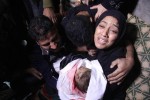
On November 10, 2012 a mother and a father in Gaza lost their 19 year old son. Matar Abu Al-Atta. Within two hours after Matar was killed his mother overwhelmed by shock gave birth to his little brother.

On the 14th November 3 year old Razan Yousef Arafat, the most beautiful angel I have ever seen was torched to death by an Israeli attack.

On Thursday, Nov. 15, 2012, 2-year-old Palestinian Waleed Al-Abadlah was killed in the southern Gaza Strip city of Khan Younis.

On the 16th of November 10-month-old Hanen Tafesh, was killed in a Gaza air strike.

Then, there was this 11 month old Omar Jihad Misharawi killed by an israeli attack who received a little bit of attention from the world media due to him being the son of BBC journalist.

An Israeli round hit Misharawi’s four-room home in Gaza Wednesday, killing his son, according to BBC Middle East bureau chief Paul Danahar, who arrived in Gaza earlier Thursday. Misharawi’s sister-in-law was also killed, and his brother wounded. Misharawi told Danahar that, when the round landed, there was no fighting in his residential neighborhood.” ~ The Washington Post

On 20th November two children, Suhaib and Mohammed, and their father Fuad Hejazi were killed in the northern Gaza Strip when an Israeli air strike in the Gaza town of Beit Lahiya crushed their home.

These are just some of the 165 people murdered by Israeli strikes. The pictures from Gaza melted every human heart. Yes, I said human, because some hearts are harder than rocks, calling for Hiroshima-Nagasaki like one-off solution for Gaza, (Gilad Sharon, son of Ariel Sharon), some calling for Palestine Holocaust, or some of them shamelessly defending Israeli atrocities as a well-deserved treatment for whoever died in the attacks.

When the efforts of truce were underway, on 14 November Israel carried out the extrajudicial killing of Hamas military chief Ahmad al-Jabbari. One question: Does Israel really want peace with a history of breaking ceasefires, targeting civilians including pregnant women, children and media personnel and sabotaging peace and truce agreements?

There’s a lot of noise in the media about rockets fired from Gaza towards Tel Aviv ‘in retaliation’ by the Zionist-loving media, conveniently reporting the rhetoric of 12000 rockets from Gaza to Jerusalem in 12 years. When asked about the casualties the lamest of answers emerge. ‘Israel knows how to defend its citizens while Gaza doesn’t’. No! The reality is that there is no comparison of the scales of ammunition and weapons of mass destruction Israel has against the homemade rockets of Hamas.

ISRAEL has 176,500 armed troops, 500,000 armed reservists, 11,000 armoured vehicles, 3000 battle tanks, 786 aircraft including American F16 bombers, 60 ships, 3 nuclear submarines and 1000s of prohibited cluster bombs. Compare it with the ‘force’ called Hamas: 12,500 troops,
0 armoured vehicles, 0 tanks, 0 aircraft, 0 ships, 0 submarines, 0 cluster bombs but 1000s Qassam and Grad rockets; not to forget the siege, the crisis of food, and shortage of medical and surgical facilities .

The world is out on streets for Gaza. Thanks to social media. The bias of conventional media has made them look uglier than ever and taken the trust further away. People trust independent activists and columnists more than the giant media mouthpieces of superpowers. Just to give you one example out of many. The fearless Harry Fear, the British journalist has been live streaming day in and day out from Gaza. He doesn’t share religion, caste or colour with the Palestinians. But some precious things we all share, like a live, beating, weeping human heart and eyes that see and appreciate the truth.

Long live Gaza

Oh! Did I forget to tell you that many facebook accounts including my own, were blocked due to Gaza pictures? Long live freedom of speech too.

Heroes of Gaza – III

Thanks to a Manchester Masjid’s fund raising in the UK, the children now have shoes footballs, table tennis kits, new tracksuits for the boys and the father. The girls have a new abaya each. The mothers are given tapestry and sewing materials to teach the girls the beloved Palestinian artistry of sewing. The family has a hot meal during our visit and is provided with wood for cooking in the coming weeks. Israel’s illegal witholding of essential supplies such as enough gas, oil and the components to maintain the utility works here means that Gaza is being pushed back to the time before electricity existed.When the power is cut, families must cook using gas from canisters. When the gas runs out – and right now, even the smallest gas ration means an eight to ten hour wait – families scavenge for twigs and light fires inside their apartments to try and cook what food they can afford to buy. It is becoming the norm for children to miss meals entirely. In this Beit Hanoun family, I ask the youngest boy of four, what his dream is, what he wants to be; “ I want to eat’ he says. “Somehow. Somehow.” This makes all the family laugh.

Next stop, Jaffa Street, Gaza city. The smart home of Mohammed Ajur, 25. He is a handsome young man with the sweet smile of faith (emaan) on his lips. He happily greets his friend who has brought me to meet him and myself and we are seated in the family salon. Mohammed was in his uncle’s home when a rocket hit during what Israel proudly calls operation Cast Lead. He woke up in hospital in Egypt having been in a coma for four days. His family were around him weeping.

What happened?’ he asked.

Habibi, you have lost both your legs’ he is told. His eyes shine with light and he smiles (smiles!) at the memory.

What did you say?’ I ask. Although by his contentment I already know the answer.

‘I said “Thanks be to God’ he replies.

I was so grateful to Allah for saving my eyes and my hands and giving me so many chances to continue my life in a good way. Many, many others in Gaza lost their sight and their hands from the attacks. Alhamdulillah, I have those. Alhamdulillah!’

Mohammed has since completed his university degree in sports education.

He laughs at this ‘yes I know sports education right! But I can do anything and I will succeed in this life, with God’s blessing, inshaAllah. My life is only beginning. I am now looking for a wife. There is so much I have to do now and I will!

He is the kind of man that makes you smile just being around him. On the middle of the table between us is a stunning urn, in copper glaze with rose workings and Arabic lettering across it. I admire it. ‘I made it’ he says shyly. He is also a talented artisan. ‘Do you like this jug?’ He asks me. I do. ‘Take it’ he says. I offer to pay but he refuses to sell it to me. It is a gift. Because I came to see him.

One final visit must be made this evening to a man whose livelihood mattered so much to my dear friend Vittorio Arrigoni; a fisherman. This father of six is in his late forties and hasn’t fished for two months. He explains that under the Oslo accord it was agreed that Gaza fisherman could sail up to 25miles from their coastline in order to fish. But Israel never honored this agreement. At first their naval forces forced the fisherman back to just six miles from the coast, then in recent years, to just three miles from the shore. There are no fish in this depth any longer due to over fishing and pollution. So, this fisherman took his boat, within his rights, to six miles and began to fish. The Israelis – as is a daily occurence for fishermen – attacked. At gunpoint he was told to strip naked and jump into the freezing February water where he was made to say for some time. Then still naked and humiliated he was handcuffed and taken to Ashdod for questioning. In the meantime the navy shot his boat so full of holes it is too damaged to repair. The livelihoods of four brothers and their thirty plus dependants – destroyed. Thanks to the same UK Masjid for donating the money to keep these families fed for the next month. After that, what will happen to them? Who knows?

As I type these words Israeli fighter jets are buzzing overhead jangling my nerves. They can be flying just for that effect or to launch yet another deadly attack on Gaza. It is 6am. The time when children are having breakfast and getting ready for school. Besides the night, this is the hour most favoured by Israel to inflict emotional terrorism on the population here. Driving through Gaza and seeing the queues of gas and petrol, I mentally titled my writing today as – Gaza’s suffering. But now the title has changed to ‘Gaza’s heroes’.


Previous links:

Heroes of Gaza – I

Heroes of Gaza – II

Rachel Never Died

Rachel Corrie, beautiful soul, born in Olympia, Washington was no ordinary child, no ordinary 23 year old student and no ordinary human being. And people, who are extraordinary, never die. They live for ever in the hearts and minds of their followers. They give direction to many and because of them, hope never dies. Because of such crazy and courageous, the ugliness of injustices is exposed.

Her 5th grade speech I am here because I care’ revealed no small dreams. At such a tender age, she talked of the oppressed, the poor and hungry and resolved to eradicate the ugly realities by the year 2000. As a student, she was different and wanted to explore the world especially after 9/11, year 2001. Ditching a beautiful and colourful American dream which she could have lived like many of her age, she travelled thousands of miles to Gaza to act as a human shield, where mercy and humanity is butchered every day and night, where men, women and children are murdered as a part of ethnic cleansing program, where houses are bulldozed, olive trees are cut, help including food and medicines from the rest of the world is denied and flotillas travelling to help humanity are attacked.

‘’Anyway, I’m rambling. Just want to write to my Mom and tell her that I’m witnessing this chronic, insidious genocide and I’m really scared, and questioning my fundamental belief in the goodness of human nature. This has to stop. I think it is a good idea for us all to drop everything and devote our lives to making this stop. I don’t think it’s an extremist thing to do anymore. I still really want to dance around to Pat Benatar and have boyfriends and make comics for my co-workers. But I also want this to stop. Disbelief and horror is what I feel. Disappointment! I am disappointed that this is the base reality of our world and that we, in fact, participate in it. This is not at all what I asked for when I came into this world. This is not at all what the people here asked for when they came into this world. This is not the world you and Dad wanted me to come into when you decided to have me.’’  (28.02.2003)

On the day she died (16.03.2003), she was 23, dressed in a fluorescent orange vest and with a megaphone in her hand she was trying to stop the demolition of a Palestinian home where she lived with the children who were considered family by her and vice versa. She was mercilessly crushed under a military Caterpillar bulldozer which came towards her, knocked her down, crushed her with its blade, backed up, and ran her over again and she died shortly afterwards. ’My back is broken’ were her last words.

What did she have in common with the Palestinian; faith, ethnicity, skin colour, language, social background? Absolutely nothing! What was common was humanity. She had eyes that could appreciate the truth, mind that wasn’t closed because of any bias, heart that would cry on injustice and brutality and a soul that would feel the pain of Nazi-style genocide.

Her emails to her family are a must read in which she accounts Israeli atrocities towards innocent Palestinians.

”I think, although I’m not entirely sure, that even the smallest of these children understand that life is not like this everywhere. An eight-year-old was shot and killed by an Israeli tank two days before I got here, and many of the children murmur his name to me, “Ali”–or point at the posters of him on the walls. The children also love to get me to practice my limited Arabic by asking me “Kaif Sharon?” “Kaif Bush?” and they laugh when I say “Bush Majnoon” “Sharon Majnoon” back in my limited Arabic. (How is Sharon? How is Bush? Bush is crazy. Sharon is crazy.)”

In 2003, Rachel’s news opened a new aspect of Palestinian cause to me. I learnt humanity existed above the boundaries of faith, ethnic origins and languages. I came to learn there are people on this earth who would risk their lives and everything for some other people despite absolutely no worldly strings attached between them. And it’s to date that I have explored a world that is cruel, unjust and merciless, but such people are a reason to live and resist. They give you direction, motivation and energy to challenge the ugly forces of the world.

For me Rachel Corrie is not the name of a person. It’s a phenomenon which embodies humanity, resistance, courage and craziness. Yes, she was as crazy as it needs to be to shake the world and stir the plans of the handful of unjust men ruling this world. And it’s this craziness and madness which is the ultimate requirement to challenge falsehood and malice. Human beings live and die, but phenomena, missions and ideas never die. They’re like beacons of light for generations to come. Rachel Corrie, an American, a peace activist and a trailblazer, will always be my hero.

“Love you. Really miss you. I have bad nightmares about tanks and bulldozers outside our house and you and me inside. Sometimes the adrenaline acts as an anaesthetic for weeks and then in the evening or at night it just hits me again – a little bit of the reality of the situation. I am really scared for the people here’..“When I come back from Palestine, I probably will have nightmares and constantly feel guilty for not being here, but I can channel that into more work. Coming here is one of the better things I’ve ever done. So when I sound crazy, or if the Israeli military should break with their racist tendency not to injure white people, please pin the reason squarely on the fact that I am in the midst of a genocide which I am also indirectly supporting, and for which my government is largely responsible. “I love you and Dad…”  Email to parents ~ 27.02.2003