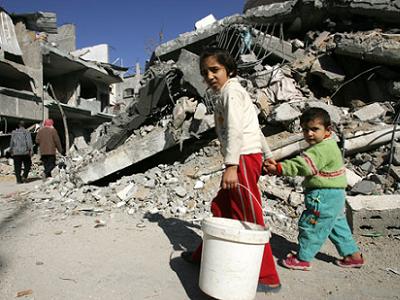
Heroes of Gaza – III

Thanks to a Manchester Masjid’s fund raising in the UK, the children now have shoes footballs, table tennis kits, new tracksuits for the boys and the father. The girls have a new abaya each. The mothers are given tapestry and sewing materials to teach the girls the beloved Palestinian artistry of sewing. The family has a hot meal during our visit and is provided with wood for cooking in the coming weeks. Israel’s illegal witholding of essential supplies such as enough gas, oil and the components to maintain the utility works here means that Gaza is being pushed back to the time before electricity existed.When the power is cut, families must cook using gas from canisters. When the gas runs out – and right now, even the smallest gas ration means an eight to ten hour wait – families scavenge for twigs and light fires inside their apartments to try and cook what food they can afford to buy. It is becoming the norm for children to miss meals entirely. In this Beit Hanoun family, I ask the youngest boy of four, what his dream is, what he wants to be; “ I want to eat’ he says. “Somehow. Somehow.” This makes all the family laugh.

Next stop, Jaffa Street, Gaza city. The smart home of Mohammed Ajur, 25. He is a handsome young man with the sweet smile of faith (emaan) on his lips. He happily greets his friend who has brought me to meet him and myself and we are seated in the family salon. Mohammed was in his uncle’s home when a rocket hit during what Israel proudly calls operation Cast Lead. He woke up in hospital in Egypt having been in a coma for four days. His family were around him weeping.

‘What happened?’ he asked.

‘Habibi, you have lost both your legs’ he is told. His eyes shine with light and he smiles (smiles!) at the memory.

‘What did you say?’ I ask. Although by his contentment I already know the answer.

‘I said “Thanks be to God”’ he replies.

“I was so grateful to Allah for saving my eyes and my hands and giving me so many chances to continue my life in a good way. Many, many others in Gaza lost their sight and their hands from the attacks. Alhamdulillah, I have those. Alhamdulillah!’

Mohammed has since completed his university degree in sports education.

He laughs at this ‘yes I know sports education right! But I can do anything and I will succeed in this life, with God’s blessing, inshaAllah. My life is only beginning. I am now looking for a wife. There is so much I have to do now and I will!’

He is the kind of man that makes you smile just being around him. On the middle of the table between us is a stunning urn, in copper glaze with rose workings and Arabic lettering across it. I admire it. ‘I made it’ he says shyly. He is also a talented artisan. ‘Do you like this jug?’ He asks me. I do. ‘Take it’ he says. I offer to pay but he refuses to sell it to me. It is a gift. Because I came to see him.

One final visit must be made this evening to a man whose livelihood mattered so much to my dear friend Vittorio Arrigoni; a fisherman. This father of six is in his late forties and hasn’t fished for two months. He explains that under the Oslo accord it was agreed that Gaza fisherman could sail up to 25miles from their coastline in order to fish. But Israel never honored this agreement. At first their naval forces forced the fisherman back to just six miles from the coast, then in recent years, to just three miles from the shore. There are no fish in this depth any longer due to over fishing and pollution. So, this fisherman took his boat, within his rights, to six miles and began to fish. The Israelis – as is a daily occurence for fishermen – attacked. At gunpoint he was told to strip naked and jump into the freezing February water where he was made to say for some time. Then still naked and humiliated he was handcuffed and taken to Ashdod for questioning. In the meantime the navy shot his boat so full of holes it is too damaged to repair. The livelihoods of four brothers and their thirty plus dependants – destroyed. Thanks to the same UK Masjid for donating the money to keep these families fed for the next month. After that, what will happen to them? Who knows?

As I type these words Israeli fighter jets are buzzing overhead jangling my nerves. They can be flying just for that effect or to launch yet another deadly attack on Gaza. It is 6am. The time when children are having breakfast and getting ready for school. Besides the night, this is the hour most favoured by Israel to inflict emotional terrorism on the population here. Driving through Gaza and seeing the queues of gas and petrol, I mentally titled my writing today as – Gaza’s suffering. But now the title has changed to ‘Gaza’s heroes’.


Previous links:

Heroes of Gaza – I

Heroes of Gaza – II

Heroes of Gaza – II

I, a stranger here in Beit Hanoun, walk down this road at dusk. Every window with a face in offers me ‘Salam.’ The doorway of the sole shop has a family sitting in it, I wave.

‘Assalamu Alaykum’, they shout at me – cheerily. Yes cheerily, I feel the lump in my throat that I carry inside forming again. “Peace’ they offer to the stranger in their midst, as they bathe me in smiles of instant friendship. On the corner two young guys come over and greet me as if I am a long lost cousin. There welcome is so warm that I wonder for a moment if we have met on a previous visit to Gaza.

“Okay’ says the tallest brother, after introducing himself.
‘Nice to meet you now you come to our home to spend the evening, First tea, then you stay with us. Yalla come!’..

I laugh..

‘Why you laugh?’ asks the other boy in his late teens or early twenties.

‘We don’t joking – you come for tea now, really, Fadal.’

These boys are brimming with life. Their eyes have energy and hope in them that is utterly at odds with the grim landscape they live in. They are heroes of Gaza, the next generation of hope, the ones who will not be broken.

We can’t take tea with them and are eventually allowed to leave only with sincere promises to return to their home as soon as possible.

We have come to visit, amongst this needy populace, a family in dire need.

Through a broken wooden gate, behind a crumbling stone wall, my friend Yassir, silent and grim faced, points me into a cement building that has no right to be standing. It was once a PLO prison. Now it is ‘home’ to a family of one father, his two wives and their seventeen children. Before the second intifada the father used to work in Israel and he had enough money for his growing family. After the blockade, it stopped. So he worked as taxi driver. And that income was just enough to get by on for his growing family. Then the siege came. Food prices have shot up to parity with those in European nations whilst incomes here are Third World low. His car began to have small problems which he couldn’t afford to repair, which led to worse ones which killed it. I pass its rotting carcass and enter a large unplastered room with a cement floor. There is no furniture, no pictures, no adornments of any kind. Besides, two plastic chairs, the freezing space is utterly empty except for a small TV, on a crate in one corner. Children with hollow eyes, mill about, expressionless, wide eyed at the surprise visit of so many unknown faces. They look (and are) shell shocked.

One of the wives makes an attempt to smile. The husband in his shame at the poverty of his family mutters ‘salam’ and looks at the ground. Their sixteen year old son has a limp, I ask what the matter is, ‘has he hurt himself playing?’.

His trouser leg is pulled up and a large plaster ripped off revealing a fresh ten inch wound with stitches. His ankle is also bandaged. Two years earlier the boy (then 14) had been collecting rubble in the wasteland, once orchards that Israel has now stolen as its ‘buffer zone.’ His job was to sell the rock for whatever he could, to scavenge then, in the hope of some money for the hungry family. An Israeli sniper at a long distant shot him in his leg, shattering the bone. He has finally after years had the pins put in his shin. It is likely he will limp for the rest of his life.

A smaller boy of around ten is brought over. His dirty tracksuit bottoms are pulled above the knee to reveal strange white patches. White phosphorous, the napalm of the 21st century was blown across this area when Israel rained it, by the ton, onto one of the most densely populated cities in the world.

Another son of around seven, shoeless and silent clings to his father’s legs.
‘This boy’ he tells me, ‘has developed mental problems since the attack in 2009. The soldiers came many times into our home and wake the children up, shouting. Now he doesn’t talk and doesn’t act normally. Doctors can’t help him.’

Cooking is being done in the kitchen i.e. an empty cement space with a fridge that is empty except for four cauliflowers of questionable age. Due to the ‘cuts’ – twelve hour electricity blackouts – no family can chill or freeze food anymore. Fridges are just storage cupboards in Gaza. There is nothing else in the room except on the dirty floor, a single, ancient electric ring on which, now, a pan of chips is cooking. Chips that are enough for perhaps three children in the UK would here feed a family of 20.

It is Salah (prayer) time. The smaller of the wives takes me to another empty room. This one is called a bedroom because it has blankets in it. She lays out a prayer mat for me.

As I pray, I can see my own home, my own happy, educated, well fed, daughters. All the luxuries of London flood my sight and tears come. Besides me the mother makes her prayer. Behind me one of her daughters hold a torch on me as the room has no lights and no electricity anyway. It’s not the poverty that gets me it’s the evil of humanity that pours agony on almost two million Gazans, year in year out for 63 years. It is so much worse here than when I came four years ago, that words can barely describe the new cruelties Israel has designed to torture the people in this vast concentration camp.

‘Habeebiti’ says the mother beside me. ‘Please don’t cry.’

Her concern for me makes me sob even more. I can’t speak with the weight of my grief. ‘Oh God’, I think to myself. ‘Don’t let her be kind to me, please, I can’t take it’.

But she is. Of course she is. She is Palestinian.

‘My dear, why do you cry? Are you alright?’

‘I…I..hate this for you...’ is all I manage to utter.

She looks into my eyes. Mother to mother.

‘What? Don’t cry for us, it’s okay, you can stop now, shhh’.

Then, she says the words that almost break me, words that make me feel so humble. I fear, I may never stop crying. Tears that begin as frustration and sadness -become tears of love and respect.

‘We are so happy. We are Muslims, we know this is our test and we must be patient. We are happy, really sister, we are. Allah will reward us if we can just be patient’.

These are the exact words I have heard in EVERY home I have entered in Gaza at this terrible time.

Continue to  Heroes of Gaza – I

or Heroes of Gaza – III


Heroes of Gaza – I

I write this from a freezing, dark hostel room in the centre of Gaza. This area is now in a twelve hour blackout, so there will be no hot water to shower with this morning and no internet. After three days here, I feel, dirty, tired and emotionally wrung out. Yet, I know that in 48 hours, when the time comes to leave, I will not want to go. For Gaza’s incredible people have again overwhelmed a visitor with their warmth, their ability to offer friendship on a first meeting and their absolute resilience and faith in a Divine plan.

Yesterday, driving around was a stark reminder of just how serious the fuel shortage is here. At regular intervals the roadside becomes jammed with many hundreds of battered, near death, vehicles, stalled. Men sit at the wheels or smoke leaning against them, faces grim. They are locked into an 8 hour wait for just 100 shekels of fuel. Not enough for a quarter of a tank in the larger cars. When the fuel at the pumps becomes perilously low, each driver may buy just 50 shekels. As a result, cars are becoming if not quite a rarity, then certainly for a city with a population the size of Gaza – a luxury. Roads that were once jammed with the honking life typical of all major Middle Eastern cities are silent. The silence is not a blessing either; don’t think that for a moment! I remember when Diana died and cars were banned from the city centre for her funeral, what a beautiful day that was. Citizens could reclaim the streets and remember what it was to stroll in peaceful, bliss.

This is different. This silence is morbid and desperate. For alongside the near empty roads, are shops boarded up. And the pavements which you’d think would be jammed with people are empty too. There is simply no way to get to work – if you have it. Many shops simply close down due to the blackouts. This silence is the quiet of despair.

My bodyguard Mr Falafel (his nickname) and my friend Yassir, drive me to Beit Hanoun to visit a family living on the edge of one of Israel’s infamous and ever expanding buffer zones. On our way out of the main city, Yassir shouts,

‘Stop, Lauren let us get out and see this.’

It’s not clear what he wants me to see, As I get out there are men and boys milling everywhere, hundreds. There is shouting. Then I see them. A yellow, mountainscape of plastic containers piled four high in some places and stretching from one end of the road to the other. We follow the line of boys and are shocked to see the queue is the same length around the corner.

‘What is your name!?” shout boys of all ages
‘How are you today?’
‘Where you come from?’

The foreign lady in the hijab provides a welcome distraction from their miserable duty and Yassir and I are quickly embroiled in a human maelstrom of faces and laughter. We squeeze away from the youngsters towards a father in his fifties who is near the front of the queue. I ask him what he needs.

‘Fuel for the generator. We have no light. No electricity. We can’t eat. The children are cold.’

He has six children. That is a small family here. Looking at the thousands of containers waiting to be filled, each powering a generator that has become the only (ir) regular source of power for Gaza homes, I realise that each one represents a family of ten or more.

In a week, they say, even the fuel at these stations will run out. Then what?…

It is dusk, Maghrib prayer time, as we reach Beit Hanoun. An area that was, not too long ago, a place of farming. Of vast orchards stretching as far as the eye could see, where adults worked and children sheltered from the heat of the sun, playing the games that only children understand.

This evening the sun sets over what’s left; a sealed off scrubland of weeds and thorns.

We get out of the car. “Israel sent bulldozers and destroyed everything, all the trees; old trees, old orchards.’ I learnt.

Such is the sight to my right. To my left across the pot holed ‘road’ is Gaza’s frontline with Israel. The enemy that it fears so much are families in roughshod apartment blocks. No frills here. No trips to Ikea for little home touches. Here ‘home’ is a cement block low rise, half finished, slum. There are so many children here it’s hard to fathom for the first time visitor. Large families are the norm in Palestine and in Gaza, a pride. Each window of the hundreds I pass can represent easily five children within. Beside each and every window are dozens of Israeli bullet holes or the larger impact damage from shells of all variety. Hard to imagine the international reaction if a family suburb in Tel Aviv were attacked like Beit Hanoun is attacked by the IOF, over not just days, not even months – but years.

I remember once asking a very poor mother in Gaza why she had so many children.

‘We need atleast seven children to each family here’, she said

‘Why? Because atleast two will be killed by Israel. Two more, Israeli will take to prison for a long time or cripple with rockets. Two may (may) have a chance to get educated and they will leave Palestine and never return, which leaves just one child to look after us in our old age...’


Continue to Heroes of Gaza – II

Rachel Never Died

Rachel Corrie, beautiful soul, born in Olympia, Washington was no ordinary child, no ordinary 23 year old student and no ordinary human being. And people, who are extraordinary, never die. They live for ever in the hearts and minds of their followers. They give direction to many and because of them, hope never dies. Because of such crazy and courageous, the ugliness of injustices is exposed.

Her 5th grade speech ‘I am here because I care’ revealed no small dreams. At such a tender age, she talked of the oppressed, the poor and hungry and resolved to eradicate the ugly realities by the year 2000. As a student, she was different and wanted to explore the world especially after 9/11, year 2001. Ditching a beautiful and colourful American dream which she could have lived like many of her age, she travelled thousands of miles to Gaza to act as a human shield, where mercy and humanity is butchered every day and night, where men, women and children are murdered as a part of ethnic cleansing program, where houses are bulldozed, olive trees are cut, help including food and medicines from the rest of the world is denied and flotillas travelling to help humanity are attacked.

‘’Anyway, I’m rambling. Just want to write to my Mom and tell her that I’m witnessing this chronic, insidious genocide and I’m really scared, and questioning my fundamental belief in the goodness of human nature. This has to stop. I think it is a good idea for us all to drop everything and devote our lives to making this stop. I don’t think it’s an extremist thing to do anymore. I still really want to dance around to Pat Benatar and have boyfriends and make comics for my co-workers. But I also want this to stop. Disbelief and horror is what I feel. Disappointment! I am disappointed that this is the base reality of our world and that we, in fact, participate in it. This is not at all what I asked for when I came into this world. This is not at all what the people here asked for when they came into this world. This is not the world you and Dad wanted me to come into when you decided to have me.’’  (28.02.2003)

On the day she died (16.03.2003), she was 23, dressed in a fluorescent orange vest and with a megaphone in her hand she was trying to stop the demolition of a Palestinian home where she lived with the children who were considered family by her and vice versa. She was mercilessly crushed under a military Caterpillar bulldozer which came towards her, knocked her down, crushed her with its blade, backed up, and ran her over again and she died shortly afterwards. ’My back is broken’ were her last words.

What did she have in common with the Palestinian; faith, ethnicity, skin colour, language, social background? Absolutely nothing! What was common was humanity. She had eyes that could appreciate the truth, mind that wasn’t closed because of any bias, heart that would cry on injustice and brutality and a soul that would feel the pain of Nazi-style genocide.

Her emails to her family are a must read in which she accounts Israeli atrocities towards innocent Palestinians.

”I think, although I’m not entirely sure, that even the smallest of these children understand that life is not like this everywhere. An eight-year-old was shot and killed by an Israeli tank two days before I got here, and many of the children murmur his name to me, “Ali”–or point at the posters of him on the walls. The children also love to get me to practice my limited Arabic by asking me “Kaif Sharon?” “Kaif Bush?” and they laugh when I say “Bush Majnoon” “Sharon Majnoon” back in my limited Arabic. (How is Sharon? How is Bush? Bush is crazy. Sharon is crazy.)”

In 2003, Rachel’s news opened a new aspect of Palestinian cause to me. I learnt humanity existed above the boundaries of faith, ethnic origins and languages. I came to learn there are people on this earth who would risk their lives and everything for some other people despite absolutely no worldly strings attached between them. And it’s to date that I have explored a world that is cruel, unjust and merciless, but such people are a reason to live and resist. They give you direction, motivation and energy to challenge the ugly forces of the world.

For me Rachel Corrie is not the name of a person. It’s a phenomenon which embodies humanity, resistance, courage and craziness. Yes, she was as crazy as it needs to be to shake the world and stir the plans of the handful of unjust men ruling this world. And it’s this craziness and madness which is the ultimate requirement to challenge falsehood and malice. Human beings live and die, but phenomena, missions and ideas never die. They’re like beacons of light for generations to come. Rachel Corrie, an American, a peace activist and a trailblazer, will always be my hero.

“Love you. Really miss you. I have bad nightmares about tanks and bulldozers outside our house and you and me inside. Sometimes the adrenaline acts as an anaesthetic for weeks and then in the evening or at night it just hits me again – a little bit of the reality of the situation. I am really scared for the people here’..“When I come back from Palestine, I probably will have nightmares and constantly feel guilty for not being here, but I can channel that into more work. Coming here is one of the better things I’ve ever done. So when I sound crazy, or if the Israeli military should break with their racist tendency not to injure white people, please pin the reason squarely on the fact that I am in the midst of a genocide which I am also indirectly supporting, and for which my government is largely responsible. “I love you and Dad…”  Email to parents ~ 27.02.2003