Ghazali Premier College – An Untold Story

gps

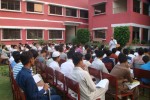
I was invited for a talk to Ghazali Premier College  (GPC) and I was very surprised when I visited the place.  Without any doubt, it was one of the best institutions I had seen in years. GPC immediately became an inspiration for me.
Muhammad Tariq, the director of GPC left a lucrative job in Dubai and came back to Pakistan to play a positive role. It was always on the back of his mind to contribute towards the society. Ghazali education trust took him on board and they went on to acquire this new boarding school which was going to house talented students from all across the country.  Students from 354 schools of Ghazali education trust were selected and Ghazali Premier college came into being. One year onward, its something worth visiting.

The facility is located in suburbs of Lahore on Multan road. It is a purpose built campus with attached mosque and hostel in one campus, housing 118 students. These students are selected from all over Pakistan. I was delighted to know that six students from Balochistan are also in this campus. Many of the enrolled kids belong to poor families and quality education is a distant dream for them. GPC provides free education, boarding and lodging to all the students. It is difficult to think about a free boarding school which intakes underprivileged students from all over the country and gives them free education and boarding without any compromise on the quality of education. GPC is certainly a shinning star on the dark horizon of Pakistan.

The focus in GPC  is on inculcation of Islamic ethical values along with contemporary education.  The schedule of students start with Fajar prayers at the mosque and then they are taught lessons from holy Quran. Entire day activities are thoroughly planned which includes studies and co-curricular activities. Weekends are reserved for social activities and guest lectures.  Typically I got impressed with the social activities of students when I was told that currently these students have planted 4000 trees in the nearby locations of the campus. I was told  that students are very keen in social activities which is actually a missing aspect in typical Pakistani education system.
My lecture was on contribution of Muslims towards science and how can we get back on track. I tried to involve the kids and was stunned to see their IQ level. The knowledge level of 7th and 8th graders was amazing.  Their knowledge was also certainly above the text books.  They were very energetic and confident. I was amazed by the quality of their questions. Given the scenario that these kids belong to remote areas of the country, their participation in my talk reflected the hard work of their teachers.
During the interaction with the teacher, I came to know that most of them are highly qualified, with some having their Masters from abroad and all of them joined hands to contribute towards the betterment of the society. Ghazali Premier Trust is planning to open many colleges in far flung areas of Pakistan to spread education in remote areas. The beauty of this project is that it is entirely free and the students have to pay nothing. The quality of education is comparable to any best system  just because of the dedication of the team.

Resources are key to such projects. The team of GPC is trying its level best to raise donations so far. They are also thinking about expanding this project and plan to open other such boarding schools in remote areas of the country. I hope that people like these will continue their efforts. It is our job to help them in every sense so that they succeed in their mission of making Pakistan a better society.

The ‘Begum’ and ‘Saheb’ Culture

Come, visualize with me..

Sakeena, a 10 year old who has never been to school, never enjoyed playing with dolls let alone the funky hi-tech gadgets,  is carrying a 1 year old in her lap, sitting on a table distant to begum saheba’s. Her dull glitterless clothes, unadorned arms and ears tell us, she’s the odd one. Sakeena’s job is to take care of the child who she can hardly carry, feed him, change his nappy and make sure he doesn’t cry while begum saheba enjoys her lavishly decorated table and socialising exercise. Sakeena has no right to run around, play or enjoy with her age-mates at the dinner and absolutely no sharing the table. She may get some food though.

Najma, a 28 year old who looks to be 40, skinny and dark is sweeping the floor of a ‘bangla‘ (a huge mansion). Her two-year old has an ear infection and she does not have money for antibiotics. Her concentration is everywhere. She has to finish work and get her child’s ailment sorted somehow. She takes a day off next day to see the doctor and to take care of her child who does not have proper clothes on his body and no footwear whatsoever whether it’s summer or winter. She gets told off as there was a grand dinner at saheb’s place and begum saheba was in thick soup when Najma didn’t turn up as there was a big mess in the kitchen to be sorted after dinner. She was scolded, insulted and eventually fired.

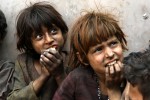
A child surrounded by a garbage heap, sorting paper and recyclables and eating our rotten left-overs from it at the same time – A child covered with houseflies sleeping on a pavement outside a jeweller’s shop (where jewellery of millions of rupees is being chosen). He dozed off while waiting for his father to go home, who sells Kulfi outside a popular shopping centre – A child who sits outside a fast-food restaurant and begs usfor roti and cannot afford a chicken wing let alone a mighty burger – A child who cleans our windscreen for a few rupees and we shun him away because his water is dirty and would ruin our car – A baby sleeping in the lap of a begging mother unaware of the cruel world he has come to. She covers his face to avoid bright headlights of the cars passing by but we can see his beautiful but muddy feet sticking out of her chaadar – A child who sells a rose bud outside a restaurant where we spent thousands of rupees for what? Yes, one meal –

A woman who washes our expensive branded and imported (etc.) dinnerware, breaks a small chip and is shouted at, beaten and declared unfit for her job – A woman who cleans our extravagant dining table, but is never allowed to share it, dusts our sofa but can’t sit on it and we love it when she sits on the floor near our feet – A driver who drives our luxurious car but waits for a bus for hours around midnight to get home and see his children on the weekend – The guard/chowkidar who sleeps outside on the next door plot under a tent or in our car porch while we sleep in our air-conditioned room away from heat and mosquito bites – The labourer who builds our beautiful house in scorching sun, just to sleep in a place one can hardly call a room, but it’s all-in-one home for him (kitchen, bedroom, lounge etc.).

Close your eyes..

Imagine the muddy feet, the dirty smelly clothes, no surety of food for the day, no money in the pocket, let alone banks, no transport. Recall their mistakes and shortcomings; recall our anger, lack of forgiveness, zero tolerance, and humiliation they face every day. And now, switch sides.Imagine they were us and we were them. Scary thought, isn’t it? They didn’t choose their fate neither did we. So why not fear the Creator who put us in a MORE difficult test than them by giving us authority over them.

The dehumanization of the society has reached its limits. The above examples are complacently accepted. Humans are not equal. They are unequal just because they were born to parents of different social statuses. And the one who has money and authority is superior. The kings and queens found everywhere in our society show their grandeur with harshness and humiliation towards the subordinates at home as well as the less fortunate outside home. Softness, empathy and forgiveness are considered weaknesses.

But this is not what we were taught, is it? ‘We are Muslims and we are proud’, ‘we love the Prophet (SAW)’ and ‘we are ready to die for him’ etc., but are we ready to live in a way he taught us to and follow his footsteps if it kills our big ego? Forgiveness, controlling anger and ignoring mistakes were compared by the Prophet (SAW) with strengths of a wrestler. He taught us that superiority came with piety and not money. Do we think that the mighty and wealthy Arab leaders who lashed and tortured the bodies of Khubab and Bilal (RA) were superior to them? No! Bilal, the black, the poor, the slave, the worthless was the most precious in the eyes of the Prophet (SAW). Did he eat in a separate corner, in different plates, a left-over food? Dig out something that supports us doing so with our servants. But, sharing tables is probably too much to ask for as far as our magnificence is concerned.

“When the slave of anyone amongst you prepares food for him and he serves him after having sat close to [and undergoing the hardship of] heat and smoke, he should make him [the slave] sit along with him and make him eat [along with him], and if the food seems to run short, then he should spare some portion for him [from his own share]” (Muslim).

Remember, Zaid Ibn Harith (RA) who was a slave and the Prophet (SAW) freed him and gave him the choice to go with his father, who had come, to take him, but he refused to go with his father and preferred to stay with the Prophet just because he was loved and cared for. He says he was never told his mistakes and the Prophet (SAW) used to cover what he did wrong without even mentioning it to him.

Once the Prophet (SAW) reprimanded a companion like this,

 ‘O Abu Dhar! Did you abuse him (your slave) by calling his mother with bad names. You still have some characteristics of ignorance. Your slaves are your brothers and Allah has put them under your command. So whoever has a brother under his command should feed him of what he eats and dress him of what he wears. Do not ask them (slaves) to do things beyond their capacity (power) and if you do so, then help them.’(Sahih Bukhari)”

Gentleness and kindness are rare traits, very valuable in the scales of Allah. They are not weaknesses. They are actually extremely difficult traits to stick to in this materialistic world where everyone can get their mission accomplished at the point of a gun, money or a big tongue which cause similar damage to the weak ones. Kindness is a forgotten virtue. To kill an enemy might be easy in the current times, but killing ego is a hard job. But it raises us in the eyes of Allah and we are actually following the Prophet (SAW) when we do it. What a deal and what a surely victorious way. He went on to say, ‘Seek me among your weak ones, for you are given provision (or help) only by reason of the presence of your weak ones’.

Once a man came to Prophet Muhammad (saw) and said, “O Allah’s Messenger! How many times should I forgive the mistakes of slaves?” The Prophet (SAW) kept quiet. The man repeated his question three times, and the Prophet replied at the third time, “Forgive them seventy times every day.”

We are in a more difficult test than they are. Their hereafter is easier, while we have to answer for every word that we uttered that broke them, every opportunity that we missed to help them and every action that we did to look down upon them as inferior human beings.  It was the equality, justice and liberty Islam talked of that attracted the poor and slaves to the call of the Prophet (SAW). We must correct ourselves and create a society that cares, loves and forgives shortcomings of each other.

“O God, grant me life as a poor man, cause me to die as a poor man and resurrect me in the company of the poor.” His wife asked him why he said that, and he replied: “Because (the poor) will enter Paradise (before) the rich. Do not turn away a poor man even if all you can give is half a date. If you love the poor and bring them near you, God will bring you near Him on the Day of Resurrection.” – Al-Tirmidhi, Hadith 1376

Goodbye Mr President

GoodbyeZardariGood Bye Mr.President. Those who announced to drag you on streets gave you an honourable farewell in the end. Five years of Zardari regime will be remembered in the history of Pakistan. Corruption, incompetency, lawlessness and ‘mofahimat’ (reconciliation) are the ‘golden’ words of Zardari’s era. If our memory is not too short, we must not forget the long list of corruption scandals PPP government got on its credit. It can easily be marked as the most incompetent government of all times which failed to solve any crisis whatsoever. Rather, it made everything worse. No doubt, it inherited a lot of issues from the regime of Musharraf but it is also a reality that people think of Musharraf era, a’ lesser evil’ in comparison with Zardari tenure.

When Zardari came into power after assassination of his wife, he raised the slogan ‘Pakistan khappey’ which was welcomed across the board. But his decisions/actions were contrary to his slogans. Main goal of the regime was to install Jiyalas on every post and reward PPP stalwarts as if Pakistan was their inherited property.
Incompetency to solve the economic, energy and security issues proved to be disastrous for Pakistan. They raised the slogan that Democracy is the best revenge and indeed the nation felt the revenge. Moreover, murderers of Mohtarma Benazir Bhutto remained at large throughout PPP era.

It’s easy to criticize a government which is gone now. Especially when people have given them a real life feedback for their bad governance in the recent years, yet we should not forget that Pakistan touched all lows in Zardari’s era. Zardari has left the office thinking about reorganizing the party to get the next turn or may be bringing Bilawal Bhutto forward to take the next turn. But political legacies and their alternating turns should come to an end now.

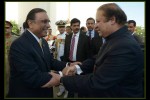
PM Nawaz Sharif bade farewell to Zardari in a cordial manner. Nawaz Sharif and Shahbaz Sharif must be reminded of their speeches of the election days when they were openly abusing Zardari. That’s the dilemma of Pakistani politics. The language of public gathering is totally different from drawing room meetings for our politicians. Whatever they promise with public, they easily forget it behind the close doors.

Will Sharif’s be any different in the office? We have to see carefully. They have installed a puppet in the President house. PM holds key ministries of Foreign Affairs and Defence with him and Finance ministry is already out for loans. But I hope that they work responsibly towards national issues. The government has five years to go and I believe they should be given a fair chance to show their real face or service. I believe if Pakistan can survive the disastrous era of Zardari, it will be able to survive the era of Nawaz Sharif also and then people will realize that they are two sides of the same coin.
Zardari era is gone, but the memories will chase us even in the nightmares.

The Morning Show Circus

morningshowpakistanA while back, I was watching a morning-show when one of the guests on the show compared two very famous morning show hosts to Oprah Winfrey and called them the Oprah Winfreys of Pakistan. The next minute, I was cleaning the tea I had spilled on the table. As much as I wish with all my heart that, that statement was true but unfortunately those two morning show hosts are not even an iota of what Oprah Winfrey is all about.

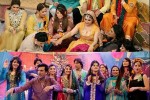
For starters, Oprah Winfrey show does not have ‘Wedding Weeks’. Yes, weddings are an integral part of our culture, we are a nation which loves festivals and celebrations and marriage is a beautiful bond but that being said it does not mean that being unmarried is a disease or a taboo. Morning shows have an anti-dote for this ‘disease’ too, just by the way. The ‘matchmaking aunties’ are frequent guests on these shows to conduct ‘workshops’ on how a girl should carry herself and the tray when the potential in laws come to scrutinize her

Pakistani morning shows are on a mission to get the entire nation married before the world ends. It is about time they start to do shows on contraceptives as well before the population of Pakistan has doubled due to the weddings arranged by these shows. Or wait, they cannot really dare to do a show on contraceptives because that would upset  us and PEMRA. But why don’t we ever raise a voice against the extravagance showcased on these shows and why does not PEMRA ever object to the crime shows which air forced confessions of alleged criminals? For how long will we continue to pick and choose to condemn or disregard the evils?

The shows portray their tactics of generating maximum revenue as a service to humanity. I have never been able to understand what joy does the couple from an under-privileged household get from watching people from the entertainment industry dance around in expensive couture. By doing all this, the morning shows are just demarcating the line between the rich and poor and making it more obvious than before. Showing the majority of Pakistanis who belong to middle, lower-middle and low classes, almost about everything they cannot afford just creates resentment.

An all-time favorite segment of these shows is about supernatural creatures and spirits and black magic. The morning show hosts ooh and aah every time a different ‘Aalim‘ tries to exorcise someone by sprinkling water on them, cutting lemons, lighting candles etc. It is actually painful to watch this and frustrating at the same time to witness different ‘Babas‘ torture people when in fact all they usually need is a good psychiatrist and therapy!

These shows have also really abused the concept of ‘Oprahfication’, that is, if that is what they try to imitate. While Oprah coined this term to describe public confession as a therapy and talked about various issues in her life, in our morning shows it is the other way around. The morning show hosts never talk about their failures, shortcomings, mistakes and life experiences but they invite people and cash on their misery by shedding a tear or two at their heart-breaking stories. While it has its advantages, we are still not ready for it. Inviting people to confess their secrets and discuss their personal and intimate issues on live television without  a psychologist or psychiatrist being present is not only harmful but can have long term effects on the lives of these people as we are a part of an extremely judgmental society .

The morning show hosts are usually very active about speaking against domestic violence and gender-issues. But those issues set aside, what do they have to say about how they let themselves and other females on the morning shows be used as eye-candy? It’s not really hard to get why majority of the morning show hosts are females. A single female host carries the weight of dozen of labels and sponsors. Clothes, shows, make up, accessories and the list goes on. The more, the merrier.

These hosts constantly endorse the view that it is of utmost importance to fit in the society and for that you have to look a certain way. Whereas Oprah showed the world how a black woman with a voluptuous body can look so elegant, beautiful and charismatic only if she believes in herself. Almost every day at least one morning show has a make-up competition, which is fine but what is not okay is when the beauticians apply a foundation ten shades lighter to the model’s skin tone in order to make her look fair. This is very rare though, because most of the models chosen are fair-skinned anyway. What message are they conveying by this?

The most disappointing thing about these shows is the guests who are invited. There are few guests, couples to be specific who are permanent guests. They come, they dance, and they laugh out loud, go on and on about their recent vacation in Dubai or Thailand, gossip about other celebrities, display a lot of public affection and leave. From the guests lists of these shows it almost looks like as if half of the Pakistani nation is a part of the show business and the other half is trying desperately to be a part of it.

How often do we see Pakistanis who have excelled in other fields as guests on these shows? The shows endorse lawn brands but never speak up against the low wages the factory workers are paid. We are told about who wore who at the red carpet but we are never told who won the Booker or the Pulitzer prizes. Dramas and movies are reviewed and recommended but books are never talked about. Fashion designers, models, actors and singers are treated as if they are gods and goddesses with magical powers but scientists, economists, thinkers, social and human rights activists are never mentioned. Achievements of Dr. Abdu’s Salam, Prof. Atta-or-Raman, Mahbub-ul-Haq, etc. are never recognized and appreciated. They portray the Pakistani woman as a materialistic human being who has no business other than wearing designer clothes, expensive make up and brewing up facial masks in order to look at least ten years younger than her age. Why cannot the average Pakistani woman be portrayed as somebody who wants to fly a plane, be an astronaut, mountain climber or a F1 racer?

The media tries to get away with all this by using the excuse that it is broadcasting what people like to watch.  But that is not a legitimate excuse. Yes, people have grown accustomed to watching trash because it’s the only thing that is aired these days. However that does not mean that we Pakistanis love to watch Turkish couples somersault around on our television screens. We are a nation who loved and appreciated 50-50, Angan Terha, Dhoop Kinaray, Loose Talk. We have been shown great things, so I do not know why the media thinks that all we deserve are dubbed foreign dramas and cheesy morning shows.

Independence Day – Why Must I Celebrate?

pakistan-is-a-strange-country-1024x640

My home, my country is 66 years old today. Come August and we start gearing up to celebrate Pakistan’s birthday, if we can call it that.  The emotional patriot that I am, the whole “green” thing works for me. It is my time to re-visit the qaumi taraanaas (patriotic songs) and hoist a flag on my roof and go all teary when I see Quaid e Azam on the TV screen. In August, basically, I am having a crash course in patriotism. Like a 2nd or 8th or 16th honeymoon of a couple who over the years have forgotten what they mean to each other. So they take a trip down memory lane and sit and watch their shaadi movie and leave the kids with the grandparents and take a trip together to rekindle what’s left.

In most cases, this stuff works. As in the case of me and Pakistan.

But one minor issue. Let’s go back to the weird example about the couple. So imagine this. They have a great “re-kindle the romance” tryst at a far-eastern island resort, have spent a week together, and love is in the air. But then reality sets in once they return. The honeymoon fever starts subsiding. They slide back into the old pattern. The wife nags, the husband is indifferent and insensitive. She’s obsessed with her clothes and her family, he is a workaholic who gives her no time. Honeymoon goes down the drain.

That might be, sadly, the problem with how we look at 14th August, or any ritual in any relationship for that matter, whether it is our relationship with a person, a country, an idea or even God. When we indulge into something without thinking and without reflection and introspection, all that remains is hollow and outward expressions of a love that is shallow.

In a love that is deeper and more real (and most of us claim to love Pakistan), we must give back in return. The truest relationships are those that stand the tests of time. Relationships in which you feel an urge to do for your beloved anything that makes him/her happy. What can I do that would make Pakistan happy, I wonder?

For sure, Pakistan LOOKS happy today. Celebration’s in the air. Fireworks marked the grand entry of the 66th birthday of my homeland at midnight. Everyone will be dressed in green (yes, me too, I confess!). Flags, songs, chants, slogans of hope, of better tomorrow.

So yeah, sure, Pakistan looks all happy. Just like that couple looks happy in the 2nd honeymoon pictuers they post on facebook. But are they, really? And is Pakistan happy? Really?

A REGISTERED 23% (almost) living below the poverty line, a dismal literacy rate, a non-existent state emphasis on health and education when compared to what we spend on defense, ethnic prejudice and violence, killing in the name of caste and creed, extremism, huge economic disparity, an increasing tendency of polarization in society; a society divided between liberal extremists and religious extremists, persecution of minorities; the list is endless. Poverty in the land of the pure forces people to commit suicide. Women are raped and silenced. Our government’s corruption has assumed legendary proportions. While minorities are persecuted, we, the Muslim majority (with all due respect) is essentially clueless about the true nature of Islam. We have not yet met Islam one on one, most of us. A reflection of us not knowing Islam is evident in tiny things like breaking the traffic signal and littering and losing tempers in Ramadan and also in bigger things like killing our fellow Muslims and Pakistanis.

In a nutshell, Pakistan is not happy, really.

Like a cynical but forthright friend’s tweet said, “I am not a proud Pakistani. With this mess I can’t be. Seriously. But I promise to work towards it.”

Yet, I still DO celebrate the 14th of August. Not just because I am an emotionally labile person who reaches out for her tissue to wipe tears when she hears “Khayal Rakhna” by Alamgir and the Benjamin Sisters. Not just because I am in the 14tn August honeymoon zone. No. I have given it careful thought.

And the reason lies in the last part of my friend’s tweet:”….I promise to work towards it”.

With all the mess that it is in, when I look at that white-haired old man called Dr Adeeb Rizvi serving at SIUT, and I see people believing in him, I know there is something worth celebrating. When I look at the work Imran Khan has done at Shaukat Khanum and the work Edhi has done, I know there is hope. And not just the very known heroes. At grass root level, I meet a woman in Heera Mandi Lahore, running a school for literacy of her children. In the dangerous Lyari, a man is teaching children peace-skills in his school. My nephew is working with his group of friends as a small initiative to spread literacy among under-privileged children. At an even smaller level, my mother always would teach the children of domestic staff to read and write. She was a member of the National Women’s Guard in the years around independence, a fierce patriot, who still in spite of her dementia sings patriotic songs and tells stories of how she saw Quaid e Azam. History repeats itself when my daughter teaches an underprivileged child in her summer holidays. I land at Jinnah International and with all the negatives, the positive is that the chivalrous men of my nation will still help me with my luggage, and the poor fruit vendor may give me an extra banana free of charge. We still cherish good values. We are a poor nation (not talking about the ruling elite right now!) but one of the most charitable nations in the world. We have been through hell and Pakistan is a dangerous country to live in, but we are resilient, and all this “mess” is bringing out the best in us in art, literature, and very importantly in humour – yes, Pakistanis know how to have a good laugh at themselves.

Deep down, somewhere, Pakistan is happy.

But the emotionally charged paragraph I have written above still does not fully justify why I celebrate 14th of August. For me, the reason is multifold. Patriotism, unless ill-founded and leading to anger and an “us versus them” psyche, can be and is a positive force if used correctly. It re-kindles the spirit of volunteerism, a sense of responsibility towards one’s country and one’s nation. If coupled with a bit of reflection and awareness, it can remind us of important lessons long-forgotten. A small example would be that if we take a careful look at the flag of Pakistan, the white reminds us of the presence of minorities as equal citizens of the state. Disrespecting or persecuting innocent minorities is tantamount to disrespecting the basic ideology on which this nation was formed. Celebrating this day, as my daughter has made me understand, is important to her generation who have sadly grown up in a time where most of what they hear about their country is negative, skeptic and disillusioned. The new generation must thrive on a sense of hope and a sense of pride.

So let’s give a careful thought today, each one of us, to what we are doing to make Pakistan happy. If we are positive contributors to the well-being of this nation, we have every right to celebrate the Independence Day, sing the national anthem and say Pakistan Zindabad.

🙂 If you’ll excuse me, I gotta go iron my green dress now.

Loving Pakistan Against the Odds

LovingPakistanPakistan- a word I’ve been hearing since my first day but every single time I hear it and interpret it, the familiar sense of belonging and feeling of love is rejuvenated. I’ve heard it under muffled voices as my grandparents would narrate their childhood stories; we would squeeze beside them under the blankets and awe at the thrilling events of 1947 while we munched peanuts and walnuts. I, then grew up and with time the voices spelling out Pakistan changed as well. I remember the gasp which would travel around the class every time our teacher shared an unusual fact regarding Pakistan. Then, I heard some people pronouncing it spitefully, executing particular stress on it during their heated debates. At times, the word reflected hopelessness and despair while at others it spoke of elation, pride, enthusiasm and determination. The tones and speakers were of great variety but a single thing remained unimpeded- the name never ceased to leave an impact on my heart. Either I speak of it in a mediocre manner or chant “Pakistan Zindabad”. I speak of it as one would speak of a cherished family member.

It wasn’t I who chose Pakistan as an identity, culture, lifestyle or a possession. Instead, Pakistan chose me to breathe in its air and walk upon its soil; I was invited to experience the feeling of being at home and being loved at this part of the world.

Since my young days I have been witnessing argument about Pakistan and its issues but all along I’ve been no more than a reticent listener. People are prepared to alienate their homeland and consider a single ticket, a single flight to be their key to success because it’s hard for them to see this country prosper. However, amidst this devastation I see a smile. I see it beaming through the tears and scars and just when I have been disheartened enough to turn around and join the crowd I see a glisten in those sorrowful eyes. The eyes have put behind the grievances as they stare at me hopefully. I see trust and belief in them, an unhampered belief that if not this time then the next or maybe some other time Allah would help and heal those scars. And, despite the disappointments it has had to face it still believes the people are worthy enough to be relied upon. I cannot abandon my idealism after finding life beneath the dead.

It will be hard to believe if you claim to have never lost anything because of Pakistan or to Pakistan. There were times when I stumbled and I, too lost my confidence in this country but when I stood up I had even greater zest because I realized it were my hopes which still give the green-white flag a reason to stand tall. It’s your ideology and vision which will help Pakistan to overcome the tribulations, thrive and rise to the long forgotten glory, it’s actual destination.

Prophet (SAW) is reported to have said,

“And know that victory comes with patience, relief with affliction, and ease with hardship.” (Tirmidhi-Saheeh)

Say No to Extremism – Stand Up

Terrorism has no religionWhat happens when events recur so often that we become accustomed to them? They end up becoming a part of our lives and we learn to live with them.

Pakistan came into existence because it was seen as the sole solution to safeguard the rights of the minority i.e. Muslims. However, the very basis of the creation of Pakistan was soon violated by its people; a country where Quaid had promised utmost respect and security for the minorities became the breeding ground for extremism and intolerance. A country which had been envisioned to be a land of justice has faced nothing but disappointment because we all failed to live up to the expectations of the father of the nation. We have not been able to make the country into what it was supposed to be.

It might be a just argument to say that it’s not the ‘us’ but ‘them’; the terrorists, the extremists, the corrupt politicians and the rival countries adamant to crumble our country. However, we have failed to grasp the fact that in reality we are the ones who are nourishing this injustice and violence. What else can make those militants who are not even 1/10th of the population annihilate our peace? We believe that we cannot make a difference by talking about sectarianism and genocides, that we are not capable of changing the course of things. We have made our lives congested for ourselves, being oblivious to everything happening around us and remaining silent to the attacks intended at minorities. And once we allowed this oppression to exist, its grotesque growth became inevitable. In our country, each terrorist attack is treated as a forgotten memory and a ghost which lurks to haunt us. “Iss mulk ka kuch nahi ho sakta” and other such phrases define our meek submissiveness to fate. We have entitled ourselves as the ones in disdain, the ones who are helpless.

“The nation which reposes on the pillow of political confidence will sooner or later end its political existence in a deadly lethargy. (Quote by – James Madison)”

We are unaware of our potential, our real power. We are unwilling to believe that we are capable of bringing about the change, the ‘tabdeeli’ that is so much talked about these days. It’s not a single man, a single government that can revive peace in our country overnight. To get rid of the darkness of cruelty we have to gather ourselves, realize our strengths and work together. It’s high time we start owning responsibility for our current condition and realise that it was our negligence which has allowed thousands to be killed till now. Things will not change until we are prepared to change them, until we decide to talk about them and start thinking about the solutions. Discussing an issue is the first step towards eliminating it. Instead of running away from things which scare or hurt us, we should face up to them and start our own war against them, for peace. We should take the fate of our land in our own hands and work for its betterment and make sure that the sacrifices that were made to claim this piece of land which we call home don’t go in vain.

But ‘What is MBFC?’

302931_248959945161026_1585264984_nChange is one of the most popular themes in contemporary Pakistan. But what exactly do we mean by ‘change’, and even more importantly, why do we need it so badly? This is something that we should all learn to question. When we demand something, we should be conscious of what it is exactly. This question is even more relevant when it comes to ‘My Bit for Change’. It is common to be asked what we mean precisely by our bit of ‘Change’.  It becomes eerily more difficult to respond to such questions when certain inquirers come with their own framework of change and refuse to take any other possibility as a legitimate concern for social action. I will be trying in the following lines to clarify where we stand when we talk of change.

Most people see change as a one-time event. Many more view change as something that happens, not always something that is done. Others see change as all-encompassing and all-imposing, or to say; what I want for others.  Some people see change as simply to challenge all things upheld in society as good and desirable. Some people see change as refusing anything that challenges established norms and values of society, whether such things are themselves oppressive and condemnatory. Some people don’t see change as anything but a simple slogan behind which the popular trend is going, while others see change as a call for irresponsible and disruptive action geared towards dismantling the social order.

To accommodate all such views under a singular umbrella would be too difficult a task for even the brightest of relativists. We, however, would only consider such an endeavor to be outright pointless and directionless.  Because from our point of view; when you set your eyes in every direction, you’re not heading anywhere. There is a fine line between being accommodative and accepting all opinions as equally valid.

Our conception of change is one that is a life-time endeavor; a struggle; a jihad; a constant effort to improve ourselves and the world around us. There is no permanent state of perfection, at least not in this world, and we believe in relentlessly looking within ourselves critically and engagingly, and continuously improving ourselves and coming out as better human beings.

We endorse Rumi’s conception of change from the depths of being, who said, “Yesterday I was clever, so I wanted to change the world. Today I am wise, so I am changing myself.” And just as Gandhi put it, “Be the change you want to see in the world.”

We also believe that change doesn’t come, it is something you have to bring, or to invent, or to create. One should be in charge of destiny and fate, and not the other way around.

As Iqbal would suggest, “Khudi ko kar buland itna ke har taqdeer se pehle, Khuda banday se khud pooche, bata teri raza kiya hai.”  (“Rise above yourself so high that even God, before deciding upon your fate, should ask you: Tell me, what would you like?”), and also, “Na Tu Zameen Ke Liye Hai Na Aasmaan Ke Liye. Jahaan Hai Tere Liye, Tu Nahin Jahan Ke Liye” (You are neither for the earth nor for the heaven: The world is for you, and not you for the world.)

We want the world to be a better place, a more peaceful and tolerant place, for all human beings whether they live in the ‘developed’ world or the ‘developing’ world; whether they belong to the majority or minority; or whether they belong to one so-called civilization or the other. Our call is a call to be human, and humanity begins at empathy; and realizing that persons other than you also feel, desire, and think, that they too have an existence as much valid as yours.

We don’t consider MBFC to be an ‘Islamic’ forum, if by doing so one is dividing a Muslim population and society across lines of ‘Islamic’ and ‘Non-Islamic’, or between acts of ‘Deen’ (religion) and acts of ‘Duniya’ (this world). For the first matter, we don’t believe Muslims can be categorized against a scale telling them who is how much ‘Islamic’. It is not our job to say who is more or less Islamic, or Muslim, as this is a matter of individual conscience, as well as one’s private relationship with the Almighty. It is not in our jurisdiction, but God’s alone, to judge other peoples religiosity. Secondly we don’t believe in the duality of our faith with the matters of this world. We believe that faith is as much a matter of this world as it is of the Hereafter. From our perspective, while praying is an act of worship so is earning an honest living or spending quality time with one’s family. In this sense, we consider ourselves ‘Islamic’ not as separate, but as part of the broader Muslim society. This is not to say that we exclude the non-Muslim voice either. A non-Muslim perspective has its own validity and legitimacy in a fully functioning Islamic society.

What one should grasp from the above description is that we want to bring people closer and not further apart. We are staunchly against sectarianism but also strongly against extreme polarization in society. We feel that extreme positions often fail to take the existence of another perspective into account. While religious extremism has been condemned and spoken of in media discourse; an opposite extremist discourse is also a common sight. Both depend on each other, as without the presence of the opposite, there would be little for either to say. To be exact, both speak in absolute and exclusivist terms; they talk about each other but never to each other. It should not come as a surprise that both sides have tried to attack our forum, either in the form of hate-mail to some of our writers or through certain reason-free writings.

This may be taken as a cost for trying to be moderate. To be moderate, of course, is not to merely take a balanced position in the middle of two extreme discourses; it is to refuse to fall prey to either. Some may not realize this but sometimes a loud call for moderation may be the most radical attack on extremists. To refuse to fight them is to defeat them.

But this is not where we end. We have continuously adopted an anti-imperialist, anti-hegemonic and anti-oppression stance. We have been very vocal against the drone attacks, as well as persons undermining their brutality, and such horrifying incidents as an American spy killing innocent civilians in the daylight of one of our major cities. We have spoken against outright human rights violations, such as the illegitimate kidnapping of our citizens, especially the case of Afia Siddiqui, and calling them ‘missing persons’. We have voiced concern for the brutal attacks on the Shia Hazara community in Quetta, as well as the tragic Badami Bagh incident. We have also spoken against various oppressive measures of state institutions and the state itself.

We have also been firm believers in accelerating the process of decolonization. We believe that has yet to end. The legacies of colonization are strongly visible even today, some more tangible than others. We have spoken against the usage of a certain language and traits that show of a false ‘superiority’. We have advocated pride in our own national, cultural and religious heritage. We have promoted such figures as Iqbal and Malcolm X for this very reason. And to quote our favorite activist for change, the latter of the two,

“A race of people is like an individual man; until it uses its own talent, takes pride in its own history, expresses its own culture, affirms its own selfhood, it can never fulfill itself.”


Being Human

Being HumanEvery day, the news channels give an estimated figure of deaths due to target killing, bomb-blasts, sectarian barbarism etc. But those figures are inaccurate. There are more deaths than we can fathom. Each day, we all die as a society, nation and as human beings. We turned off our humanity a long time ago. We all have just been cold, semi-alive bodies lost in our own lives and with each day we get a step closer to death.

Incidents such as the Abbas Town and Ziarat Mansion bomb blast, Hazara genocide, Badami Bagh arson attack, etc do bring us back to life in a state of shock. We wake up, we sympathize, we protest, we help and then we go back to feeling indifferent. One may argue that there is nothing wrong in moving on with our lives. We all have duties and responsibilities to fulfil and chores to run. A calamity occurs, we wake up and we leave our houses to help the victims and then slumber again as a dead nation.

And then there are those under-privileged people who we ignore and fail to help every day? Have we ever spared a moment to think how the people who work for us, for example, our maids and drivers manage to feed and support their families on the low wages we pay them?

We have become indifferent towards suffering unless it hits us. We do not care if a child works for us for low wages, instead of attending school but we make it a point that our children should be enrolled in English medium schools and expensive only. We do not worry about how our maid feeds her children for the entire month, but we do worry when we fail to get a reservation at a new restaurant and when we do go, we never feel guilty when our bill comes down to almost being equal to our maid’s monthly salary. We never notice the ragged clothes of the beggars on the roads but we try our best to be the first ones to reach the ‘Exclusive Lawn Exhibitions’. We do not care if our driver needs his salary in advance to buy medicines for one of his family members and we insult him for always asking for money as long as our cabinets are stuffed with the best multivitamins and health supplements and we can afford the best medical facilities.

We are morally degenerating as a society. The gap between the rich and the poor is at its widest now. It’s about time we realize that we cannot overcome this gap by feeding a poor person once a month, giving a hundred rupees note to a beggar, handing down our old clothes to our maids, etc. If we do that, that is good but there are better things we need to do and much bigger steps we need to take in order to bridge this gap.

‘Give a man a fish and you feed him for a day; teach a man to fish and you feed him for a lifetime’. 

Your maid complains about her husband’s unemployment? Pull some strings and get him employed and if all fails set him up a thela, (a cart where he can sell little things). You provide grocery to various households? Instead of that, pay the school fees of your driver’s child so that one day he can grow up to be someone who can feed his family on his own. These are just two examples. Look around and you will find plenty of opportunities and ways to help them live on their own and not just survive on your mercy.

We HAVE to cut down on our luxuries so that others can get their basic necessities. Please wake up, feel the pain and responsibility, empathize, support and be human(e).

The Foster Parent of an Orphan Nation

GilaniWe are humans, thank God, for we have the ability to suppress animal instincts. It is this nature to control raw flares of often unwanted behaviour that makes us human. Of the animal instincts most abhorred in our being, it is not the unnecessary and unheeded violent behaviour that I want to highlight; it has already been made the subject of many a films, articles and pieces of literature. It is instead the goldfish instinct in all of us, which we so ironically forget about, that we should visit today.

That sun-drenched afternoon, 2 days before the election, history repeated itself in Multan; like the Taseers’, a Gilani son got abducted. The public sentiments varied from the crude poetic justice to sagacious sympathy. Emotions ran high in the family and party supporters alike and desperate outbursts from the Gilani brothers graced the TV screens and disgraced law enforcement agencies yet again. To date, the young Gilani remains missing with a few credible leads leading to some arrests. This is marginally better progress than the Taseers’ case and infinitely better progress than most of us could have dreamt of seeing if we were put in a similar nightmare.

On the day, the clamour of this unfortunate event could have taken the whole city and eventually the whole election process into a downward spiral. The right focus from the media, the right nerve, the right note from PPP at that precise time and a whole lot of wrong would have entailed. Who is to know our Tehrir Square might have started from the sweet, loving people who converse in melodious Seraiki?

However, Gilani Saab’s prudent handling of the matter remains, to date, is his most desirable memory in the minds of most. We have all forgotten and forgiven what had come to pass for 4 years. For a father to lose a son in such manner is most painful. Spare a thought, as well, for the missing persons’ families going through similar ordeals without any closure for years. Our prayers go out to the whole Gilani family for now; to console them and to give them hope that no more wrong will happen to them. We appeal for the safe release of Ali Haider Gilani.

So, for the time being, let’s bow in to the goldfish instinct of short term memory and let our criticism of mediocrity be shrouded by the emotion of pity. We forgive you Gilani Saab but, in our next hour of need, please don’t ask us to leave Pakistan; remnants of that sinister smirk laden image of you still remain. I am quite sure you had better words of consolation for your bereaved sons on 09th May 2013. Yes, blood is thicker than water but you were, after all, a foster parent to an orphaned nation.