Fall of Granada and the Plight of Morisco


” My friends, say farewell to her as a noble place, or else entrust her to whomever her affairs [will] belong to [i.e. God]

We have neglected the rights of the Lord so he has allowed us to perish, all but a few of the bonds of Islam have been broken.

Our Muslim community has never distinguished what is right to do from what is forbidden; see how this disapproval is now [turned on us].

We have obtained what [God] has given us through what we have deserved; such is the evil life for those who lead it.

In our miser, splitting up [disunity] accompanies our unity; we have been brought to circumstances that are blameworthy.

Our enemy has gained power over us because of our sinfulness; the lions and leopards of the enemy have wreaked havoc upon us.

Yes, they have pillaged our homeland, our lives and our possessions; its abundance has been allowed [them] s legitimate spoils;

They have seized [ravished] her [Andalus] without providing a bride-price; no spears have been watered for them, nor have her menfolk fought them for her;

The Franks have howled down at us from every hilltop and their vows to Cross have been completely achieved

A lamenting poem by an Andalusian poet from Ronda, Abu al-Baqa’ al-Rundi. [1]


2 January 1492 marks the end of Muslim rule in Spain, which lasted for nearly eight centuries. It brought the Reconquista to close, consolidating Christian rule, although it took two and a half centuries for Granada to fall to Christian kings. It also marks the beginning of a dark chapter of religious intolerance to achieve the purity of land on the criterion of purity of blood, thus cleansing the Christian land of the impure infidels and heretics (Jews and Muslims) by their ultimate expulsion.

Fall of Granada was not by a sudden stroke of fate but was the last curtain of a long standing drama of disunity of Muslims, warfare between competing emirs, conspiracies within each dynasty, son rebelling against the father, civil wars, a financially decaying society as well as external aggression. Militarily weak, but protected geographically by Sierra Nevada, Granada was always at risk of being attacked and conquered by the stronger Christian armies. King Ferdinand’s full support to the last Muslim emir, Mohammad bin Ali’s (Boabdil or el Rey Chico i.e. ‘the little one’ in Spanish) rebellion against his father in 1483, that resulted in a civil war, weakened Granada even further. With Christian armies slowly pressing inside the Granadan land, only the city of Granada was left for Boabdil to rule when he took power in 1490. When King Ferdinand asked Boabdil to hand over the city to him, out of surprise and despair, Boabdil sought help from North Africa to assist him militarily, but none arrived. The war and drought stricken city could not resist any further in front of the mighty Christian kings and Boabdil officially handed over the city to Isabella and Ferdinand on January 2, 1492 thus closing the chapter of the Muslim rule in Spain.

Before the handover, Boabdil was in negotiations with the Catholic monarchs who offered him that he should abandon Granada and retire in the Alpujarras in exchange of income for him and his descendants. His mother, who was a converted Muslim, always resisted the idea, as she wanted him to ‘die a king’[2]. But a text from Cronica de los Reyes Católicos by Alonsa de Santa Cruz (1550), explains how, later, she herself tried to convince Boabdil to stay away from war and reach some kind of agreement with the monarchs to avoid massacre of his family and the misery of people and towns under his rule at the hands of the Christian armies, if he goes to fight and gets killed.[3] The city was stricken with hunger and Boabdil had lost many of his men and towns to the preceding military combats[4]. The people had no energy to fight in a state of hunger and desperation and they demanded peaceful negotiation with the monarchs. Some old Moors with military experience advised him to save his neck and pride by entering into a peaceful solution ‘for in this way their Majesties would respect their dignity, and treat him as a friend; if this were not done, they would surely all end up dead or imprisoned’[5]

 Unfolding events of history reveal unmistakably that it was a wishful thinking, and events in Granada, although kicked off with a hopeful start in the shape of a magnanimous treaty written in 1491, ended up in forced expulsion of the Moors in only a hundred years, with all promises broken only under eight years. The terms of capitulation[6] were very comprehensive addressing the tiniest of the concerns of Moors. Put to practice, it would have set a glorious example of accommodating a minority in an unprecedented way. Not only did it guarantee freedom to practice religion and protection of all the Moors, but also promised punishment to the Christians who try to make life of Moors difficult in any way. The properties of Moors would not be confiscated nor would their lives or estates be harmed ‘without due legal process or without cause[7]’. Mosques, minarets and Muezzins were to stay, and actually be respected. ‘The Moors shall be judged according to the code of Sharia, under their judges and qadis[8]. There were promises of protection of customs, traditions, prayers and rituals. Muslims were given a choice of relocation to North Africa for free, for coming three years, and at a small price thereafter. ‘No Moor will be forced to become Christian against his or her will’. The promises were big and no one would have wanted to leave their homes and their beloved land of memories of their forefathers if they were offered such bountiful assurances. These clauses meant that effectively nothing would change for Moors, and there would only be better days to come.

All the Jews of Spain were expelled in 1492 because their conversion to Christianity did not materialize as they ‘apostatized” to Judaism again. The Spanish Inquisition took to task, the ‘heretic’ Jews who secretly practised their faith, and also the Christians converting to Judaism. The Charter of Expulsion of the Jews (1492) cut off all interaction between Jews and Christians to prevent the ‘corruption of the Holy Catholic faith and its followers’ from ‘the evil and wicked purpose that Jews continue wherever they live and congregate.’[9] The intimidating language warned the Jews never to return to the kingdom.

The terms of agreement for Moors were strikingly different. Full of leniencies and freedom to practice faith and retain property, language, dress and custom; it was a remarkable contract. But what did this mean? Were Moors relatively acceptable to the Holy Catholic faith as compared to the Jews, or were the clauses of treaty only a political move with an ultimate goal of pulling the Moors to the Inquisition with ‘a due legal procedure’ and with ‘a cause’, or was the conversion of Moors and their faithfulness to Christianity, not tried and tested until then?

The truth is that Moors were no better than the Jews in the eyes of Christian kings. Sancho IV (1295–1312) of Castile, in his book of advice that he compiled for his son wrote, ‘The Moor is nothing but a dog… Those things which Christian considers evil and sinful, he considers goodly and beneficial for salvation; and what we think beneficial for salvation, he considers sinful.’[10] According to sixteenth century Granadan historian Luis de Mármol Carajaval, in the early period after the fall of Granada, Spanish bishops urged Ferdinand to give the same choice to Moors as given to Jews i.e. conversion or exile, but the king rejected these demands as it would mean a return to war. According to Mármol, the king opted the policy of relaxation so that ‘through domestic communications with Christians, debating and discussing religious matters, [the Muslims] would understand the error they were in and abandoning it, …come to a true knowledge of the faith and embrace it, as many other barbarous nations had done in the past.’[11]

In an under-populated land due to its geographic limitations, Muslims were a source of revenue for Spain. They were hardworking and able craftsmen and losing the entire Muslim population by a radical and absurd move would have resulted in loss of actual manpower to run the country at the grass root level. Also with years of war, Ferdinand wanted to stabilise Christian Spain with a policy of moderation. Thus, the first archbishop of Granada, Hernando de Talavera, was chosen for his saintly reputation and policy of moderation. Although conversion to Christianity was a goal, but persuasive methods, and not coercion, was his policy. He tried to learn Arabic and insisted the priests to do the same in order to get close to the Moors for their assimilation, as Christianising of the Moors meant civilising them. Pedro de Alcalá who composed his Art for Learning Rapidly the Arabic Language, states in his prologue that its purpose was to ‘bring the recent converts out of darkness and many errors induced by that evil, vile, and accursed Muhammad.’[12]

Talavera’s gradualist approach was too slow. Hence, Francisco Ximenez de Cisneros, the archbishop of Toledo was sent to assist him. His strategy, initially, was bribing the Muslim nobles, and later, conversion by harassment. Failure to convert would mean death. Arabic religious books were burnt and main mosque of Albaicín was converted to a church. Cisneros’ radical methods led to the first revolt of Alpujarras (1499-1500). The revolt finally made the terms of Capitulations null and void. The impressive clauses of the treaty were practised only initially, as a cautious political move, not to grant full religious freedom but to win Muslims towards integration into the Catholic faith by conversion. So, were they put on paper with a clear intention of giving freedom? Or were they ever truly practised to the core as ‘live and let live’; the evidence is hard to find with the attitude of the clergy, and the complacency of the monarchs towards it.

The year 1501 marks the beginning of Royal ordinances calling Muslims to disarm[13], to choose between exile and baptism, and abandonment of Moorish dress and customs. 5000 Arabic religious books were put to flames in a public bonfire with thousands of Qurans and texts of ‘Muhammadan impiety’. Moors transformed from Mudejars to Moriscos, a lowly class of converted Christians separate from the Old Christians who enjoyed purity of blood (limpieza de sangre).[14] It was easier for the people, who did not have the means to migrate, to convert to Christianity and keep practising Islam secretly. They were subject to Inquisition on the slightest of suspicion of apostasy or secretly practising their own faith, just like with the Jews earlier, as described by Professor B. Netanyahu quoting an eyewitness account of the time:

Those of them who refused to accept baptism were immediately slain, and their corpses, stretched in the streets and the squares, offered a horrendous spectacle.[15]

This was re-enacted upon the Muslims just a few years after the fall of Granada. As the agreement put in clear words that no Moor would be harmed ‘without a due legal process or without cause’, the due legal process was now the Inquisition, where people would be brought to ‘swift justice’ by torture until they confessed and when they confessed, they would either be baptised or killed any way. ‘The cause’ why they could be harmed or brought to Inquisition was justified by the crime i.e. heresy and apostasy.

Heresy could mean anything i.e.; taking bath on a Friday, wearing clean clothes, eating couscous, dancing on a Berber music, fasting in Ramadhan, retaining Arabic names, working on Christian holidays, refusing to eat pork or drink wine etc. The treaty did have loopholes, which were exploited by the clergy. No Christians who had converted to Islam before the capitulation, were to be abused but Christian women, who had married Muslim men, were subject to be questioned. Prior to the surrender there were incidents, where the converts were tied to stakes and killed with cane spears. Granadan converts were protected, in theory, against such treatment, but Cisneros took advantage of the loophole and started summoning the convert wives of Moors to which people revolted and one of Cisneros cardinals was killed. While Ferdinand was furious of the policies of the archbishop, Cisneros was unrepentant, convincing him that pardoning the rebels against the offer of conversion to Christianity would be a promising political move, to which Ferdinand agreed[16]. It hints that while Ferdinand disliked Cisneros’ radical approach, he never disagreed to conversion of the Moors to Christianity and the terms of the treaty were a pragmatic and political way of gradually Christianising the population, united under the Cross.

Moriscos were considered a hindrance to the unity of Christian Spain due to internal reasons, but they were also considered a threat because of their links externally with the global family of Muslims. They were a force that could potentially get help from North Africans, Egyptians, French, Turks, pirates of the Mediterranean, or other Christian heretics. Discovery of America and Spanish expansion made Spain dangerous to England, France and the Ottomans. Out of these, Turks were the biggest threat to Spain, with a mighty force that had conquered Constantinople and were making way to North Africa. The rise of Protestantism also had its repercussions for the Moriscos who, the Catholic Clergy thought, could conspire with them to weaken Spanish power. Thus, the attitude toward the Moriscos was hardened due to the multiple potential threats to the Peninsula. The irony was that, while in Spain, they were considered as bad and unreliable Christians, they were bad Muslims who had given up their faith and accepted that legitimacy of Trinity and the Church, for their co-religionists outside the Peninsula. Moriscos appealed to both Turks and North Africans for intervention. A letter written in the form of Qaseeda (praise) to Sultan Bayazid[17] in 1501, explained in an unusual way, as to why Moors of Spain were made to convert to Christianity against their wills, and under the fear of death. It was a composition of praise for the Sultan, prayer for his success, plight of the fellow brethren, and plea to him to intervene in the dire situation where young girls were raped by priests, and ‘slaves’ in Andalus had been ‘smitten by misfortune’, forced to eat pork, oppressed in a shameful way and struck by an ‘enormous calamity’. He also protested, subtly, of a total lack of help from those whom Muslims looked to, as their ‘brethren’. He conveyed that all promises of the kings were revoked and books of religion were burnt and to be mixed with dung and filth. The Muslims were asked to curse the Prophet Muhammad and faced beatings, fines and humiliation if invoked or chanted his name. The dead would not be buried (in Islamic way) but left ‘on a dung heap like a dead donkey’ or ‘burnt like charcoal’.

The Morisco was very much a Spaniard. In the words of Spanish historian, Américo Castro, he was ‘heir to the glorious tradition of race that dominated almost the entire Spanish soil’ who ‘maintained a patriotic sentiment for the native country like the sailor, who prefers all sort of danger to the abandonment of ship. No doubt, the Morisco were Spaniards and no less so than the Castilians and Aragonese’.[18] But in the post-1492 Spain, he was considered impure and ignorant and everything attached to him including his customs and lifestyle was seen with contempt. Aznar Cardona, an anti-Muslim Catholic priest depicted Morisco as

‘the vilest of people, enemies of letter and sciences, far from courteous and polite manners and customs who brought up their children as animals without any education or hygiene. They were barbarous in language and ridiculous in dress, ate on the floor and lived on vegetables, grains, fruits, honey and milk. Sensual and disloyal, they marry young and multiply like weeds overcrowding places and contaminating them.[19]

Early in the new century, edicts were issued prohibiting Morisco music and songs, traditional weddings, Moorish clothing, circumcision and slaughtering of animals. The laws also ordered destroying public baths, obliging Moriscos to leave their doors open and unveil their women. Francisco Núñez Muley, an old Morisco nobleman, wrote in protest to the president of the High Court, a comprehensive letter arguing as to why he thought the clauses of the edict were unreasonable[20], but it fell on deaf ears. The next revolt of Alpujarras (1568-70) was a disastrous one. The Granadans burnt churches, killed Christian clerics and innocent people, while the government responded with pillage, rape, mass killing and enslaving people[21]. The text by Huraldo de Mendoza, who was a diplomat, soldier, scholar and a poet, written between 1571-75, clearly depicts what was in store for the Moriscos thereafter. Arabic use was totally banned even among the Moriscos, and their exodus was imminent[22].

It became clear with time that the policy of forced conversion had not worked and would never do. After the Alpujarras revolt, pressures mounted on both sides and co-existence became impossible. The memorandum by the Bishop of Segorbe (1587) to Philip II summarised how Moriscos had failed the repeated efforts of the Church and Monarchs towards their assimilation into society. It all went in vain over time, as the Moriscos still repented to their God instead of confession, practised polygamy and divorce, killed Christians, circumcised their children, performed their own prayer and ablution, buried their dead in virgin lands and refused to go to the church. They conspired with the Turks and North Africans and persisted in following the ‘abominable sect of Muhammad’. They, therefore, must be considered heretics, worse than Jews and expelled the same way[23].

In 1609-10, Phillip III issued the edicts of expulsion. Archbishop of Valencia Juan de Ribera (1609) delivered a sermon in which he said that the land would not become fertile again until these heretics had been expelled. The justification of expulsion was put forward by depicting the Moriscos, as a threat to security of Christian territory, as they had allied with 150,000 Turks for the coming spring to slay the Christians in the name of Muhammad, thus convincing his listeners of the ‘admirable remedy, king had employed.[24]’ Orders were issued to landlords to deliver the Moriscos working for them to the port of departure, only with portable things, which they could carry on their backs[25]. The question of their children[26] was an interesting one. The state was confused whether the children should be allowed to go with their parents in exile or not. The letting go would be sinful and embarrassing as they would be raised as Moors and ‘hell would swallow so many innocent lambs.’ Ribera suggested that children under ten years should remain in Spain to be educated by priests. Infants should be given to Christian wet nurses. But after some negotiations with other theologians, he changed his mind. Children above seven would be sold as slaves to Old Christians as they are old and would be difficult to raise them as Christians. Slavery was morally wrong but would save children from apostasy, hence became an acceptable deed.

The reasons behind expulsion were multifactorial. Apart from lack of transformation successfully into a different faith and set of customs, on the part of the Moriscos, they were a demographic threat as well. According to Ribera, ‘Morisco only thinks about reproducing[27], and would soon outnumber the Christians. Population growth would ultimately make Morisco successful without arms or help from abroad. Ribera described them to Phillip II as an imminent danger, ‘wizened trees full of knots of heresy, who needed to be uprooted before they send out new shoots that quickly grow into trees[28]. Also, Moriscos were hardworking, thus an imminent danger forever, as they retained the possibility of a ‘comeback’ with strength if they were given room to flourish. Danvila wrote about the incompatibility of the two races. He called it justifiable and unavoidable. ‘Humanity and religion fought, but religion emerged victorious. Spain lost its most industrious sons; children separated from the lap of their mothers, and from paternal love. There was no pity or mercy for any Morisco, but religious unity appeared radiant and luminous in the sky of Spain. Happy is the nation that is united in all its sentiment.’[29] And the resultant Spain was like Henry Lea described,

‘The fanaticism which expelled the Jew and the Morisco hung like a pall over the land, benumbing its energies and rendering recuperation impossible… transformed Spain into a paradise for priests and friars and familiars of the Inquisition, where every intellectual impulse was repressed, every channel of intercourse with the outer world was guarded, every effort for material improvement was crippled’[30]

Such was the dramatic end of a realm that the world sees with romance as well as nostalgia. Was it a war of religions or a ‘clash of civilizations’ as fashionably called? Was it a unique story of history that only occurred between Islamic and Christian forces? Was it the last encounter between the mighty and the weak, on the basis of religion and race? The case of this particular century must be viewed in a broad context of eight centuries as a constant struggle of claiming and reclaiming of territories, justified by a religious sentiment and arousal of the competing people with a hope of salvation, that lies in the eradication of ‘the other’, ‘the impure’ and ‘the infidel’. A call to save what belongs to ‘us’ and eradication of what belongs to ‘them’ has been running the political scenario of the world since ever and even to this day. Victory is a shower of support from God just like Christians thought at the Reconquista, and humiliation is a punishment from Him as Muslims interpreted at the time of persecution. Religious supremacy, territorial hegemony, economic benefits, and conspiracies to achieve these, have driven the world vicious. It was a turning point in the history of ‘Islam and the West’, which continues to shape attitudes, affiliations and trust or mistrust in treaties and promises etc. The tragedy of the Morisco is a small component of a bigger picture which manifests itself repeatedly whenever a minority is at the mercy of a powerful ruling majority that makes the use of racial superiority in order to establish a national identity, free of corruption of ‘the other’.

History is very much alive with same or similar manifestation of expulsions, exclusion, walls, denial of rights, separation of children from parents, and other forms of persecution, none of which is new. Fear-mongering, stereotyping the other and justifying the mistreatment in the name of saviourship, worked well throughout history and are still the most useful rules of the game in the world of power. The mighty and the powerful find one way or the other to justify the oppression by portraying ‘the other’, a threat to ‘our’ faith, ‘our’ values and ‘our’ freedom..


References: 

[1] S. Mohammed, ed., Une élégie andalouse sur la guerre de Grenade (Algiers, 1914, 1919), pp. 60-65, C. Melville & A. Ubaydli, Christians and Moors in Spain Vol. 3 (Warminster, 1992) pp. 182-85

[2] C. Melville & A. Ubaydli, Christians and Moors in Spain Vol. 3, p.145

[3] Ibid, p.147

[4]Nubdhat al-asr, trans. L.P. Harvey, Islamic Spain, 1250-1500 (University of Chicago Press, 1990) pp. 307-314 in O. R. Constable, Medieval Iberia – Readings from Christian, Muslim and Jewish Sources (University of Pennsylvania Press, 1997) p.350

[5] C. Melville & A. Ubaydli, Christians and Moors in Spain Vol. 3, p.149

[6] L.P. Harvey, Islamic Spain, 1250-1500 (University of Chicago Press, 1990) pp.313-315

[7] O. R. Constable, ed., Medieval Iberia, Readings from Christian, Muslim, and Jewish Sources, p. 345

[8] Ibid, p. 345

[9] Ibid, p.354


[10] R. Fletcher, Moorish Spain, (London, 1992) p. 135

[11] L. Mármol y Carajaval, Historia de la rebelión, p.63, in M. Carr, Blood and Faith, The Purging of Muslim Spain 1492-1614, (London, 2009) p. 64

[12] Pedro de. Alcalá, Arte para ligeramente saber la lengua arábiga, (Granada, 1505) in A.G. Chejne, Islam and the West: The Moriscos (State University of New York Press, 1983) p.6

[13] ‘The deprivation of arms was not only humiliation but it left them defenseless at a time when violence was constant and to an Old Christian the blood of the deprived race was little more than that of a dog’, H.C. Lea, The Moriscos of Spain, Their Conversion and Expulsion (Philadelphia, 1901) p. 190

[14] A.G. Chejne, Islam and the West: The Moriscos, p.7

[15] B. Netanyahu, The Origins of the Inquisition in Fifteenth-Century Spain, 2nd Edition (New York, 2001), p. 159

[16] M.Carr, Blood and Faith, The Purging of Muslim Spain 1492-1614, p.70-72

[17] O. R. Constable, Medieval Iberia – Readings from Christian, Muslim, and Jewish Sources, p.364

[18] A. Castro, Espána en su historia: Cristiano, moros y judíos. (Buenos Aires, 1948), A.G. Chejne, Islam and the West: The Moriscos, pp. 7, 176

[19] A. Cardona, Expulsíon Justificada de los Moriscos españoles, cited in G. Arsenal, Los Moriscos, (Madrid, 1975), A.G. Chejne, Islam and the West: The Moriscos, pp. 8, 176

[20] K. Garrad, The Original Memorial of Don Francisco Núñez Muley Atlante, 2 (1954), C. Smith, Christians and Moors in Spain Vol. II 1195-1614 (Warminster, 1989), pp. 160-163

[21] A.G. Chejne, Islam and the West: The Moriscos, p. 11

[22] C. Smith, Christians and Moors in Spain, Vol. II, pp. 164-67

[23] P. Boronat y Barrachina, Los moriscos españoles y su expulsion. (Valencia, 1901), A.G. Chejne, Islam and the West: The Moriscos, p. 12

[24] H.C. Lea, The Moriscos of Spain, Their Conversion and Expulsion, (Philadelphia, 1901), p. 325-26

[25] Ibid, p.320

[26] Ibid, p. 322-24

[27] D. Fonseca, Justa expulsión de los moriscos de Espana (Rome, 1612) pp.161-62, R. Boase, ‘The Morisco Expulsion and Diaspora’, Cultures in Contact in Medieval Spain, ed. D. Hook, & B. Taylor (London, King’s College, 1990)

[28] B. Ehlers, Between Christians and Moriscos: Juan de Ribera and Religious Reform in Valencia, 1568-1614 (Baltimore, 2006), M.Carr, Blood and Faith, The Purging of Muslim Spain 1492-1614, p. 246

[29] M. Danvilla y Collado, La expulsion de los moriscos españols, (Madrid, 1889) in A.G. Chejne, Islam and the West: The Moriscos, p. 15

[30] H.C. Lea, The Moriscos of Spain, Their Conversion and Expulsion, pp. 400-401


Bibliography

Boase, R., ‘The Morisco Expulsion and Diaspora’, Cultures in Contact in Medieval Spain, ed. D. Hook, & B. Taylor (London, King’s College, 1990)

Boase, R., Muslim Expulsion from Spain, The History Today, Vol. 52, Issue 4, 2002 http://www.historytoday.com/roger-boase/muslim-expulsion-spain

Carr, M., Blood and Faith, The Purging of Muslim Spain 1492-1614 (London, 2009)

Chejne, A.G., Islam and the West: The Moriscos (State University of New York Press, 1983)

Constable, O. R., Medieval Iberia – Readings from Christian, Muslim, and Jewish Sources (University of Pennsylvania Press, 1997)

Fletcher, R., Moorish Spain (London, 1992)

Harvey, L.P., Islamic Spain, 1250-1500 (University of Chicago Press, 1990)

Harvey, L.P., Islamic Spain, 1500-1614 (University of Chicago Press, 2005)

Harvey, L.P., ‘The Political, Social and Cultural History of the Moriscos’, The Legacy of Muslim Spain, ed. S. K. Jayyusi (E.J. Brill, 1992)

Huntington, S., The Clash of Civilizations (1993)

Lea, H.C., The Moriscos of Spain, Their Conversion and Expulsion (Philadelphia, 1901)

Melville C., & Ubaydli A., Christians and Moors in Spain Vol. 3 (Warminster, 1992)

Smith, C., Christians and Moors in Spain Vol. 2 1195-1614 (Warminster, 1989)


The Second Coming

Father of Boys Killed by IsraelTurning and turning in the widening gyre

The falcon cannot hear the falconer;

Things fall apart; the centre cannot hold;

Mere anarchy is loosed upon the world,

The blood-dimmed tide is loosed, and everywhere

The ceremony of innocence is drowned;

The best lack all conviction, while the worst

Are full of passionate intensity.

                                                                        –W.B. Yeats, The Second Coming, 1921

This was the first poem I had ever read as a Literature student. And this was about thirteen years ago. I distinctly remember the words of our teacher who said, “Yeats takes strange apocalyptic delight in these words.” Then, while simply making class-notes, the words just sounded cool. Today, after thirteen years, I recall them now with strange apocalyptic dismay. I just read an acquaintance’s post off Facebook – something about detention camps and the systematic (um, strategic?) exit of the Palestinians from their own home. On a permanent basis. I offhandedly posted a comment on the post about how I thought that “history repeats itself” is an obsolete cliché. In this poem, the word “gyre” was Yeats’s philosophical concoction: that history repeats itself every two thousand years. Or something. He obviously had The Great Apocalypse in mind. But how wrong was he. History repeats itself sooner than what he had perhaps calculated.

I will not say that Israel is the new Hitler. That’s been done. I will not say that the suffering of the Jews at the hands of Hitler with his premise to purify the Aryan race was justified. I will not say that the Jews of that unfortunate time were not oppressed. I will not even say that all Jews should now be condemned simply because they are Jews. Thankfully, I choose not to be anti-Semitic. However, what we are seeing today is a telling commentary of profound racism, discrimination, otherization, profiling, stereotyping, ethnic cleansing, apartheid or whatever anthropological/political label you want to choose for convenience. I faintly recall one of the slides from a popular apocalyptically delightful documentary called ‘The Arrivals’ that came out in 2008. No, I am not a conspiracy theorist; however, the documentary had some certain truths. One of them being how The Arab has been systematically and strategically been represented as the convenient villain, the sub-human, the barbarian, the uncouth monster who is incapable of sensitivity that is otherwise so intrinsic to the rest of the human race. How – by that very fact – we feel no sympathy when we see images of the horrors of Abu Ghraib, of Gitmo, of Palestinians or anyone who could be linked in any way to the desolate desert of Hijaz. Who are we kidding? Islamophobia was present even Sayyidna Muhammad (peace and blessings be upon him) shocked the world with his arrival. The Final One came from Ismail, not Ishaq (blessings upon them both), much to everyone’s surprise. He was an Arab. He was not from Jerusalem, as was the case otherwise with the rest who came before him. He came and changed the way things were done and to be done, forever. And those who rejected him simply because he was unlike them were deeply and detrimentally racist. But some like Sayyidna Salman bin Farsi’ who were out to root for the truth saw the difference. And accepted him.

Yet as time has gone by, the Arab – now loosely seen as the Muslim – is a potential threat. We have all heard of, and some have possibly read, Edward Said’s Orientalism in which he carefully dissects this ambivalent relationship between the Self and the Other. Again, context is an important factor in determining the content of any author’s work. Perhaps seeing himself as a Palestinian, Said’s own analysis can now be dismissed as being prejudiced. But it would be quite disingenuous for us to conveniently disregard his work which offers an incisive introspection of the West’s gaze on the other side of the globe: how is difference viewed – to be fascinated by, and to be feared, and to be controlled. Maybe even conquered. This fear did not just erupt with the tragic events of 9/11. Again, a convenient trump card to look at the Bedouin beast under the microscope.

Islamophobia today – in our very own backyard – is demonstrating itself in the most strange and silly of ways showing how deeply entrenched we are with our fears and prejudices. From people getting so upset by the trivial semantics of sehri versus suhoor and Khuda versus Allah Hafiz, to an entire population that is being bull-dozed and droned and dimed into annihilation, the Arab is an intruder, that “little snake” that has crept into not just our preciously paak Pakistani culture, but is somehow going to take control of the world. We get uncomfortable when we see any woman dressed like an Arab, or any man who is looking like one, or a child who doesn’t say “Hey” but rather says “salaam” even to kids of his own age. We feel and take offence at it as if our own national integrity is at stake. That is why whenever you talk about Palestinian suffering at least in the drawing rooms of Pakistan, what you inevitably get to hear is: oh what about our IDPs? What about our minorities? Hamas is a terror organization like the Taliban; and other such half-baked tautologies. Extend this same dynamic of discourse and thought to the larger drawing rooms of the globe: oh what about animal rights? What about global warming? All these terror organizations are a menace that must be removed – after all, we are the defenders of humanity. Yes, IDPS are a huge and pressing concern for our nation – much more pressing than “suhur” and black abayas; Yes, if we don’t care enough about global warming there won’t be any Maldives for us to party away in the summers and we may just be living off an iceberg. I am deliberately being sarcastic, if not entirely cynical. These issues are grave. But graver still has been the utter apathy of the entire global community over a people that has been duped, manipulated, marginalized, bombed, beaten up, massacred, shot, imprisoned, and now potentially going to be expelled from its own soil. Why: they’re Arabs, why not?

 Thankfully, many are not tuning into mainstream newsrooms to see what is really going on, as was the case before. Little did we know that we had been warned before, long, long ago:

O you who believe, if an evildoer comes to you with a report, look carefully into it, lest you harm a people in ignorance, then be sorry for what you have done! Al-Qur’an(49:6)

Now most of us are quite sorry for our chosen ignorance. Perhaps, we chose not to believe. Finally, due to social media, after nearly a century of silence the world has seen some semblance of the truth. Not perhaps as true as Salman bin Farsi’, but many are getting there. The conflict effectively began as early as 1897 when the Zionist Organization, now ironically known as the WZO (W, stands for World) rose to full throttle in 1948 and now simmers and seethes to this day. And the battle is not perhaps on the face of it about God, the Promised Land, or the Dangerous Neighbor. As Robert Fisk has stated, “as usual, it’s about land.” Veni, vidi, vici. Wonder why the Arabs said, “You’re welcome,” in the first place. A fitting remix of Caesar’s words have now retuned in a rap song.

I came, I saw, I conquered, I shot you down

Your brain no have no conscious, don’t make a sound

I came, I saw, I conquered, what you do now?

Your brain no have no conscious, what you do?

Don’t make a sound…

But social media finally helped the hitherto silent global community speak, and shout. Protests are being raged, petitions are being signed, boycotts are being advocated, webpages are being designed, images, stories, videos are being shared. But many mouths are left gaping in silence. How could someone bully a people like that? How could anyone stand up and root for such bullies? How can anyone not say a word? How can an oppressed people not react? The fact that Protective Edge is a retaliation for the kidnapping and killing of three Israeli teenagers is not new news. What happened to the boys was wrong, unacceptable, and unsavory. And so, IDF killed not three, but four boys playing football on a beach. If simply, and callously, mere numbers are looked at, and the Jewish and Islamic principle of lex talionis – eye for an eye, or qisas – which both religious communities (among other things agree on) is followed, retribution has been grossly served. But the IDF is not winning by just one number, but by a hundred. The retribution is being unleashed on thousands, and nearly 600 have already paid for it, of which 76% are civilians, and 45% women and children, according to the UN’s Coordination of Humanitarian Affairs. Yet still protocol demands that this just may be amounting to war crimes. And finger-pointing is always convenient: “ask them, they started it.” But the Arabs can turn around and make the same claim when the conflict began to take its monstrous form nearly half a century ago.

“With the establishment of a relationship of oppression, violence has already begun. Never in history has violence been initiated by the oppressed. …There would be no oppressed had there been no prior of violence to establish their subjugation.” – Paulo Freire.

Both nations have met with oppression in their religious history. Both nations have met with oppression in their recent living history. How can they not understand what it means, and what it entails? How can Hamas’s reaction be simply dismissed as terrorism? How can a home-made rocket be the same as DIME munitions? How can a one-minute warning phone-call be adequate for an entire home to wrap up, pack up, and run for their lives? How can a stone stand in the way of a tank ready to bulldoze? How can the global audience not stir and shout? How can those who have the reins of power wear blinders themselves? As journalist, Ferrari Sheppard noted during his recent trip to Israel-Palestine,

“Zionism has convinced many Jews that they are preserving themselves. The common thought is that if the “savage” Palestinians stop resisting, stop shooting rockets, stop fighting Israel’s inevitable domination, there can be peace. I find this peculiar because during my visit, I felt no danger from Palestinians, only from Israeli soldiers. Perhaps it’s because I’m accustomed to being hunted in America. There is no Palestinian-Israeli conflict; there is only oppression.”

This is a lopsided war. There is no contest really between unequal players. The Nazis were no match for the Jews. The Israel State is no match for a marginalized Palestinian group. The issue of Palestine is not just about a people being wronged and punished for being different. It’s not just about power either anymore. It’s a tug of war for survival, with millions that have been swept away in the struggle. The Jews who have witnessed the horror of the Holocaust have seen how generations have been wasted, never to recover. And the same fate and horror awaits the Palestinian people. Gideon Levy, a survivor of the Holocaust and a prominent literary figure of the Israelite community, poignantly points out:

“I am amazed again and again at how little Israelis know of what’s going on fifteen minutes away from their homes,” he says. “The brainwashing machinery is so efficient that trying [to undo it is] almost like trying to turn an omelette back to an egg. It makes people so full of ignorance and cruelty.”

Yeats was wrong. It really does not take a gyre to unspiral itself through the ages to show how history recklessly regurgitates. History is ruthless in its repetition. We see it every day now on our Facebook pages and our tweets, unravelling as a protracted and pathetic global human tragedy. And we, as the audience, wait yet again – to see what happens next.

Surely some revelation is at hand;

Surely the Second Coming is at hand.

The Second Coming! Hardly are those words out

When a vast image out of Spiritus Mundi

Troubles my sight: a waste of desert sand;

A shape with lion body and the head of a man,

A gaze blank and pitiless as the sun,

Is moving its slow thighs, while all about it

Wind shadows of the indignant desert birds.

The darkness drops again but now I know

That twenty centuries of stony sleep

Were vexed to nightmare by a rocking cradle,

And what rough beast, its hour come round at last,

Slouches towards Bethlehem to be born?

Israel’s Zionist Foundation and Expansionist Dream – A Short History

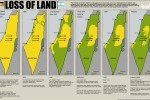
palestine-loss-of-land‘At Basel, I founded the Jewish State. If I said it out loud today, I would be answered by universal laughter. Perhaps in five years, and certainly in fifty, everyone will know it.’[1] ~ (Theodor Herzl writes in his diary about Basel Zionist Conference, 1897 where Zionism was officially coined)

The birth of the State of Israel on 14th May 1948 is a turning point in the history of the Middle East and one of the most significant events of the twentieth century. Based on Zionist ideology, Israel came into being as a ‘fulfilment of the promise of the Jewish scriptures’. Since its inception, Israel centres its relations with the native population and neighbouring countries on an existential threat. Alliances, ties, negotiations and treaties all base on Israel’s so-called security concerns faced from within and outside the country. But Israel’s Zionist foundations and expansionist aims have a major role to play in the volatile situation of the Middle East.

Israel, by definition and by essence is a Jewish state and was formed to give the Jews, living in different parts the world after the Diaspora, a national home. While Zionist ideology laid the foundation stone of the state, the native Arab population and the seemingly mighty neighbours joined by the rhetoric of common Arab roots, language and cultures became the immediate security threat for the country. But very soon Israel’s man and military power was evident to her as well as to the hollow and deeply divided Arab world. The idea that there was no power in the neighbouring world that matched the military strength of Israel became evident after repeated humiliating defeats encountered by Arab forces, but the case built by Israel as, David surrounded by the forces of Goliath, continued to play a significant role in Israel’s expansionist plans based actually on the ideas of Zionism.

ZIONIST FOUNDATIONS OF ISRAEL:

Zion is the biblical name for Jerusalem.[2] Political Zionism is a concept of the late nineteenth century, coined by Theodor Herzl, a Hungarian secular Jew, in the background of strong anti-Semitism in Europe. His book ‘The Jewish State’ provided a detailed plan for a state where Jews, who were not a religious group but a nation in his views, were to live in peace. In 1897, at the Basel Zionist Conference, the idea of Zionism was officially founded i.e. a ‘Jewish national home’ in Palestine. Herzl mentions in his diary,

‘At Basel, I founded the Jewish State. If I said it out loud today, I would be answered by universal laughter. Perhaps in five years, and certainly in fifty, everyone will know it.’[3]

The three strands of Israel’s identity i.e. religion, nationalism and the Holocaust, as described by Michael Barnett, help Israel portray herself to be in an isolated state and vulnerable to security concerns from different fronts.

‘While all national identities differentiate between ‘us’ and ‘them’, arguably the centrality of religion, nationalism and the Holocaust in Israel’s identity, make these effective and cognitive boundaries more severe and austere’.[4],[5]

Chaim Weizmann, the elected President of World Zionist Organisation was the strongest link between ideas initiated by Herzl and the British Empire. He put all his efforts to win British support for ‘Jewish Commonwealth in Palestine’ belittling the risk of Arab opposition and portraying them ‘a tiny fraction of large Arab nation’[6]- Balfour Declaration, a letter written by British Foreign Secretary Arthur J. Balfour, promising a national home for Jewish people under British support came as a major achievement for Zionists in 1917. Jews were only 10% of the population. The 90% were a non-existent entity for Weizmann as well as the British. The declaration opened the doors of Palestine to the Jews and the Zionist ideas started becoming clearer with time. Although diplomacy was always the way to the goal, and avoidance of the term ‘state’ and preference for usage of ‘a national home’ was the trend, but Weizmann when asked at a peace conference in Paris defined the Jewish National home as to make Palestine as Jewish as England is English.’[7] The Arabs were not partners in any negotiations and Weizmann’s policy was uncompromising in terms of Jewish settlement goals in Palestine.

Jabotinsky, a staunch Jewish nationalist and the founder of Revisionist Zionism, believed in the supremacy of the Jews. For him, Jews were the source of budding Western civilization in the backward and stagnant East. While he acknowledged that no voluntary agreement was possible between alien settlers and native population, the idea of return to Palestine could not be bargained.

We must either suspend our settlement efforts or continue them without paying attention to the mood of the natives. Settlement can thus develop under the protection of a force that is not dependent on the local population, behind an iron wall which they will be powerless to break down.’[8]

For him, an iron wall, i.e. a strong invincible force, was the answer to the Arab problem. Negotiations would only be fruitful if the Zionists were physically and militarily stronger than the natives. Peaceful coexistence is a possibility only after overpowering the threats, materially and by force. For Jabotinsky, there was nothing immoral about the concept of the ‘iron wall’, if the idea of Zionism and right to return to the Zion was to be achieved. The latter is a sacred truth, so any step taken in whatever shape, no matter how immoral it looks to the world, becomes automatically sacred.[9]

Arab resistance was very natural in these circumstances. Riots against the Jews took the shape of full-blown upheavals. Arabs rejected all proposals put forward by the British. David Ben Gurion, the founder of the State of Israel, pushed the British for establishment of a Jewish state after increasing Arab resistance. Lord Peel’s commission report suggested partition of the land in two states in 1937. Although the Zionist leaders were divided on the issue of borders of the states, Ben Gurion’s idea was to accept it for the start and the rest of the country would soon be under Jewish rule.

‘Erect a Jewish State at once, even if it is not in the whole land. The rest will come in the course of time. It must come.’[10]

This was the foundation of Israel: Religion, Zionism (Jewish nationalism), a history of Diaspora, and a strong belief in moral right to return. As perceived by Jabotinsky, the settlers would naturally be unwelcomed by any native population and that is where importance of security would come into play. Thus, pillars of unmatched security and powerful military were absolutely essential to support the foundation stone of identity. Zionist movements developed their own military power in order to be independent of any outside support for survival through the paramilitary organisation called Haganah, and Irgun. In the backdrop of end of World War II, the Holocaust and strengthening Zionist military force, General Assembly of the United Nations passed a resolution in favour of the partition of Palestine in 1947. In 1948, the state of Israel was born in the midst of confrontation with Arabs, within and outside the state.

THE CONFLICT: A NATURAL OUTCOME OF OCCUPATION:

The Arab-Israel conflict is as old as the proclamation of Israel. The Jewish population in Palestine increased dramatically from 10% (54,000) to 32% in 1947. With military supremacy, Zionists were able to gain control of the territories defined in the UN partition plan. The first war against the new state began immediately with Egypt, Jordan, Syria, Iraq and Lebanon but due to disunity, poor communication, absence of reliable intelligence and poor leadership, coordination and planning[11], the Arab states failed badly. Also, the military balance was in favour of Israel with total number of Arab troops of only 25,000 and IDF over 35,000 increasing to 65,000 within two months and 96,441 in seven months. As Avi Shlaim comments, ‘In this war, as in most wars, the stronger side prevailed.’[12] Armistice was signed between Israel and Arab states in 1949. But the border tensions remained high.

The subsequent crisis came in the shape of the Suez war of 1956. Colonel Gamal Abd al-Nasser of Egypt had reached an agreement with the British to withdraw from the military base in the Suez Canal. Israel for her own security wanted the British to remain in the area, therefore a spy ring was activated so as to blow up the installations and give reason to the British not to vacate the area. Spies were captured, tried and hanged by Egypt. Israel’s public saw it as Egypt’s hostile attitude towards their state. To satisfy the public with government’s prompt action and state’s military superiority, Israel attacked Gaza and caused heavy Egyptian casualties. Nasser signed arms deal with Soviet Union, which caused Israel to get more arms from France. Britain not happy with Gamal refused to finance Aswan Dam. Nasser’s retaliation came in the form of nationalising the Suez Canal which was the lifeline for the colonialists to rule the other side of the world. Britain, France and Israel attacked Egypt in the Suez War of 1956. The Israeli army managed to occupy the Sinai Peninsula within 100 hours[13]and Sharm al-Sheikh, thus opening the Straits of Tiran, which were Israel’s primary route to East Africa but had been blocked by Egypt for several years.

In 1967 the six-day war was the most remarkable military victory in the history of Israel. 5th June to 10th June, Israel had occupied the West Bank and the Golan Heights, the Gaza Strip and the entire Sinai Peninsula. Arabs suffered from a humiliating defeat, tipping the balance of power heavily in favour of Israel. ‘The annexation of East Jerusalem, was the first and the most dramatic assertion of Israel’s claim to sovereignty over its ancient homeland. Zion, was at the heart of Zionist dream for the restoration of a Jewish kingdom in Palestine.’[14]

The political and military equation began to change after this war. Syria and Saudi Arabia displayed willingness to recognize Israel, and Egypt and Jordan signed peace treaties. The demand of surrendering the territories occupied in 1967 remained prominent in exchange of recognition and peace with Israel throughout the post war era. The major argument in retaining the West Bank was security-based, as it would form a barrier against any attacks from the East. But the West Bank also formed part of ancient Israel (Judaea and Samaria). The Revisionist Zionist Likud party kept rejecting the idea of any kind of surrender even if peace with neighbours and natives became impossible. Their expansionism towards the fulfilment of a Jewish state did not take into account the opportunities of peace offers. Israel’s military supremacy and invincibility throughout these years had made the expansionist goal much easier even if it meant the subjugation of the native population. Negotiations, compromise and diplomacy did not hold much value due to the ‘iron wall’, the unconquerable force once perceived by Jabotinsky, which had later transformed into a literal physical reality.

 THE MIGHTY OPPRESSOR AND THE HELPLESS NATIVES:

The Palestinian problem remains a real one until today. Israel’s population reached six millions in 1998, nearly ten times what it had been in 1948.[15]Israel’s war of independence in 1948 was Palestinian’s Nakba (disaster) when 780,000 Palestinians, two-thirds of country’s population were driven out by Zionist troops and design.[16]The remaining population was denied any political rights as if they were non-existent in the flow, due to the Zionist program, which had to be implemented by any means necessary. Destruction of an existing society in 1948, conquest of West Bank and Gaza in 1967, the invasion of 1982 with 17,500 Lebanese and Palestinian dead, the Sabra and Shatila massacres; the continuous assault on Palestinian schools, refugee camps, hospitals, civil installations[17] was all a show of asymmetrical power unwilling to create a peaceful society meant for coexistence. Israel’s security issues arise not only from it being a product of Zionist ideology but, simply put, an occupant in a land where the native population has no rights whatsoever despite Israel’s big claims of being democratic. The disparity of power between Israel and the native population also nullifies the security argument especially from inside the state, when Palestinians have no army, air force, tanks or sophisticated defences of any kind.

 ‘There can be no conceivable peace, in my opinion, that doesn’t tackle the real issue, which is Israel’s utter refusal to accept the sovereign existence of a Palestinian people that is entitled to rights over what Sharon and most of the people supporting him consider exclusively to the land of Greater Israel, i.e. the West Bank and Gaza.’[18]~ Edward Said

 A French philosopher Ernest Renan once said, ‘A nation is a group of people united by a mistaken view about the past and a hatred of their neighbours.’ In Israel’s case, the view of the past is not mistaken. The Diaspora, the Holocaust, and anti-Semitism of Europe are a horrible reality. But the translation of a terrible past into an uncompromising dream with results like massacres, subjugation, violation of international laws and expansionism, has given rise to merciless atrocities and has put at risk, the peace of the world. Security for Israel may be a genuine concern and will always be, not because the world is bent upon being anti-Semitic, but an oppressor will always be seen as an oppressor, no matter which part of the world he exists in. Every native population will see an alien settler with concern and the peaceful co-existence would never come into being if the settler’s inflexible passion or hunger for fulfilment of a dream brings endless tragedies, bloodshed and fears for the natives.

REFERENCES:

[1]A. Shlaim, The Iron Wall, Israel and the Arab World (The Penguin Press, 2000), p.3

[2] Ibid, p.1

[3]Ibid, p.3

[4]M. Barnett, Culture, Strategy and Foreign Policy Change, Israel’s Road to Oslo http://home.gwu.edu/~barnett/articles/1999_israel_ejir.pdf

[5]S. Telhami, M. Barnett,Identity and Foreign Policy in the Middle East (Cornell University Press, 2002), p.58

[6]A. Shlaim, The Iron Wall, Israel and the Arab World (The Penguin Press, 2000), pp. 6-7

[7]Ibid, p.8

[8]Ibid, p.13

[9]Ibid, p.15

[10]David Ben Gurion, Letters to Paula,(London, 1971), 153-157, A. Shlaim, The Iron Wall, Israel and the Arab World (The Penguin Press, 2000) p. 21

[11]E. L. Rogan, A. Shlaim, The War for Palestine, Rewriting the History of 1948, 2nd Edition (Cambridge University Press, Cambridge, 2007), pp. 80-81

[12]Ibid

[13]A. Bregman, Israel’s War, A History Since 1947, 3rd Edition (Cornwall, 2010), p. 59

[14]A. Shlaim, The Iron Wall, Israel and the Arab World (The Penguin Press 2000), p. 251

[15]A. Shlaim, The Iron Wall, Israel and the Arab World (The Penguin Press 2000), p. 597

[16]E. Said, The Consequences of 1948, E. L. Rogan & A. Shlaim (ed.), The War for Palestine, 2nd Edition (Cambridge University Press, Cambridge, 2007), p.248

[17]E. Said, The End of Peace Process: Oslo and After (Granta Books, London, 2002), p. xv

[18]Ibid, p. xv

The Regime of Reason

Your intelligence is different from mine. And mine is different from yours.

Times changed. “My intelligence is superior to yours”, said Reason.

Who and what is ‘Reason’?

Reason was born and raised like any other intelligence.

It too lived on the imaginative outskirts of human minds.

It too insisted that it had a point.

‘A point to a point’ as it put it.

The point, it ‘reasoned’, was to get to a point.

“It was right”, thought others, “in its own right.”

“You do make a point”, it was told.

But then. One day. Out of the blue. It panicked. It reasoned.

“Is it enough to make a point that is valid? Shouldn’t my point be the only valid one?”

It ran towards the city. It made an announcement.

It “reasoned” that there can only be one intelligence.

Intelligence could be more or less. Not merely ‘this’ and ‘that’.

It was not enough to be different. It had to be superior.

It told others that they must accept its singularity.

Reason alone is intelligence.

Reason’s intelligence alone is Reason.

“Such a wild proposition”, it was told at first.

But then it gained strength.

It used its skills to make a point to reach a point.

It reasoned itself into power. It took over. It ruled a tyrannical rule.

Order was ordered.

Opposition was crushed.

The vulnerable were executed.

Resistance was punished.

Compliance was rewarded.

The terror of Reason became the regime of Reason.

Reason declared the non-existence of all intelligences except its own.

Intelligence was singular.

There was only one intelligence.

This was absurd. This was bizarre. This was letter of the law.

“How can redness describe the colorfulness of yellow”,  drew an artsy intelligence.

“How can sweetness describe the tastefulness of a hamburger”, cried a fanatic intelligence.

“Your truth will never compare to mine”, prophesized a mystical intelligence.

Art, emotion, religion were executed.

The death of God was declared.

Man was born.

The Man of Reason began to exist.

Existence became the universal privilege of reasonable man.

“I am being rational”, said reasonable man.

“Your rationality is irrationality. It must not exist.”

“Millions must die so I can build Reason’s civilization.”

Civilization was built on a graveyard of unreason.

Unreason was buried.

There was reason and there were lesser reasons.

The lesser could exist insofar as they acknowledge reason’s sovereignty.

The lesser could exist insofar as they acknowledged their imperfectability.

They could exist if they severed their claims to intelligence.

They were made to destroy their selves to become the self of reason.

Their generations grew under these conditions.

With time, they forgot their ancestors withdrawn rights altogether.

This system. This system that decided which intelligence is intelligent and which is not.

It was very real.

It became realer.

Then it became reality.

Reality was this system.

It was how things are.

It was how things are supposed to be.

It was all for our own sake.

It produced. It produced stuff we needed.

We need that stuff.

We must stuff ourselves with that stuff.

We may not be able to have that stuff today.

It will trickle down tomorrow.

It will trickle down the day after.

It will trickle down later.

It will trickle down.

Trust me.

indian-genocide


Down to Earth – With a Bump

laurenbooth_profileIt doesn’t happen quickly, it takes time.

For a long time you can’t imagine it happening at all.

Then one morning, you wake up and it’s living within you. A spiky, pebble in the midst of joyous certainty; disappointment.

Disappointment in the Ummah, you are now a part of.

For ‘born Muslims’ the acknowledgement that those who try to follow the teachings of the Prophet of Mercy, (May Allah The Most Merciful bless him) always fall short, comes with the territory. If you are from Pakistan or Bangladesh or Egypt or Palestine, or any other majority Muslim nation, you will have most likely experienced all manners of corruption from the political level down.

Family members, being human beings after all, will have done as we all do; raised their voices, gossiped (probably), missed Fajr and failed in a thousand, small, yet visible ways, to fully embody the teachings we are directed to follow in the Quran. Teachings that if taken to heart, absorbed into the very core of our understanding and then translated into our daily lives, would make this testing reality, dunya, so much easier to bear.

‘Born Muslims’ inevitably try and warn those of us who take testimony of faith as adults, in a variety of ways about the disappointment to come:

“Not all Muslims are good, be careful”; “We don’t keep our promises, pray for us.”

And always my favourite: “Facial veil is no guarantee of piety!”

New Muslims can’t and don’t listen. It is as if our eyes only seek out the good in our brothers and sisters. We are blinded by love, filled with joyous hope.

Finding Islam through the Kindness of People

This apparent ‘naiveté’ seems to jar many brothers and sisters. It is almost as if they can’t wait to burst the bubble of our new found admiration for this community. This family-in-faith, remain stunned, as I announce in lectures that: “I came to Islam through the incredible character and kindness of the people.”

Yet, it’s true.

In 2005, I first set foot in the Holy Land, Palestine. There, in homes, of which the wealthiest I was invited to would be considered the poorest in the West, I learnt about love, patience and generosity; And how to host guests; And how to bring up children; And how to be a good human being.

Time and again, I would make excuses to go back to Falastin, treading the fertile grounds of Jenin, Nablus, Bethlehem. All because my heart yearned to spend time with the most remarkable people I had ever met.

After one such visit to the Gaza Strip, I experienced the terrible humiliation visited upon Palestinians, even in old age, at the Israeli ‘Crossing’ known as Erez; Half a mile of concentration camp style watchtowers, barbed wire, concrete and turnstiles cruel for livestock – terrible for human beings.

An elderly Gazan grandmother, traveling to America for a spinal operation, was turned back time and again at the crossing, without explanation, until she missed her flight and her operation. It took the rest of us; UN workers, Fatah government ministers, business men, five hours to pass through the hellish process.

I had booked a Palestinian taxi driver, Jamal, to collect me at around 11:00 am. It was now past 5:00 pm, dark, winter. My mobile battery had long ago died.

Suddenly a car sped towards me in the empty parking lot. It was my taxi.

“I booked you for 1:00 pm” I said aghast.

“Yes” replied Jamal “I waited from then”.

“For five hours?” His response made me weep all the way to Jerusalem, Al Quds.

“A Muslim man would never leave a woman on her own in danger.”

Subhan Allah!

These inspiring moments have not been limited to a land under occupation, nor to those whom hardship and poverty has cleansed of arrogance.

From Palestine to the UK

Back in London, my path continued to cross gentle women, whose manners were unlike any I had encountered before, with sweetness from another, purer, age and time. Women who despite working in highly regarded professions, as lecturers, doctors and teachers, greeted me, an unbelieving stranger, with greater love than many I had known all my life.

Then I took my shahadah and I waited for the change (that all my born Muslim friends warned me) was certain to happen.

One morning, in February this year I woke up to find that it had arrived. Suddenly, not everyone around me was shiny, amazing. Everywhere I looked Muslims were bragging, lying, gossiping, drinking alcohol, stealing, flirting and every other sin, major and minor.

What happened guys?

On reflection, two realizations occur within the revert that finally bring this grim moment to fruition. The first is that we, ourselves, start to fail more and more. In our ibadah, in our speech, in our deeds. From those glorious first days and months when we are immersed in learning Islam, where constant dhikr creates something like an invisible force-shield, around the believer who practices. It keeps us in check, protects us from harm.

Oh how we fill our waking hours with the Quran, reading books on Hadith and downloading inspirational lectures by people of knowledge. A person, who accepts Islam wholly and completely, cannot be late for prayer. It is unthinkable. Clutching a sheet of paper or a donated book, the newbies nervously, cautiously, hearts swelling with love, work the way through Salah. They will painstakingly mouth each alien vowel, respecting every sacred syllable. How direct is the unwavering gaze downwards – which is an imitation of the blessed Prophet’s own concentrated eye line during prayer. How the grateful, saved heart cries towards Allah, The Merciful, who has cleared away all our previous sins.

“Ihdinas Sirat al Mustiqeem”

 Do we seek shortcuts in our wudhu? No!

Do we watch TV shows which may show kissing or drinking alcohol? No!

Do we hang out with chatty (gossipy) friends – No!

This is the moment born Muslims may see us as ‘extreme’ in our practice.

This is the moment too when our ‘khushoo’, sincerity in seeking Allah’s face, is at its highest peak. Love is everywhere, peace is possible, and faith is all.

As I say, then we begin to falter. You know how it goes. First you drag your feet a little, to the prayer mat. A week later, barely noticed, all your prayers are last minute and rushed. Soon after that Fajr is done ‘before going to work’ and not pre-dawn. And here we all are together at last in our weakened, stumbling, frail, version of faith.

A second powerful blow is delivered as experience means we must realign our expectations of our community. What I mean is this.

You are Already a Kinder Person 

Compared to the world outside the Ummah; great sections of our community are and always will be, inshaAllah, amazing. Whole villages are known in far flung places to be beacons of hope to the traveller and seeker of knowledge. Whilst in every city in every nation on every continent, humble servants of The One, quietly support friends, neighbours and strangers as best they can, even if it means personal hardship.

 ‘They (the true believers) give food, out of love for Allah, to the poor, the orphan and the slave, saying: We feed you only for Allah’s pleasure – we desire from you neither reward nor thanks.’ (Al Qur’an 76:89)

 Coming from the cold, hard, materialistic, half drunken, non-Muslim world, I can tell you that thanks to the teachings of Prophet Muhammad (peace upon him) you are already a kinder person than you otherwise would be. How quickly sisters jump to one another’s aid where children are concerned for example. I never had the kind of support I now have, outside the Ummah. How quickly we rally together to help a family if a member falls ill and times are hard. Did I see this so routinely outside? Not at all!

In February the differential, the gap between how good we all manage to be and what we should be, was simply made clear. The natural goodness of those around me has become something I now take for granted.

Yusuf Islam is famously credited as saying: “Thank God I learned about Islam before I met Muslims”. I can understand that.

The question we must answer as disappointment in everyone else pecks at the grains of our faith. Have we already become one of ‘those’ Muslims – more likely to put others off this complete way of life, than be an example of its high principles?

Also published on OnIslam.net

From Christopher Columbus to Malala Yousafzai‎

Columbus to MalalaParallax errors of selective historical and contemporary view points

A simple definition of Parallax would be “an apparent change in the position of an object resulting from a change in position of the observer”. By some accounts on October 12 Christopher Columbus arrived in the Americas [1]. 521 years later a girl, Malala Yusufzai, from Swat, Pakistan met President Obama. President Obama stated “Across the globe there are girls who will one day lead nations, if only we afford them the chance to choose their own destinies.” Both Pakistan and Bangladesh have had women Prime Ministers. A lady has never been elected to the President’s office in the US.

In 2007 30% of Iraqi elementary school children attended school [2] as opposed to 75% previously. Between the 1990 and 2005 the increase in infant mortality in Iraq of 150% was the highest in the world, a period that saw inhumane sanctions and a war based on greed [3] , an IMR had by contrast declined from 120 per 1000 in 1960 to 45 per 1000 in the late 1980’s. Some charge Muslims with trying to take over the West, forgetting conveniently that Iraq alone has lived the nightmare of foreign takeover multiple times. A 1920 “uprising” was crushed by Churchill through the RAF with Winston itching to use chemical weapons [4] and authorizing a brutal bombardment [5] of the “enemy” who happened to be the native of the land being occupied. The exact death and destruction from Iraq from first gulf war is still an obscurity in the media, so there is no surprise that the mortality and morbidity from the latest fiasco is manufactured in to a question mark. The Lancet study[6]  concluding 650,000 excess deaths and by some counts well over a million are disputed by the same media that John Kerry uses to drum up support for yet another war, this time in Syria shoulder to shoulder with Al-Qaida [7], backed by “numbers” pouring in thick and fast. Fortunately, the sanity of American people prevailed over a proxy war between Turkey, Saudi Arabia, Israel, USA against Iran and Russia presented as yet another divine call to protect the weak by the media.

Stringing it together – “Rediscovering” Columbus:

In school curriculum by our colonial masters, we found the names Christopher Columbus and Ferdinand Magellan. One of the first things to relearn about Columbus is that he was by no means the only one who believed that the earth was not flat. Second and more importantly, he conducted a shameless genocide of the indigenous population. In the schoolbook version in Pakistan and the US[8], he was an intrepid explorer, inspired by his faith as much as curiosity and “discovered” the “New World” because the Ottomans had blocked off the land route to India, the latter an assertion challenged by some as it was a money making venture for the Ottomans. In this day and age of connectivity it is hard to keep old myths alive let alone build new ones. One finds that Columbus was welcomed by an indigenous population only to return with arms and annihilate them. The “New World” was already home to an indigenous population, 90 to 95% of who would be wiped out in a single generation. The cause of this remains controversial and although disease from the “old world” did play a role, genocidal violence had very clear role as well, the people of the old world having the advantage of newer weapons unknown to the indigenous. In American Holocaust, David E. Stannard writes that in 21 years after Columbus came to the Caribbean, it went from a population of 8000,000 to be being desolate. The numbers and causes seem to get more obscure the more inconvenient they are to the myth of a linear unblemished history. The war on the natives was not despite faith but done in its very name as “the Requirement” would be read out to natives, imploring them to recognize the Church and Pope or be ready to face war declaring explicitly that women and children will be taken as slaves. Only a fool would use this as a reference to approach Christianity in general yet a similar bias is used for Islam daily in the media.

The current Palestinian-Israeli conflict becomes just another chapter, overlooking the fact that at the time Columbus sailed from Spain under Isabella Ferdinand, one of the most luminous chapters of coexistence [9] were coming to an end, that is the Spain under Moorish rule which was not perfect, but would still make us question the world that we are shaping since 9/11. In Spain Christians, Jews and Muslims had come together to make advances in art and science that Europe would owe its emergence from the dark ages to. Under Isabella and Ferdinand in Spain came the Spanish Inquisition, Jews and Muslims were expelled, even co-religionists were persecuted on suspicion of being fifth columnists. By contrast Jews and Christians had freedom of religion under the Moors [10] [11] and in fact many Jews were forced to flee to Ottoman lands.

Lessons from the Columbian myth: 

One has to be careful of the lessons learned from Columbus, just like one must not reduce Malala’s wonderful story to a conspiracy theory despite the undoubted exploitation by some. In a time of unprecedented propaganda we can fall to the temptation of our own parallax error – of creating our own “other.” However, we have to advocate that West and Islam question sincerely our biases, from a distorted history of the Crusades to the temptation of a religious transference.  The historical place of women in Islam and their roles are very different from what the exploitation of Malala would suggest. It is overlooking that just like early Christians, early Muslims were persecuted and the first martyr of Islam was Sumayah (May Allah Be Pleased with her) was a lady, killed when a spear was thrust through her private parts. It was the background of such victimization that Quranic verses of retaliating were revealed.

Most importantly, Columbus was a myth built over 500 years but took a few days of research in this day and age of the technology to dismantle. Those trying to reduce the violence of the last dozen years, both by a lunatic and fringe that has killed more Muslims than anyone else as well as by elected governments taking their people to wars based on lies, to the face of a young girl need to learn that the world does not lend itself to such a convenience any more. Muslims also need to learn that increasingly our struggles are intellectual. As a Muslim living in the West one can have many fears about disagreeing with the media narrative, being labelled a Taliban apologist, a closet extremist, a person mired in 1400 years of hateful history that never was, but perhaps the single most insincere thing that one can do to the society that we now live in is not share our perspective.

What Malala is not:

It is interesting how passionate a debate Malala has generated. Perhaps the most laughable was Bilawal and Bahtawar Bhutto (Last name Zardari?) saying they want her as their Prime-minister. This after unprecedented corruption by the Bhuttos as well as the Sharifs followed by Asif Zardari, a man known internationally for his money laundering and corruption, being installed as the President of Pakistan by the powers that be in and out of Pakistan, A fact Condoleezza Rice narrates in her book ironically named “No higher honour.” It is this manipulation of the fates of millions that breeds resentment against the US that leaves others robbed of their dignity and yes, also leaves the US a scape goat for one’s own failures.

One has to wonder about the stunning figures of mortality among children from US policies in just the last 2 decades, not to mention the malnutrition, internal displacement, destruction of families and lost opportunities for education, the thousands of innocents killed in drone attacks and the contrast of parading Malala. She was a face of the children of Pakistan but has been projected as a mask for the atrocities of the West. Even a partial list of children killed in drone strikes speaks of another reality [12].  The media uses her to obscure that Aisha (May Allah be pleased with her) is one of the most prolific narrator of prophetic traditions (Ahadith), that the colonialism has exploited women as much as imperialism does now, that bigots like Lord Cromer in the early 1900’s in Egypt criticizing Islam were opposing women’s right at home in England [13]) and that a French General had concluded“If you convert 100, 000 young indigenous girls to our civilization …. these young girls, who would naturally become the privileged wives of the most important men of their class will, forever guarantee the subjugation of the country and be the guarantee of its future assimilation. [14]” Malala is a daughter of Pakistan, a young girl among many who suffer in a country plagued by feudalism, lawlessness, corruption and economic mismanagement, all factors that have helped the US government manipulate Pakistan to its interest while the media keeps people misinformed by creating out of one life what it has denied to millions.

Why Malala is a real princess:

Some months ago my daughter had asked about Princess Diana when she watched a video of Diana visiting the Shaukat Khanam Cancer Hospital in Pakistan, one of the biggest philanthropic ventures in Pakistan that serves all Pakistanis regardless of race, religion or color. I told her she was “real princess.” I will teach her the same about Malala for her courage is truly phenomenal and makes me question what I have done to build a better world. I think the biggest lesson this young girl taught me is that if you believe in something then you should be willing to stand up for it. There have been many satirical blogs and articles about how Pakistanis see a conspiracy behind her including by a minority of Pakistanis whose parallax is the convenience of picking a (often profitable) side in a black and world narrative, conveniently overlooking that in the last 10 years Pakistan has seen unprecedented violence, the influx of Black water mercenaries, the interests of its own people sold by the corrupt elite and the likes of Raymond Davis literally getting away with murder. That Humanity in the midst of the never ending war on terror has decided to handle collective affairs on anything other than on power is bound to draw skepticism.

Pakistan air force now has women pilots and women have served in the police for years and that many teachers in Pakistan are ladies. I celebrate  Malala, like  my grandmother, a physician who went on to participate in the Pakistan movement, My mother a physician who practiced in Saudi Arabia and Pakistan, my sisters who went on to successful medical careers and my wife, yet another physician in the family.  Today more than ever it is easier to retrace history. To celebrate Fatima Al-Fihri, a Muslim woman who established the first University in the world and perhaps even dare suggest that Columbus Day be renamed Bartolome De La Casas Day who unlike Columbus had the courage to see the humanity of the “other” and said:

“What we committed in the Indies stands out amongst the most unpardonable offenses ever committed against God and mankind and this trade [in American Indian alaves] as the most unjust, evil and cruel among them”.

References:
1. Columbus day: Wikipedia http://en.wikipedia.org/wiki/Columbus_Day
2-3. The War Machine and Global Health, A Critical Medical Anthropological Examination of the Human Costs of Armed Conflict and the International Violence industry
4.   Winston Churchill’s Secret Poison Gas Memo: http://www.informationclearinghouse.info/article999.htm  
5. Iraq, 1917: http://www.informationclearinghouse.info/article6337.htm
6. Lancet surveys of Iraq War casualties: http://en.wikipedia.org/wiki/Lancet_surveys_of_Iraq_War_casualties
 7. Does Obama know he is fighting on Al Qaida’s side: http://www.independent.co.uk/voices/comment/does-obama-know-hes-fighting-on-alqaidas-side-8786680.html
8, 10. Lies my Teacher told me, James W. Loewen
9. Ornament of the World, Maria Rosa Menocal
11. State, Society, and Law in Islam: Ottoman Law in Comparative Perspective, Haim Gerber
12. A List Of Children Killed By Drone Strikes In Pakistan and Yemen http://www.policymic.com/articles/24164/a-list-of-children-killed-by-drone-strikes-in-pakistan-and-yemen
13, 14,The Miseducation of the West, How schools and media distort our understanding of the Islamic world, Joe Kincheloe

The Political Economy of Hatred

llll

Hatred is a scam. Just like a lot of stuff Capitalism and its globalizing effects want to sell us. This is what they do right? They come at our doors and they sell stuff. We buy stuff. But we also buy into stuff. Into the ideology of stuff.

The ideology of stuff isn’t your next door neighbour- wait, maybe it is. Nevertheless, it’s an outrageous liar, a manipulative predator, a tormented bully, a murderous blasphemous mother figure, a haunting daunting cyborg, a pretentious cold hearted drone, and an official doctrine- a doctrine of hate, and of lustful appetites; a doctrine of obedience, and of going wild.

To keep us at bay, Capitalism invents enemies and detractors. Focus on them it says. Business takes place as usual. But behind curtains; in the form of official mantras, and national songs. And of all sorts of patriotic jibberjabber- that weird old feeling you get when you are told to be proud of those latest mechanical contraptions made to murder other human subjects; subjects of the God of Modernity, also known as the ‘Nationstate’- a global God, a God of boundaries, a God everyone worships, both ‘us’ and ‘them’.

And here stand two neighbours. India and Pakistan. Enslaved by the passions of their new found religions- nationalism and nationalism respectively. Always bickering and swearing about and to each other. Both could benefit from a little give and take, a little mutual cooperation, a little mutual trust, which would in turn lead to some trimming off military spending here and some added social welfare spending there. But both fail to realize what’s good for them- and by them, I mean their people. Instead, both impose doctrines of hate on their people. People are told to hate people. A nation is told to hate a nation. And vice versa.

Recent developments are quite interesting. War hysteria had taken over India. But what really happened. Did people suddenly decide that Pakistan was the source of their misery. The fact that the average Indian person lives in abject poverty while the country is producing some of the wealthiest Billionaires on the planet seems too sophisticated a scheme for the diabolical foe across the border to concoct. What’s really happening here? And why is it happening when elections are at the corner and a billion people will be given the power- formally speaking- to change their destiny? Why are they told that the problems inside their borders are less important than the problems outside their border? Why are they told the miseries of the people are less important than the egos of the ruling elite? And why now?

On the other side, Pakistan just experienced elections. And what we are seeing is a pronouncedly pro-dialogue and pro-friendship government of Prime Minister Nawaz Sharif. The PM has already stated that both countries should work on cutting military spending and on boosting people spending. This is a positive sign, despite some skirmishes on the border. One can hope that some sort of dialogue and sanity is restored in the future.

But then we are reminded of a very real fear. A genocidal fascist is making his way to the throne in Delhi. In the heart of the world’s largest democracy, a mass slaughterer, Narendra Modi, is not only the strongest candidate for the PM’s office but is also the blue-eyed boy of the corporate world. He offers a lot of promise. To the corporate world that is. Under his watch, the world tolerated a systematic pogrom against the Muslim community of Gujrat. Rape, torture and slaughter were orchestrated openly in the streets while Modi justified it in an terrifying action-reaction logic.

It’s only high time to do away with logics of actions and reactions, and of ‘us’ and ‘them’.  For someone like Modi to become PM only tells how nationalist-conservative rhetorics are so intertwined with capitalism and globalization. The way they get away with all this is through sowing the seeds of hatred.  One may think otherwise but haters are part of the same process; the same ritual; and the same religion—the religion of nationalism.

Who is Behind the Bloodbath?

bloodbathThe catalogue of bloodbath in the Muslim world is harrowing and sickening. I want to know who is responsible for it all. It has been a bloody week – the Westgate shopping centre massacre in Nairobi that left 67 people dead, the killing spree of students in North Eastern Nigeria has left 50 students dead, the bomb blast has left 40 people dead in Peshawar in Pakistan and another bomb in Baghdad has taken the lives of 47 people. I want to know who is behind it all.

While the media and pundits brandish “Islamist terrorists” as the key culprits the more serious questions does not even get discussed. They get buried under the hysteria of the Islamist threat. I would like to know who these people are. What is their true identity? Who is funding them? Where are they getting their weaponry and technical support? Why are they hell bent on doing it in the name of Islam and not Christianity, Judaism or other faiths?

We all know that no true Muslim would ever carry out such atrocious and heinous massacres. Yet they are promoted as the true representatives of Islam and the Muslims by the media; their actions are labelled as Islamic and terroristic at the same time. I want to challenge those who are making a living out of pretending to be an Islamic terrorism expert by posing a few simple questions:

1. They are well aware of the fact that terrorism can never be Islamic but knowingly they make the association. This remains registered in the conscious and sub-conscious minds of people. When they think of Islam they think of bombs, killings and terror. Why do these experts deliberately conceal the truth and make these false associations?

2. By making Islam synonymous with terrorism what do they intend to achieve apart from fanning the fuel of Muslim hatred and discord? They know Islam could end terror and tyranny instantly if the Muslim world was truly free.

3. Why call terrorism, Islamic?

The Muslim world is sick and tired of more and more frontiers being thrust on their faces. They have the internal dictators and despots to fight in their respective homes. They have to struggle against imperialism and neo-colonialism. They are now facing a new menace; unknown people and groups are popping up everywhere and carrying out indiscriminate attacks and massacres using crude bombs with devastating consequences. Whose agenda are these murderous mischief-makers serving?

We all know that according to Islam killing one innocent person is tantamount to killing the entire humanity. In Islam life, intellect, property, family and faith of people are the most basic rights that must always be preserved. Yet, there are people who are randomly picking shopping centres, targeting markets, selecting schools and even choosing mosques to kill Muslims. There are those who are attacking the non-Muslims and their places of worship. A true Muslim would never do anything like that! A genuine Muslim would naturally be deterred by God consciousness, the inevitable consequence of the Hereafter and their scared commitment to fairness and justice.

The truth of who is pulling the strings and who are the real masterminds behind these attacks needs to be uncovered. Who are the paymasters of these bloodthirsty monsters need to be unveiled? Who are the real terrorists?

Anyone who believes in the God, most Merciful and most Kind and the last day would never attack innocent people or kill. These are the works of some dreadful people whose only motive is to demonize Islam and destabilize the Muslim world. A free and modernized Muslim world, embedded in Islam would pose a huge challenge to the interest of these ghastly people. I eagerly wait for that day when the Muslim world would be truly free and Islamic.

My all-time favourite chapter of the Quran summarizes the true character of Muslims in the following timeless words:

“CONSIDER the flight of time!
Verily, humanity is bound to lose
Except those who attain to faith, and do good works, and enjoin upon one another the keeping to truth, and enjoin upon one another patience in adversity.” (Chapter – The Time)

Murder, mayhem and terror has no place in Islam and please do not attribute it to Islam either.

Reclaiming Rainbows

rainbow

Human thought finds a rather romantic metaphor in a rainbow. With reflection one may find more in it than a fleeting comfort. Perhaps find even a way to reconnect with our purpose and reassurance that God ordered the perfection of Angels to bow to the ‘imperfection’ of humanity.

“Behold, thy Lord said to the angels: “I will create a vicegerent on earth.” They said: “Wilt Thou place therein one who will make mischief therein and shed blood?- whilst we do celebrate Thy praises and glorify Thy holy (name)?” He said:I know what ye know not.” Quran Surah Al-Baqarah (The Cow): Ayat 30

The majestic arch across the horizon is a reminder of the futility to reduce the expanse of the earth in to one thought for it was never meant to be such. Our essential task is to outdo each other in good and being in a state of constantdawah’

“If Allah had so willed, He would have made you a single people, but (His plan is) to test you in what He hath given you: so strive as in a race in all virtues. The goal of you all is to Allah; it is He that will show you the truth of the matters in which ye dispute” Quran Surah Al-Maeda (The Table Cloth): Ayat 48

Rainbows beg the question, “If all are wronged who is right?” They set a deep contrast to the black smoke billowing from towers reduced to rubble in the west or houses turned to ash in the lands where the Abraham walked, oblivious of whether it marks the loss of material or a child. A proud Afghan standing in a queue for ‘compensation’ becomes as irrelevant to peace as those led to believe in moral wars on ideological evils, for self-righteousness comes in many guises, the absoluteness of dogma, conviction of being free from it or more still, having defeated the eternal conflict between physical temptations and spiritual quests through absolute sincerity to a constitution.

One man’s righteousness can be another’s white-washed tomb and vice versa. This is why ultimately one understanding of faith and its place in society cannot be imposed universally.

Woe to you, teachers of the law and Pharisees, you hypocrites! You are like whitewashed tombs, which look beautiful on the outside but on the inside are full of the bones of the dead and everything unclean” Matthew 23:27

For I tell you that unless your righteousness surpasses that of the Pharisees and the teachers of the law, you will certainly not enter the kingdom of heaven.” Matthew 5:20

The rainbow is not an ascetic argument. Beauty is really in the eyes of the beholder. The Unseen is infinitely beautiful to all of us and should be the very reason to neither oppress nor be oppressed. God, may therefore, be sought individually in some societies and collectively in others but all too often we lose sight of this Rainbow. Ethnocentricity brings with it a religious ‘transference’ and a complex world of hate and greed becomes an a half-sincere call for ‘reformation’ not willing to understand that there is no central authority or hierarchy for a Muslim Martin Luther to abolish material exploitation through ‘indulgences’. For the very same reason there is no ‘ex-communication’ of terrorists – simply because there is nothing to excommunicate them from, their actions are sufficient to identify their deviousness. Yet, hypocritical cries of ‘Muslims not denouncing terrorism’ emanate from our TV screens while by and large simultaneously denying any forums to people who don’t fit in to a ‘this or that’ classification.

The world gets ugly in monochrome. The diversity of a rainbow promises otherwise, where we can differ on everything including happiness being an overstocked refrigerator or a stomach half empty, a house by the lake or a modest abode, the enjoyment of losing ourselves to head banging in a concert or the content of a prayer said in solitude. Whether it is religions inspired by scripture or systems such as socialism or capitalism to manage our collective affairs, our inspiration or intent should not be questioned, nor reduced to a black and white convenience. Helen Keller for instance is remembered for what she taught us rather than her sympathy for communism.

Ultimately, the truth is not something to be imposed, nor can it be denied by a nation to another, a religion to another religion. Reducing a faith to distortions on a select few issues like Jizya, treatment of women or status of minorities is seeking refuge in a black and white for we cannot acknowledge the good in others. It is the self-deception of setting conditions for dialogue after a monologue with our own bias. The general good in us becomes a crowd in a company of extremes. But the good in us is unmistakable despite our ability to be incredibly wrong, for he breathed his spirit in us

“Then He fashioned him in due proportion, and breathed into him the soul (created by Allah for that person); and He gave you hearing (ears), sight (eyes) and hearts. Little is the thanks you give!” Quran Surah As-Sajda (The Prostration) Ayat 9

We deny this goodness to ourselves when we assume reasons for our choices are universal truths that apply most to those who disagree. It for this reason that we point to the inheritance of women but fail to take in to account that the same faith granted inheritance rights to women 1200 years before England and that the very same faith allows the women to keep the inheritance for their own business or pleasure without needing to pledge any part of it to the household. Jizya becomes an evidence of discrimination when we do not acknowledge it as part of a collective social security system and in lieu of the 2.5% of savings Muslims would give to charity, including equal protection under the state.

Religion is a sensitive subject but not in the sense of banning crosses, skull caps and head scarves. For secular extremism of this sort is a return to first century Rome, as decades after Jesus PBUH walked the earth and some years after the destruction of the second temple, Josephus Flavius (Yusuf ben Matityahu), a Jewish man who after the second destruction of the temple of Solomon (PBUH) became a Roman citizen through a peculiar set of circumstances wrote

Antiochus …. He compelled the Jews to dissolve the laws of their country, and to keep their infants uncircumcised, and to sacrifice the swines flesh upon the altar, against which they all opposed themselves and the most approved among them were put to death.

The hate-mongers of our age are like mercenaries that ambush the values of others but hide behind the general good of the religion they claim to represent, at times mere convenience and at times a very deliberately measured act. The worlds turns black and white as explanations and accusations are exchanged and anger rises, just the way a few among us wish it to be. For instance, when one mentions the massacre in Jerusalem of 1099, the role of the church in the Holocaust, that about 3% of Muslim men are polygamous and that the average sexual partners in the US alone for men is 7, that the ottoman empire under the millet system allowed personal laws to govern affairs of minorities, this seems to split the world further in to an “us” and “them.” We instantly become parties in a conflict that had seemed distant. The clash of civilizations narrative continues at a time when faiths have no distinct borders. To justify wrong’s of our age on the basis of history is to not know our own past. Humans have hard enough time agreeing on the present let alone over 1400 years of history which has seen war, peace and even luminous coexistence such as La Convivencia .

What is just and right is not divine violence, nor a nations interests over others but a signature of monotheism that guides us to treating others justly, perhaps related to the concept of Carl Jung’s collective unconscious that has been expounded by some to represent a collective ‘known’ truth.

“When thy Lord drew forth from the Children of Adam – from their loins – their descendants, and made them testify concerning themselves, (saying): “Am I not your Lord (who cherishes and sustains you)?”- They said: “Yea! We do testify!” (This), lest ye should say on the Day of Judgment: “Of this we were never mindful” Quran Surah Al-Araf (The Heights) Ayat 172.

In seeking moral superiority or denying others the right to differ, we return to a pitch dark. We become exceptional for some tough questions follow if we have to follow what the scriptures teach us.

“So in everything, do to others what you would have them do to you, for this sums up the Law and the Prophets.” Matthew 7:12

“Nor can goodness and Evil be equal. Repel (Evil) with what is better: Then will he between whom and thee was hatred become as it were thy friend and intimate!” Quran Surah Fussilat: Ayat 34

The rainbows become a rarity in the polluted skies of our times, not just because of obscure hate filled videos from fringe elements hiding in mountains and killing more of their coreligionists than the “evil” they claim to be battling, but a very systemized narrative of convenience unleashing overt wars or covert subversion in the name of an equal conviction of being the keepers of “the way.” The irrationality of being absolutely right and absolutely wrong has played out all too long. Yet, the gray clouds, the thunder and lightning at times, are the very harbingers we hope for. It is in our children’s eyes that the secrecy of tomorrow will reveal itself. We owe them  rainbows – for they are a rather romantic metaphor.


How I Came to Love the Veil

YvonneRidleyVeilPoliticians and journalists just love to write about the oppression of women in Islam … without even talking to the females beneath the veil.

They simply have no idea how Muslim women are protected and respected within the Islamic framework which was built more than 1400 years ago.

Yet, by writing about cultural issues like child brides, female circumcision, honour killings and forced marriages they wrongly believe they are coming from a point of knowledge.

And I am sick of Saudi Arabia being cited as an example of how women are subjugated in a country where they are banned from driving.

The issues above have simply nothing to do with Islam yet they still write and talk about them with an arrogant air of authority while wrongly blaming Islam. Please do not confuse cultural behaviour with Islam.

I was asked to write about how Islam allows men to beat their wives. Sorry, not true. Yes, I’m sure critics of Islam will quote random Qur’anic verses or ahadith but all are usually taken out of context. If a man does raise a finger to his wife, he is not allowed to leave a mark on her body … this is another way of the Qur’an saying; “Don’t beat your wife, stupid”.

Now let’s take a glance at some really interesting statistics, hmm. I can almost hear the words pot, kettle, black. According to the National Domestic Violence Hotline, four million American women experience a serious assault by a partner during an average 12-month period.

On the average, more than three women are murdered by their husbands and boyfriends every day . . . that is nearly 5,500 women battered to death since 9/11.

Some might say that is a shocking indictment on such a civilized society, but before I sound too smug, I would say that violence against women is a global issue. Violent men do not come in any particular religious or cultural category. The reality is that one out of three women around the world has been beaten, coerced into sex or otherwise abused during her lifetime. Violence against women transcends religion, wealth, class, skin colour and culture.

However, until Islam came on the scene women were treated as inferior beings. In fact we women still have a problem in the West where men think they are superior. This is reflected in our promotion and wages structure right across the spectrum from cleaners to career women who make it into the boardroom.

Western women are still treated as commodities, where sexual slavery is on the rise, disguised under marketing euphemisms, where women’s’ bodies are traded throughout the advertising world. As mentioned before, this is a society where rape, sexual assault, and violence on women is commonplace, a society where the equality between men and women is an illusion, a society where a women’s’ power or influence is usually only related to the size of her breasts.

I used to look at veiled women as quiet, oppressed creatures and now I look at them as multi-skilled, multi-talented, resilient women whose brand of sisterhood makes Western feminism pale into insignificance. My views changed after the truly terrifying experience of being arrested by the Taleban for sneaking into Afghanistan in September 2001 wearing the burka.

During my 10-day captivity I struck a deal that if they let me go I would read the Quran and study Islam. Against all the odds, it worked and I was released. In return I kept my word but as a journalist covering the Middle East I realized I needed to expand my knowledge of a religion which was clearly a way of life.

And no, I’m not a victim of Stockholm syndrome. To be a victim you have to bond with your captors. During my imprisonment I spat, swore, cursed and abused my jailers as well as refusing their food and going on hunger strike. I don’t know who was happier when I was released – them or me!

Reading the Quran was, I thought, going to be a very simple academic exercise. I was stunned to discover that it clearly stated women are equal in spirituality, education and worth. A woman’s gift for child birth and child-rearing is very much recognised as a quality and attribute. Muslim women say with pride they are homemakers and housewives.

Furthermore The Prophet (pbuh) said that the most important person in the home was The Mother, The Mother, The Mother. In fact he also said that heaven lies at the feet of the mother. How many women make it into the top 100 power lists for simply being a “great mother”?

With Islam choosing to remain at home and raise children takes on a new dignity and respect in my eyes, similar to those sisters among us who choose to go out to work and have careers and professions.

I then began looking at inheritance, tax, property and divorce laws. This is where Hollywood divorce lawyers probably get their inspiration from. For instance the woman gets to keep what she earns and owns while the man has to stump up half his worth.

Isn’t it funny the way the tabloid media gets very excited over the prospect of some pop or film stars pre-nuptial wedding agreement? Muslim women have had wedding contracts from day one. They can choose if they want to work or not and anything they earn is theirs to spend while the husband has to pay for all the household bills and the upkeep of his family.

Just about everything that feminists strived for in the 70s was already available to Muslim women 1400 years ago.

As I said, Islam dignifies and brings respect to motherhood and being a wife. If you want to stay at home, stay at home. It is a great honour to be a home maker and the first educator of your children

But equally, the Quran states if you want to work, then work. Be a career woman; learn a profession become a politician. Be what you want to be and excel in what you do as a Muslim because everything you do is in praise of Allah (swt).

There is an excessive, almost irritating concentration or focus on the issue of Muslim women’s’ dress particularly by men (both Muslim and non-Muslim).

Yes, it is an obligation for Muslim women to dress modestly but, in addition, there are many other important issues which concern Muslim women today.

And yet everyone obsesses over the hijab. Look, it is part of my business suit. This tells you I am a Muslim and therefore I expect to be treated with respect.

Can you imagine if someone told a Wall Street executive or Washington banker to put on a t-shirt and jeans? He would tell you his business suit defines him during work hours, marks him out to be treated seriously.

And yet in Britain we have had the former Foreign Secretary Jack Straw describing the nikab – the face veil revealing only the eyes – as an unwelcome barrier. When, oh when, will men learn to keep their mouths shut over a woman’s wardrobe?

We also had Government Ministers Gordon Brown and John Reid express disparaging remarks about the nikab – both these men come from over the Scottish Borders where men wear skirts!!

Then we had a series of other parliamentarians enter the fray describing the nikab as a barrier for communication. What a load of nonsense. If this was the case can anyone explain to me why cell phones, landlines, emails, text messaging and fax machines are in daily use? Who listens to the radio? No one switches off the wireless because they cannot see the face of the presenter.

The majority of sisters I know who choose to wear the nikab are actually white, Western reverts who no longer want the unwelcome attention of those few leering men who will try and confront females and launch into inappropriate behaviour. Mind you, there are a couple of London sisters I know who say they wear the nikab at anti-war marches because they can’t stand the smell of spliffs.

I am afraid Islamophobia has become the last refuge of the racist scoundrel. But the cowardly, chauvinistic attacks launched – largely by men – is unacceptable to Muslimahs as well as their secular, female sisters from the left.

I was a feminist for many years and now, as an Islamic feminist, I still promote women’s’ rights. The only difference is Muslim feminists are more radical than their secular counterparts. We all hate those ghastly beauty pageants, and tried to stop laughing when the emergence of Miss Afghanistan in bikini was hailed as a giant leap for women’s liberation in Afghanistan.

I’ve been back to Afghanistan many times and I can tell you there are no career women emerging from the rubble in Kabul. My Afghan sisters say they wish the West would drop its obsession with the burka. “Don’t try turning me into a career woman; get my husband a job first. Show me how I can send my children to school without fear of them being kidnapped. Give me security and bread on the table,” one sister told me.

Young feminist Muslimahs see the hijab and the nikab as political symbols as well as a religious requirement. Some say it is their way of showing the world they reject the excesses of Western lifestyles such as binge drinking, casual sex, drug-taking etc.

Superiority in Islam is accomplished through piety, not beauty, wealth, power, position or sex.

Now you tell me what is more liberating. Being judged on the length of your skirt and the size of your cosmetically enhanced breasts, or being judged on your character, mind and intelligence?

Glossy magazines tell us as women that unless we are tall, slim and beautiful we will be unloved and unwanted. The pressure on teenage magazine readers to have a boyfriend is almost obscene.

Islam tells me that I have a right to an education and it is my duty to go out and seek knowledge whether I am single or married.

Nowhere in the framework of Islam are we told as women that we must do washing, cleaning or cooking for men – but it is not just Muslim men who need to re-evaluate women in their home. Check out this 1992 excerpt from a Pat Robertson speech revealing his views on empowered women. And then you tell me who is civilized and who is not.

He said: “FEMINISM ENCOURAGES WOMEN TO LEAVE THEIR HUSBANDS, KILL THEIR CHILDREN, PRACTICE WITCHCRAFT, DESTROY CAPITALISM AND BECOME LESBIANS”.

Here is an American man living in a pre-Islamic age who needs to modernize and civilize. People like him are wearing a veil and we need to tear that veil of bigotry away so people can see Islam for what it is.

Yvonne Ridley