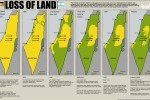
Israel’s Zionist Foundation and Expansionist Dream – A Short History

palestine-loss-of-land‘At Basel, I founded the Jewish State. If I said it out loud today, I would be answered by universal laughter. Perhaps in five years, and certainly in fifty, everyone will know it.’[1] ~ (Theodor Herzl writes in his diary about Basel Zionist Conference, 1897 where Zionism was officially coined)

The birth of the State of Israel on 14th May 1948 is a turning point in the history of the Middle East and one of the most significant events of the twentieth century. Based on Zionist ideology, Israel came into being as a ‘fulfilment of the promise of the Jewish scriptures’. Since its inception, Israel centres its relations with the native population and neighbouring countries on an existential threat. Alliances, ties, negotiations and treaties all base on Israel’s so-called security concerns faced from within and outside the country. But Israel’s Zionist foundations and expansionist aims have a major role to play in the volatile situation of the Middle East.

Israel, by definition and by essence is a Jewish state and was formed to give the Jews, living in different parts the world after the Diaspora, a national home. While Zionist ideology laid the foundation stone of the state, the native Arab population and the seemingly mighty neighbours joined by the rhetoric of common Arab roots, language and cultures became the immediate security threat for the country. But very soon Israel’s man and military power was evident to her as well as to the hollow and deeply divided Arab world. The idea that there was no power in the neighbouring world that matched the military strength of Israel became evident after repeated humiliating defeats encountered by Arab forces, but the case built by Israel as, David surrounded by the forces of Goliath, continued to play a significant role in Israel’s expansionist plans based actually on the ideas of Zionism.

ZIONIST FOUNDATIONS OF ISRAEL:

Zion is the biblical name for Jerusalem.[2] Political Zionism is a concept of the late nineteenth century, coined by Theodor Herzl, a Hungarian secular Jew, in the background of strong anti-Semitism in Europe. His book ‘The Jewish State’ provided a detailed plan for a state where Jews, who were not a religious group but a nation in his views, were to live in peace. In 1897, at the Basel Zionist Conference, the idea of Zionism was officially founded i.e. a ‘Jewish national home’ in Palestine. Herzl mentions in his diary,

‘At Basel, I founded the Jewish State. If I said it out loud today, I would be answered by universal laughter. Perhaps in five years, and certainly in fifty, everyone will know it.’[3]

The three strands of Israel’s identity i.e. religion, nationalism and the Holocaust, as described by Michael Barnett, help Israel portray herself to be in an isolated state and vulnerable to security concerns from different fronts.

‘While all national identities differentiate between ‘us’ and ‘them’, arguably the centrality of religion, nationalism and the Holocaust in Israel’s identity, make these effective and cognitive boundaries more severe and austere’.[4],[5]

Chaim Weizmann, the elected President of World Zionist Organisation was the strongest link between ideas initiated by Herzl and the British Empire. He put all his efforts to win British support for ‘Jewish Commonwealth in Palestine’ belittling the risk of Arab opposition and portraying them ‘a tiny fraction of large Arab nation’[6]- Balfour Declaration, a letter written by British Foreign Secretary Arthur J. Balfour, promising a national home for Jewish people under British support came as a major achievement for Zionists in 1917. Jews were only 10% of the population. The 90% were a non-existent entity for Weizmann as well as the British. The declaration opened the doors of Palestine to the Jews and the Zionist ideas started becoming clearer with time. Although diplomacy was always the way to the goal, and avoidance of the term ‘state’ and preference for usage of ‘a national home’ was the trend, but Weizmann when asked at a peace conference in Paris defined the Jewish National home as to make Palestine as Jewish as England is English.’[7] The Arabs were not partners in any negotiations and Weizmann’s policy was uncompromising in terms of Jewish settlement goals in Palestine.

Jabotinsky, a staunch Jewish nationalist and the founder of Revisionist Zionism, believed in the supremacy of the Jews. For him, Jews were the source of budding Western civilization in the backward and stagnant East. While he acknowledged that no voluntary agreement was possible between alien settlers and native population, the idea of return to Palestine could not be bargained.

We must either suspend our settlement efforts or continue them without paying attention to the mood of the natives. Settlement can thus develop under the protection of a force that is not dependent on the local population, behind an iron wall which they will be powerless to break down.’[8]

For him, an iron wall, i.e. a strong invincible force, was the answer to the Arab problem. Negotiations would only be fruitful if the Zionists were physically and militarily stronger than the natives. Peaceful coexistence is a possibility only after overpowering the threats, materially and by force. For Jabotinsky, there was nothing immoral about the concept of the ‘iron wall’, if the idea of Zionism and right to return to the Zion was to be achieved. The latter is a sacred truth, so any step taken in whatever shape, no matter how immoral it looks to the world, becomes automatically sacred.[9]

Arab resistance was very natural in these circumstances. Riots against the Jews took the shape of full-blown upheavals. Arabs rejected all proposals put forward by the British. David Ben Gurion, the founder of the State of Israel, pushed the British for establishment of a Jewish state after increasing Arab resistance. Lord Peel’s commission report suggested partition of the land in two states in 1937. Although the Zionist leaders were divided on the issue of borders of the states, Ben Gurion’s idea was to accept it for the start and the rest of the country would soon be under Jewish rule.

‘Erect a Jewish State at once, even if it is not in the whole land. The rest will come in the course of time. It must come.’[10]

This was the foundation of Israel: Religion, Zionism (Jewish nationalism), a history of Diaspora, and a strong belief in moral right to return. As perceived by Jabotinsky, the settlers would naturally be unwelcomed by any native population and that is where importance of security would come into play. Thus, pillars of unmatched security and powerful military were absolutely essential to support the foundation stone of identity. Zionist movements developed their own military power in order to be independent of any outside support for survival through the paramilitary organisation called Haganah, and Irgun. In the backdrop of end of World War II, the Holocaust and strengthening Zionist military force, General Assembly of the United Nations passed a resolution in favour of the partition of Palestine in 1947. In 1948, the state of Israel was born in the midst of confrontation with Arabs, within and outside the state.

THE CONFLICT: A NATURAL OUTCOME OF OCCUPATION:

The Arab-Israel conflict is as old as the proclamation of Israel. The Jewish population in Palestine increased dramatically from 10% (54,000) to 32% in 1947. With military supremacy, Zionists were able to gain control of the territories defined in the UN partition plan. The first war against the new state began immediately with Egypt, Jordan, Syria, Iraq and Lebanon but due to disunity, poor communication, absence of reliable intelligence and poor leadership, coordination and planning[11], the Arab states failed badly. Also, the military balance was in favour of Israel with total number of Arab troops of only 25,000 and IDF over 35,000 increasing to 65,000 within two months and 96,441 in seven months. As Avi Shlaim comments, ‘In this war, as in most wars, the stronger side prevailed.’[12] Armistice was signed between Israel and Arab states in 1949. But the border tensions remained high.

The subsequent crisis came in the shape of the Suez war of 1956. Colonel Gamal Abd al-Nasser of Egypt had reached an agreement with the British to withdraw from the military base in the Suez Canal. Israel for her own security wanted the British to remain in the area, therefore a spy ring was activated so as to blow up the installations and give reason to the British not to vacate the area. Spies were captured, tried and hanged by Egypt. Israel’s public saw it as Egypt’s hostile attitude towards their state. To satisfy the public with government’s prompt action and state’s military superiority, Israel attacked Gaza and caused heavy Egyptian casualties. Nasser signed arms deal with Soviet Union, which caused Israel to get more arms from France. Britain not happy with Gamal refused to finance Aswan Dam. Nasser’s retaliation came in the form of nationalising the Suez Canal which was the lifeline for the colonialists to rule the other side of the world. Britain, France and Israel attacked Egypt in the Suez War of 1956. The Israeli army managed to occupy the Sinai Peninsula within 100 hours[13]and Sharm al-Sheikh, thus opening the Straits of Tiran, which were Israel’s primary route to East Africa but had been blocked by Egypt for several years.

In 1967 the six-day war was the most remarkable military victory in the history of Israel. 5th June to 10th June, Israel had occupied the West Bank and the Golan Heights, the Gaza Strip and the entire Sinai Peninsula. Arabs suffered from a humiliating defeat, tipping the balance of power heavily in favour of Israel. ‘The annexation of East Jerusalem, was the first and the most dramatic assertion of Israel’s claim to sovereignty over its ancient homeland. Zion, was at the heart of Zionist dream for the restoration of a Jewish kingdom in Palestine.’[14]

The political and military equation began to change after this war. Syria and Saudi Arabia displayed willingness to recognize Israel, and Egypt and Jordan signed peace treaties. The demand of surrendering the territories occupied in 1967 remained prominent in exchange of recognition and peace with Israel throughout the post war era. The major argument in retaining the West Bank was security-based, as it would form a barrier against any attacks from the East. But the West Bank also formed part of ancient Israel (Judaea and Samaria). The Revisionist Zionist Likud party kept rejecting the idea of any kind of surrender even if peace with neighbours and natives became impossible. Their expansionism towards the fulfilment of a Jewish state did not take into account the opportunities of peace offers. Israel’s military supremacy and invincibility throughout these years had made the expansionist goal much easier even if it meant the subjugation of the native population. Negotiations, compromise and diplomacy did not hold much value due to the ‘iron wall’, the unconquerable force once perceived by Jabotinsky, which had later transformed into a literal physical reality.

 THE MIGHTY OPPRESSOR AND THE HELPLESS NATIVES:

The Palestinian problem remains a real one until today. Israel’s population reached six millions in 1998, nearly ten times what it had been in 1948.[15]Israel’s war of independence in 1948 was Palestinian’s Nakba (disaster) when 780,000 Palestinians, two-thirds of country’s population were driven out by Zionist troops and design.[16]The remaining population was denied any political rights as if they were non-existent in the flow, due to the Zionist program, which had to be implemented by any means necessary. Destruction of an existing society in 1948, conquest of West Bank and Gaza in 1967, the invasion of 1982 with 17,500 Lebanese and Palestinian dead, the Sabra and Shatila massacres; the continuous assault on Palestinian schools, refugee camps, hospitals, civil installations[17] was all a show of asymmetrical power unwilling to create a peaceful society meant for coexistence. Israel’s security issues arise not only from it being a product of Zionist ideology but, simply put, an occupant in a land where the native population has no rights whatsoever despite Israel’s big claims of being democratic. The disparity of power between Israel and the native population also nullifies the security argument especially from inside the state, when Palestinians have no army, air force, tanks or sophisticated defences of any kind.

 ‘There can be no conceivable peace, in my opinion, that doesn’t tackle the real issue, which is Israel’s utter refusal to accept the sovereign existence of a Palestinian people that is entitled to rights over what Sharon and most of the people supporting him consider exclusively to the land of Greater Israel, i.e. the West Bank and Gaza.’[18]~ Edward Said

 A French philosopher Ernest Renan once said, ‘A nation is a group of people united by a mistaken view about the past and a hatred of their neighbours.’ In Israel’s case, the view of the past is not mistaken. The Diaspora, the Holocaust, and anti-Semitism of Europe are a horrible reality. But the translation of a terrible past into an uncompromising dream with results like massacres, subjugation, violation of international laws and expansionism, has given rise to merciless atrocities and has put at risk, the peace of the world. Security for Israel may be a genuine concern and will always be, not because the world is bent upon being anti-Semitic, but an oppressor will always be seen as an oppressor, no matter which part of the world he exists in. Every native population will see an alien settler with concern and the peaceful co-existence would never come into being if the settler’s inflexible passion or hunger for fulfilment of a dream brings endless tragedies, bloodshed and fears for the natives.

REFERENCES:

[1]A. Shlaim, The Iron Wall, Israel and the Arab World (The Penguin Press, 2000), p.3

[2] Ibid, p.1

[3]Ibid, p.3

[4]M. Barnett, Culture, Strategy and Foreign Policy Change, Israel’s Road to Oslo http://home.gwu.edu/~barnett/articles/1999_israel_ejir.pdf

[5]S. Telhami, M. Barnett,Identity and Foreign Policy in the Middle East (Cornell University Press, 2002), p.58

[6]A. Shlaim, The Iron Wall, Israel and the Arab World (The Penguin Press, 2000), pp. 6-7

[7]Ibid, p.8

[8]Ibid, p.13

[9]Ibid, p.15

[10]David Ben Gurion, Letters to Paula,(London, 1971), 153-157, A. Shlaim, The Iron Wall, Israel and the Arab World (The Penguin Press, 2000) p. 21

[11]E. L. Rogan, A. Shlaim, The War for Palestine, Rewriting the History of 1948, 2nd Edition (Cambridge University Press, Cambridge, 2007), pp. 80-81

[12]Ibid

[13]A. Bregman, Israel’s War, A History Since 1947, 3rd Edition (Cornwall, 2010), p. 59

[14]A. Shlaim, The Iron Wall, Israel and the Arab World (The Penguin Press 2000), p. 251

[15]A. Shlaim, The Iron Wall, Israel and the Arab World (The Penguin Press 2000), p. 597

[16]E. Said, The Consequences of 1948, E. L. Rogan & A. Shlaim (ed.), The War for Palestine, 2nd Edition (Cambridge University Press, Cambridge, 2007), p.248

[17]E. Said, The End of Peace Process: Oslo and After (Granta Books, London, 2002), p. xv

[18]Ibid, p. xv

Khadijah – The Beloved of The Prophet Muhammad (SAW)

KhadijaHe was young, handsome, of noble lineage and of impeccable character. He was known as “The Truthful” and “The Trustworthy”. Yes, he was born an orphan and his financial standing was not the best when Khadija (ra) met him. But he, nevertheless, was the best of the best. The epitome of the human race, when Khadija (ra) proposed to him, was a young 25, when she was 40 and widowed twice before, having borne children from both earlier marriages. He could have had any younger girl, any virgin who did not carry with her the baggage of widowhood and children. So why, then, did he accept her proposal?

Two reasons come to my humble mind.

Firstly, the “he” in question was Muhammad (pbuh), a young man but not just any man. Although he had not yet attained prophethood, he could look beneath the surface….the superficial. Khadija (RA) even on the apparent was a beautiful woman. “Ameerat-Quraish” or “Princess of Quraish” as she was called, she was rich, beautiful and had social standing. Yet, for Muhammad (pbuh), it would have to be more than riches and beauty that drew him towards the decision of accepting this proposal. Khadija had qualities that were unmatched, as time would prove; Maturity, wisdom, intelligence, loyalty, generosity and courage.

Secondly, this was the woman (like all of his other wives) who was chosen to be his wife by Allah in His infinite wisdom. She was the only wife who bore Muhammad’s (pbuh) children and had the longest singular companionship with him – a companionship of almost 25 years. She was to be the backbone of Islam, the foundation stone of Islam, the first ever Muslim who believed in Muhammad (pbuh) as Allah’s last and chosen Prophet. If it were not for her unflinching support for him and unequivocal faith in him, Muhammad (pbuh) would have still done what Allah destined for him to do, but without Khadija (ra) beside, it would have been a lonelier and even more tedious journey.

Whenever I read about Khadija (ra) I am amazed, always, by how much she loved and supported him.

She opened the doors to her home and heart to him. She shared her wealth with him. She took into her home his cousin, the young Ali (ra) And then there was Zaid ibn Harith (ra). And then, there were their own children – Qasim (who died young), Zainab (ra), Ruqayya (ra), Umm Kulthum (ra), Fatimah (ra) and Abdullah (who also died very young). And this blessed home’s doors were open to all – charity was a norm – an abundant norm. As a couple, they complemented each other so beautifully and thought so much in synch, that goodness was what their world was full of.

The years before and around prophethood of Muhammad (saw) would have been tough for her. Imagine how she felt when he disappeared into the cave of Hira and did not come home for days. Any wife in her position would cease to see the bigger picture and let the desire to own her man and his time take over. But Khadija (ra) knew her man. She allowed him the space he needed to grow inch by inch and day by day towards prophethood and her support remained unequivocal. There are reports that she would climb up to the cave of Hira and carry food and water for him. She was not exactly young at that time. But she did what it took to support him.

Perhaps the most well-known and yet never deplete of lessons and emotional impact is the incidence when the Muhammad (pbuh) returned after he received the first revelation from the cave of Hira, having witnessed the angel Gabriel (as); shivering, and scared. Realizing somewhat what a massive responsibility laid ahead of him, understanding that his life would change forever, fearing for his safety, and in those moments as he asked her to cover him with a blanket. It was Khadija (ra) by his side – to comfort and calm him down.

Her words at this moment have gone down in history. In Sahee Bukhari, is mentioned:

“Then he went to Khadija bint Khuwailid and said, “Cover me! Cover me!” They covered him till his fear was over and after that he told her everything that had happened and said, “I fear that something may happen to me.” Khadija replied, “Never! By Allah, Allah will never disgrace you. You keep good relations with your kith and kin, help the poor and the destitute, serve your guests generously and assist the deserving calamity-afflicted ones.”

She was the first to believe in his prophethood and therefore the first Muslim. Today, Muslims are a 2.1 billion strong, and growing. At that time, in those crucial moments that were to alter history, it was just her.

We all need that one person, at least, to believe in us implicitly, to know our mettle, to bring out the best in us and to be our fall-back. We need to know in moments of fear and insecurity and vulnerability that there is someone who will stand by us, no matter what. And the bigger and more important a human’s intended task or goal, the better will be the person Allah chooses to complement us, to facilitate an ultimate aim. For Prophet Muhammad (saw), Allah chose Khadija (ra).

It is then no small wonder that one day, Gabriel (as) came to the Prophet (saw) and said:

 “O Allah’s Messenger! This is Khadijah, coming to you with a dish having meat soup (or some food or drink). When she reaches you, greet her on behalf of her Lord (Allah) and on my behalf, and give her the glad tidings of having a palace made of Qasab in Paradise, wherein there will be neither any noise nor any toil, (fatigue, trouble, etc.).” [Al-Bukhari]

Muhammad (pbuh) included her in the four foremost ladies of the universe: Khadija bint Khuwaylid (ra), Fatimah bint Muhammad (ra), Maryam bint Imran (the mother of the Prophet Isa) and ‘Asia bint Muzahim (the wife of the Pharaoh).

The richest woman in Makkah sacrificed all her wealth for the cause of Islam. The Princess of Quraish had to sustain the hardships of the 3 years of political and economic boycott, during which the Muslims had to stay in Shaib e Abi Talib, at times surviving by eating mere leaves! Yet, she did not complain or let go of her sabr.

It is no wonder, then, that Muhammad (pbuh) never really got over her death. He called the year of her death “the year of grief”. A Companion of the Prophet narrates that whenever any gift was brought to him he would immediately send it to some lady who had been a friend of Khadija (ra). Ayesha (ra), a favourite wife of Muhammad (saw) says that whenever a goat was slaughtered the Prophet (pbuh) would send some meat to Khadija’s (ra) friends; when she remarked about this on one occasion he told her that he had great regard for her friends, as she had a special place in his heart. Ayesha said she never experienced such a feeling of natural feminine jealousy for any other wife of the Prophet (saw) as she did for Khadija. She also narrates that whenever Muhammad (pbuh) spoke of her he would talk at great length and praise her qualities, and pray for her forgiveness.

Once the Blessed Messenger (pbuh) mentioned Khadīja (ra) before Ayesha (ra), the latter responded: “She was not but a such and such of an old lady, and Allah replaced her with a better one for you.” He replied:

“Indeed Allah did not grant me better than her; she accepted me when people rejected me, she believed in me when people doubted me, she shared her wealth with me when people deprived me, and Allah granted me children only through her.”

Ayesha (ra) says, after this incident, “I learnt to keep quiet, whenever Khadīja’s name was mentioned by Muhammad.” (Sahih Muslim)

Her place in his life can easily be understood by the fact that till she lived, the young Muhammad (pbuh), in the prime of his youth, did not marry any other woman.

She fulfilled all his needs and gave him the happy content married life that is required for anyone who wishes to achieve or do anything great in life. Khadija (ra), Mother of the believers, took care of the home front and gave Muhammad (pbuh) support in the worst of times, enabling him to do what he did. For her part, she understood and appreciated him and his responsibility. For his part, he cherished and appreciated who she was and what she meant to him. Together, they complemented each other, working hand in hand for a cause bigger than anything.

Such a companionship, then, is the material of the truest love story ever.

Am I Not Your Lord?

adfadf

Apart from what theologians have taught you what do you know of God yourself?” asked a new found friend. I reflected on the question and thought some more, during the early morning showers, the long drives to work, a lunch completed in solitude, the gratitude and the atmosphere of reflection that is born in the silence of a house that moments ago was alive in the laughter of children and the bliss still hanging in the air. The contrast of one’s own abundance becomes the very quest for a prosperity that must be beyond material, inherent differences in ability and free of predisposition. I began to formulate an answer.

In the outstretched hands and sunburnt faces I would see my father disappear till the homemade food to be distributed on a Friday evening would run out. There was never enough for everyone and in the rabid capitalism of our times, there never will be. A sense of relief at seeing him return to the car unhurt would give way to a twinge of guilt at asking for a simple treat, a bottle of Pepsi or an ice-cream, the contrast all too fresh in our minds. I must have found Him there or thereabout, perhaps even in half-eaten sweets my sister had packed away taking literally the teaching of sharing with the less fortunate what you like for yourself. As an adult I am obligated to spend two and a half percent of what I save in charity but I learned long ago that I am a mere custodian of the rest. It was not until years later in an atmosphere of my identity being hijacked that I would actually learn:

“And they feed, for the love of Allah, the indigent, the orphan, and the captive,-. (Saying),”We feed you for the sake of Allah alone: no reward do we desire from you, nor thanks.” (Quran 76:8-9)

Yet what was being taught in the Friday sermons resonated with an inherent truth. I don’t recall a distinct conversation about who God is or an encounter with a “theologian.” There was perhaps no need, for God was never a mystery. He revealed Himself in the stories told by my parents at the end of a 12 hour work day; Noah, Abraham, Jacob, Joseph, Job, Moses, Aaron, David, Jonah, Jesus and Mohammed (Peace Be upon them) – all stories much similar but different in significant ways than the scriptures before the Quran. Again, it was much later that I would learn:

Say: “We believe in Allah, and in what has been revealed to us and what was revealed to Abraham, Isma’il, Isaac, Jacob, and the Tribes, and in (the Books) given to Moses, Jesus, and the prophets, from their Lord: We make no distinction between one and another among them, and to Allah do we bow our will (in Islam).” Quran (3:84)

Surely, He is not the author of confusion for He fit the simple mental construct of a fifth grader. Promises of being good and praying regularly made with devotion as one went in to collect the annual examination results – convinced of a God that can erase and redo answers to algebra and fill in the ones you left blank. Looking back I could have sworn He did just that.

Of course, come summer vacations, the promises would quickly be forgotten in the fun and games with siblings and cousins. Until, one would find in a second hand bookstore the “Choose your own Adventure” series. In space or undersea one would find dilemmas like choosing to fight aliens or futuristic pirates versus the alternative of making a run for it. The book was written, but could end many different ways depending on the choices that we made. I struggle to find a better analogy for life.  I learned about predestination much before I discovered it as an article of faith. I must have by then heard the story of our parents, Adam and Eve, the free-will which is the singular feature that distinguishes humanity from the rest of creation, a gift that makes us capable of much evil but when submitted totally to the One Creator can make us stand alone against the mockery of our times like Noah, be willing to sacrifice that most beloved to us like Abraham, find patience rewarded with reunion like Jacob, go from wells to thrones like Joseph, thank Him endlessly in suffering like Job, find the courage to stand against a mighty Pharaoh like Moses, find the wisdom of Jesus and the strength to deliver a complete code of life in a little over two decades despite incredible odds like Mohammed (Peace be upon them all). I must have learned by then the story of original forgiveness by a God that gives you the very words to ask for it, even though it would till decades later that I would read:

Then Adam received from his Lord Words. And his Lord pardoned him (accepted his repentance). Verily, He is the One Who forgives (accepts repentance), the Most Merciful. (Quran 2:37)

Salvation must lie in faith in an All Forgiving God, despite Whose Mercy, we could never find it for the Prophet (PBUH) himself taught

Narrated Abu Huraira: I heard Allah’s Apostle saying,

“The good deeds of any person will not make him enter Paradise.” (i.e., None can enter Paradise through his good deeds.) They (the Prophet’s companions) said, ‘Not even you, O Allah’s Apostle?’ He said, “Not even myself, unless Allah bestows His favor and mercy on me.” So be moderate in your religious deeds and do the deeds that are within your ability: and none of you should wish for death, for if he is a good doer, he may increase his good deeds, and if he is an evil doer, he may repent to Allah.”  

(Sahih Bukhari Book #70, Hadith #577)

I can’t recall ever being explained that in our quest to return to our original abode, Heaven, we must pay heed to our deeds as much as rely on The Most Compassionate, The Most Merciful. It seemed to be a truth we were born with the knowledge of, a logical conclusion given the one gift that sets us apart – the free will, for which the universe was fashioned to perfection so that we may reflect and know Him through his attributes.

Blessed be He in Whose hands is Dominion; and He over all things hath Power;-

He Who created Death and Life, that He may try which of you is best in deed: and He is the Exalted in Might, Oft-Forgiving ;- He Who created the seven heavens one above another: No want of proportion wilt thou see in the Creation of (Allah) Most Gracious. So turn thy vision again: seest thou any flaw?(Quran 67: 1-4)

Sadly, what was as clear as the starlit night, a fringe benefit of sleeping on the roof during a power outage, got lost in the illusion that love, wealth, career needed to be “pursued.” The stars disappeared behind the clouds and the very romance of existence got corrupted and still does for surely we are creatures of much error as the Prophet (PBUH) taught us:

“All the children of Adam constantly err, but the best of those who constantly err are those who constantly repent.” [Tirmidhi, Ibn Majah, Ahmad, Hakim]

The events of the last over a decade provide an opportunity to relearn the known. Not only returning to the Quran and Sunnah to reclaim our identity but to learn about our history and most importantly being thankful for the questions asked of us; both by the deviants claiming to speak in our name and those who fail to understand the futility of freedom of speech without a right to be heard. Ultimately,  to learn about my Creator comes naturally, for all of beauty and knowledge has already passed through and all Prophets came to remind us of the straight path that we have known before the beginning of time:

When thy Lord drew forth from the Children of Adam – from their loins – their descendants, and made them testify concerning themselves, (saying): “Am I not your Lord (who cherishes and sustains you)?”- They said: “Yea! We do testify!” (This), lest ye should say on the Day of Judgment: “Of this we were never mindful (Quran 7:172)

The ‘Begum’ and ‘Saheb’ Culture

Come, visualize with me..

Sakeena, a 10 year old who has never been to school, never enjoyed playing with dolls let alone the funky hi-tech gadgets,  is carrying a 1 year old in her lap, sitting on a table distant to begum saheba’s. Her dull glitterless clothes, unadorned arms and ears tell us, she’s the odd one. Sakeena’s job is to take care of the child who she can hardly carry, feed him, change his nappy and make sure he doesn’t cry while begum saheba enjoys her lavishly decorated table and socialising exercise. Sakeena has no right to run around, play or enjoy with her age-mates at the dinner and absolutely no sharing the table. She may get some food though.

Najma, a 28 year old who looks to be 40, skinny and dark is sweeping the floor of a ‘bangla‘ (a huge mansion). Her two-year old has an ear infection and she does not have money for antibiotics. Her concentration is everywhere. She has to finish work and get her child’s ailment sorted somehow. She takes a day off next day to see the doctor and to take care of her child who does not have proper clothes on his body and no footwear whatsoever whether it’s summer or winter. She gets told off as there was a grand dinner at saheb’s place and begum saheba was in thick soup when Najma didn’t turn up as there was a big mess in the kitchen to be sorted after dinner. She was scolded, insulted and eventually fired.

A child surrounded by a garbage heap, sorting paper and recyclables and eating our rotten left-overs from it at the same time – A child covered with houseflies sleeping on a pavement outside a jeweller’s shop (where jewellery of millions of rupees is being chosen). He dozed off while waiting for his father to go home, who sells Kulfi outside a popular shopping centre – A child who sits outside a fast-food restaurant and begs usfor roti and cannot afford a chicken wing let alone a mighty burger – A child who cleans our windscreen for a few rupees and we shun him away because his water is dirty and would ruin our car – A baby sleeping in the lap of a begging mother unaware of the cruel world he has come to. She covers his face to avoid bright headlights of the cars passing by but we can see his beautiful but muddy feet sticking out of her chaadar – A child who sells a rose bud outside a restaurant where we spent thousands of rupees for what? Yes, one meal –

A woman who washes our expensive branded and imported (etc.) dinnerware, breaks a small chip and is shouted at, beaten and declared unfit for her job – A woman who cleans our extravagant dining table, but is never allowed to share it, dusts our sofa but can’t sit on it and we love it when she sits on the floor near our feet – A driver who drives our luxurious car but waits for a bus for hours around midnight to get home and see his children on the weekend – The guard/chowkidar who sleeps outside on the next door plot under a tent or in our car porch while we sleep in our air-conditioned room away from heat and mosquito bites – The labourer who builds our beautiful house in scorching sun, just to sleep in a place one can hardly call a room, but it’s all-in-one home for him (kitchen, bedroom, lounge etc.).

Close your eyes..

Imagine the muddy feet, the dirty smelly clothes, no surety of food for the day, no money in the pocket, let alone banks, no transport. Recall their mistakes and shortcomings; recall our anger, lack of forgiveness, zero tolerance, and humiliation they face every day. And now, switch sides.Imagine they were us and we were them. Scary thought, isn’t it? They didn’t choose their fate neither did we. So why not fear the Creator who put us in a MORE difficult test than them by giving us authority over them.

The dehumanization of the society has reached its limits. The above examples are complacently accepted. Humans are not equal. They are unequal just because they were born to parents of different social statuses. And the one who has money and authority is superior. The kings and queens found everywhere in our society show their grandeur with harshness and humiliation towards the subordinates at home as well as the less fortunate outside home. Softness, empathy and forgiveness are considered weaknesses.

But this is not what we were taught, is it? ‘We are Muslims and we are proud’, ‘we love the Prophet (SAW)’ and ‘we are ready to die for him’ etc., but are we ready to live in a way he taught us to and follow his footsteps if it kills our big ego? Forgiveness, controlling anger and ignoring mistakes were compared by the Prophet (SAW) with strengths of a wrestler. He taught us that superiority came with piety and not money. Do we think that the mighty and wealthy Arab leaders who lashed and tortured the bodies of Khubab and Bilal (RA) were superior to them? No! Bilal, the black, the poor, the slave, the worthless was the most precious in the eyes of the Prophet (SAW). Did he eat in a separate corner, in different plates, a left-over food? Dig out something that supports us doing so with our servants. But, sharing tables is probably too much to ask for as far as our magnificence is concerned.

“When the slave of anyone amongst you prepares food for him and he serves him after having sat close to [and undergoing the hardship of] heat and smoke, he should make him [the slave] sit along with him and make him eat [along with him], and if the food seems to run short, then he should spare some portion for him [from his own share]” (Muslim).

Remember, Zaid Ibn Harith (RA) who was a slave and the Prophet (SAW) freed him and gave him the choice to go with his father, who had come, to take him, but he refused to go with his father and preferred to stay with the Prophet just because he was loved and cared for. He says he was never told his mistakes and the Prophet (SAW) used to cover what he did wrong without even mentioning it to him.

Once the Prophet (SAW) reprimanded a companion like this,

 ‘O Abu Dhar! Did you abuse him (your slave) by calling his mother with bad names. You still have some characteristics of ignorance. Your slaves are your brothers and Allah has put them under your command. So whoever has a brother under his command should feed him of what he eats and dress him of what he wears. Do not ask them (slaves) to do things beyond their capacity (power) and if you do so, then help them.’(Sahih Bukhari)”

Gentleness and kindness are rare traits, very valuable in the scales of Allah. They are not weaknesses. They are actually extremely difficult traits to stick to in this materialistic world where everyone can get their mission accomplished at the point of a gun, money or a big tongue which cause similar damage to the weak ones. Kindness is a forgotten virtue. To kill an enemy might be easy in the current times, but killing ego is a hard job. But it raises us in the eyes of Allah and we are actually following the Prophet (SAW) when we do it. What a deal and what a surely victorious way. He went on to say, ‘Seek me among your weak ones, for you are given provision (or help) only by reason of the presence of your weak ones’.

Once a man came to Prophet Muhammad (saw) and said, “O Allah’s Messenger! How many times should I forgive the mistakes of slaves?” The Prophet (SAW) kept quiet. The man repeated his question three times, and the Prophet replied at the third time, “Forgive them seventy times every day.”

We are in a more difficult test than they are. Their hereafter is easier, while we have to answer for every word that we uttered that broke them, every opportunity that we missed to help them and every action that we did to look down upon them as inferior human beings.  It was the equality, justice and liberty Islam talked of that attracted the poor and slaves to the call of the Prophet (SAW). We must correct ourselves and create a society that cares, loves and forgives shortcomings of each other.

“O God, grant me life as a poor man, cause me to die as a poor man and resurrect me in the company of the poor.” His wife asked him why he said that, and he replied: “Because (the poor) will enter Paradise (before) the rich. Do not turn away a poor man even if all you can give is half a date. If you love the poor and bring them near you, God will bring you near Him on the Day of Resurrection.” – Al-Tirmidhi, Hadith 1376