Historical Roots of Inferiority Complex (II)

Colonial Invasion & State Structures. Loss of self-confidence in Muslims is justifiably related to defeats on the battlegrounds at the hands of west. But a military defeat is not enough to enslave hearts and minds, as it can be an impetus for revenge. Today Muslims are envious of West’s power, which proves the fact that the real challenge of west is not of materialism, but of intellectualism (which modernity certainly lacks in the true sense of the world).

However, what happened after the first phase of colonial invasion? How did colonials succeed in subduing large populations in vast areas? We’ve partial answers.

Realizing the danger that native “monkeys” might overrun them by sheer numbers, colonizers had to play the games of perceptions and mind control. They had to look big and strong. Few in numbers, they developed railway and laid communication systems to travel fast over the huge mass of land to subdue any possible mutiny, which did take place and successfully crushed. But the physical assets won’t do the job if the natives were enthusiastic and confident of their victory. Hence, that spirit of rebellion was decimated, and fear and inferiority complex were placed like time bombs beneath our (un)conscious. Self-confidence was shattered when Muslims’d see Tipu Sultan’s majestic dress being worn by peons of whites. Healthy, buildup, young officers constantly replaced older ones to give the illusion that all whites are brave and strong and can’t be messed with. These are just few of countless examples of this social-engineering.

We’ve to contextualize heroic things we attribute our colonial masters. Colonialism was about dispossession. In a paper on this very topic, Cole Harris summarizes colonists’ grand strategy of dispossession as following:

“The initial ability to dispossess rested primarily on physical power and the supporting infrastructure of the state; the momentum to dispossess derived from the interest of capital in profit and of settlers in forging new livelihoods; the legitimation of and moral justification for dispossession lay in a cultural discourse that located civilization and savagery and identified the land uses associated with each; and the management of dispossession rested with a set of disciplinary technologies of which maps, numbers, law, and the geography of resettlement itself were the most important…” (‘How Did Colonialism Dispossess? Comments from an Edge of Empire’, Annals of the Association of American Geographers, Vol. 94, No. 1 (Mar., 2004), abstract)

Hence, administrative and other infrastructures, and all the technologies were means to loot and pillage, although in a more civilized or face-saving way.

Education: Colonists’ Most Favorite Vehicle (MFV)

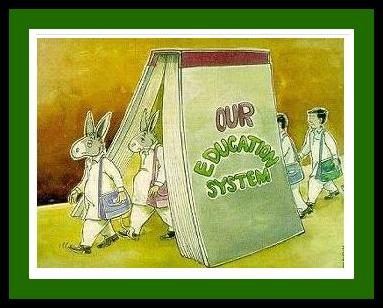
While military and political subjugation of colonists broke the spirits of many, colonial education convinced many that modern West’s ventures in barbarism were for our own benefit. When defeat induced fears of a mightier foe, the education changed the victim’s heart. As Akbar Abadi said: ‘An easterner would cut off the head of the foe; a westerner would change his heart’. British justified their rule to their own people on the pretext of ‘civilizing’ natives. This was different from what was happening to Blacks in Africa. This comparison will make things more clear.

Blacks were made colonizers on the basis of their color. They were led to believe that their skin color reflects that of sin, ugliness. Black lies are unforgivable, white lies are ignored. They don’t have any right to exist. Be white or disappear was the attitude of their colonizers. Blacks even had dreams of being white. They craved for white color at any cost.

Our minds were made slaves. Our color is not such a problem to them. Our culture, religion, and thought endangered their existence. They worked to snatch our inheritance, our ilm from us. That is why they used education. They changed minds.

Economic-historian Atiyab Sultan writes that in the beginning of 19th century, colonization became more ‘pedagogic’ in India. Previously, Britishers were consolidating militarily and administratively. It was time to tend to education, which was primarily used to create a special kind of class of natives, loyal to them.

Liberals and utilitarians advocated ‘civilizing’ natives in the “universal image” of modern western man. There were 3 distinct groups in British parliament who lobbied for their own educational programs (with unmistakable similarities): Evangelicals, utilitarians, and uiberals. Evangelicals like Charles Grant believed Indians to be ‘race of men lamentably degenerate and base’; liberals like Macaulay fancied, “A single shelf of a good European library is worth the whole native literature of India and Arabia”; and utilitarians like JS Mills considered Indian stock of knowledge to be ‘obscure and worthless’ (perhaps he did so without digesting a page of Indian literature). On the contrary, Dr Asad Zaman argues, “A single chapter on sacrifice in a book like Fazail e Amaal that teaches man to go against his nafs, is worth the whole literature of modern West.” Only Orientalists, Atiyab mentions, argued that colonial educational system in India should be according to indigenous sources and be taught according to indigenous views.

In a way summing up the educational policy, which was fiercely debated in English parliament, Atiyab further writes:

“Education was also a chief instrument in the creation of a colonial subject that would be a loyal and willing consumer of British knowledge and produce. Macaulay voiced this concern thus: ‘Indians should not be too ignorant or too poor to value and buy English manufactures’ (Basu 58.)  In a larger sense, the loyal subjects were needed for the calm preservation of empire, echoing the imperial policy of cultivating supportive local elites …”

It becomes clear that their educational institutions served colonists needs, not ours. This reminds of what Iqbal called the “un-Muslim character” colonial education produced. Also, that system was unfair to the masses as it sent few to higher service, leaving the rest impoverished. We should also add that this created an anti-native character in Indians at large, to which Hindus responded very well, boycotting foreign goods.

Triumph of Materialism. Hamza Yusuf (HY) notes that the colonists saw the global and historical link Muslims maintained due to their religious Tradition. Muslims had many global learning centers which played vital role in this regard and maintained some kind of visible unity (although the underlying unity of Ummah is still undeniable and, in fact, crucial to the venture of Islam). In order to destroy that unity among Muslims, colonists sought to destroy this ‘historical link’. And as per HY, they did so by injecting inferiority complex in Muslims regarding their lack of material progress. “It’s all documented how they did this,” he emphasizes. For instance, they’d compare paper to pre-modern tablet, which Muslims used for instruction. “Using a tablet is backward. Now we’ve paper!” This notion of backwardness is still on the lips of 75-80% (if not 100%) of Muslims, especially the educated class.

Eurocentrism. The roots of civilizational inferiority complex may also lie in the venom called euro-centrism, especially for uncritical bookish minds. These are more less two central tenets of this mythological, racist & historicist thesis: All civilizations must develop along the lines of West to achieve the idols of indefinite economic progress, civility and “enlightenment”; and that Europe is at the center of world stage, and that all other civilizations are mere supporting pillars, resource fields to it. But western civilization not the end of civilizations, argues Rene Guenon:

“So long as western people imagine that there only exists a single type of humanity, that there is only one ‘civilization’, at different stages of development, no mutual understanding will be possible. The truth is that there are many civilizations, developing along very different lines, and that, among these, that of the modern West is strangely exceptional, as some of its characteristics show.”

Further Guenon scrutinizes the true nature of this highly over-rated civilization, which dominates the world materially so far (we would concede to the objection that even its material dominance is soon to be surpassed):

“The civilization of the modern West appears in history a veritable anomaly: among all those which are known to us more or less completely, this civilization is the only one which has developed along purely material lines and this monstrous development, whose beginning coincides with the so-called Renaissance, has been accompanied, as indeed it was fated to be, with a corresponding intellectual regress; we say corresponding and not equivalent, because here are two orders of things between which there can be no common measure. This regress has reached such a point that the Westerners of today no longer know what pure intellect is; in fact they do not even suspect that anything of the kind can exist…”

Post-Pakistan: Continuation. Leadership produced by the British took over the country after the partition. They molded state policies and institutions in the image of their departed masters, more or less. Discussion of continuation of such structures is not relevant here. What’s important is that the inferiority complex of native Brown Sahibs’ turned into superiority complex that caused much harm.

After 1947 we witnessed exploitation of our Bengali brothers, which was at once racial and materialistic. It wasn’t religious extremism that separated two brothers, but the absence of spiritual training of the governing “elites”, in bureaucracy, politicians and army. We’ve accounts of how West Pakistani elites treated Bengalis as lower level race. Our false-elite was certainly a clone of their masters.

(In the next part, we’ll talk about in detail possible harmful effects of this complex in various aspects of our individual and national life.)

This article has been co-authored by Hira Shamim.

Proceed to the final part

..Link to Part I

Inferiority Complex And The Disease Known as Civilization (I)

I am talking of millions of men who have been skillfully injected with fear,

inferiority complexes, trepidation, servility, despair, abasement.

—Aimé Césaire, Discours sur le Colonialisme

The independence movements in colonies and protectorates came into being, not through a return to indigenous values on the part of those concerned, but through the absorption of occidental ideas and ideologies, liberal or revolutionary … the process of modernization – a euphemism for Westernization – far from being halted by the withdrawal, was in fact accelerated. The enthusiasm of the new rulers for everything ‘modern’ was not restrained, as had been the enthusiasm of their former masters, by any element of self-doubt.

—Gai Eaton, Islam and the Destiny of Man

The celebrated Algerian psychologist freedom fighter of blacks, Franz Fanon, saw only two parties in the battle between the colonialists and colonized: white and black. We, the brown, had pretty benign colonizers, who did not like to butcher millions or harass indiscriminately 24/7. We have no idea about the mass murdering of Central Asian Muslims and Africans by imperial powers of 19th/20th century. Our colonization was far less brutal and far more subtle, which left us unsettled, undiscovered, and even unwelcomed in both clubs, of whites and blacks. Our body was not tortured as much as we’re brainwashed and deluded through education and social-engineering by the “generous” colonizers.

J Sartre, a philosopher, writes in preface to Fanon’s famous work Wretched of the Earth (hope it reminds you of our “elite” elders):

“In the colonies the truth stood naked, but the citizens of the mother country [of colonists] preferred it with clothes on: the native [colonized subject] had to love them, something in the way mothers are loved. The European élite undertook to manufacture a native élite. They picked out promising adolescents; they branded them, as with a red-hot iron, with the principles of western culture, they stuffed their mouths full with high-sounding phrases, grand glutinous words that stuck to the teeth. After a short stay in the mother country they were sent home, whitewashed. These walking lies had nothing left to say to their brothers; they only echoed.” (Brackets ours)

We post-colonial, brown Muslims (like our colonial parents) lack self-confidence at many levels. This loss of confidence – in our culture, essence and the way of Islam – haunts us in intellectual and practical matters. Many of us pay lip-service to Islam and carry on with it; many choose to ‘reform’ Islam to be ‘compatible’ with an aggressive West, which declared its independence from Heavens few centuries back (although we mistakenly hail that to be ‘enlightenment’ from heavens). Some of us are just indifferent to the unavoidable contradictions between Islamic teachings and modern thought and its practice. We might not like these realities. Truth, however, is not concerned with likeness or dis-likeness of this or that person or society, or even a generation. Truth is above sentimentality and fashions of minds that keep changing with every cycle of moon.

Despite the loss of confidence (and a Center), we’ve not stopped calling ourselves Muslims, so far. But, thanks to our modern education we certainly are not that homo Islamicus of the glorious past (a) who’d not be dazzled by materialism of any kind, (b) who’d serve knowledge (not for money’s sake), and, (c) integrate influences from diverse sources from his own civilization’s viewpoint. His world-view was based on Qur’an and sunnah (as amply clear from the writings of great theological and philosophical scholars of past). He would ‘think enough, think clearly’ and think rightly. More importantly, he’d think Islamically. They were the people of izzat, or respect, and were imitated (who’re Indians imitating when they wore turbans?).

The shocking encounter of colonialism in 19th/20th century seemingly paralyzed the body and mind of ummah. Dr Muzaffar Iqbal argues that our defense mechanisms failed because we’re too little prepared, and responded too late to the sea changes that were going to change our world, perhaps forever. Europeans were notorious for being barbaric, always engaged in sectarian (or else) warfare – nothing compared to what we can do today with all the weapons of mass destruction. Being over-confident, Ottomans didn’t pay much attention to the reports on rising power of the Nordics, i.e., Westerners. What now? According to a medical-religious scholar, we’re in a post-traumatic stress from the psychological trauma of the invasion of the ‘unclean West’. Perhaps it was a medicine of our arrogance. Recovery process has not been what Qur’an envisages for us. (‘We do not change the condition of people…’) A young Muslim is perplexed, dazzled and confused by the power and wealth of West, and the condition of his own civilization, when confronting statistics on poverty, injustice, corruption, treachery and all sorts of such evils in Muslim lands. Likewise, we have more questions than answers to trouble you with (which is exactly what we hope to achieve here).

Ibn-e-Khuldun distinguishes between are two classes of people or nations: the free people/leaders and the followers. Those in chains of slavery (or followership) imitate all easy acts of the leaders. In a bid to feel superior, they’d imitate leader’s dress, learn his language, adopt his manners, and take a dog for an evening walk with them in the park (just like the boss). However, the difficult acts are truly difficult to follow for them; the actions that make a leader what he is are not for followers to focus their attention on. Followers are just too busy being ‘at the receiving end of waves’ to be proactive enough to fight back. Consequently, two remain where they are. Imitators lack seriousness and content, but remain up-to-date with changing fashions of leading nations. (‘Oh, did you watch that movie, XYZ?’)

This is not to suggest at all that we should thoughtlessly start photo-copying westerners. It is precisely this mentality of blind-following we are arguing against, besides pointing out that we only follow what’s on easy-to-do-list. On the contrary, what’s really hard for us is to respond forcefully to western modernity’s challenges – intellectual, political, cultural, military, etc.

Our laziness and contentment with the works our forefathers pushed us into deep slumber of ignorance. West happily took advantage from this situation and injected us further with its own disease of materialism. It was the last straw and we went down tumbling in the abyss of inferiority complex. What’s superficial and relative seemed to us important and absolute. West made us believe that without machine man was destined to stay in primitive age. In the race of machines, spirit was left far behind and thus world saw the decline of humanity. We in our naivety followed blindly the ‘matter’, when indeed we were needed to have mind over matter. This complimentary work of mind over matter has always been going on till 16th century. Before that, world was in much better and proper shape (with the exception of some areas). Truth like intelligence is complex.

In a quest to control us – afraid of our religious rationality or perhaps completely oblivious of it – they started alienating us from our own language, modes of education, culture, science, philosophy, etc. We became timid, fearful to act on our own teachings, sent down to us from Divine. This is what we’ll try to explore and elaborate in next article.

In next part we will also try explaining historical process that gave birth to inferiority complex (although not exhaustively); will describe various illnesses and harmful effects of this disease in various fields of knowledge and action; also, we’ll show that this is as much a Pakistani’s problems as it is of an Iranian, Egyptian, Indian, and others who’re ‘brainwashed with modernism’. In the final part of this series we’ll talk about possible remedies (which would require more input from you, actually).


This article is written jointly by Muhammad Umer Toor and Hira Shamim

Proceed to Part II

Imported Revolution

The bullet proof, bomb-proof, container-led revolution of Dr Tahir-ul-Qadri has concluded, thankfully without any loss of human life, but needs some reflection on its course, its aims and results.

Dr Tahir-ul-Qadri claimed to bring an overnight revolution because people are sick of current corrupt system. The idea seemed fascinating but the problem remained that the concept of changing the system from outside didn’t fascinate many. Unless there is a strong urge of change from within, no one from outside can impose a change. No matter how catchy the slogans are, people don’t bother if they don’t feel an attachment towards it. When he quoted people like Imam Khumeni who were abroad and came back for revolution, he simply forgot to have a look at his popularity and credibility back home. Also, even in exile, Imam Khumeni was actively leading the movement. Nation would always be sceptical about someone who disappeared for good five years and came back to munch away a fruit which has been ripened with a struggle and misery of years.  The tag of support of establishment/hidden hand also proved detrimental for Qadri saheb. His demands and agenda had nothing new and people doubted his real agenda.

A lot has been shared and said about the personal record of credibility of Dr Tahir-ul-Qadri. It’s in bad taste to do character assassination; but still it’s a reality that character of a leader does matter towards his words, slogans and ultimately leadership. Commitment of a leader towards his cause is also very important. Security might be a burning issue, but revolutions don’t come in containers.  Also, Qadri took several U-turns from his initial stance and virtually he had to end up with a face-saving agreement. He clearly failed to give a clear vision to his followers and didn’t tell them what the real goal was. People stayed in confusion and lacked proper direction. They still might not know what they were out for in biting cold for 4 nights while the leader and his family stayed in a heated room throughout.

The role of media is disgraceful in this entire situation. Pakistan media lacks direction, professionalism and ethics This revolution drama got passionate coverage further confusing the nation. People were ‘captivated’ for 5 days and entire media was hijacked by the long march but no clear picture was shown to the country. Sensationalism was at its peak which is ruining the society by creating hypes out of nothing, wasting time, nerves and energies.  But few exceptions can be seen, where journalists were very clear in their stance and gave remarkable analysis of the long march.

Thousands of people spent 5 nights in cold weather of Islamabad without proper arrangements and the crowd comprised of people from all walks of life. It signifies that supporters of Dr Qadri, no matter what their number was, were committed to the cause. They were blindly following their leader which is another problem in Pakistan; blind following and no questioning of the leader even if it leads to a blind well. The followers of Qadri sb didn’t listen to any dissenting opinion and they still claim victory despite the fact that they have virtually achieved nothing.

Again, it is very important that what shape we want to give to our movement. If someone compares himself to Hazrat Imam Hussain (RA) and then shamelessly goes and bows down to those whom he calls yazeedis, nation is simply not going to forgive him. Dr. Qadri was very vocal in calling people names and swearing a lot of times; but all this was actually weakening his cause.

This long march indicated a ray of hope that people are willing to bring change but shallow slogans and inappropriate leadership is the biggest hurdle. Specific goals, thoroughly chalked out agenda and committed leadership is required to bring people back on streets. Also, a lot of people still believe in democratic process and are willing to give it one last chance. If the upcoming elections are rigged and same corrupt politicians appear, we could see the entire episode of long march repeated with much more enthusiasm and probably that will be the final blow to the current system.

But then again, the leadership should be crystal clear about its objectives and should have a strong character, integrity and credibility unlike Dr. Qadri, to whom we can dedicate this urdu verse

عشق قاتل سے بھی، مقتول سے ھمدردی  بھی
یہ بتا کس سے محبت کی جزا مانگے گا
سجدہ خالق کو بھی ، ابلیس سے یارانہ بھی
حشر میں کس سے عقیدت کا صلہ مانگے گا

So following conclusions can be derived safely from the entire episode.

  • No one from outside can forcefully impose a revolution unless the people of country want it that way
  • The character of leader is of prime importance.
  • Establishment always misused used the slogan of religious emotionalism and/or political corruption to intervene but now majority of people think , we’ve had enough of boots.
  • Media can be manipulated by creating a drama with huge funds, but the impact of media is not the final blow.

Foundations of Secular Educational System

Know thy enemy.

“Allah is the Protecting Friend of those who believe. He bringeth them out of darkness into light. As for those who disbelieve, their patrons are false deities. They bring them out of light into darkness. Such are rightful owners of the Fire. They will abide therein. 2:257

Are we conscious of what we take from the modern-secular thought and its educational system, and what we reject? In fact, are we rejecting anything harmful? Are we deciding hard what is useful for us and what is unacceptable from Islamic point of view? Do we fully know what we’re up against? Not so much.

Our universities and intelligentsia model itself on the contents of western educational system, and are heavily influenced by it. What then are the major components of western, modern educational system which contrast with Islamic worldview? What are its philosophical and practical bases? This is the first article which encompasses the influences on modern education and its origins. In further articles, we’ll try to come up with some rationale on which to build the structure of modern education which keeps human nature intact with its ethics and preserves the teachings and injunctions of Allah Almighty. We invite you to participate in that and broaden our mutual understanding from Islamic point of view.

Setting the Context: Roots of Modern Education

The loss of God is death, is desolation, hunger, separation. All the tragedy of man is in one word, ‘godlessness’ – (Metropolitan Anthony of Sourzah)

Contemporary education, or modern literacy, has harmed, as well as benefited human race. To understand the long lasting effects of modern education we have to go back in history towards its inception. From there we believe we can conceive the idea of what contemporary endeavor of modern education is. For now it is enough to say that it has given us war, bloodshed, imperialism, disbelief in unseen higher order realities, exploitation, slavery to created things, nationalism and list goes on. It has divested the superior human values from us and has turned human society into an individualistic and hedonistic one; where men are involved in performing feats of personal gratification in which there is no room for love and care due to their shear selflessness. Selfishness is at the heart of economics, for instance. It has so far given two major wars or world wars in the human history. This cannot be said the age of enlightenment, rather a dark age to many. It is a delusion of evolution without any direction. No doubt that science and education of people have given us some wondrous inventions and have laid the foundations of various subjects, but these were supposed to make human life easier and were to make them civilized. Ironically, repercussions have been disastrous.

Understanding the context (or the times) is imperative here. We have our differences with Hinduism, but we ought to call to ‘a common word’. Similarities can be startling, like the following predictions of The Vishnu Purana, “a Hindu text dating back nearly two millennia,” which describe the Dark Age or Kali Yuga:

“Riches and piety will diminish daily, until the world will be completely corrupted. In those days it will be wealth that confers distinction, passion will be the sole reason for union between the sexes, lies will be the only method of success in business, and women will be the objects merely of sensual gratification. The earth will be valued only for its mineral treasures, dishonesty will be the universal means of subsistence, a simple ablution will be regarded as sufficient purification…The observances of castes, laws, and institutions will no longer be in force in the Dark Age, and the ceremonies prescribed by the Vedas will be neglected. Women will obey only their whims and will be infatuated with pleasure…men of all kinds will presumptuously regard themselves as equals of Brahmins…The Vaishyas will abandon agriculture and commerce and will earn their living by servitude or by the exercise of mechanical professions…The dominant caste will be that of the Shudras…” (The last point may raise eyebrows. Interestingly, Prophet also indicated that lowly people will be happy people in final days, like these modern singers and movie stars, as per Hamza Yusuf.)


Let us delve into the influences and foundations that modern curricula’s globally have in common, in East and West.

Industrialization & Progressivism

The modern age of industrialization initiated by the Great Britain was founded on the sentiments of increasing productivity. On these grounds it can be said that it was related to greed present in human nature. It cannot also be simply linked to increase in population, but more or less it can be related to greed or avarice, and subjugation of extremely poor people who were used as ‘grist in the mill’ of industrialism. (Also because at that time Malthus’ theory argued that “poverty is caused by excessive breeding of the poor,” a factually wrong and disproven dogma still held by anti-poor elites. Hence poor had to be left at the mercy of wolves or corporate elites.) With this radical change there came a rush of inventions and products that changed the face of human society forever.

Previously wars were fought between groups for land, ownership and money. This has not changed yet, only the form has changed (in these supposedly extremely ‘civilized’ times). Groups now are nations & corporations led by war mongering political establishments and Opera going executives. They wage wars on other groups (weaker the better) for their own sake of safety, protection and survival. Their excuse: “we’re here to civilize savages and bring the Light of Democracy.” (Ironically, Donald Rumsfeld categorically said that ‘an Islamic state is not an option for Iraq’ even if people want it!)

Today, the businesses are running on Machiavellian thought, Adam Smith’s principle of pursuit of self-interest and totalitarianism without any bounds and without any absolute set of ethics. Very recently around 20 banks in UK and Europe joined hands to loot and fool the world by fixing certain trading rates (or Libor) that affect all financial transactions, for instance.

All that boils down into the domination of a system based on money and power. Globally, this is translating into the rise of the American Corporate Imperialism, as exposed in Confessions of an Economic Hitman. Capitalism whose decline has just been started in Wall Street outlines a system in which the whole of economy stands on the greed of humans for power and outward beauty. Economics, when stripped off from ethics, results in the bigotry of unequal distribution of wealth and immorality. One of us vividly remembers his economics professor forbidding use of any moral arguments against narcotic drugs; so he had to argue “rationally” in favor of legalizing drugs according to economic analysis!

Industrialism and capitalism is the soul for today’s educational system. (Remember what’s the bottom-line? Dollars & prestige.) The degrees which are now offered are only to sustain this system and to make it robust. The curricula have failed to give people any higher aim of living. Those who aspire for greater good are themselves restrained to a small local level, and have up till now failed to achieve any milestone in bringing a halt to the devastation borne by a vast majority of people around the globe. But quality will prevail over quantity, Allah willing.

Capitalistic ideas must be taken critically and attacked from various angles. We tend to naively believe that this is the end-result of human effort in economic sphere. Surely anyone familiar with economic research at the forefront knows that dogmas of neo-classical economics or capitalism are being challenged bottom-up.

Philosophical Purge

While nineteenth century materialism closed the mind of man to what is above him, twentieth century psychology opened it to what is below him

(René Guénon)

The ‘eclipse of human soul and intellect’ by secular thought has brought disastrous consequences not just at pure intellectual level, but at societal and practical level as well. The change agents have been ‘false prophets of modernity’ (i.e., modern philosophers and theorists). At intellectual level, they’ve lost the traditional, religious view of nature and knowledge, and created false alternatives – the cause of mass misguidance. Not only that, these handful of men have produced this ‘Dark Age’, a material civilization, in which both human actions and intellectual efforts are profane and cut off from Divine guidance. At practical level, though they have discovered in their way great deal of facts about human mind and body, but still paved way to moral degradation, materialism and suffocation of public morality. (We hope to give historical and evidential bases to these ‘bold claims’ of major religious thinkers in future, Allah willing.)

At political level, we have seen destruction by and self-abdication of great many political minds and men: thanks to Machiavelli’s work, The Prince. In his over-rated book, he suggests that for rulers, ethical norms do not matter. In fact, being truthful and honest is inefficient. His dajjalic policies are just another case of modern man’s declaration of independence from heaven. Similar strains on ideologies and humans actions are attributed to Sigmund Freud. These mistaken ideas have in fact formed the basis of human nature, society, economy and government, with harmful consequences for societies and even for individuals who practice it.

Ideas of Darwin and Karl Marx are the nails in the coffin of education. Karl Marx perpetuating Darwin’s theory of evolution into historical materialism (as he was took Darwin’s book as building block for his own theory) suggests in Marx’s Critique of Political Economy that:

“… in every historical epoch the prevailing economic system by which the necessities of life are produced determines the form of societal organization and the political and intellectual history of the epoch; and that the history of society is a history of struggles between exploiting and exploited, that is, between ruling and oppressed, social classes.”

On his funeral, F. Engel summed up Marx’s grand theory about human life on earth:

“Just as Darwin discovered the law of development of organic nature, so Marx discovered the law of development of human history: the simple fact, hitherto concealed by an overgrowth of ideology, that mankind must first of all eat, drink, have shelter and clothing, before it can pursue politics, science, art, religion, etc; that therefore the production of the immediate material means, and consequently the degree of economic development attained by a given people or during a given epoch, form the foundation upon which the state institutions, the legal conceptions, art, and even the ideas on religion, of the people concerned have been evolved, and in the light of which they must, therefore be explained, instead of vice versa, as had hitherto been the case.”

According to him, the structure of society including politics, religion, arts, and philosophy is founded on the basis of economic conditions of prevailing era alone. Economics explains everything in Marxian worldview. Religion and ethical systems are either products of economic realities, or merely tools used to justify a given economic system. Moreover, if a system is exploitative, religion will be used as opium to cancel out resentments of the masses. (Actually, “opium is the religion of masses.”) People often read and are influenced with these writings without being critical, just as Ilich Lenin was influenced and brought up the revolution in Russia.

The curriculum of today take these adulterations as credible and as “scientific facts,” mal-nourishing young minds philosophically. In reality these ideas have exploited the darker sides of human conscience & mind, bringing forth those attitudes which were once considered taboo. “With the sword of furqan,” says one Islamic thinker, “Muslim minds should destroy the idols of western ideologies.”

Revolutions and Wars

“Wars and revolutions and battles are due simply and solely to the body and its desires. All wars are undertaken for the acquisition of wealth; and the reason why we have to acquire wealth is the body, because we are slaves in its service” – Socrate


The unrests and revolutions that came in past few centuries have also framed the worldview of education and its outcomes. The French revolution attributes a significant place for wiping out feudalism and is credited with giving birth to liberalism. People overthrow the government of King, the oppressor, to free themselves. This idea found in this revolution gained strength later on and reached in its purest form in the Human Rights Charter.

A sceptic might object: how can this be freedom that a mob can overthrow a king and then take control of everything for themselves? Instead of one king, a state is created for few to rule. They maintain the cycle though: they print the currency, impose taxes, compel everybody to work for material gain, start a competition in the society, bring women out just to boost economy, make children learn things that are not going to matter to them except for increasing taxes and wealth of only a bunch of people. All it does is to make the suffering swallowable for sensitive minds.

This revolution preceded by the American Revolution instills a spirit of absolutist liberty in the approach of institutions of teaching and learning. It also contributes the idea of democracy in the western world and it was through this revolution that basis of modern political thought is inspired. Political theorists and students now advance their thought after considering the universality of the ideas of democracy and capitalism, without analyzing critical the implications of these systems and without challenging its naive assertions.

Similarly, the Russian Revolution and Marxism have brought with it a completely different mindset and values. When these values were first implemented after the revolution, ferocious was the attempt to impose these ideas to the whole world. Nazi Nationalism was another despicable event that took place and failed. Now the world is left with a single dominion of Capitalism awaited to be replaced with something more ideal.

These revolutions have then helped fringe these (and other) concepts of liberalism.

20th century World Wars can safely be attributed to Nationalism (and other psychological diseases and delusions). Education served the warfare. Many of the subjects and fields of study were developed owing to the demands of warfare like Operations Management, Supply Chain Management, and Resource Planning etc. Even the invention of internet is accredited to the needs of military communication after World War II (and to some pure mathematical pursuits too, we must mention).

The overall focus of the education in previous two centuries hasn’t been on the moral grounds, because if it was so people would be enjoying a more safer, indiscriminate and peaceful planet. These so-called “management” and “engineering” fields are nothing but the tools to keep the “system” running and to spread the void between rich and the poor, powerful and the oppressed, from one perspective.

A conscious citizen knows that industrial-military-complex is at the heart of American economy. Those who set up wars, sell weapons and then blame others for mischief are equally responsible and real barbarians.

Anti-Principlism

A brief survey of modern thought and its educational system will show that it’s based on overturning principles, notes Hamza Yusuf, an American convert and preacher. Whereas, he further said, in Islamic educational system, you cannot question those principles. Prof. S. H. Nasr notes that in old days, when Islamic Tradition was fully intact, the intellectual environment was like a sea in which all kinds of fish would swim, with all kinds of colors and shades; but none would question existence of water. No one would doubt unity of God, for instance, but have very sharp differences at the same time. Secular, positivist, modern education attempts murdering this holistic and sacred understanding of knowledge and instruction.

Today, ulema are anathematized for having deep theological differences (when in fact those differences lead to greater synthesis, as per M Iqbal); whereas, the very modernists would dare disagreeing with Quran, and whole of the Orthodoxy developed and perfected by the best generations of Muslims – progressive-academics like Amina Wadud for instance.

Logical Positivism in Social Sciences: Rejection of the Unseen

No understanding of western social sciences (hence its educational system) is complete without delving deep into logical positivism. Western social sciences are based on logical positivism, which rejects belief in and study of the Unseen. An implication of rejection or indifference to the existence of God.

It only studies what can be seen and observed, while rejecting underlying realities like courage, love, goodness, etc. For instance, we cannot see gravity. Hence, we won’t talk about gravity, but we’ll only study its effects. Equations describing its effects will be studied only. (However, physicists don’t bow to positivism much and always talk about such unobservable things as gravity, strings, etc.) Similarly, in psychology, many things are unobservable, unconscious for example. Behaviorists reacted to this invocation of unseen concepts and called for rejecting the study of such areas in psychology. Not many heeds their call anymore.

Unfortunately, despite having failed, logical positivism continues to stick (like a sticky tape) and be taught in many areas. This is evident from its two basic dogmas, which have also taken disbelievers away from light and into darkness:

“S1: Unobservable entities cannot be invoked as explanatory factors. Social science, like the physical sciences, must be built around quantifiable and measurable concepts.

S2. Morals, values, ideals are unobservable and hence unscientific.  Activism, or efforts to create a better society are not part of scientific activity. Social scientists must act as neutral, detached observers seeking to describe laws of motion for human and social activities.” (Source, please read the paper for a detailed description, history and criticism of logical positivism.)

One can appreciate that these misunderstandings are opposite to Islamic understanding of knowledge and method of inquiry. Islam on the contrary is for those who believe in the Unseen, and that invoking unobservables is necessary and only rational to be objective in social sciences.

Media: The Mind Control Machinery

Brainwashing and conditioning doesn’t end with classroom sessions in the afternoon. The very potent one begins afterwards. It can be said that today many are reading, writing, learning, understanding, persevering, and moving forward only for the sake of money and lifestyle. Not for the sake of Allah, which has severe consequences, as evident from pupils’ boredom with the education. Media, advertising and our education reinforces these “ideals.” But the fall is much grave and deeper. The subtleties of men now rest in the hands of some ignorant celebrities and movie stars, or a bunch of business giants who’re controlling and influencing a major portion of the population. These corporations  are centralized and concentrated. A few many firms own large, diverse businesses like magazines, gaming, newspapers, etc. They won’t let research published against them spread so easy.

With its unprecedented influence, media is termed as the fourth pillar of the state and is the most influential tool rampant in the circles of life of contemporary global culture. The “culture” is nothing but the monoculture imported from America (like McDonalds, etc.). It frowns upon facial hairs, turbans, sandy terrains, and everything more natural. At deeper levels, it’s contemptuous towards various manifestations of traditional civilization, especially the latter’s anti-absolute-freedom-to-do stance.

It’s a mind control machine that ‘manufactures consent’, to put it mildly. But it is much more than that, and impacts deeply spiritual state of those who’re exposed to it without caution. Our national identity, and moral growth of individuals is at stake due to this media because it has torn apart the garment of modesty from people’s eyes and it has once again took humanity to those primitive times when there was degradation of feminine gender and immodesty it faced. In Islam, bashfulness is the essence. In modernity, it is a meaningless commodity that doesn’t help.

Conclusion

An education that only makes us honest, efficient, hardworking and loyal to the system can be very deluding. If the system negates the many clear-cut commands of Allah, honesty, efficiency and hard work won’t do any good to the individual and society. This, to us, is the case with education in Pakistan.

Many things must have been left while writing this as this is no short topic it requires deliberate working and understanding of human conscience and zeitgeist of time in order to identify its fallacies. This article is just an effort to compile the thoughts into an organized form to better understand the problem at hand and to convey it to others. We welcome you to amend, add and expand the scope, contents and depth.

The Islamic concept of educational system is based on the spiritual and moral grounds and implies a set of principles which are completely different and in fact in conflict with the contemporary world view of education. The modern education has moved on after renouncing the existence of any other world other than what they perceive and feel, this attitude has casted a curse on society which has sabotaged its moral values. Dignity, courage, austerity, justice, freedom, wisdom, virtuousness, integrity, and absolute sincerity are absent from today’s learned and literate man. Because if it were a part of the education or if education would have taught these moralities; there must have been less suffering by human race.

“To learn is to understand and to understand we need free thought and for free thought we need not to be slaves”

خرد کو غلامی سے آ زاد کر


The above article has been co-authored by Muhammad Umer Toor with Hassan Habib
We Are All Shahzeb Khan

Just like Madame Defarge of Charles Dickens’ ‘A Tale of Two Cities’ silently kept knitting the registry of all those condemned to death and punishment, once the simple and humble peasants eventually rise to the massacre of the oppressors, the nature is writing down all the names and crimes of the feudals acting as pharaohs in the land of the pure. Just as the ‘bloody red queen’ of Tim Burton’s Alice in Wonderland uses pigs as her foot rest, flamingo as a mallet, hedgehog as her croquet ball and monkeys as her throne support, feudals in Pakistan enslave the commoners and treat them like animals. You annoy them slightly and the verdict comes ‘Off with his head‘ and job done. Remember the pharaoh who said to Moses ‘I give life and I give death’. These are no different.

Feudalism in Pakistan is a disease, the metastasis of the primary ailment called colonialism. It’s been ages since the imperialists left us but the common man remains enslaved to the feudal lords all across Pakistan. Big lands, property, cars, arms, luxurious pastimes, oppression of the poor, harassment of women and private jails symbolise them. And when these above-the-law feudals become a part of government and legislation, the country becomes a perfect example of anarchy and lawlessness.

Shahzeb, the 20yr old handsome young man, the only son of his parents was killed in cold blood right after his sister’s valima dinner, not on a huge feud but a trivial squabble. ‘You don’t know who I am‘ attitude of the feudal youth driving those lavish cars, surrounded by armed men as their security guards, has replaced the humans in them with devils. Shahzeb Khan is not the name of an individual nor does the killer represent an individual criminal. Shahzeb represents a commoner, who like any brother would be annoyed if someone harasses his sister and would get over it if the issue is settled amicably. He has no right to protest or raise voice against an influential monster and can be cleaned out of the way if need arises, with no one to look for justice.  The killer represents the pharaohs of the society, with their right to attack, grab, harass and then feel humiliated if a ‘kammi-kameen’ makes noise, eventually plucking the weed out of their way. The whole picture of this tragic incident is a portrayal of our intolerant society. ‘You annoy me – i’ll kill you. You disagree with me – i’ll kill you. You don’t know who I am, but i’ll make sure you will as i’ll kill you‘.

Shahzeb killing symbolises a menace which should be dealt with an iron fist. But who wears an iron fist in front of the pharaohs? Yes. The same commoners, the peasants, the ‘awam’ which are painted black in face by an angry zameendaarni who uses the filthiest language for a man of her father’s age and he stands helplessly in front of one ‘bloody red queen’ of the area like a helpless animal. Or, the common man who is beaten and taken to task for annoying another ‘red queen’ by telling her that the bakery is closed and he can’t sell her the cake. Or, you and I who would be creating more Shahzeb Khans in future if we opt to stay silent.

What Is The Problem Then?

We have got all the ingredients it takes; we just don’t follow our own recipe.

When I landed in Korea couple of years ago, a Korean lab-mate was there to pick me up. On our way to the university, he was showing me advancements of Korea. It was early morning with temperatures running around -15 degrees Celsius. He showed me decorative lights and asked that do such things exist in Pakistan? In his mind, Pakistan was a poor country which may not have seen the luxuries at all. During the discussion, I told him that we are suffering from an energy crisis so we can’t afford to light so many bulbs these days. He asked, ‘don’t you have nuclear (energy) in your country?’ I responded in a super-emotional tone, ‘We are a declared nuclear state and have test-fired nukes’.  Hearing this he asked a simple question, ‘What is problem then?’

For a moment, I wasn’t able to understand what he was talking about. Then I realized that he was mentioning ‘civil’ use of nuclear energy which as nation we probably have never thought about. I was literally speechless for couple of moments and then a thought flashed in my mind, ‘we lack political will to implement national interest’. Actually, we don’t know what national interest is and have never been taught how to align our personal goals with the national interest.

For the next two years, I cautiously observed Koreans just to dig out the real ‘thing’ in Koreans which made them successful in implementing the original Pakistani plans. What I learnt was that ‘collective interest’ was embedded in their mind-sets through their educational system. From parking a car, to separating trash into recyclable/non-recyclable categories, everyone used to think about the probable impact of his/her actions on others.

So if anyone asks me the same question, my immediate reply would be that we lack the concept of ‘collective/national’ interest.  We are suffering from a deep energy crisis but not solving it because all viable projects have the problem of ‘trust-deficit’. This trust deficit has become such a problem that we are not even ready to listen to each other.  We are suffering from worst lawlessness, corruption and disastrous economy, but as a nation, we are badly divided in these testing times. Reason: we don’t trust our rulers because they are working in their self-interests.

It’s not that we have never learnt the concept of collective interest; the issue is that we have forgotten this concept. Our religion taught us 1400 years ago when Prophet Muhammad (SAWW) said that ‘None of you can be a Muslim if he doesn’t like for his brother, whatever he likes for himself’. We read this hadith and pass on without reflecting upon it.

The solution to all of our problems is only one, i.e. each and every one of us should think about the national interest and should align personal choices with it, only then we can bring a change. Otherwise it will just be shallow words with no actions supporting them. Leaders cannot bring change for us, unless we want to change ourselves.

We have got all the ingredients it takes; we just don’t follow our own recipe (Islam).

Education System: Manufacturing Slaves in Pakistan

“Sticks and drones may break our bones, but fitna would eventually be more lethal”

Few months back, a private channel aired different kinds of ads of success stories in education. We had very heated discussions with our friends on Facebook about those one-sided educational promos, in which only worldly education was being glorified: materialism that helped people gain jobs i.e. ‘success’.  Then, nothing was too startling or alarming about it.  With a very smooth transition, the message has been stepped up to a whole new level.  Now they have come up with a very bold and provocative message:  Taleem k siwa Pakistan ka matlab kaya? (‘Except education, what can be the meaning of Pakistan?’ The message is known to at least 44% of Pakistanis in a survey conducted by Gallup Pakistan.

Pakistan, we believe, was forged in the liberating fire of Tawheed, and any attempt to replace this meta-historical basis is to bring a new idol back into the Kaaba of Muslim consciousness. Pakistan was gained in the name of Allah, apart from other factors, such as economic freedom, etc. Saleena Karim in her thoroughly researched and seminal book, Secular Jinnah & Pakistan: What the Nation Doesn’t Know (2005), has exposed multiple myths of secular academia. Some of these textbook myths paraded as facts are: “Jinnah never used the word ‘Ideology of Pakistan’,” or, “Jinnah vetoed the proposals for an Islamic state’,” or, “Jinnah wanted a homeland for Muslims, not an Islamic state’,” or, “Islam was just a propaganda tool.” Suffice to say that Pakistan’s soul is Islam and its supra-identity is Islamic identity, as formulated by Quaid in following words: “The Pakistan Movement started when the first Muslim put his foot on the soil of Sindh, the Gateway of Islam in India.” Of course our history goes beyond this period, and we do not seek to disown or forget our national heritage; but, we do not believe in the modernist, nationalist notions of nationality/identity based solely on geography or race. Rather, our nationalism is based on a direct link with Heaven and the Final Revelation of Islam.

What has to be understood is that formal education cannot be a complete world-view for a nation. It is just a part of the world-view. Unfortunately, we are obsessed with ‘means and money’ due to ignoring sacred, unifying principles of revelations of Islam. The threat of destroying our values by emulating Western culture is a real one, when in fact, we should be working towards integrating modern forms of knowledge within Islamic framework, stresses.

According Dr. Seyyed H. Nasr:

“There is always a relationship between every form of knowledge and a worldview within which that knowledge is accepted as knowledge. There is no doubt about that. The worldview in all civilizations before modern times came from religion. This is true for every civilization. Hindu universities, Chinese universities, Islamic universities — but as Western influence spreads all over the world, we will begin to emulate Western forms of knowledge, which claim to now be independent of religion. But it was not independent of the Christian worldview. The secularist paradigm which was created in the 17th century is itself a pseudo-religion in that it is a view of the nature of reality. There is no abstract knowledge; knowledge is always within the framework of a worldview, of a way of looking at the nature of reality.”

All education is useless until it teaches you the splendours of yourself. The present education system of our country is exactly the opposite to this phenomenon. We rejoice over the Golden Period of Muslims yet don’t acknowledge the reasons behind that epitome. List all the Muslim scientists, scholars of that time and you will notice a common thread running through all of them. They studied history and nature, in addition to inner experience. Their basis for education was Quran. They took the spirit and matter hand in hand. Fresh avenues of research and studies kept coming forth, unlike our rote-learning culture. What is the basis of our current education system?

What does it tell us about our world, our history as humanity, our role, and our future?  What does it teach us except slavery, materialism, inferiority complex, blind-following, selfishness and hording a lot of money! And that’s just one platform.

Dr Muhammad Iqbal raised serious doubts about the colonial educational system prevalent in his time; and, we have many reasons to believe that the ghosts of that period are still living realities. Ironically, credentials of Iqbal are used to convince us about the benefit s of an alien system of education, whereas his severe critiques are not incorporated. In his paper ‘Islam as a Moral and Political Ideal’ (1909), he argues:

“Education, we are told, will work the required transformation. I may say at once that I do not put much faith in education as a means of ethical training—I mean education as understood in this country … I venture to say that the present system of education in this country is not at all suited to us as a people. It is not true to our genius as a nation, it tends to produce an un-Muslim type of character, and it is not determined by our national requirements, it breaks entirely with our past and appears to proceed on the false assumption that the idea of education is the training of human intellect rather than human will. ”

We venture to say that not much has changed, at least at higher levels of education. Secular western world-view continues to dominate Muslim thought, especially in social sciences and even in the philosophy of science; from psychology to economics to, from pure philosophy to governance systems; although many positive developments  have been  taking place in modern fields of knowledge for past fifty years.

Education in Pakistan should be subservient to the genius of Pakistanis and their aspirations; it should be subordinate to the operating Principle of Tawheed. He further inquiries:

“But what sort of education? …  A form of education which has no direct bearing on the particular type of character which you want to develop is absolutely worthless.  I grant that the present system of education in India gives us bread and butter.  Well, if we succeed in securing a few appointments in the higher branches of service, what then? It is the masses who constitute the backbone of the nation; they ought to be better fed, better housed and properly educated. Life is not bread and butter alone; it is something more; it is a healthy character reflecting the national ideal in all its aspects.” [Emphasis added]

Coming back to Iqbal’s scepticism regarding the presumed “magic” of education: how can we put so much trust in (a more or less) materialistic, job-oriented educational system, and announce it as the purpose of Pakistan, as the solution for all of our ills? We believe that present educational system has many, many resemblances with the  colonial setup  of Iqbal’s era. Even the authors find themselves guilty of giving more thought to bread and butter than pursuit of pure knowledge, which was the hallmark of madrassah system before the colonial invasion, according  to educationist Dr Tariq Rehman. Summing up, Iqbal takes a very brief quiz in basic intellectual, moral and practical life of Islamic history – I miserably failed:

“… How many of us know that Muhammad II conquered Constantinople at the age of twenty-two? How many of us have even the faintest notion of the influence of our Muslim civilization over the civilization of modern Europe? How many of us are familiar with the wonderful historical productions of Ibn Khaldun or the extraordinarily noble character of the great Amir Abdul Qadir of Algeria [20th century hero]?”

Our media, like its global mentors, is expert at propaganda psychology: repeat a lie 1000 times, and it will transform itself into a truth. Perhaps this is what they hope to achieve with this campaign of ignorance, devoid of illumination.  We thank the channel for creating this controversy which has led many into serious introspection about the purpose of Pakistan, basis for education, and our comprehensive world-view, including the authors of this article. It seems to be a blessing in disguise!   This introspection is more needed than ever, given that we are far from achieving various educational goals:  high literacy rate while at the same time integrating modern education within Islamic framework, and creating alternative to discourses based on a-religious and secular worldview.


This article is written jointly by Muhammad Umer Toor and Hira Shamim

The Lost Lesson

We all are entangled in various problems; and as time passes by, we sink ever deeper in difficulties of increasing magnitude. While a way out seems far out of reach, the tunnel gets darker as we proceed in our path. I believe I wouldn’t be wrong if I said that the severity of our complications is beyond our grasp and imagination. Yet, we try not to fix these issues we face. While distinct parties within the larger Muslim compass face distinct problems, the collective suffering and troubles that contain the whole Muslim Ummah arise from single root cause; this happens to be “The Lost Lesson”. As a result, we are not only lagging far behind in the race of nations in the world; instead, we strangle each other and come in the way of one another’s success.

This lost lesson happens to be the last sermon of the Holy Prophet (peace and blessings be upon him); taught to us some 1400 years ago on the 9th of Zil Hajj in the valley of Mount Arafat. The essence of the lesson is to carry forward the prophetic legacy and teach humankind the essence of humanity. The Prophet’s teachings were not limited to the audience of the Hajj ceremony, but, in fact, are universal guidance for the Ummah in any given moment in history of the universe. These teachings emphasize the following:

  • Keep sacred the life and property of your Muslim brethren.
  • Don’t hurt anyone as you wouldn’t like others to hurt you.
  • Don’t deal in Riba, or to say “usury” (Numerous accounts in Quran and Hadith prohibit taking, giving or being a part of any transaction dealing with interest).
  • Don’t be party to inequity. Don’t tolerate, or quietly suffer, either.
  • Don’t forget that both women and men have rights over each other. Their relationship must be based then on mutual cooperation and respect.
  • Behave kindly and respectfully towards women.
  • Keep hold of modesty and chastity.
  • Don’t underestimate the importance of worshiping Allah (saying your five daily prayers (Salah), fasting during the holy month of Ramadan, giving charity (Zakat) and performing pilgrimage (Hajj).
  • Practice equality towards all, and stay away from all forms of prejudice and racism.
  • Establish justice and peace.
  • Never forget that everyone is fully accountable for their deeds in the sight of Allah Almighty.
  • Beware of Satan and his tricks that might sway us away from the right path.
  • Keep hold tightly to the sources, the Quran and Sunnah, of the last revealed religion, Islam.
  • Don’t keep this message for yourselves and propagate it to others.

We can heed words of wisdom and guidelines from the last sermon (Khutbah) of the Prophet (PBUH), and can transform the world to a peaceful and prosperous place but unfortunately our actions often contradict with the points of this lesson. We make fun of others as a habit and we put others through difficult circumstances and wrongly see it as our means to rise. Our financial and economic circumstances are overwhelmed by the filth that is Riba; additionally we often consider it a profit. Partisanship and bias are our core principles. Trying to go against the order of things and trying to compete with each other in a battle of survival, both men and women violate each other’s rights; especially men who often treat women like second grades. Women often act arrogant and proudly exhibit themselves in an indecent way. Many among us simply lack the basic knowledge to offer prayer, or fast; and zakat/charity has become a burden nowadays. Our society knows no justice and is in a state of anarchy and chaos; in fact, “justice” is an item that money and power can buy.

The Day of Judgment is not something we take into account and our misdeeds carry little burden on our conscience. Deviated we have, to the path of evil. We have let go of the teachings of the Quran and Sunnah. We read the Quran without ever going through its meanings. Propagating and practicing the teachings of Islam are followed by ridicule and such brand names as “Maulvi” (which actually refers religious scholars). It is as a result of such behavior that we have lost the last lesson of Holy Prophet Mohammad (PBUH) and are entangled in such dire dilemmas.

It is high time we woke up from our slumber and submit ourselves to the panacea that is the practicing and spreading of the last and lost lesson of Holy Prophet Mohammad (PBUH). This is our only hope.

A Method in The Madness?

Attacking a girl who expressed her will to educate herself and others like her is a crime most heinous is something every right-minded human being would assent to. There is, quite unsurprisingly therefore, an absolute consensus among Pakistanis and the rest of the world about the reprehensibility of the act_ and that certainly tells us our hearts are still in the right place. It is also a given that whoever is behind this attack is evil.

Thinking thus is not leftist or rightist, or liberal or conservative or religious or secular. It is just common decency. But I must risk being controversial beyond the facile narrative of this episode. There are vital questions that need to be asked. For one, who would do this, and why really? I am told it is the thing called Taliban. But I must be cautious against unproven assumptions. Not because I am a Taliban sympathizer, but because I do not know enough to make that conclusion other than the fact that one Ehsanullah Ehsan claimed it was the Taliban. He also tells me he wants her killed because she ‘promoted secularism’ and had the shamelessness to quote to me the Quran and the Sunnah to justify the most despicable act. Indeed, the devil can cite scriptures for his purpose.

I would really like to know and condemn whoever is behind this in the strongest possible terms. But I cannot but put my finger on a murky, dubious and elusive entity that is called Taliban. I do not know what that is, except that it is an umbrella-term for something far more nuanced and complex than the term implies; used more liberally, loosely and expediently than it should- by both those who call themselves the Taliban as well as those who use it for others. Because while it originally described a popular defensive struggle against warlordism and civil strife in Afghanistan and thereafter against the US occupation of the same, it is now adopted by a band of sorts, consisting of mercenaries, petty criminals, hired assassins, agency funded terrorists, double agents, spies and pathological fanatics. Their link with the original Pashtun resistance by this name in Afghanistan remains unclear and questionable, and often denied by mainstream Taliban leadership in Afghanistan.

The skewed up mindset I read in the letter by Ehsanullah Ehsan is sickeningly diabolical. I stop and think what kind of a mind would call for the killing of a mere child using a completely irrelevant, ill-fitting and utterly out-of-context sacred text to justify the point-blank targeting of a female child who had come to mean so much for so many. Even if one cannot expect moral scrupulousness from the Taliban, this sounds like a masterstroke of grandiose stupidity in terms of political consequences as well as psychological repercussions. It is an absolutely suicidal move on the part of the Taliban, given the fact that the very natural and very expected sympathy for the innocent victim will bring utter condemnation and ruination to their cause. It is only natural that a pretty little girl wanting to educate herself and getting shot in the head by misogynistic terrorists for it will deflect any sympathy there may have been for what the Taliban fight for and will provoke the ire of all feeling hearts.

But perhaps there is method in this madness? For one, the episode came to light right after Imran Khan’s peace march against drone strikes had managed to draw attention to this issue that ails the heart of many Pakistanis, and just when there was talk of creating grounds for an operation in North Waziristan. A news report in ‘The Express Tribune’ on September 17, 2012 entitled ‘North Waziristan Operation to Stay Under Wraps’ quotes a Pakistan government official saying that Pakistani authorities plan to create a ‘necessary environment’ for the Waziristan operation. Moreover, soon after the attack given the overwhelming public sympathy there is conspicuous effort to swing opinion in favour of the necessity to use drones to hit targets in the region and the necessity to begin a military operation in North Waziristan agency. This had been a demand from the White House since some time. I must be allowed to wonder who really is the beneficiary of it all? The pattern I detect is a familiar one. Before the Swat operation some years ago, opinion had been swung in support of it after the screening of a video that showed the Taliban lashing a yelping woman. Months later, a small news strip revealed the video had been a fake one. It did not matter then, for the deftness of the forgery had come in handy to justify the operation and to give an inept regime reasons for self-congratulation over something the Former Dictator had failed to do: rally public opinion before a military move into the restive, bleeding north.

Last month’s joint report by Stanford and NYU on the impact of the drone strikes in Pakistan calls them ‘damaging and counterproductive’ as opposed to the false US narrative of these being ‘surgically precise effective tools’ to hit specified targets with minimal collateral damage. The report documents 2562 to 3325 casualties by drone strikes since 2004, out of which 474-881 are civilians including 176 children. The number of injured is roughly between 1226 to 1362 individuals. The report includes harrowing narratives of survivors and victim communities in a region where the ‘free media’ of the country cannot dare to tread.

I may be dubbed a hopelessly ‘illiberal’ fanatic for linking up the Malala incident to the drones when I say that the sympathy generated for Malala must also be for all victims of terror, drone strikes, sectarian and ethnic killings, indiscriminately. We cannot discriminate between dead bodies just because it may not be ‘politically correct’ to question and condemn the cause of the deaths of some, depending on who the killer is. However, the necessary link between Malala and the drone strikes is best drawn by an anonymous lady holding up a most unforgettable placard that confounds the senses: ‘Drones kill so Malala can live.’ I commend her scathing honesty. Few can put so succinctly the political agenda behind the state-sponsored media campaign for Malala and the vital link that does exist between the two. It is, in fact, quite ordinarily a strategy of psychological warfare to generate favourable opinion and support for a planned military offensive which may otherwise be opposed and questioned on moral grounds. In American military terminology, this vital strategy is called PSYOPS (Psychological Operations). Wikipedia explains:

“Psychological operations are planned operations to convey selected information and indicators to foreign audiences to influence their emotions, motives, objective reasoning, and ultimately the behavior of foreign governments, organizations, groups, and individuals.The purpose of the United States psychological operations (PSYOP) is to induce or reinforce behavior favorable to US objectives. They are an important part of the range of diplomatic, informational, military, and economic activities available to the US. Strategic PSYOPS include informational activities conducted by the US government agencies outside of the military arena.”

So now again I hear talk of military operations with renewed vigour while public outrage is toned down and muted. Hawks who cannot see beyond a military solution to the complex, deep-rooted phenomena on the rampage in the tribal north must be patting themselves on the back for yet another tawdry, meaningless triumph. I shudder to think of the possibilities being contemplated.

And I wonder if this really is all about girls education as it is being made out to be? How effective will this be to further the cause of education for the girlchild in this country? Or will it blow to smithereens more lives, generate more terror wreaking havoc on human lives and keeping little girls away from school? And I think of those other victims it is not good manners to make mention of: those battered anonymous and unsung lives connected to so many other lives; of children whose dreams of brighter futures die away and recede into the falling debris; and of my religion audaciously sinned against and made a malleable ploy to the whims and unholy ambitions of evil self-appointed guardians of it.

But if we wish to reach solutions we must be ready to understand, ask questions and wonder why, really? If it is really an ideology that motivates the Taliban’s diabolical moves, I wonder why the ideology never drove these misogynistic Pashtuns into paroxysms of fury and frenzy when Swat hosted tourists and many young honeymooning couples a decade ago? A friend born and raised in Swat speaks of the cheerful, chivalrous, hospitable people with well-knit and warm community lives. My mother who went to school in Nowshehra and Peshawar reminisces of ruddy chivalrous Pathan youths escorting groups of girls to school and of bright-eyed Pathan girls following their dreams into high school and college, many of whom graduated as professionals. So where exactly has it all turned awry? Ideologies do not take birth instantaneously; but vengeance does.
And, if it really is an ideology that motivates the madness, can the use of wholesale, blind brute-force that does not discriminate, defeat it? The answer is a most basic lesson of history it would serve us well to learn.

And somewhere, this simplistic narrative I must believe, just does not cohere.

The pointer here is that maybe this uncontrollable hydra of insane extremism and terrorism is the work of our own fumbling, bloodsoaked, sinning hands? Maybe it is the inevitable result of the dirty deals we brokered and the unholy alliance we forged in indecent haste and sinister hush? And maybe the monster will not be tamed and cut down to size unless we dare to understand that violence begets violence, and the victim does not forget or forgive; that drones don’t see the faces in the dust nor hear the moans in the darkness, but that the faces are people and lives and stories forever knitted into several other stories with the silken ties of love. And by being complicit in this unholy mission, we make these sad stories ugly, grotesque, haunting, terrifying, vengeful. And our own story of ignominy and annihilation is writ indelibly by the Moving Finger.

The real match we lost against India

Not long ago, I heard a scholar in a University’s masjid that one day he saw one of his acquaintances sulking. He and some other friends noticed that despite being in company of other people this otherwise chatty, socially amicable person didn’t utter a single word that day. They were all grown men with children. The scholar thinking something must have been troubling him at home asked, ‘What’s wrong with him’. He remained still, his head on the table and  replied in cracking voice “Javed Miandad ko Opener Bhaijne ki kia zarurat thi”
(Why did they sent Javed Miandad as opener in the field?)

I think This scenario  pictures beautifully the state of mind of a very large (probably majority) number of people of Pakistan after losing a cricket match with India. The whole nation is heartbroken. I cannot and will not object on this state of  mind (although some reactions can be /should be discussed by some population psychologists) because the very idea that made cricket fans of my country crazy-enthusiastic in watching India defeated, stems from a strong reaction to the cruel, barbaric postures and atrocities that Indian state has been adopting against the  Indian Muslims and Kashmiris in the far and near past.

The objection lies in a small bulb that suddenly got lit in my brain of mine  which was subconsciously searching for reasons as to why Russian President Putin postponed his long-awaited, 1st-ever trip to Pakistan. The same trip that was of an immense & probably utmost importance to Pakistan as well as Russia not only due to the changing dynamics of the region (Af-Pak) but also the potential market and investment opportunities for both. In plain words, it would have helped Pak made some not just DOD (Dept of Defence) MoUs but also helped our economy better. Next day Pakistan lost the cricket match to India.

Turns out, India understandably does not want Russians to help Pakistan and Russians do not want to lose India, one of their largest arms-market with trades over 9 Billion dollars per year.
This made me wonder what I (an educated Pakistani) should should be sulking more about. The fact that we lost a match to India or that our economy is being incapacitated and industry is being shutdown permanently by crippling power-outages due to a lack of Hydro energy source (Kala-Bagh Dam being on top), the sponsorship of whose opposition is evidently executed by India
and due to the lack of foreign investment in SuperMega Project of Gawadar caused by chaos in Baluchistan, the perpetration of which are also clearly identifiable in Indian consulates across Durand line, an accusation repeated by IG Baluchistan as well as Federal Interior Minister of Pakistan.

So I wonder in times like this which match was more important, the match of real-time and real -life survival against an oppressing power or a cricket match between two nations?

Agreed diplomacy has always been a difficult battleground for Pakistan against India for a long time. But never have we encountered such insulting defeats like today. Agreed, the stupidity of a dictator made all the nations of the world turn on us & despite being a front-line ally, we’re the biggest victim of US policies. But did my Sindhi brethren ever thought whose agenda they are serving by blindly following politicians opposing the Kalabagh Dam. Did a thought like this ever crossed an educated Balochi’s mind who studies in Lahore and without ever being a victim of a racist encounter in his entire life, believes in it and practices it?

We all support the same cricket team yet reflect a bigoted state of mind when it comes to supporting  a cause the outcomes of which are far more greater than a cricket match. There is not a scarcity of reports today picturing what will a Pakistan of 2025 will look like. Barren lands, drought, famines , devalued currency, powerless cities, immense fuel shortages can probably be enough of lightning sparks for us today to read in dark the situation of tomorrow.

We should not have doubt any in our minds concerning the fact whose fault this is. We, with our own selection of this democratic government, are all responsible for whatever is going on and what will happen in this land a few years later. No one else, but we, can change tomorrow for us and our generations to come. I sincerely hope my fellow countrymen realize that in time and  choose their leaders with the same zeal and enthusiasm they have for our cricket team.

May Allah bless my nation with wisdom to differentiate good from evil, make good choices, and identify real significant matches from insignificant ones!

By the way, I don’t know what’s more ironic, I writing a full article to vent my grief of the cricket match or Failure of full state machinery in convincing Russian president to come here despite COAS visits to Russia to court him.