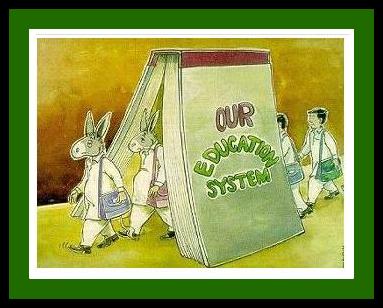
 “Sticks and drones may break our bones, but fitna would eventually be more lethal”
Few months back, a private channel aired different kinds of ads of success stories in education. We had very heated discussions with our friends on Facebook about those one-sided educational promos, in which only worldly education was being glorified: materialism that helped people gain jobs i.e. ‘success’. Then, nothing was too startling or alarming about it. With a very smooth transition, the message has been stepped up to a whole new level. Now they have come up with a very bold and provocative message: Taleem k siwa Pakistan ka matlab kaya? (‘Except education, what can be the meaning of Pakistan?’ The message is known to at least 44% of Pakistanis in a survey conducted by Gallup Pakistan.
Pakistan, we believe, was forged in the liberating fire of Tawheed, and any attempt to replace this meta-historical basis is to bring a new idol back into the Kaaba of Muslim consciousness. Pakistan was gained in the name of Allah, apart from other factors, such as economic freedom, etc. Saleena Karim in her thoroughly researched and seminal book, Secular Jinnah & Pakistan: What the Nation Doesn’t Know (2005), has exposed multiple myths of secular academia. Some of these textbook myths paraded as facts are: “Jinnah never used the word ‘Ideology of Pakistan’,” or, “Jinnah vetoed the proposals for an Islamic state’,” or, “Jinnah wanted a homeland for Muslims, not an Islamic state’,” or, “Islam was just a propaganda tool.” Suffice to say that Pakistan’s soul is Islam and its supra-identity is Islamic identity, as formulated by Quaid in following words: “The Pakistan Movement started when the first Muslim put his foot on the soil of Sindh, the Gateway of Islam in India.” Of course our history goes beyond this period, and we do not seek to disown or forget our national heritage; but, we do not believe in the modernist, nationalist notions of nationality/identity based solely on geography or race. Rather, our nationalism is based on a direct link with Heaven and the Final Revelation of Islam.
What has to be understood is that formal education cannot be a complete world-view for a nation. It is just a part of the world-view. Unfortunately, we are obsessed with ‘means and money’ due to ignoring sacred, unifying principles of revelations of Islam. The threat of destroying our values by emulating Western culture is a real one, when in fact, we should be working towards integrating modern forms of knowledge within Islamic framework, stresses.
According Dr. Seyyed H. Nasr:
“There is always a relationship between every form of knowledge and a worldview within which that knowledge is accepted as knowledge. There is no doubt about that. The worldview in all civilizations before modern times came from religion. This is true for every civilization. Hindu universities, Chinese universities, Islamic universities — but as Western influence spreads all over the world, we will begin to emulate Western forms of knowledge, which claim to now be independent of religion. But it was not independent of the Christian worldview. The secularist paradigm which was created in the 17th century is itself a pseudo-religion in that it is a view of the nature of reality. There is no abstract knowledge; knowledge is always within the framework of a worldview, of a way of looking at the nature of reality.”
All education is useless until it teaches you the splendours of yourself. The present education system of our country is exactly the opposite to this phenomenon. We rejoice over the Golden Period of Muslims yet don’t acknowledge the reasons behind that epitome. List all the Muslim scientists, scholars of that time and you will notice a common thread running through all of them. They studied history and nature, in addition to inner experience. Their basis for education was Quran. They took the spirit and matter hand in hand. Fresh avenues of research and studies kept coming forth, unlike our rote-learning culture. What is the basis of our current education system?
What does it tell us about our world, our history as humanity, our role, and our future? What does it teach us except slavery, materialism, inferiority complex, blind-following, selfishness and hording a lot of money! And that’s just one platform.
Dr Muhammad Iqbal raised serious doubts about the colonial educational system prevalent in his time; and, we have many reasons to believe that the ghosts of that period are still living realities. Ironically, credentials of Iqbal are used to convince us about the benefit s of an alien system of education, whereas his severe critiques are not incorporated. In his paper ‘Islam as a Moral and Political Ideal’ (1909), he argues:
“Education, we are told, will work the required transformation. I may say at once that I do not put much faith in education as a means of ethical training—I mean education as understood in this country … I venture to say that the present system of education in this country is not at all suited to us as a people. It is not true to our genius as a nation, it tends to produce an un-Muslim type of character, and it is not determined by our national requirements, it breaks entirely with our past and appears to proceed on the false assumption that the idea of education is the training of human intellect rather than human will. ”
We venture to say that not much has changed, at least at higher levels of education. Secular western world-view continues to dominate Muslim thought, especially in social sciences and even in the philosophy of science; from psychology to economics to, from pure philosophy to governance systems; although many positive developments have been taking place in modern fields of knowledge for past fifty years.
Education in Pakistan should be subservient to the genius of Pakistanis and their aspirations; it should be subordinate to the operating Principle of Tawheed. He further inquiries:
“But what sort of education? … A form of education which has no direct bearing on the particular type of character which you want to develop is absolutely worthless. I grant that the present system of education in India gives us bread and butter. Well, if we succeed in securing a few appointments in the higher branches of service, what then? It is the masses who constitute the backbone of the nation; they ought to be better fed, better housed and properly educated. Life is not bread and butter alone; it is something more; it is a healthy character reflecting the national ideal in all its aspects.” [Emphasis added]
Coming back to Iqbal’s scepticism regarding the presumed “magic” of education: how can we put so much trust in (a more or less) materialistic, job-oriented educational system, and announce it as the purpose of Pakistan, as the solution for all of our ills? We believe that present educational system has many, many resemblances with the colonial setup of Iqbal’s era. Even the authors find themselves guilty of giving more thought to bread and butter than pursuit of pure knowledge, which was the hallmark of madrassah system before the colonial invasion, according to educationist Dr Tariq Rehman. Summing up, Iqbal takes a very brief quiz in basic intellectual, moral and practical life of Islamic history – I miserably failed:
“… How many of us know that Muhammad II conquered Constantinople at the age of twenty-two? How many of us have even the faintest notion of the influence of our Muslim civilization over the civilization of modern Europe? How many of us are familiar with the wonderful historical productions of Ibn Khaldun or the extraordinarily noble character of the great Amir Abdul Qadir of Algeria [20th century hero]?”
Our media, like its global mentors, is expert at propaganda psychology: repeat a lie 1000 times, and it will transform itself into a truth. Perhaps this is what they hope to achieve with this campaign of ignorance, devoid of illumination. We thank the channel for creating this controversy which has led many into serious introspection about the purpose of Pakistan, basis for education, and our comprehensive world-view, including the authors of this article. It seems to be a blessing in disguise! This introspection is more needed than ever, given that we are far from achieving various educational goals: high literacy rate while at the same time integrating modern education within Islamic framework, and creating alternative to discourses based on a-religious and secular worldview.
This article is written jointly by Muhammad Umer Toor and Hira Shamim
