Toxic Effects of Inferiority Complex (III)

In South Africa there are two million whites against almost thirteen million native people, and it has never occurred to a single black to consider himself superior to a member of the white minority.Frantz Fanon

The feeling of inferiority of the colonized is the correlative to the European’s feeling of superiority. Let us have the courage to say it outright: It is the racist who creates his inferior.Frantz Fanon

(First quote of Fanon really shook our spines to the core. This thought has never occurred to us! We must confess. Ask yourself. The second one is a ‘proven’ psychological fact.)

There’s an undeniable existence of self-hatred, self-pity and total disregard for our Way (cultural and above all religious) present in many of us, especially those dazzled by all things ‘western’. Another term for this disease is Occidentosis. Speaking of which Jalal Al-i Ahmed writes in his famous Occidentosis: A Plague from West:

“Under [occidentosis] we are like strangers to ourselves, in our food and dress, our homes, our manners, our publications, and, most dangerous, our culture. We try to educate ourselves in the European style and strive to solve every problem as the Europeans would.”

Jalal has comprehensively summarized negative effects of westernization in various aspects of our individual and collectives lives which we’ll attempt to examine as following.

Aftershocks: 150+ Years of Psychic Downfall

1. Psychological Illness. Inferiority Complex is a psychological problem, to begin with. It’s a disorder arising from the conflict between the desire to be noticed and the fear of being humiliated, characterized by aggressiveness or withdrawal into oneself. It engenders the survival of distinct value systems and identities.

It could be learned through observation, or a subject could be induced with it (we recommend self-examination first). It’s a deadly weapon in the hands of a skillful occupier or one fed with superiority complex; even a suicidal technique that subjugated societies/individuals may like to impose on itself, sometimes. It can destroy glorious sanctities, making us un-objective and profane. British used this weapon quite exceedingly and successfully, who else can come to our mind? And, they had totally studied the types of it too; Frantz Fanon documents in his book Black Skin, White Masks. Wherever they needed to use force to inject it, they didn’t hesitate; like their colleague Frenchmen operating ruthlessly in Africa. Blacks were played with on the terms of their appearance. But, in Asia, they relentlessly used mind control tactics, along with coercion, to crush South Asians.

Due to that long historical process, loyalty and admiration of westerners is deeply embedded in many minds. Utter one critical word about the excesses of westerners and it will severely provoke west-worshiping extremists. One of their knee-jerk reactions is: “How dare you criticize them? Look at yourself,” they’ll remind you with contempt. “West might have its share of evils, but we’ve no right to criticize them.” “Who gave you the right to deny us our right of criticism?” we might ask humbly (only in English though). It only shows the shallowness and poverty of Brown Sahibs, who do not stop complaining about their not being taken seriously anymore. Have they taken the down-trodden, poor, “backward” natives more or less seriously than discarded western ideologies or its new imported gadgets & fashions?

2. Linguistic Prejudice. We South Asians have not given up our obsession with that foreign language and culture yet, let alone respond to deeper intellectual challenges of that godless civilization. Had English language been given due attention – no matter how little compared to our languages and culture – we would not have felt a need to talk about it. But, imagine the pain an Urdu-medium child in Punjab has to go through when he misspells an English word (phonetically) in front of insecure urban dwellers. Is this not Satan’s work in man’s garb? It’s remarkable, how a few of us armed with useless knowledge of this language and western manners can abuse, yield and ridicule our own brethren, and yet get away with it!

For instance, a private TV channel went after Members of Punjab Assembly (MPAs), questioning their mastery of English. Is being good at English a requirement to lead a Punjabi province? They ridiculed and harassed whoever said, a) they’d rather reply in Urdu, or, b) couldn’t speak well like a parrot.  Their assumption was: s/he who can flawlessly speak English is truly knowledgeable, and capable of maintaining peace and prosperity in Pakistan. This is obviously false, yet we all in some degree accept this subconsciously, and feel embraced when we find ourselves or our leaders bad at it. Take the example of Hussain Haqqani, one of the proficient practitioners of English, who has authored books in it. Journalist Woodward reported him equating Pakistan to a prostitute and calling us “rug sellers,” to Amerikanos. Haqqani’s job was to trade Pakistan’s resources and sovereignty for a few dollars.

Recall how much we laugh at someone named Meera – sadly. Calling McDonald as M-C-Donald is creativity, not dumbness, in a society that cannot spell correctly and fully a complex sentence in their national language.

2. Rise of Mono-culturalism. Culture is defined by collective customs, habits, styles, dresses and attitudes of people in geographical, ethnic and/or national context. Diversity is the spice of life; and Allah created these differences to let us celebrate our identities and see beauty in various forms. Monoculture of modern west destroys this diversity and beauty of forms. Moreover, the real problem is the difference between monoculture of west and native cultures: it’s that of quantity and quality. Appearances and cleverness are two hallmarks of modern man, while their inside is really dark, noted Allama Iqbal. Ours, including all native Oriental and Occidental cultures, is based on quality and content.

The outward awe of western power produces an unintelligent admiration for their culture. Consequently, it produces a psychopathic hatred of local cultural forms and manifestation. Salman Rushdie is a prime example of this self-hatred. Initially, due to deep-seated inferiority complex, he used to ridicule his family, culture and country to vent frustrations. In an article on Rushdie Affair, Dr A. Zaman writes:

“Rushdie has a tremendous hatred for Muslims … Desperate for acceptance into English society in his youth, he was denied it because of his race and culture. A common response to this childhood trauma is intense hatred for one’s own race/culture/religion.”

Imran Khan has comprehensively shown how the fake-elite class disregards its mother tongue and culture, in his book Pakistan: A Personal History. In an article published on this very site, Selective Islam, he also shows how colonial experience destroyed a sense of pride in one’s own culture and religion in English-speaking class. Leaders are most important people in a society, because people imitate them. In this light, our leaders are not ours because they totally copy occupiers from the west, for no greater good or reason. This realization transformed Imran Khan into a proud desi, which is visible from his priorities and habits; although he admires deeper aspects of western civilization, like that of rule of law, justice, etc.

The bottom-line is that we have to differentiate between real enemies and real friends. Appearances shouldn’t matter. If an illiterate, uncultured villager is patriotic, then he’s far better than a snobbish, inferiority complex-ridden, west-worshipping PhD or high ranking general. How can they act in our best interest, when their worldview, likes and dislikes only mirror that of their masters?

4. Spiritual disease. In short, inferiority complex – which shouldn’t be reduced to being a linguistic or cultural issue – is not just a psychological disorder, but primarily is a spiritual disease. Psychology might suggest solutions which can boost self-confidence or self-esteem. However, its side effects can be more severe; it might induce too much narcissism and egoism, two of the leading ailments of the modern man.

This inferiority complex made us do absurd things. We threw away our priceless culture, knowledge, our (spiritual) attire just to please our masters; our modernized fellows would even question the very existence of these treasures. This stopped us from freeing ourselves from the falsehood, idols that reside in our hearts. Idols of power and technology are what we worship today. Our tongues do not tire of taking One God’s name yet Lat and Manat reside and perpetuate in our hearts.

Iqbal says: “The fetters are not on feet, but on the heart and soul; this is indeed a very intriguing situation.”

5. Intellectual Regress. Most importantly, inferiority complex continues to cause most damage when it comes to thinking independently and Islamically. This causes a lot of friction to the project of Islamization of knowledge. (We’ve been amazed how many times leading Islamic thinkers have pointed out that a sense of inferiority vis-à-vis west led many educated Muslims to surrender wholeheartedly (or apologetically) to western modes of thinking and action – so much so that adjective modernized/westernized has to be supplied when speaking of such Muslims.)

Late 19th century and early 20th century, the intellectual response to west by Muslim “intelligentsia” was at best apologetic and defensive towards modernity. Re-interpretation of Islam by our so-called reformists was shaped Western ideas, because they could not think independently. Here, we also witness this disease of IC and occidentiosis. Dr Basit Koshul in a survey of encounter of modernity with Islam writes:

“[Early westernized Muslims] totally disregarded any reference to an Islamic framework in the course of their interaction with Western thought. Of more pressing concern to us are the attempts consciously designed to keep Islamic teachings meaningful in the face of the western onslaught. It will be shown in the following analysis that even this “religious” response to the Western challenge has been profoundly shaped by Western ideas.”

Dr Burhan Ahmed Faruqi in his Minhaaj-ul-Quran (not to be confused with that religious organization), argues: colonial invasion and setup created two classes of mind-set with distinct world-views: a Traditional Islamic mindset that traced its roots to divine revelation of Islam; and a modernized mindset trained in modern educational systems, which felt more at home with all things with western. Modernized Muslims ascended to the ranks of power and ruled Muslims masses with aspirations to westernize their countries in totality. Traditional Islam and its political elite lost its sway with the replacement of Shariah Law with Roman or English or French law and government systems; although cultural aspects of Muslim societies continued to survive, albeit with constant losing battles with the monoculture of West. Leadership was transferred to modernized-Muslims who were completely hopeless of Quran as a source of minhaaj, a way of solving problems both at individual and societal levels. With their utter hopelessness in Qur’anic worldview, modernized Muslims looked up to knowledge produced by human capacity as a way of solving all of their problems.

The point we’re trying to make is this: Muslims have lost confidence in their own intellectual tradition because a) they do no ‘think enough and clearly’ from Islamic point view; b) reason why they don’t think Islamically, it’s because they’re hopeless of Qur’an as a source or guide to our challenges, as per Dr Burhan. (It’s our belief (through experience) that if enough thought is given to Islamic thought, and things are seen from Islamic point of view, one’s belief in the authenticity of Islamic tradition would reach the point of certitude, if not divorced from spiritual practices.)

5.b. Misadventures in Social Sciences. Summarizing his paper on Origin of Social Sciecnes in West, Dr Zaman writes:

On the whole, Muslims have accepted Western claims that both social sciences and physical sciences are equally fact and logic based, and “positive” descriptions of reality. In fact, Western formulations of social sciences hide ethical and social commitments to secular views which conflict the Islamic views. Widespread acceptance by Muslims of these false claims to factuality and objectivity has prevented the development of genuine Islamic alternatives, and has been a serious obstacle to progress in the project of ‘Islamization of Knowledge’.”

5.c. Way of thinking. Inferiority complex vis-à-vis west has given rise to pre-Islamic jahili ways of thinking. This also includes tribalism (or nationalism). But above all we have more or less stopped looking at things the way our Prophet (may peace and blessings be upon him) taught us to do. We’ll explain that by a simple example. Once, a wealthy and powerful person went by. Prophet asked his companions about what they thought of him. They replied he was a very successful, wealthy and powerful person. He had prestige and honour among people such that if he asked someone in marriage for his offspring, no one would refuse. Then, a very poor and weak Muslim went by. Prophet asked them their thoughts about this poor fellow. Everybody said that this guy was not worth a dime. He was nobody in people’s eyes. Then, Prophet taught them to reverse their thinking. That poor guy was an extremely pious Muslim who prayed tahajjudd and all. Prophet taught them that the pious Muslims, albeit poor, was more honorable and worthy of respect than someone merely possessing worldly power, wealth and prestige.

Because we no more value Taqwa, devotion and love for God, we end up being hopeless of Islamic piety. This also explains our love for dunya and worldly prestige.

5.d. Educational Myopia. As we have already noted in our previous two articles that colonial education produced westernized minds with un-Muslim character and mind. Apart from that, colonial education harmed our creativity as well. Dr Farid A. Malik, a professor, notes that colonial education produced pen-pushers (bureaucracy) and trigger-pushers (army). Punjab perhaps had largest share of these ‘hollow men’. Atiyab notes in her paper that colonial education promoted on rote-learning, whereas in previous times this was not the case.

Our education is based upon Qur’an, which teaches through nature and history. History is an important basis of humanity, and a dynamic which is continuously shaping future, affecting and is affected by each of our choices. It is very often scoffed upon by European thought. The relation to past which is very important for collective growth is always ignored in modern thought and Western education, certainly in economics. On the other hands, European thought also turn history into historicism; latter argues that all sources of morality and knowledge must be derived from history and not theory or a text. Islam begins with a foundational text (Qur’an) and then asks people to intellect through the revelation.

5.e. Blunders in Human Psychology. Technically speaking, our accepting Freud and Jung’s psychological ideas universally as ‘scientific’ results in total displacement of religion from humanities. A problem with the latter is: It separates thought from intuition which is a dangerous phenomenon in human history. Thought without intuition is ripped off of its solemnity, innocence and positive creativity. Thought tucked into the vast wings of intuition works miracles. It becomes infinite and transit human experience into something humane. Anti-spiritual forces are blind to their own limitations, yet they so vehemently deny what lies beyond them.

7. Delusions of Racial Inferiority. We might like it or not but there’s an aspect of racial inferiority too. We often feel it vis-à-vis Nordics (Northern & Atlantic Europeans). Unfortunately, we did not come across enough literature examining this reality (or its non-existence). If you know such works, please share references or online sources. But, it is through observation we can confirm it.

In Europe, Darwinism and (flawed) racial intelligence tests try to uphold colonial dogma: all humans are equal, but races are better than others. We might add: yes, some nations are better in some areas than others, but it’s a matter of history and Divine Grace (or is ‘accidental’, to a skeptic). Africans didn’t produce Taj Mahal or Mozarts, but they produced saints, and in the eyes of the Absolute this is most important, argued Frithjof Schuon.

There is inequality in the world, but it’s like diversity which has undeniable unity to it. Study of genetics shows how similar humans are in an archetypical sense, which means that we collectively are one, but potentials are inherent in all, but are distribute by forces of history and free will. Free will exists, because there is a criterion of superiority: piety. There cannot be two criteria, unless one divorces knowledge from sacred (as Qur’an says, Are those who know equal to those who don’t?).

Hence, at racial level, only history matters. Nordics were notorious for being barbaric, least likely to be cultured, notes G. H. Estabrooks in his paper That Question of Racial Inferiority. We should ponder on this, and also on the fact that no single race or nation has monopoly over human productions and achievements.

Many scholars have shown the poverty of Europeans’ self-declaration of civility and superiority over others. It’s a self-delusion of the rich, at best. Let’s talk at a very practical level: ‘it’s a simple observation that if you teach a kid from remotest areas of the world, he will learn making computers and all the technology in no time’. Today, western technical and social science universities are dominated by people from corners of the globe, and not just by one race. Only a simpleton today would still believe in the falsehood of absolute superiority of certain races over the other. Pakistanis are famous in North America for saving lives (as doctors) and producing fancy toys (as engineers), for instance. Geniuses in poor countries are being wasted. In a recent global IQ test survey, Pakistanis were ranked 4th for their intelligence in the world, despite lacking all required resources. Not that we ever doubted the extraordinary abilities of our countrymen, but it’s good to see racists rising above their prejudices.

Those who become something are imported by West, leaving their homelands in that vicious circle of deprivation and poverty – for which only the fleeing natives are to be blamed.

Conclusion

There’s no conclusion to it, unless our article changes us and our reader to any extent. But, we’d like to close this part with an advice from a French-English Muslim thinker, Sidi Hassan Charles Gai Eaton:

“Muslims in general … have an ambivalent attitude to the West. On the one hand there is bitterness and resentment induced by the history of colonialism and now by the brute fact of Western hegemony; on the other hand there are feelings of admiration and envy. And yet admiration … should be tempered by caution. No race, no people, no human group can be good at everything. It is therefore always a question of priorities. If we can only be successful in a few aspects of this life, a choice has to be made.” (Source: Roots of Western Culture.)

This article is co-authored by Hira Shamim
Links to Part I and Part II

Historical Roots of Inferiority Complex (II)

Colonial Invasion & State Structures. Loss of self-confidence in Muslims is justifiably related to defeats on the battlegrounds at the hands of west. But a military defeat is not enough to enslave hearts and minds, as it can be an impetus for revenge. Today Muslims are envious of West’s power, which proves the fact that the real challenge of west is not of materialism, but of intellectualism (which modernity certainly lacks in the true sense of the world).

However, what happened after the first phase of colonial invasion? How did colonials succeed in subduing large populations in vast areas? We’ve partial answers.

Realizing the danger that native “monkeys” might overrun them by sheer numbers, colonizers had to play the games of perceptions and mind control. They had to look big and strong. Few in numbers, they developed railway and laid communication systems to travel fast over the huge mass of land to subdue any possible mutiny, which did take place and successfully crushed. But the physical assets won’t do the job if the natives were enthusiastic and confident of their victory. Hence, that spirit of rebellion was decimated, and fear and inferiority complex were placed like time bombs beneath our (un)conscious. Self-confidence was shattered when Muslims’d see Tipu Sultan’s majestic dress being worn by peons of whites. Healthy, buildup, young officers constantly replaced older ones to give the illusion that all whites are brave and strong and can’t be messed with. These are just few of countless examples of this social-engineering.

We’ve to contextualize heroic things we attribute our colonial masters. Colonialism was about dispossession. In a paper on this very topic, Cole Harris summarizes colonists’ grand strategy of dispossession as following:

“The initial ability to dispossess rested primarily on physical power and the supporting infrastructure of the state; the momentum to dispossess derived from the interest of capital in profit and of settlers in forging new livelihoods; the legitimation of and moral justification for dispossession lay in a cultural discourse that located civilization and savagery and identified the land uses associated with each; and the management of dispossession rested with a set of disciplinary technologies of which maps, numbers, law, and the geography of resettlement itself were the most important…” (‘How Did Colonialism Dispossess? Comments from an Edge of Empire’, Annals of the Association of American Geographers, Vol. 94, No. 1 (Mar., 2004), abstract)

Hence, administrative and other infrastructures, and all the technologies were means to loot and pillage, although in a more civilized or face-saving way.

Education: Colonists’ Most Favorite Vehicle (MFV)

While military and political subjugation of colonists broke the spirits of many, colonial education convinced many that modern West’s ventures in barbarism were for our own benefit. When defeat induced fears of a mightier foe, the education changed the victim’s heart. As Akbar Abadi said: ‘An easterner would cut off the head of the foe; a westerner would change his heart’. British justified their rule to their own people on the pretext of ‘civilizing’ natives. This was different from what was happening to Blacks in Africa. This comparison will make things more clear.

Blacks were made colonizers on the basis of their color. They were led to believe that their skin color reflects that of sin, ugliness. Black lies are unforgivable, white lies are ignored. They don’t have any right to exist. Be white or disappear was the attitude of their colonizers. Blacks even had dreams of being white. They craved for white color at any cost.

Our minds were made slaves. Our color is not such a problem to them. Our culture, religion, and thought endangered their existence. They worked to snatch our inheritance, our ilm from us. That is why they used education. They changed minds.

Economic-historian Atiyab Sultan writes that in the beginning of 19th century, colonization became more ‘pedagogic’ in India. Previously, Britishers were consolidating militarily and administratively. It was time to tend to education, which was primarily used to create a special kind of class of natives, loyal to them.

Liberals and utilitarians advocated ‘civilizing’ natives in the “universal image” of modern western man. There were 3 distinct groups in British parliament who lobbied for their own educational programs (with unmistakable similarities): Evangelicals, utilitarians, and uiberals. Evangelicals like Charles Grant believed Indians to be ‘race of men lamentably degenerate and base’; liberals like Macaulay fancied, “A single shelf of a good European library is worth the whole native literature of India and Arabia”; and utilitarians like JS Mills considered Indian stock of knowledge to be ‘obscure and worthless’ (perhaps he did so without digesting a page of Indian literature). On the contrary, Dr Asad Zaman argues, “A single chapter on sacrifice in a book like Fazail e Amaal that teaches man to go against his nafs, is worth the whole literature of modern West.” Only Orientalists, Atiyab mentions, argued that colonial educational system in India should be according to indigenous sources and be taught according to indigenous views.

In a way summing up the educational policy, which was fiercely debated in English parliament, Atiyab further writes:

“Education was also a chief instrument in the creation of a colonial subject that would be a loyal and willing consumer of British knowledge and produce. Macaulay voiced this concern thus: ‘Indians should not be too ignorant or too poor to value and buy English manufactures’ (Basu 58.)  In a larger sense, the loyal subjects were needed for the calm preservation of empire, echoing the imperial policy of cultivating supportive local elites …”

It becomes clear that their educational institutions served colonists needs, not ours. This reminds of what Iqbal called the “un-Muslim character” colonial education produced. Also, that system was unfair to the masses as it sent few to higher service, leaving the rest impoverished. We should also add that this created an anti-native character in Indians at large, to which Hindus responded very well, boycotting foreign goods.

Triumph of Materialism. Hamza Yusuf (HY) notes that the colonists saw the global and historical link Muslims maintained due to their religious Tradition. Muslims had many global learning centers which played vital role in this regard and maintained some kind of visible unity (although the underlying unity of Ummah is still undeniable and, in fact, crucial to the venture of Islam). In order to destroy that unity among Muslims, colonists sought to destroy this ‘historical link’. And as per HY, they did so by injecting inferiority complex in Muslims regarding their lack of material progress. “It’s all documented how they did this,” he emphasizes. For instance, they’d compare paper to pre-modern tablet, which Muslims used for instruction. “Using a tablet is backward. Now we’ve paper!” This notion of backwardness is still on the lips of 75-80% (if not 100%) of Muslims, especially the educated class.

Eurocentrism. The roots of civilizational inferiority complex may also lie in the venom called euro-centrism, especially for uncritical bookish minds. These are more less two central tenets of this mythological, racist & historicist thesis: All civilizations must develop along the lines of West to achieve the idols of indefinite economic progress, civility and “enlightenment”; and that Europe is at the center of world stage, and that all other civilizations are mere supporting pillars, resource fields to it. But western civilization not the end of civilizations, argues Rene Guenon:

“So long as western people imagine that there only exists a single type of humanity, that there is only one ‘civilization’, at different stages of development, no mutual understanding will be possible. The truth is that there are many civilizations, developing along very different lines, and that, among these, that of the modern West is strangely exceptional, as some of its characteristics show.”

Further Guenon scrutinizes the true nature of this highly over-rated civilization, which dominates the world materially so far (we would concede to the objection that even its material dominance is soon to be surpassed):

“The civilization of the modern West appears in history a veritable anomaly: among all those which are known to us more or less completely, this civilization is the only one which has developed along purely material lines and this monstrous development, whose beginning coincides with the so-called Renaissance, has been accompanied, as indeed it was fated to be, with a corresponding intellectual regress; we say corresponding and not equivalent, because here are two orders of things between which there can be no common measure. This regress has reached such a point that the Westerners of today no longer know what pure intellect is; in fact they do not even suspect that anything of the kind can exist…”

Post-Pakistan: Continuation. Leadership produced by the British took over the country after the partition. They molded state policies and institutions in the image of their departed masters, more or less. Discussion of continuation of such structures is not relevant here. What’s important is that the inferiority complex of native Brown Sahibs’ turned into superiority complex that caused much harm.

After 1947 we witnessed exploitation of our Bengali brothers, which was at once racial and materialistic. It wasn’t religious extremism that separated two brothers, but the absence of spiritual training of the governing “elites”, in bureaucracy, politicians and army. We’ve accounts of how West Pakistani elites treated Bengalis as lower level race. Our false-elite was certainly a clone of their masters.

(In the next part, we’ll talk about in detail possible harmful effects of this complex in various aspects of our individual and national life.)

This article has been co-authored by Hira Shamim.

Proceed to the final part

..Link to Part I

Inferiority Complex And The Disease Known as Civilization (I)

I am talking of millions of men who have been skillfully injected with fear,

inferiority complexes, trepidation, servility, despair, abasement.

—Aimé Césaire, Discours sur le Colonialisme

The independence movements in colonies and protectorates came into being, not through a return to indigenous values on the part of those concerned, but through the absorption of occidental ideas and ideologies, liberal or revolutionary … the process of modernization – a euphemism for Westernization – far from being halted by the withdrawal, was in fact accelerated. The enthusiasm of the new rulers for everything ‘modern’ was not restrained, as had been the enthusiasm of their former masters, by any element of self-doubt.

—Gai Eaton, Islam and the Destiny of Man

The celebrated Algerian psychologist freedom fighter of blacks, Franz Fanon, saw only two parties in the battle between the colonialists and colonized: white and black. We, the brown, had pretty benign colonizers, who did not like to butcher millions or harass indiscriminately 24/7. We have no idea about the mass murdering of Central Asian Muslims and Africans by imperial powers of 19th/20th century. Our colonization was far less brutal and far more subtle, which left us unsettled, undiscovered, and even unwelcomed in both clubs, of whites and blacks. Our body was not tortured as much as we’re brainwashed and deluded through education and social-engineering by the “generous” colonizers.

J Sartre, a philosopher, writes in preface to Fanon’s famous work Wretched of the Earth (hope it reminds you of our “elite” elders):

“In the colonies the truth stood naked, but the citizens of the mother country [of colonists] preferred it with clothes on: the native [colonized subject] had to love them, something in the way mothers are loved. The European élite undertook to manufacture a native élite. They picked out promising adolescents; they branded them, as with a red-hot iron, with the principles of western culture, they stuffed their mouths full with high-sounding phrases, grand glutinous words that stuck to the teeth. After a short stay in the mother country they were sent home, whitewashed. These walking lies had nothing left to say to their brothers; they only echoed.” (Brackets ours)

We post-colonial, brown Muslims (like our colonial parents) lack self-confidence at many levels. This loss of confidence – in our culture, essence and the way of Islam – haunts us in intellectual and practical matters. Many of us pay lip-service to Islam and carry on with it; many choose to ‘reform’ Islam to be ‘compatible’ with an aggressive West, which declared its independence from Heavens few centuries back (although we mistakenly hail that to be ‘enlightenment’ from heavens). Some of us are just indifferent to the unavoidable contradictions between Islamic teachings and modern thought and its practice. We might not like these realities. Truth, however, is not concerned with likeness or dis-likeness of this or that person or society, or even a generation. Truth is above sentimentality and fashions of minds that keep changing with every cycle of moon.

Despite the loss of confidence (and a Center), we’ve not stopped calling ourselves Muslims, so far. But, thanks to our modern education we certainly are not that homo Islamicus of the glorious past (a) who’d not be dazzled by materialism of any kind, (b) who’d serve knowledge (not for money’s sake), and, (c) integrate influences from diverse sources from his own civilization’s viewpoint. His world-view was based on Qur’an and sunnah (as amply clear from the writings of great theological and philosophical scholars of past). He would ‘think enough, think clearly’ and think rightly. More importantly, he’d think Islamically. They were the people of izzat, or respect, and were imitated (who’re Indians imitating when they wore turbans?).

The shocking encounter of colonialism in 19th/20th century seemingly paralyzed the body and mind of ummah. Dr Muzaffar Iqbal argues that our defense mechanisms failed because we’re too little prepared, and responded too late to the sea changes that were going to change our world, perhaps forever. Europeans were notorious for being barbaric, always engaged in sectarian (or else) warfare – nothing compared to what we can do today with all the weapons of mass destruction. Being over-confident, Ottomans didn’t pay much attention to the reports on rising power of the Nordics, i.e., Westerners. What now? According to a medical-religious scholar, we’re in a post-traumatic stress from the psychological trauma of the invasion of the ‘unclean West’. Perhaps it was a medicine of our arrogance. Recovery process has not been what Qur’an envisages for us. (‘We do not change the condition of people…’) A young Muslim is perplexed, dazzled and confused by the power and wealth of West, and the condition of his own civilization, when confronting statistics on poverty, injustice, corruption, treachery and all sorts of such evils in Muslim lands. Likewise, we have more questions than answers to trouble you with (which is exactly what we hope to achieve here).

Ibn-e-Khuldun distinguishes between are two classes of people or nations: the free people/leaders and the followers. Those in chains of slavery (or followership) imitate all easy acts of the leaders. In a bid to feel superior, they’d imitate leader’s dress, learn his language, adopt his manners, and take a dog for an evening walk with them in the park (just like the boss). However, the difficult acts are truly difficult to follow for them; the actions that make a leader what he is are not for followers to focus their attention on. Followers are just too busy being ‘at the receiving end of waves’ to be proactive enough to fight back. Consequently, two remain where they are. Imitators lack seriousness and content, but remain up-to-date with changing fashions of leading nations. (‘Oh, did you watch that movie, XYZ?’)

This is not to suggest at all that we should thoughtlessly start photo-copying westerners. It is precisely this mentality of blind-following we are arguing against, besides pointing out that we only follow what’s on easy-to-do-list. On the contrary, what’s really hard for us is to respond forcefully to western modernity’s challenges – intellectual, political, cultural, military, etc.

Our laziness and contentment with the works our forefathers pushed us into deep slumber of ignorance. West happily took advantage from this situation and injected us further with its own disease of materialism. It was the last straw and we went down tumbling in the abyss of inferiority complex. What’s superficial and relative seemed to us important and absolute. West made us believe that without machine man was destined to stay in primitive age. In the race of machines, spirit was left far behind and thus world saw the decline of humanity. We in our naivety followed blindly the ‘matter’, when indeed we were needed to have mind over matter. This complimentary work of mind over matter has always been going on till 16th century. Before that, world was in much better and proper shape (with the exception of some areas). Truth like intelligence is complex.

In a quest to control us – afraid of our religious rationality or perhaps completely oblivious of it – they started alienating us from our own language, modes of education, culture, science, philosophy, etc. We became timid, fearful to act on our own teachings, sent down to us from Divine. This is what we’ll try to explore and elaborate in next article.

In next part we will also try explaining historical process that gave birth to inferiority complex (although not exhaustively); will describe various illnesses and harmful effects of this disease in various fields of knowledge and action; also, we’ll show that this is as much a Pakistani’s problems as it is of an Iranian, Egyptian, Indian, and others who’re ‘brainwashed with modernism’. In the final part of this series we’ll talk about possible remedies (which would require more input from you, actually).


This article is written jointly by Muhammad Umer Toor and Hira Shamim

Proceed to Part II

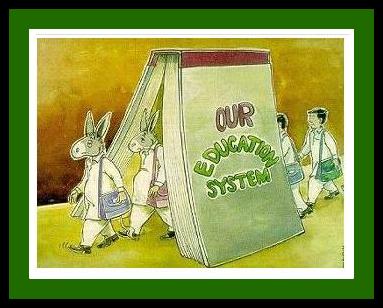
Education System: Manufacturing Slaves in Pakistan

“Sticks and drones may break our bones, but fitna would eventually be more lethal”

Few months back, a private channel aired different kinds of ads of success stories in education. We had very heated discussions with our friends on Facebook about those one-sided educational promos, in which only worldly education was being glorified: materialism that helped people gain jobs i.e. ‘success’.  Then, nothing was too startling or alarming about it.  With a very smooth transition, the message has been stepped up to a whole new level.  Now they have come up with a very bold and provocative message:  Taleem k siwa Pakistan ka matlab kaya? (‘Except education, what can be the meaning of Pakistan?’ The message is known to at least 44% of Pakistanis in a survey conducted by Gallup Pakistan.

Pakistan, we believe, was forged in the liberating fire of Tawheed, and any attempt to replace this meta-historical basis is to bring a new idol back into the Kaaba of Muslim consciousness. Pakistan was gained in the name of Allah, apart from other factors, such as economic freedom, etc. Saleena Karim in her thoroughly researched and seminal book, Secular Jinnah & Pakistan: What the Nation Doesn’t Know (2005), has exposed multiple myths of secular academia. Some of these textbook myths paraded as facts are: “Jinnah never used the word ‘Ideology of Pakistan’,” or, “Jinnah vetoed the proposals for an Islamic state’,” or, “Jinnah wanted a homeland for Muslims, not an Islamic state’,” or, “Islam was just a propaganda tool.” Suffice to say that Pakistan’s soul is Islam and its supra-identity is Islamic identity, as formulated by Quaid in following words: “The Pakistan Movement started when the first Muslim put his foot on the soil of Sindh, the Gateway of Islam in India.” Of course our history goes beyond this period, and we do not seek to disown or forget our national heritage; but, we do not believe in the modernist, nationalist notions of nationality/identity based solely on geography or race. Rather, our nationalism is based on a direct link with Heaven and the Final Revelation of Islam.

What has to be understood is that formal education cannot be a complete world-view for a nation. It is just a part of the world-view. Unfortunately, we are obsessed with ‘means and money’ due to ignoring sacred, unifying principles of revelations of Islam. The threat of destroying our values by emulating Western culture is a real one, when in fact, we should be working towards integrating modern forms of knowledge within Islamic framework, stresses.

According Dr. Seyyed H. Nasr:

“There is always a relationship between every form of knowledge and a worldview within which that knowledge is accepted as knowledge. There is no doubt about that. The worldview in all civilizations before modern times came from religion. This is true for every civilization. Hindu universities, Chinese universities, Islamic universities — but as Western influence spreads all over the world, we will begin to emulate Western forms of knowledge, which claim to now be independent of religion. But it was not independent of the Christian worldview. The secularist paradigm which was created in the 17th century is itself a pseudo-religion in that it is a view of the nature of reality. There is no abstract knowledge; knowledge is always within the framework of a worldview, of a way of looking at the nature of reality.”

All education is useless until it teaches you the splendours of yourself. The present education system of our country is exactly the opposite to this phenomenon. We rejoice over the Golden Period of Muslims yet don’t acknowledge the reasons behind that epitome. List all the Muslim scientists, scholars of that time and you will notice a common thread running through all of them. They studied history and nature, in addition to inner experience. Their basis for education was Quran. They took the spirit and matter hand in hand. Fresh avenues of research and studies kept coming forth, unlike our rote-learning culture. What is the basis of our current education system?

What does it tell us about our world, our history as humanity, our role, and our future?  What does it teach us except slavery, materialism, inferiority complex, blind-following, selfishness and hording a lot of money! And that’s just one platform.

Dr Muhammad Iqbal raised serious doubts about the colonial educational system prevalent in his time; and, we have many reasons to believe that the ghosts of that period are still living realities. Ironically, credentials of Iqbal are used to convince us about the benefit s of an alien system of education, whereas his severe critiques are not incorporated. In his paper Islam as a Moral and Political Ideal’ (1909), he argues:

“Education, we are told, will work the required transformation. I may say at once that I do not put much faith in education as a means of ethical training—I mean education as understood in this country … I venture to say that the present system of education in this country is not at all suited to us as a people. It is not true to our genius as a nation, it tends to produce an un-Muslim type of character, and it is not determined by our national requirements, it breaks entirely with our past and appears to proceed on the false assumption that the idea of education is the training of human intellect rather than human will. ”

We venture to say that not much has changed, at least at higher levels of education. Secular western world-view continues to dominate Muslim thought, especially in social sciences and even in the philosophy of science; from psychology to economics to, from pure philosophy to governance systems; although many positive developments  have been  taking place in modern fields of knowledge for past fifty years.

Education in Pakistan should be subservient to the genius of Pakistanis and their aspirations; it should be subordinate to the operating Principle of Tawheed. He further inquiries:

“But what sort of education? …  A form of education which has no direct bearing on the particular type of character which you want to develop is absolutely worthless.  I grant that the present system of education in India gives us bread and butter.  Well, if we succeed in securing a few appointments in the higher branches of service, what then? It is the masses who constitute the backbone of the nation; they ought to be better fed, better housed and properly educated. Life is not bread and butter alone; it is something more; it is a healthy character reflecting the national ideal in all its aspects.” [Emphasis added]

Coming back to Iqbal’s scepticism regarding the presumed “magic” of education: how can we put so much trust in (a more or less) materialistic, job-oriented educational system, and announce it as the purpose of Pakistan, as the solution for all of our ills? We believe that present educational system has many, many resemblances with the  colonial setup  of Iqbal’s era. Even the authors find themselves guilty of giving more thought to bread and butter than pursuit of pure knowledge, which was the hallmark of madrassah system before the colonial invasion, according  to educationist Dr Tariq Rehman. Summing up, Iqbal takes a very brief quiz in basic intellectual, moral and practical life of Islamic history – I miserably failed:

“… How many of us know that Muhammad II conquered Constantinople at the age of twenty-two? How many of us have even the faintest notion of the influence of our Muslim civilization over the civilization of modern Europe? How many of us are familiar with the wonderful historical productions of Ibn Khaldun or the extraordinarily noble character of the great Amir Abdul Qadir of Algeria [20th century hero]?”

Our media, like its global mentors, is expert at propaganda psychology: repeat a lie 1000 times, and it will transform itself into a truth. Perhaps this is what they hope to achieve with this campaign of ignorance, devoid of illumination.  We thank the channel for creating this controversy which has led many into serious introspection about the purpose of Pakistan, basis for education, and our comprehensive world-view, including the authors of this article. It seems to be a blessing in disguise!   This introspection is more needed than ever, given that we are far from achieving various educational goals:  high literacy rate while at the same time integrating modern education within Islamic framework, and creating alternative to discourses based on a-religious and secular worldview.


This article is written jointly by Muhammad Umer Toor and Hira Shamim