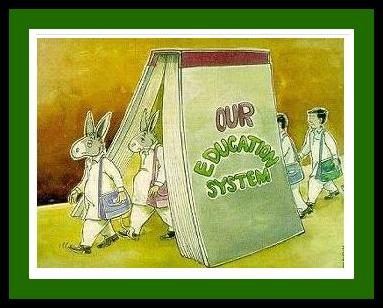
Foundations of Secular Educational System

Know thy enemy.

“Allah is the Protecting Friend of those who believe. He bringeth them out of darkness into light. As for those who disbelieve, their patrons are false deities. They bring them out of light into darkness. Such are rightful owners of the Fire. They will abide therein. 2:257

Are we conscious of what we take from the modern-secular thought and its educational system, and what we reject? In fact, are we rejecting anything harmful? Are we deciding hard what is useful for us and what is unacceptable from Islamic point of view? Do we fully know what we’re up against? Not so much.

Our universities and intelligentsia model itself on the contents of western educational system, and are heavily influenced by it. What then are the major components of western, modern educational system which contrast with Islamic worldview? What are its philosophical and practical bases? This is the first article which encompasses the influences on modern education and its origins. In further articles, we’ll try to come up with some rationale on which to build the structure of modern education which keeps human nature intact with its ethics and preserves the teachings and injunctions of Allah Almighty. We invite you to participate in that and broaden our mutual understanding from Islamic point of view.

Setting the Context: Roots of Modern Education

The loss of God is death, is desolation, hunger, separation. All the tragedy of man is in one word, ‘godlessness’ – (Metropolitan Anthony of Sourzah)

Contemporary education, or modern literacy, has harmed, as well as benefited human race. To understand the long lasting effects of modern education we have to go back in history towards its inception. From there we believe we can conceive the idea of what contemporary endeavor of modern education is. For now it is enough to say that it has given us war, bloodshed, imperialism, disbelief in unseen higher order realities, exploitation, slavery to created things, nationalism and list goes on. It has divested the superior human values from us and has turned human society into an individualistic and hedonistic one; where men are involved in performing feats of personal gratification in which there is no room for love and care due to their shear selflessness. Selfishness is at the heart of economics, for instance. It has so far given two major wars or world wars in the human history. This cannot be said the age of enlightenment, rather a dark age to many. It is a delusion of evolution without any direction. No doubt that science and education of people have given us some wondrous inventions and have laid the foundations of various subjects, but these were supposed to make human life easier and were to make them civilized. Ironically, repercussions have been disastrous.

Understanding the context (or the times) is imperative here. We have our differences with Hinduism, but we ought to call to ‘a common word’. Similarities can be startling, like the following predictions of The Vishnu Purana, “a Hindu text dating back nearly two millennia,” which describe the Dark Age or Kali Yuga:

“Riches and piety will diminish daily, until the world will be completely corrupted. In those days it will be wealth that confers distinction, passion will be the sole reason for union between the sexes, lies will be the only method of success in business, and women will be the objects merely of sensual gratification. The earth will be valued only for its mineral treasures, dishonesty will be the universal means of subsistence, a simple ablution will be regarded as sufficient purification…The observances of castes, laws, and institutions will no longer be in force in the Dark Age, and the ceremonies prescribed by the Vedas will be neglected. Women will obey only their whims and will be infatuated with pleasure…men of all kinds will presumptuously regard themselves as equals of Brahmins…The Vaishyas will abandon agriculture and commerce and will earn their living by servitude or by the exercise of mechanical professions…The dominant caste will be that of the Shudras…” (The last point may raise eyebrows. Interestingly, Prophet also indicated that lowly people will be happy people in final days, like these modern singers and movie stars, as per Hamza Yusuf.)


Let us delve into the influences and foundations that modern curricula’s globally have in common, in East and West.

Industrialization & Progressivism

The modern age of industrialization initiated by the Great Britain was founded on the sentiments of increasing productivity. On these grounds it can be said that it was related to greed present in human nature. It cannot also be simply linked to increase in population, but more or less it can be related to greed or avarice, and subjugation of extremely poor people who were used as ‘grist in the mill’ of industrialism. (Also because at that time Malthus’ theory argued that “poverty is caused by excessive breeding of the poor,” a factually wrong and disproven dogma still held by anti-poor elites. Hence poor had to be left at the mercy of wolves or corporate elites.) With this radical change there came a rush of inventions and products that changed the face of human society forever.

Previously wars were fought between groups for land, ownership and money. This has not changed yet, only the form has changed (in these supposedly extremely ‘civilized’ times). Groups now are nations & corporations led by war mongering political establishments and Opera going executives. They wage wars on other groups (weaker the better) for their own sake of safety, protection and survival. Their excuse: “we’re here to civilize savages and bring the Light of Democracy.” (Ironically, Donald Rumsfeld categorically said that ‘an Islamic state is not an option for Iraq’ even if people want it!)

Today, the businesses are running on Machiavellian thought, Adam Smith’s principle of pursuit of self-interest and totalitarianism without any bounds and without any absolute set of ethics. Very recently around 20 banks in UK and Europe joined hands to loot and fool the world by fixing certain trading rates (or Libor) that affect all financial transactions, for instance.

All that boils down into the domination of a system based on money and power. Globally, this is translating into the rise of the American Corporate Imperialism, as exposed in Confessions of an Economic Hitman. Capitalism whose decline has just been started in Wall Street outlines a system in which the whole of economy stands on the greed of humans for power and outward beauty. Economics, when stripped off from ethics, results in the bigotry of unequal distribution of wealth and immorality. One of us vividly remembers his economics professor forbidding use of any moral arguments against narcotic drugs; so he had to argue “rationally” in favor of legalizing drugs according to economic analysis!

Industrialism and capitalism is the soul for today’s educational system. (Remember what’s the bottom-line? Dollars & prestige.) The degrees which are now offered are only to sustain this system and to make it robust. The curricula have failed to give people any higher aim of living. Those who aspire for greater good are themselves restrained to a small local level, and have up till now failed to achieve any milestone in bringing a halt to the devastation borne by a vast majority of people around the globe. But quality will prevail over quantity, Allah willing.

Capitalistic ideas must be taken critically and attacked from various angles. We tend to naively believe that this is the end-result of human effort in economic sphere. Surely anyone familiar with economic research at the forefront knows that dogmas of neo-classical economics or capitalism are being challenged bottom-up.

Philosophical Purge

While nineteenth century materialism closed the mind of man to what is above him, twentieth century psychology opened it to what is below him

(René Guénon)

The ‘eclipse of human soul and intellect’ by secular thought has brought disastrous consequences not just at pure intellectual level, but at societal and practical level as well. The change agents have been ‘false prophets of modernity’ (i.e., modern philosophers and theorists). At intellectual level, they’ve lost the traditional, religious view of nature and knowledge, and created false alternatives – the cause of mass misguidance. Not only that, these handful of men have produced this ‘Dark Age’, a material civilization, in which both human actions and intellectual efforts are profane and cut off from Divine guidance. At practical level, though they have discovered in their way great deal of facts about human mind and body, but still paved way to moral degradation, materialism and suffocation of public morality. (We hope to give historical and evidential bases to these ‘bold claims’ of major religious thinkers in future, Allah willing.)

At political level, we have seen destruction by and self-abdication of great many political minds and men: thanks to Machiavelli’s work, The Prince. In his over-rated book, he suggests that for rulers, ethical norms do not matter. In fact, being truthful and honest is inefficient. His dajjalic policies are just another case of modern man’s declaration of independence from heaven. Similar strains on ideologies and humans actions are attributed to Sigmund Freud. These mistaken ideas have in fact formed the basis of human nature, society, economy and government, with harmful consequences for societies and even for individuals who practice it.

Ideas of Darwin and Karl Marx are the nails in the coffin of education. Karl Marx perpetuating Darwin’s theory of evolution into historical materialism (as he was took Darwin’s book as building block for his own theory) suggests in Marx’s Critique of Political Economy that:

“… in every historical epoch the prevailing economic system by which the necessities of life are produced determines the form of societal organization and the political and intellectual history of the epoch; and that the history of society is a history of struggles between exploiting and exploited, that is, between ruling and oppressed, social classes.”

On his funeral, F. Engel summed up Marx’s grand theory about human life on earth:

“Just as Darwin discovered the law of development of organic nature, so Marx discovered the law of development of human history: the simple fact, hitherto concealed by an overgrowth of ideology, that mankind must first of all eat, drink, have shelter and clothing, before it can pursue politics, science, art, religion, etc; that therefore the production of the immediate material means, and consequently the degree of economic development attained by a given people or during a given epoch, form the foundation upon which the state institutions, the legal conceptions, art, and even the ideas on religion, of the people concerned have been evolved, and in the light of which they must, therefore be explained, instead of vice versa, as had hitherto been the case.”

According to him, the structure of society including politics, religion, arts, and philosophy is founded on the basis of economic conditions of prevailing era alone. Economics explains everything in Marxian worldview. Religion and ethical systems are either products of economic realities, or merely tools used to justify a given economic system. Moreover, if a system is exploitative, religion will be used as opium to cancel out resentments of the masses. (Actually, “opium is the religion of masses.”) People often read and are influenced with these writings without being critical, just as Ilich Lenin was influenced and brought up the revolution in Russia.

The curriculum of today take these adulterations as credible and as “scientific facts,” mal-nourishing young minds philosophically. In reality these ideas have exploited the darker sides of human conscience & mind, bringing forth those attitudes which were once considered taboo. “With the sword of furqan,” says one Islamic thinker, “Muslim minds should destroy the idols of western ideologies.”

Revolutions and Wars

“Wars and revolutions and battles are due simply and solely to the body and its desires. All wars are undertaken for the acquisition of wealth; and the reason why we have to acquire wealth is the body, because we are slaves in its service” – Socrate


The unrests and revolutions that came in past few centuries have also framed the worldview of education and its outcomes. The French revolution attributes a significant place for wiping out feudalism and is credited with giving birth to liberalism. People overthrow the government of King, the oppressor, to free themselves. This idea found in this revolution gained strength later on and reached in its purest form in the Human Rights Charter.

A sceptic might object: how can this be freedom that a mob can overthrow a king and then take control of everything for themselves? Instead of one king, a state is created for few to rule. They maintain the cycle though: they print the currency, impose taxes, compel everybody to work for material gain, start a competition in the society, bring women out just to boost economy, make children learn things that are not going to matter to them except for increasing taxes and wealth of only a bunch of people. All it does is to make the suffering swallowable for sensitive minds.

This revolution preceded by the American Revolution instills a spirit of absolutist liberty in the approach of institutions of teaching and learning. It also contributes the idea of democracy in the western world and it was through this revolution that basis of modern political thought is inspired. Political theorists and students now advance their thought after considering the universality of the ideas of democracy and capitalism, without analyzing critical the implications of these systems and without challenging its naive assertions.

Similarly, the Russian Revolution and Marxism have brought with it a completely different mindset and values. When these values were first implemented after the revolution, ferocious was the attempt to impose these ideas to the whole world. Nazi Nationalism was another despicable event that took place and failed. Now the world is left with a single dominion of Capitalism awaited to be replaced with something more ideal.

These revolutions have then helped fringe these (and other) concepts of liberalism.

20th century World Wars can safely be attributed to Nationalism (and other psychological diseases and delusions). Education served the warfare. Many of the subjects and fields of study were developed owing to the demands of warfare like Operations Management, Supply Chain Management, and Resource Planning etc. Even the invention of internet is accredited to the needs of military communication after World War II (and to some pure mathematical pursuits too, we must mention).

The overall focus of the education in previous two centuries hasn’t been on the moral grounds, because if it was so people would be enjoying a more safer, indiscriminate and peaceful planet. These so-called “management” and “engineering” fields are nothing but the tools to keep the “system” running and to spread the void between rich and the poor, powerful and the oppressed, from one perspective.

A conscious citizen knows that industrial-military-complex is at the heart of American economy. Those who set up wars, sell weapons and then blame others for mischief are equally responsible and real barbarians.

Anti-Principlism

A brief survey of modern thought and its educational system will show that it’s based on overturning principles, notes Hamza Yusuf, an American convert and preacher. Whereas, he further said, in Islamic educational system, you cannot question those principles. Prof. S. H. Nasr notes that in old days, when Islamic Tradition was fully intact, the intellectual environment was like a sea in which all kinds of fish would swim, with all kinds of colors and shades; but none would question existence of water. No one would doubt unity of God, for instance, but have very sharp differences at the same time. Secular, positivist, modern education attempts murdering this holistic and sacred understanding of knowledge and instruction.

Today, ulema are anathematized for having deep theological differences (when in fact those differences lead to greater synthesis, as per M Iqbal); whereas, the very modernists would dare disagreeing with Quran, and whole of the Orthodoxy developed and perfected by the best generations of Muslims – progressive-academics like Amina Wadud for instance.

Logical Positivism in Social Sciences: Rejection of the Unseen

No understanding of western social sciences (hence its educational system) is complete without delving deep into logical positivism. Western social sciences are based on logical positivism, which rejects belief in and study of the Unseen. An implication of rejection or indifference to the existence of God.

It only studies what can be seen and observed, while rejecting underlying realities like courage, love, goodness, etc. For instance, we cannot see gravity. Hence, we won’t talk about gravity, but we’ll only study its effects. Equations describing its effects will be studied only. (However, physicists don’t bow to positivism much and always talk about such unobservable things as gravity, strings, etc.) Similarly, in psychology, many things are unobservable, unconscious for example. Behaviorists reacted to this invocation of unseen concepts and called for rejecting the study of such areas in psychology. Not many heeds their call anymore.

Unfortunately, despite having failed, logical positivism continues to stick (like a sticky tape) and be taught in many areas. This is evident from its two basic dogmas, which have also taken disbelievers away from light and into darkness:

“S1: Unobservable entities cannot be invoked as explanatory factors. Social science, like the physical sciences, must be built around quantifiable and measurable concepts.

S2. Morals, values, ideals are unobservable and hence unscientific.  Activism, or efforts to create a better society are not part of scientific activity. Social scientists must act as neutral, detached observers seeking to describe laws of motion for human and social activities.” (Source, please read the paper for a detailed description, history and criticism of logical positivism.)

One can appreciate that these misunderstandings are opposite to Islamic understanding of knowledge and method of inquiry. Islam on the contrary is for those who believe in the Unseen, and that invoking unobservables is necessary and only rational to be objective in social sciences.

Media: The Mind Control Machinery

Brainwashing and conditioning doesn’t end with classroom sessions in the afternoon. The very potent one begins afterwards. It can be said that today many are reading, writing, learning, understanding, persevering, and moving forward only for the sake of money and lifestyle. Not for the sake of Allah, which has severe consequences, as evident from pupils’ boredom with the education. Media, advertising and our education reinforces these “ideals.” But the fall is much grave and deeper. The subtleties of men now rest in the hands of some ignorant celebrities and movie stars, or a bunch of business giants who’re controlling and influencing a major portion of the population. These corporations  are centralized and concentrated. A few many firms own large, diverse businesses like magazines, gaming, newspapers, etc. They won’t let research published against them spread so easy.

With its unprecedented influence, media is termed as the fourth pillar of the state and is the most influential tool rampant in the circles of life of contemporary global culture. The “culture” is nothing but the monoculture imported from America (like McDonalds, etc.). It frowns upon facial hairs, turbans, sandy terrains, and everything more natural. At deeper levels, it’s contemptuous towards various manifestations of traditional civilization, especially the latter’s anti-absolute-freedom-to-do stance.

It’s a mind control machine that ‘manufactures consent’, to put it mildly. But it is much more than that, and impacts deeply spiritual state of those who’re exposed to it without caution. Our national identity, and moral growth of individuals is at stake due to this media because it has torn apart the garment of modesty from people’s eyes and it has once again took humanity to those primitive times when there was degradation of feminine gender and immodesty it faced. In Islam, bashfulness is the essence. In modernity, it is a meaningless commodity that doesn’t help.

Conclusion

An education that only makes us honest, efficient, hardworking and loyal to the system can be very deluding. If the system negates the many clear-cut commands of Allah, honesty, efficiency and hard work won’t do any good to the individual and society. This, to us, is the case with education in Pakistan.

Many things must have been left while writing this as this is no short topic it requires deliberate working and understanding of human conscience and zeitgeist of time in order to identify its fallacies. This article is just an effort to compile the thoughts into an organized form to better understand the problem at hand and to convey it to others. We welcome you to amend, add and expand the scope, contents and depth.

The Islamic concept of educational system is based on the spiritual and moral grounds and implies a set of principles which are completely different and in fact in conflict with the contemporary world view of education. The modern education has moved on after renouncing the existence of any other world other than what they perceive and feel, this attitude has casted a curse on society which has sabotaged its moral values. Dignity, courage, austerity, justice, freedom, wisdom, virtuousness, integrity, and absolute sincerity are absent from today’s learned and literate man. Because if it were a part of the education or if education would have taught these moralities; there must have been less suffering by human race.

“To learn is to understand and to understand we need free thought and for free thought we need not to be slaves”

خرد کو غلامی سے آ زاد کر


The above article has been co-authored by Muhammad Umer Toor with Hassan Habib

We Are All Shahzeb Khan

Just like Madame Defarge of Charles Dickens’ ‘A Tale of Two Cities’ silently kept knitting the registry of all those condemned to death and punishment, once the simple and humble peasants eventually rise to the massacre of the oppressors, the nature is writing down all the names and crimes of the feudals acting as pharaohs in the land of the pure. Just as the ‘bloody red queen’ of Tim Burton’s Alice in Wonderland uses pigs as her foot rest, flamingo as a mallet, hedgehog as her croquet ball and monkeys as her throne support, feudals in Pakistan enslave the commoners and treat them like animals. You annoy them slightly and the verdict comes ‘Off with his head‘ and job done. Remember the pharaoh who said to Moses ‘I give life and I give death’. These are no different.

Feudalism in Pakistan is a disease, the metastasis of the primary ailment called colonialism. It’s been ages since the imperialists left us but the common man remains enslaved to the feudal lords all across Pakistan. Big lands, property, cars, arms, luxurious pastimes, oppression of the poor, harassment of women and private jails symbolise them. And when these above-the-law feudals become a part of government and legislation, the country becomes a perfect example of anarchy and lawlessness.

Shahzeb, the 20yr old handsome young man, the only son of his parents was killed in cold blood right after his sister’s valima dinner, not on a huge feud but a trivial squabble. ‘You don’t know who I am‘ attitude of the feudal youth driving those lavish cars, surrounded by armed men as their security guards, has replaced the humans in them with devils. Shahzeb Khan is not the name of an individual nor does the killer represent an individual criminal. Shahzeb represents a commoner, who like any brother would be annoyed if someone harasses his sister and would get over it if the issue is settled amicably. He has no right to protest or raise voice against an influential monster and can be cleaned out of the way if need arises, with no one to look for justice.  The killer represents the pharaohs of the society, with their right to attack, grab, harass and then feel humiliated if a ‘kammi-kameen’ makes noise, eventually plucking the weed out of their way. The whole picture of this tragic incident is a portrayal of our intolerant society. ‘You annoy me – i’ll kill you. You disagree with me – i’ll kill you. You don’t know who I am, but i’ll make sure you will as i’ll kill you‘.

Shahzeb killing symbolises a menace which should be dealt with an iron fist. But who wears an iron fist in front of the pharaohs? Yes. The same commoners, the peasants, the ‘awam’ which are painted black in face by an angry zameendaarni who uses the filthiest language for a man of her father’s age and he stands helplessly in front of one ‘bloody red queen’ of the area like a helpless animal. Or, the common man who is beaten and taken to task for annoying another ‘red queen’ by telling her that the bakery is closed and he can’t sell her the cake. Or, you and I who would be creating more Shahzeb Khans in future if we opt to stay silent.

The Color of the Painting

The painting was absolutely stunning. It carried a latent meaning which was profound and deep. It was both intriguing and complex. No single narrative or interpretation could really sum-it-up. It was colorful; you could see all sorts of colors of all sorts of variations and shades.

And there stood the painter gazing at his work and wondering how complex the human mind could really be. It was then that a rather blunt man walked right in the gallery. He saw how people were being fascinated at the sight they were beholding. He too looked at the painting, and, wondering what was so special about it, asked, “Umm… what color is this painting?”

How exactly was the painter supposed to answer this query? Well, he chose not to entertain a question that destroyed the purpose of discourse.  But then his “ignoring” started to be confused with “ignorance”. People started to doubt the validity of his work. Someone from the crowd stood up and with an inspecting look in his eyes, proposed “I think it’s blue”. “Nah… It looks green to me” commented another. And as soon as you knew it, the audience was arguing about the color of the painting. The painter realized soon enough that joining the conversation would be the worst way to tackle the matter. He knew quite well that when you argue with idiots, they bring you down to their level and beat you with experience. So the painter decided to leave the place quietly and search an audience elsewhere.

The states of affairs that run our everyday discourses are not so much different at times. ‘Keeping things simple’ as it goes. We want to see the world in binary terms; true and false, good and evil, us and them, and so on. Boring descriptions of things that take place around us don’t do much entertaining. So we choose to overdose reality with a lot of perspective, and a lot of they-are-out-to-get-us and we-are-the-center-of-the-world narratives.

This has led us to conveniently create a world around us that explains everything easily. The world becomes an obvious statement as soon as it is revealed to us. We know that the world is full of conspiracies and plots, and a whole bunch of stuff, and all the while these conspirators and plotters are busy in their twenty-four hour meticulous schemes just to make sure we can do nothing about it.

But alas, it is the notion that ‘nothing can be done about it’ that leads us to a state that we desire most; a state of zero action. We are betrayed by ourselves into a seat of passivity and helplessness. We are then silent spectators of history waiting for it to unfold as time passes by as if some script has been pre-written by “them”, and everything has already been decided by the big guns.

So why not, I ask, should we indulge ourselves in conspiracy theories, simplistic formulas, and populist rhetoric. After all, it suits our inherently lazy character. Taking charge of our destinies, being participants in a greater scheme of things, and, most of all, being responsible for our fate, aren’t things that one would actually want to do. They require too much blood and sweat.

But all the while that we layback and create convenient narratives about the world, we are also inflicting harm upon others and ourselves. By conceiving enemies we are also creating hate. And worse still, we let ourselves be defined by that enemy and by that hate.

One just has to look at the walls of our cities to see such slogans that say “What relationship do we have with India, but of hatred and revenge” (Bharat saye rishta kiya, Nafrat aur Inteqam ka). But really, can we consider this a healthy attitude? Does our religion teach us to hate other human beings from the bottom of our hearts and hope that they end up with the worst of fates? Is this the message of peace and compassion, as well as universality that our religion teaches?

In the process of our hate-generation, we often forget, as Muslims, that we are actually losing subjects of dawah. Human beings, despite their beliefs, or historical-cultural presence, are all common creations of the Almighty. None are creations of Satan. Neither is anyone essentially evil, as we are all human and the Almighty hasn’t made us that way.

Now enemies need not be looked only for outside, but even in our surroundings, and within ourselves. Have you heard of the Yahood-o-Nasaara theory which can be applied to everything you can put your eyes on? I heard it from a friend. I was wearing this shirt that said ‘Smile it’s a Sunnah’, and I asked his opinion on it. His response was that I was being misled by the Jewish lot as they must be laughing their heads off now that I fell to their diabolical scheme of having me wear a shirt that will sooner or later get dirty and hence insult the Islamic message it portrays.

This line of thinking stems from superficiality and results in irresponsibility. Such irresponsibility is equally demonstrated when we start talking of politics in utopian terms. We start looking for a savior of some sort or a newer ‘system’ based on some fancy word we learnt. And then we talk of change.

Talk of radical “Change” and “Revolution”, and thinking that all out of nowhere, and with the help of one person, party, political movement and so on, things would all become A-OK, is fundamentally misleading and inherently irresponsible.  It’s irresponsible because we shift the focus from ourselves and portray the responsibility on others. Others here being all those things stated above.

To take hold of our destiny and our persons, we must put some responsibility on ourselves. Iqbal talked of the Khudi, or the Self, but have we ever realized such a thing. Is it not an appeal to the individual to change and overcome himself? But be not confused for I’m not talking about the ‘individual’ in the superficial sense. I talk of the individual in the all-encompassing sense; the personal individual, the social individual, the economic individual, the political individual, and so on.

It is the individual who matters. If he decides to make a contribution then it is he who is making a difference. He has to take hold of all spheres of life and reach out to many other individuals. He must learn to be an active participant of history. But all this requires for him to look at the world more deeply. It requires for him to ask the right questions even more so than to reaching the right answers. He must realize that the color of the painting cannot be changed from green to blue. He must realize that if he likes blue that much he must add it to the color of the painting.

What Is The Problem Then?

We have got all the ingredients it takes; we just don’t follow our own recipe.

When I landed in Korea couple of years ago, a Korean lab-mate was there to pick me up. On our way to the university, he was showing me advancements of Korea. It was early morning with temperatures running around -15 degrees Celsius. He showed me decorative lights and asked that do such things exist in Pakistan? In his mind, Pakistan was a poor country which may not have seen the luxuries at all. During the discussion, I told him that we are suffering from an energy crisis so we can’t afford to light so many bulbs these days. He asked, ‘don’t you have nuclear (energy) in your country?’ I responded in a super-emotional tone, ‘We are a declared nuclear state and have test-fired nukes’.  Hearing this he asked a simple question, ‘What is problem then?’

For a moment, I wasn’t able to understand what he was talking about. Then I realized that he was mentioning ‘civil’ use of nuclear energy which as nation we probably have never thought about. I was literally speechless for couple of moments and then a thought flashed in my mind, ‘we lack political will to implement national interest’. Actually, we don’t know what national interest is and have never been taught how to align our personal goals with the national interest.

For the next two years, I cautiously observed Koreans just to dig out the real ‘thing’ in Koreans which made them successful in implementing the original Pakistani plans. What I learnt was that ‘collective interest’ was embedded in their mind-sets through their educational system. From parking a car, to separating trash into recyclable/non-recyclable categories, everyone used to think about the probable impact of his/her actions on others.

So if anyone asks me the same question, my immediate reply would be that we lack the concept of ‘collective/national’ interest.  We are suffering from a deep energy crisis but not solving it because all viable projects have the problem of ‘trust-deficit’. This trust deficit has become such a problem that we are not even ready to listen to each other.  We are suffering from worst lawlessness, corruption and disastrous economy, but as a nation, we are badly divided in these testing times. Reason: we don’t trust our rulers because they are working in their self-interests.

It’s not that we have never learnt the concept of collective interest; the issue is that we have forgotten this concept. Our religion taught us 1400 years ago when Prophet Muhammad (SAWW) said that ‘None of you can be a Muslim if he doesn’t like for his brother, whatever he likes for himself’. We read this hadith and pass on without reflecting upon it.

The solution to all of our problems is only one, i.e. each and every one of us should think about the national interest and should align personal choices with it, only then we can bring a change. Otherwise it will just be shallow words with no actions supporting them. Leaders cannot bring change for us, unless we want to change ourselves.

We have got all the ingredients it takes; we just don’t follow our own recipe (Islam).

Education System: Manufacturing Slaves in Pakistan

“Sticks and drones may break our bones, but fitna would eventually be more lethal”

Few months back, a private channel aired different kinds of ads of success stories in education. We had very heated discussions with our friends on Facebook about those one-sided educational promos, in which only worldly education was being glorified: materialism that helped people gain jobs i.e. ‘success’.  Then, nothing was too startling or alarming about it.  With a very smooth transition, the message has been stepped up to a whole new level.  Now they have come up with a very bold and provocative message:  Taleem k siwa Pakistan ka matlab kaya? (‘Except education, what can be the meaning of Pakistan?’ The message is known to at least 44% of Pakistanis in a survey conducted by Gallup Pakistan.

Pakistan, we believe, was forged in the liberating fire of Tawheed, and any attempt to replace this meta-historical basis is to bring a new idol back into the Kaaba of Muslim consciousness. Pakistan was gained in the name of Allah, apart from other factors, such as economic freedom, etc. Saleena Karim in her thoroughly researched and seminal book, Secular Jinnah & Pakistan: What the Nation Doesn’t Know (2005), has exposed multiple myths of secular academia. Some of these textbook myths paraded as facts are: “Jinnah never used the word ‘Ideology of Pakistan’,” or, “Jinnah vetoed the proposals for an Islamic state’,” or, “Jinnah wanted a homeland for Muslims, not an Islamic state’,” or, “Islam was just a propaganda tool.” Suffice to say that Pakistan’s soul is Islam and its supra-identity is Islamic identity, as formulated by Quaid in following words: “The Pakistan Movement started when the first Muslim put his foot on the soil of Sindh, the Gateway of Islam in India.” Of course our history goes beyond this period, and we do not seek to disown or forget our national heritage; but, we do not believe in the modernist, nationalist notions of nationality/identity based solely on geography or race. Rather, our nationalism is based on a direct link with Heaven and the Final Revelation of Islam.

What has to be understood is that formal education cannot be a complete world-view for a nation. It is just a part of the world-view. Unfortunately, we are obsessed with ‘means and money’ due to ignoring sacred, unifying principles of revelations of Islam. The threat of destroying our values by emulating Western culture is a real one, when in fact, we should be working towards integrating modern forms of knowledge within Islamic framework, stresses.

According Dr. Seyyed H. Nasr:

“There is always a relationship between every form of knowledge and a worldview within which that knowledge is accepted as knowledge. There is no doubt about that. The worldview in all civilizations before modern times came from religion. This is true for every civilization. Hindu universities, Chinese universities, Islamic universities — but as Western influence spreads all over the world, we will begin to emulate Western forms of knowledge, which claim to now be independent of religion. But it was not independent of the Christian worldview. The secularist paradigm which was created in the 17th century is itself a pseudo-religion in that it is a view of the nature of reality. There is no abstract knowledge; knowledge is always within the framework of a worldview, of a way of looking at the nature of reality.”

All education is useless until it teaches you the splendours of yourself. The present education system of our country is exactly the opposite to this phenomenon. We rejoice over the Golden Period of Muslims yet don’t acknowledge the reasons behind that epitome. List all the Muslim scientists, scholars of that time and you will notice a common thread running through all of them. They studied history and nature, in addition to inner experience. Their basis for education was Quran. They took the spirit and matter hand in hand. Fresh avenues of research and studies kept coming forth, unlike our rote-learning culture. What is the basis of our current education system?

What does it tell us about our world, our history as humanity, our role, and our future?  What does it teach us except slavery, materialism, inferiority complex, blind-following, selfishness and hording a lot of money! And that’s just one platform.

Dr Muhammad Iqbal raised serious doubts about the colonial educational system prevalent in his time; and, we have many reasons to believe that the ghosts of that period are still living realities. Ironically, credentials of Iqbal are used to convince us about the benefit s of an alien system of education, whereas his severe critiques are not incorporated. In his paper ‘Islam as a Moral and Political Ideal’ (1909), he argues:

“Education, we are told, will work the required transformation. I may say at once that I do not put much faith in education as a means of ethical training—I mean education as understood in this country … I venture to say that the present system of education in this country is not at all suited to us as a people. It is not true to our genius as a nation, it tends to produce an un-Muslim type of character, and it is not determined by our national requirements, it breaks entirely with our past and appears to proceed on the false assumption that the idea of education is the training of human intellect rather than human will. ”

We venture to say that not much has changed, at least at higher levels of education. Secular western world-view continues to dominate Muslim thought, especially in social sciences and even in the philosophy of science; from psychology to economics to, from pure philosophy to governance systems; although many positive developments  have been  taking place in modern fields of knowledge for past fifty years.

Education in Pakistan should be subservient to the genius of Pakistanis and their aspirations; it should be subordinate to the operating Principle of Tawheed. He further inquiries:

“But what sort of education? …  A form of education which has no direct bearing on the particular type of character which you want to develop is absolutely worthless.  I grant that the present system of education in India gives us bread and butter.  Well, if we succeed in securing a few appointments in the higher branches of service, what then? It is the masses who constitute the backbone of the nation; they ought to be better fed, better housed and properly educated. Life is not bread and butter alone; it is something more; it is a healthy character reflecting the national ideal in all its aspects.” [Emphasis added]

Coming back to Iqbal’s scepticism regarding the presumed “magic” of education: how can we put so much trust in (a more or less) materialistic, job-oriented educational system, and announce it as the purpose of Pakistan, as the solution for all of our ills? We believe that present educational system has many, many resemblances with the  colonial setup  of Iqbal’s era. Even the authors find themselves guilty of giving more thought to bread and butter than pursuit of pure knowledge, which was the hallmark of madrassah system before the colonial invasion, according  to educationist Dr Tariq Rehman. Summing up, Iqbal takes a very brief quiz in basic intellectual, moral and practical life of Islamic history – I miserably failed:

“… How many of us know that Muhammad II conquered Constantinople at the age of twenty-two? How many of us have even the faintest notion of the influence of our Muslim civilization over the civilization of modern Europe? How many of us are familiar with the wonderful historical productions of Ibn Khaldun or the extraordinarily noble character of the great Amir Abdul Qadir of Algeria [20th century hero]?”

Our media, like its global mentors, is expert at propaganda psychology: repeat a lie 1000 times, and it will transform itself into a truth. Perhaps this is what they hope to achieve with this campaign of ignorance, devoid of illumination.  We thank the channel for creating this controversy which has led many into serious introspection about the purpose of Pakistan, basis for education, and our comprehensive world-view, including the authors of this article. It seems to be a blessing in disguise!   This introspection is more needed than ever, given that we are far from achieving various educational goals:  high literacy rate while at the same time integrating modern education within Islamic framework, and creating alternative to discourses based on a-religious and secular worldview.


This article is written jointly by Muhammad Umer Toor and Hira Shamim

The Elusive Last Straw

I am such an idiot. I thought we should get that out of the way early.

Remember September?

When the whole blasphemy video issue happened? When the PPP “capitulated” to the religious right?

I remember certain people, who hold sway in the media, people who claim to be on the left, being deeply scarred by all of it. I remember their anger and outrage, and I remember them finally running out of patience with their beloved party.

I remember it being “the last straw”. And I remember believing them.

Silly me!

Corruption, poverty and just plain slaughter that goes on in Karachi every day is not of much concern for the intellectually gifted. It’s the pandering to the religious right, the targeting of minorities and the evil machinations of the military that fuel their fury.

Admirable! And perhaps, why September seemed like a turning point; a last straw. It was and it wasn’t.

September was a last straw that came after many last straws, and many last straws have come after it. Many will come. What will change? Nada.

There might be some noise made when the circumstances don’t allow otherwise, like in September, but most last straws don’t even register. The camel quite obviously is on steroids and the last straw is but a myth.

Proof, you ask me?

Well, what do you know about the Sunni Ittehad Council? Forget that religious parties are inherently against the “we want a secular state” brigade, the SIC also openly supported Mumtaz Qadri. Mumtaz Qadri, in case you have trouble recalling, is the man who killed Salman Taseer. Salman Taseer, in case you have more trouble recalling, is the man certain people remember every day as the hero who fought darkness, the knight in shining armour and other stuff in that category.

Now, there’s been an alliance involving the SIC and a “liberal” party Salman Taseer called his own. Et tu, anyone? Well, no one, at least no one in the “independent” media and hence; no last straw.

Moving on we observe that the independent media doesn’t only exercise its independence by giving the PPP a free pass. Enter Pakistan Muslim League Nawaz, hail Nawaz Sharif, the lord and owner of Punjab. There’s a strange kind of love for his highness Nawaz Sharif in our “leftist” press, despite his very Zia-ish roots.

It so happens that the saviours of our Shia community never question PMLNs shady links with Lashkar-e-Jhangvi, past or present. And whilst PMLN might have entered into a declared alliance with ASWJ again, during the by-polls, chances are that the anchors will talk about the weather when Mr. Sharif graces her show.

Here too the last straw, needless to say, remains unattainable.

What about the military then?

“Military = Evil”. So, Military+PMLN+PPP = Outrage. This is just simple math, right?

Not quite.

All of you will be pleased to know that in light of Supreme Court’s Asghar Khan case judgement, which stated that military was indeed involved in rigging elections, PPP have done the honourable thing.

The party proudly announced that they will not be probing Punjab owner Nawaz Sharif for taking ISI money and the Asghar Khan case was, their words not mine; buried.

The military interference and the ISI money and the stealing of the people’s mandate; all forgiven. Surely this is the bloody last straw?

In your dreams!

So to recap, in the space of a half a week, the PPP and PMLN have combined to

1) Protect election rigging, the famed will of the people.
2) Give cover to military interference and protect culprits in this regard.
3) Form alliances with sectarian outfits blamed for much of the violence against Shias in the country.
4) Form alliances with religious outfits supporting the murder of a sitting governor over the blasphemy law.

And yet no last straw! Actually, no straw at all!

Since 3rd December, when SIC-PPP alliance came to light, till today, here’s how the honest and upright, the “dissenters”, have reacted:

The English media, famous for their knack of spotting ASWJ flags, did not have an editorial on ASWJ-PMLN, nor did these teary-eyed Taseer fans give space to PPP-SIC. The newspapers also abstained from commenting on PPPs general amnesty for military interference.

Not a single one of “always excellent” op-ed writers was bothered by these trivial happenings. In fact the folks in these “newspapers”, God bless their unbiased heart, did not even report the SIC-PPP alliance.

Beyond pathetic isn’t it. Depressing even!

All is not lost though, for these people will find their voices again once the PPP and PMLN are not in the picture.

Now when that happens, and it will happen, I would be thankful if everyone, respectfully, tells them to take their appreciation for Taseer, their concern for the Shias, their disdain for the deep state, alongside that elusive last straw and bury it all for good.

Maryam Jameelah: ‘With An Eyeful of Madina’s Dust’

“You have to read these”, my friend compelled me, giving me a couple of yellowed, printed-long-ago sort of books. That gave me my first glimpse into the fascinating life and inspiring works of Maryam Jameelah.

Born as Margaret Marcus into an American Jewish family who cared little for religion and were active believers in the American Way, it was curious how that little girl refused to fit into that life and culture and came to realize it wasn’t the glittering American Dream, after all. She sought answers and found herself interested in the exotic and oriental. Young Maggie Marcus’s fascination with oriental cultures led her to meet many New York Arabs and Muslims, from where she was introduced to Islam.

At a relatively young age, Maryam began to study and to read up on Islam and Muslim culture. She found in Islam what the society around her lacked and never could give her. She found herself heartily in agreement. From then on, there was no going back. After her reversion to Islam in 1961, it became clear to her that New York couldn’t be her home any more. The odds were too many.

Soon after, Maryam began regularly corresponding with Muslim leaders and scholars throughout the world including Maulana Maudoodi, in whose ideas she found a close kinship. At his invitation, Maryam shortly moved to Pakistan and settled in Lahore. Here, she lives with her husband, four children and the extended family members, spending her days reading and writing regularly for the Muslim World Book Review on a wide range of issues and subjects related to Islam and the West, and the resurgence of Islam.

Maulana Maudoodi had once called Maryam Jameelah ‘a tropical sapling planted in the Arctic.’ Reading through the details in the biographies my friend had lent me, there was so much that truly moved one. What inspired me was how a young mind, with no Islamic influence around, grew to develop such a seasoned vision of Islam, such courage to enable her to resist all the tempting glamour of a privileged life in a developed society. Her search was honest and it rested only after having achieved that which alone fulfilled.

After her arrival in Pakistan, Maryam had to grapple with a totally different lifestyle and cultural milieu. She reminisces of the linguistic barrier, the climate she was totally unsuited to, the large family structure and the hygiene conditions. It could hardly be called ‘home’ for a young New Yorker. However, this cultural ‘leap’ Maryam Jameelah had undertaken was in fact also a ‘leap of faith’, making her amazingly resilient.

Some of the most beautiful passages in Maryam Jameelah’s biography which taught me much were about how the young New York girl seeks and appreciates the beauty in the simple ways of Muslim culture. For her, eating out of a common earthenware dish is beautiful for the warm sharing it involves; walking barefoot on a dirt floor and making ablution out of a clay pot are the simple, natural pleasures of life, the rare delights of the unsophisticated simplicity_ uncorrupted by materialism and artifice_ that is essential to Islam. She warms up to the largesse, generosity, hospitality of values engendered by Islam.

The flies, the heat, the dirt, the discomfort and inconveniences fail to bring low the indomitable spirit. Surely, the eyes beholding so much beauty in something a ‘ Westernized’ mind would sneer at must be beautiful_ ‘wearing in the eyes the dust of Madina’, as Iqbal would have said.

Getting a fuller view of Maryam Jameelah, I ended up reading several of her work on Islam and the West, which were certainly deeply insightful, incisively critical_ the product of an analytical mind and a passionate heart. It was around then that my friend called up, and in high pitched tones of excitement, told me of a rare discovery: she had actually traced Maryam Jameelah to her home! She had simply followed the publishers’ address given at the back of one of her books_ printed back in the 70s, and praying ardently that they hadn’t shifted since then, actually sought out the place!

Next Saturday evening we were both threading our way through the streets of Sant Nagar_ not to forget stopping at the florist’s on the way to get a bouquet of ‘Nargis’_ decidedly ‘Nargis’_ we had to be as ‘oriental’ as would suit the occasion.

On the way, observing the narrow, bumpy and dusty streets and the barefooted children playing around, I thought I could feel that beauty Maryam had sought in there too. This was so removed from the urbanized quarters_ an island within a monstrosity of ‘development.’ The car halted before an old house much like the ones around. We brightened up when a bright, cheerful and warm face appeared_ Moon Apa’s, who had facilitated the visit. She made us feel welcomed- rather, at home. I think I understood how Maryam Jameelah had so effortlessly managed to say ‘I belong.’

To my left, I saw a huge courtyard which immediately aroused the feeling of ‘dejavu’_ it clicked… I remembered a page from Maryam Jameelah’s biography… suddenly, the room filled up with gaily dressed women from the 70s laying out traditional sweetmeat dishes to welcome their guest from New York who had chosen to live among her companions in faith.

We said our Maghrib prayers in the drawing room where we were waiting adjacent to Maryam Apa’s room. Folding up the prayer mat, my heart thumping wildly, I couldn’t keep from looking at the dear old profile etched across the open window, at the head of silvery-white hair draped in a white dupatta (scarf), lowered on the prayer mat in sajdah. I felt the unspeakable blessedness of the moment filling up my veins. Some things just cannot be expressed.

Most of what we heard Maryam Apa say, we had already read in her books. But to see it come alive in the full-throated voice which had in it the energy and vitality of her rich heart; to see that ‘undying flame’ of the unbeaten spirit in the fine old eyes, and the deep-seated gratitude and thankfulness for the life she has lived was an experience unsurpassable. She brightened up sharing memories of the past, shyly smiling like a little girl, her beady eyes twinkling even though she was frail and volatile with age, exhausted and not very mobile any more.

Since she settled in Lahore, Maryam Jameelah has been a prolific writer. Her work reflects a deep, incisive and analytical understanding of Western culture and civilization. Being an ‘insider’, and not having lived in a colonial or postcolonial set up, she digs deep into the very foundations of utilitarian-materialist society and with a rare, refreshing vision and raw honesty, exposes it down to its bare bones. She feels intensely its spiritual bankruptcy and the toll materialism has taken on the life of the average American, reducing life to a struggle for material prosperity and comfort, no more.
However, the deeper questions remain unanswered, unresolved, and the inner self unsatiated:

“It is this distressing evolutionary process that has today made America a slave of machines. The supremacy of the USA is accepted all over the world and its hand is seen in everything that happens anywhere. No country, Muslim or non-Mulsim, is altogether free from its control and domination. Today America has enslaved the world with its way of life but it has itself become the slave of machines. It is a prisoner of its lifestyle, of material progress, factories, laboratories and of fancy goods and gadgets. Man here has got so completely cast in the technological mould of life that his ideas and emotions have also become mechanical. The properties of rock and iron have entered into his soul. He has become narrow and selfish, cold and unfeeling. There is no warmth in his heart; no moisture in his eyes. This is the reality I have sadly observed during my stay in America.” (Maryam Jameelah in ‘The Resurgence of Islam and Liberation from our Colonial Yoke).

It is this dissatisfaction and disappointment with the deceptive sheen of utilitarian capitalism and all it could ever offer that makes Maryam Jameelah embark on a search for meaningful life true to the purpose we are sent with, in tune with the ebb and flow of nature, imbued with simplicity and spirituality. She finds this fulfilment in Islam and Muslim culture, and this is where the seeker in her finds the anchor to hold on to. They say, ‘beauty lies in the eyes of the beholder’. The vision that rejected the emptiness of the culture of materialism and narcissism finds out the beauty of the ‘Muslim’ Way of Life:

“The remedy for the problems of the modern world is the adoption of absolute transcendental values. The fallacy that everything must change with changing times makes life devoid of meaning and purpose since there is nothing of permanent worth. It is responsible for our ‘throw-away’ culture which considers everything disposable. The relativity of values is responsible for the unprecedented epidemic of vulgarity and obscenity in the mass media, of arts and entertainments, the generation gap, widespread alcohol and drug addiction and suicide as a leading cause of death. If everything must change with the changing times, human dignity and the nobility of character are almost impossible to achieve since these are based upon permanence and stability in the moral order.”


“Modern man desperately needs a Supreme Authority for reference to distinguish between what is good and what is evil, what is right and what is wrong, what is beautiful and what is ugly. This does not mean totalitarian dictatorship but the Rule of Law in the highest sense. Only the Divine Law of the Shariah is impartial and just; where ruler and ruled, rich and poor, young and old, celebrities and ordinary anonymous folk are equally subjected to its jurisdiction… the authority of the Shariah proceeds from Almighty Allah. Thus it is feared, esteemed, loved and obeyed simultaneously. It combines the internal sanctions of fear of Allah and His retribution in the Hereafter with severe but just punishments for violation of that law on which the health of the individual and society depend.”

Her belief in Islam as the panacea and the absolute Good is powerful and authentic:

“The call of Islam to modern man is the call to stability and inward peace. A society based on the precepts of fear and reverence for the Divine Law will not be troubled with crime, violence and lawlessness.…Individually, Islam would bring a direction, meaning and purpose to life which materialistic cultures cannot provide; an inward serenity and peace even in the midst of external frustrations and adversity… the ugliness of our environment would be supplanted by beauty…” (Islam and Modern Man)

Again, being originally an outsider, she does not take the ways of Islam dully as a habit but delights in its refreshing distinction from the materialism and artifice she has known and come to detest. Observing the contrast directly, closely and first hand, Maryam Jameelah’s later works show a seasoned understanding of the inner dynamics that make post-Enlightenment secular-liberal Western society what it is and the influences_ direct and indirect_ it exercises on what it calls the ‘developing’ predominantly Muslim world. She studies and presents an analysis of Western philosophy and traces its evolution till the point where the current secular, capitalist-materialist social structure was realized. She analyses the motives and methods of Western imperialism, colonial rule and the state of perpetual neo-colonialism the Muslim world labours under. She is bitterly critical of modernist Muslims who believe that in the Westernization and ‘modernization’ of Islam lies its hope for survival and progress:

“The earliest modernizers in the Muslim world were dismayed by the contrast between the material backwardness of the Muslims and the dazzling energy and concrete accomplishments of Europe. They thought that if only the Muslims could imbibe modern knowledge through modern education, their people would become just as strong, progressive and prosperous.
Some, like Jamaluddin Afghani and Shaikh Muhammad Abduh sincerely believed that this was the proper road to Islamic revival in its call to modern man. The leaders of the Muslim countries accepted this advice without question. More than a century has passed since then but although all Muslim countries have adopted the Western system as their own, they remain poor, weak, backward…”

“Yet the Orientalists and the modernizers insist that the Muslims are weak because they are not Westernized thoroughly enough and prescribe another dose of the same harmful diet. Those who merely imitate and not create those who are always passive receptors instead of active givers are defeated in the inevitable course of events because their initial position is one of failure. The call of Islam to modern man can succeed only if it proceeds from a position of strength, independence and self-confidence.”

“Why is Westernization so attractive to the Muslims as it is for everyone else? It is irresistible because it is easy. Contemporary civilization is based upon self-indulgence while that of Islam requires sacrifice, altruism, discipline, self-control and endurance which are difficult. But self-indulgence leads to decadence and decline while the opposite qualities, which Islam demands, lead to superior strength, unity and virtue. If practiced in its right spirit, Islam leads to social integration. Self-indulgent materialism leads to social disintegration an ultimately collective suicide…”

The times in which Maryam Jameelah’s writing is placed, the 1960s to 80s were when the groundwork for contemporary politics was being laid and much of the trends today were taking shape. Her analysis and observations therefore, help one understand the roots and implications of contemporary socio-political issues. Her work bears striking relevance to current-day dilemmas_ certainly the vision of an eye gifted with foresight.

Although placed in times when the Muslim world was ravaged by modernist post-Kemalist reform movements like President Nasser’s in Egypt, Maryam Jameelah’s work is set apart, shunning all such influences, safely cocooned in her firm fidelity to the fundamental sources of Islam and her sensitive appreciation of Islamic tradition. She passionately defends this ignored treasure, showing it to the world in its unclouded, natural splendour. She believes in the eternal dynamism of Islamic tradition, its eternal relevance as a means to establish a viable egalitarian, peaceful, just and welfare-oriented society in the present day, modelled on the insights provided by the first Muslim community in Madina. She pleads her case convincingly and passionately:

“It is often asserted by orientalists that the values and ideals of traditional Islamic civilization have no relevance, even for Muslims today because, like all non-European cultures, it was the product of an antiquated tradition of the pre-scientific age. They assert that only secularity is relevant to modernity, to change, to continual technological innovations, and their social consequences. Since the genuine Muslim is a traditional man, he can therefore have nothing of relevance to contribute to the daily life of the modern man. But despite the drastic environmental transformation brought about by modern technology, the basic human drives and needs remain unchanged. Therefore modern man is just as thirsty for the spiritual sustenance which alone gives life its meaning, direction and purpose as was his ancestors, even if he is not consciously aware of it.”

“It is the purpose of those who call modern man to Islam to awaken him to the urgent intensity of these needs, not only for the individual but for the whole of human society. Unfortunately, there remains another great obstacle in the path of a modern appreciation of Islam. Islamic civilization was not only remote from modernity in the technological sense; it seems even more remote from the modern mind in its moral ideals, which cannot be appreciated by the secular man or even regarded by him as desirable. The spiritual ideals of Islam can be understood only by truly God-fearing people, who yearn for God’s mercy and salvation in the Hereafter.”

“Those who wish to call modern man to Islam must make him understand and appreciate such virtue which is utterly foreign and incomprehensible to the materialist. By an effective presentation of the profound richness of Islamic culture as an historical acuality in the life of the Muslims until the recent past, he must make the modern man appalled by the spiritual poverty in which he must live and long for a better life not limited to this world.” (Islam and Modern Man)

In the context of the contemporary dilemmas of achieving ‘liberation’, ‘pluralism’, ‘enlightened moderation’ outside of Islam and remoulding Muslim societies to toe the Western line and achieve the Western ideal of Secular-liberalism, Maryam Jameelah’s works have perhaps a relevance more than ever before.

While Muslims debate which ‘brand’ of Islam be adopted to appease the imperious demands of Western imperialism; while we concoct the smothering labels of ‘extremist’, ‘secular’, ‘modernist’, ,moderate’, ‘liberal’ and ‘conservative’ and seek an identity alien to our real, true essence, we need to rediscover the beauty and quiet superiority of the pristine ‘Muslim’ way as lived by the Prophet (S) of Islam and the earliest generation; we need to make that legacy speak to us again of our problems and dilemmas and provide a way forward.

Maryam Jameelah, in throwing overboard the naive presumptions she was socialized into, prejudices she inherited and wholeheartedly choosing to live by the way of Islam with pride and passion, has a lot to teach us as we still grope in the darkness for an identity.

Maryam Jameelah’s Open Letter to Her Parents

Maryam Jameelah (Margret Marcus), born in New York to a Jewish family explored Judaism and other faiths, converted to Islam in 1961 and emigrated to Pakistan. She is an author of over thirty books on Islamic culture and history and a prominent female voice for Islam. Below is her letter that she wrote to her parents from Pakistan:

“Dear Mother and Father,

I have now been living in Pakistan for more than twenty years during which time you have acquired an entire additional family of loved-ones there, adding much to your happiness. You have reached a ripe age, thank God, living longer in good health than I had ever expected. You have read all my books and Islamic literature I have sent you with a broad and open mind. Therefore you need no introduction to the subject I wish to discuss with you now and nothing I have to say will seem strange and new to you.

I wonder if you realize fully how very fortunate you are. So long as you can keep in reasonable health and are able to take care of yourselves, you can continue to enjoy a pleasant life. But do you ever think of the tragic faith of those hundreds of thousands of other older Americans, the victims of chronic illness and infirmities, who crowd to over-flowing hospitals and nursing homes (which are really charnel houses), the old-age homes and the senile wards of mental institutions? And do you ever think of those still greater numbers of older people who are widowed and live their lonely lives confined to their dingy rooms in constant fear of muggings, physical attacks and robberies by juvenile delinquents who prey on the old and infirm with no remorse or fear of punishment? The maltreatment of older people is a direct result of the collapse of the home and extended family. Does your elder sister – my aunt Rosalyn, a great-grandmother lovingly sheltered in a close and adoring family and a happy home, ever think how lucky she is and how few of her advanced age in America are left like her?

You must know that society in which you were brought up and have lived all your life is in a state of rapid disintegration on the brink of collapse. Actually the decline in our civilization was evident as far back as World War I but at that time few people except some intellectuals and artists were aware of what was happening. But since the end of World War II and especially during the last two decades, the rot has reached such a stage of advanced decay that nobody can any longer ignore it.

The moral anarchy in the absence of any respected, fixed standards of behavior and conduct, the obsession with perverted sex over the entertainment media, the mistreatment of older people, the divorce rate which has climbed so high that among the new generation, an enduring, happy marriage is becoming rare, child abuse, the destruction of the natural environment, the prodigious waste of scarce and valuable resources, the epidemic of veneral diseases and mental disorders, drug addiction, alcoholism, suicides as leading cause of death, crime, vandalism, corruption in the government and contempt for the law in general – all of this has a cause.

The cause of this is the failure of secularism and materialism and the absence of absolute, transcendental theological and moral values. Deed does in the final analysis depend upon creed because if the intention is wrong, the work always suffers.

No doubt that it may bore you to read this. You will protest that if you are not theologians, philosophers or sociologists, then why bother about such “deep” matters when they do not seem to be of any direct concern to you? After all, you are happy and content living just as you are. You only wish to enjoy life right now, live entirely in the present and accept each day as it comes. If life is a journey, is it not foolhardy only to be concerned with pleasant and comfortable accommodations along the way and never to think about the journey’s end? Why were we born? What is the meaning and purpose of life, why must we die and what will happen to each of us after death?

Father you have told me more than once that you cannot accept any traditional religion because you are convinced that theology conflicts with modern science. Science and technology have indeed given us much information about the physical world, provided us with abundant comforts and conveniences, increased efficiency and discovered remedies for many diseases that used to be fatal. But science does not and cannot tell us about the meaning of life and death. Science tells us “how” but it never answers the question “why”?. Can science ever tell us what is right and what is wrong? What is good and what is evil? What is beautiful and what is ugly? And to whom are we accountable for what we do? Religion does.

Today America is in many ways a repetition of ancient Rome in the terminal stages of her decline and fall. Thinking people know that secularism has failed to be a sound foundation of our social order. They are anxiously searching in other directions for a solution to the crisis but do not know yet where to find it. This is not of concern only to a few sociologists. The disease of national disintegration directly affects you and me and each one of us.

During its most critical period, ancient Rome adopted Christianity as its salvation and henceforth the Church dominated Europe for more than a thousand years. This put an end to many of the worst social and moral evils of decadent Rome and greatly raised the moral and spiritual standards of the people. Unfortunately during the formative period of its history, the Church compromised with paganism and secularism, adopting an elaborate priesthood and incomprehensive theology which could not resist the impact of the renaissance, the revival of the natural sciences and the radical secularism of the French Revolution. While Christians in Europe and America have deserted their faith wholesale leaving the churches almost empty, the missionaries continue to represent the vanguard of western imperialism and exploitation in Asia and Africa.

After Christianity, the Jews comprise the second largest religious group in America who dominate politically, and economically, as well exercising considerable control over the media. But Judaism has always been parochial and tribal, seldom welcoming converts. It is not and has never been a universal faith. The Zionist movement which resulted in the establishment of the state of Israel, is the secular expression of Jewish nationalism and tribalism. The dreadful atrocities committed by the Israelis in occupied Palestine, the unprovoked aggression in Lebanon and adjacent areas and attempted genocide of the Palestine Arabs, depriving them of all human and political rights, is the logical result of this same narrow parochial outlook. This is the reason why even the most orthodox of the rabbis refuse to believe that Israel can do any wrong and uncritically support everything she does. These glaring moral and spiritual defects automatically disqualify Judaism as the faith of the future.

The Muslims comprise the third and fastest growing faith in America today. No longer is Islam confined to remote regions of the deserts and jungles of Asia and Africa. No longer is Islam foreign to the American scene. There are more than three million Muslims in America today and their numbers are increasing fast. There are thousands of students from all Muslim countries studying in American universities, and well-educated, highly-trained Muslims are busily at work in all professions. In the last two decades, hundreds of native-born American converts have swelled their ranks. At first most of the converts were black people who found in Islam, dignity, honor, self-respect and racial brotherhood as did Malcolm-X, but in recent years more and more white converts of European origin, searching for guidance in all the affairs of their formally chaotic lives, have also embraced Islam, making many sacrifices and enduring much hardships to do so. Few of them are fortunate as I am to have loving parent like you. Most of them suffer severe frictions with their non-Muslim parents and relatives. Today churches and synagogues are almost deserted but the newly-built mosques and Islamic centers, springing up in every important American city and town, are attracting rapidly growing numbers. Most of the new Muslims in America are young, intelligent and well-educated. What attracts so many young Americans to Islam?

Americans today, both young and old, are desperately searching for guidance. They know from bitter experience that the personal freedom and opportunities they as Americans enjoy are meaningless and self-destructive without reliable guidance, direction and purpose. Secularism and materialism are powerless to provide any positive or constructive moral values for Americans either individually or collectively. That is why after Christianity and Judaism have failed them, more and more people in America today are turning towards Islam. In Islam as new Muslims, they find a sane, healthy, clean and honest life. And for Muslims, everything does not come to an end at death. They look forward to an Eternity of bliss, peace and perfect happiness (in the Hereafter).

This Guidance found in the Holy Qur’an and the recorded words and deeds of the Holy Prophet Muhammad, upon whom be peace, is not only for foreign races in some far-away corner of the East, centuries ago. Here are to be found the solutions to all economic, social, moral and political problems which face us right here in the West today. Furthermore, Islam is not cold, remote and impersonal. Muslims have complete faith in a very personal God who not only created, sustains and rules the universe but also loves and deeply cares about the fate of each of us. The Holy Qur’an tells us that God is nearer to everyone of us than our jugular veins!

Since the Holy Qur’an is divine revelation, it cannot and will never be changed. Because it is perfect, it cannot be improved, revised or reformed. Since Muhammad, upon whom be peace, is the final Prophet, his guidance can never be superseded by any other. The Qur’an and Sunnah are addressed to all peoples, in every country of the West as well as the East. Since it is relevant for all times, in all places, it can never become obsolete or out-of-date.

You are both of very advanced age and there is so little time left. Yet it is not too late if you act now. If your decision is positive, your ties with your loved ones in Pakistan will not only be by blood but also in faith. You cannot only love them in this world but be all together with us forever in eternity.

If your decision is negative, I am very much afraid that your happy, comfortable and pleasant life will very shortly come to an end. As soon as the inevitable occurs, it is too late for remorse and regrets. The punishment will be terrible from which there is no refuge and no escape.

It is as your daughter who loves you and hopes to the end that you will be spared this fate. But the decision rests entirely with you. You have complete freedom to accept or reject: Your future depends upon the choice you make now.

All my love and best wishes.

Your devoted daughter,

(Maryam Jameelah).

(Courtesy: The Universal Message). Also see Iqra: The Islamic Journal, Nairobi, Rabi-ul-Awwal 1407, November 1986, p35-37.

When Ibrahim Was Asked to Do The Unthinkable

It was not the first time, but it was probably one of the most difficult times of his life. This time he was asked to do something which was beyond the imagination of a sane person. To prove the loyalty and love had never been so hard and heart wrenching. He was asked to slaughter his son, not by anyone else but with his own bare hands, It was asking to do the Unthinkable. He was thrown in fire by his father and people and after he was miraculously saved by Allah from that inferno, he was sent into exile and remained childless for 86 years of his age. It was, when he was almost hopeless of having a child, Allah blessed him with a humble and obedient son.

His moment of bliss was hardly over, when once again he was asked to abandon/leave his infant son and his mother in the barren land of Makkah. Knowing the possible fate of these two helpless mother and son, he left them believing that the one who asked to do this, is the greatest of protector. After many years, when he came back to Makkah, his heart was filled with the gratitude after seeing his son running around and playing with him. In the age of around 100 years he was having the best of his times around his family. It did not last till long though, he saw a same dream for three continuous nights. In dream he was slaughtering his only son with his own hands. He knew that this not an ordinary dream, he is tested again and this time Allah is asking to prove his love by sacrificing his son in His way. He approached his son and asked his opinion about this dream, the obedient son, with any hesitation or argument with his beloved father, surrendered completely to the will of his creator (Allah). Qur’an describes this amazing and unbelieving event in the following words:

“And when he attained to working with him, he said; “O my son! Surely I have seen in a dream that I should sacrifice you; consider then what you see. He said of father! Do what you are commanded; if Allah pleases you will find me of the patient ones.” (37:102)

This shows the immense beauty of Prophet Ibrahim and Ismail’s commitment to Allah (swt), showing us duty, harmony and choice! The beauty of the sacrifice shows the partnership of the father and son. When both of them surrendered to the will of god, willingly, and Ibrahim (AS) made his son lay down, and Ibrahim got ready sacrifice, Allah then called on Ibrahim ;

“So when they had both submitted their wills (to Allah), and he had laid him prostrate on his forehead (for sacrifice), We called out to him “O Abraham!   Thou hast already fulfilled the vision!” – Thus indeed do We reward those who do right.  For this was obviously a trial And We ransomed him with a momentous sacrifice: And We left (this blessing) for him among generations (to come) in later times:”Peace and salutation to Abraham!”  Thus indeed do We reward those who do right, For he was one of our believing Servants.” (37:103-111)

Ibrahim’s (AS) whole life is filled with the examples of preference of love over reason. Never asked from Allah, “why me?” “You may test me but why my son has to be sacrificed? (What wrong did he do?)”  Allama Iqbal depicted his life beautifully in his poetry and he said at one point.

“Love dove into Nimrod’s fire without hesitation- while reason’s on the rooftop, merely considering the scene.”

There is much to learn and reflect on this amazing story of not only Ibrahim and Ismail (AS) but one should not forget the monumental patience shown by Hajira (Hagar) by surrendering to the will of Allah. That prayer are answered, even if they aren’t answered in our lifetime. That God tests us according to our capacity, and those of us who face the most hardship in dignity and fidelity are the most awesome in His sight. That God’s promise is true that the aches and pains in our souls will be healed one day. Perhaps not in this life, though; we must hold on to the rope of God until then.

The Lost Lesson

We all are entangled in various problems; and as time passes by, we sink ever deeper in difficulties of increasing magnitude. While a way out seems far out of reach, the tunnel gets darker as we proceed in our path. I believe I wouldn’t be wrong if I said that the severity of our complications is beyond our grasp and imagination. Yet, we try not to fix these issues we face. While distinct parties within the larger Muslim compass face distinct problems, the collective suffering and troubles that contain the whole Muslim Ummah arise from single root cause; this happens to be “The Lost Lesson”. As a result, we are not only lagging far behind in the race of nations in the world; instead, we strangle each other and come in the way of one another’s success.

This lost lesson happens to be the last sermon of the Holy Prophet (peace and blessings be upon him); taught to us some 1400 years ago on the 9th of Zil Hajj in the valley of Mount Arafat. The essence of the lesson is to carry forward the prophetic legacy and teach humankind the essence of humanity. The Prophet’s teachings were not limited to the audience of the Hajj ceremony, but, in fact, are universal guidance for the Ummah in any given moment in history of the universe. These teachings emphasize the following:

  • Keep sacred the life and property of your Muslim brethren.
  • Don’t hurt anyone as you wouldn’t like others to hurt you.
  • Don’t deal in Riba, or to say “usury” (Numerous accounts in Quran and Hadith prohibit taking, giving or being a part of any transaction dealing with interest).
  • Don’t be party to inequity. Don’t tolerate, or quietly suffer, either.
  • Don’t forget that both women and men have rights over each other. Their relationship must be based then on mutual cooperation and respect.
  • Behave kindly and respectfully towards women.
  • Keep hold of modesty and chastity.
  • Don’t underestimate the importance of worshiping Allah (saying your five daily prayers (Salah), fasting during the holy month of Ramadan, giving charity (Zakat) and performing pilgrimage (Hajj).
  • Practice equality towards all, and stay away from all forms of prejudice and racism.
  • Establish justice and peace.
  • Never forget that everyone is fully accountable for their deeds in the sight of Allah Almighty.
  • Beware of Satan and his tricks that might sway us away from the right path.
  • Keep hold tightly to the sources, the Quran and Sunnah, of the last revealed religion, Islam.
  • Don’t keep this message for yourselves and propagate it to others.

We can heed words of wisdom and guidelines from the last sermon (Khutbah) of the Prophet (PBUH), and can transform the world to a peaceful and prosperous place but unfortunately our actions often contradict with the points of this lesson. We make fun of others as a habit and we put others through difficult circumstances and wrongly see it as our means to rise. Our financial and economic circumstances are overwhelmed by the filth that is Riba; additionally we often consider it a profit. Partisanship and bias are our core principles. Trying to go against the order of things and trying to compete with each other in a battle of survival, both men and women violate each other’s rights; especially men who often treat women like second grades. Women often act arrogant and proudly exhibit themselves in an indecent way. Many among us simply lack the basic knowledge to offer prayer, or fast; and zakat/charity has become a burden nowadays. Our society knows no justice and is in a state of anarchy and chaos; in fact, “justice” is an item that money and power can buy.

The Day of Judgment is not something we take into account and our misdeeds carry little burden on our conscience. Deviated we have, to the path of evil. We have let go of the teachings of the Quran and Sunnah. We read the Quran without ever going through its meanings. Propagating and practicing the teachings of Islam are followed by ridicule and such brand names as “Maulvi” (which actually refers religious scholars). It is as a result of such behavior that we have lost the last lesson of Holy Prophet Mohammad (PBUH) and are entangled in such dire dilemmas.

It is high time we woke up from our slumber and submit ourselves to the panacea that is the practicing and spreading of the last and lost lesson of Holy Prophet Mohammad (PBUH). This is our only hope.