Still, I Rise: Reflections on the Massacres in Egypt

In the Name of Allah, the Beneficent, the Merciful.

“By the sky containing great stars. And by the Promised Day. And [by] the witness and what is witnessed, Woe to the makers of the pit (of fire)! Fire supplied (abundantly) with fuel: When they were sitting near it. And they witnessed (all) that they were doing against the Believers. And they ill-treated them for no other reason than that they believed in Allah, Exalted in Power, Worthy of all Praise!- Him to Whom belongs the dominion of the heavens and the earth! And Allah is Witness to all things.

Indeed, those who have tortured the believing men and believing women and then have not repented will have the punishment of Hell; they will have the punishment of the Burning Fire.

Lo! those who believe and do good works, theirs will be Gardens underneath which rivers flow. That is the Great Success.

Truly strong is the Grip (and Power) of thy Lord. It is He Who creates from the very beginning, and He can restore (life). And He is the Oft-Forgiving, Full of Loving-Kindness, Lord of the Throne of Glory, Effecter of what He intends. Has the story reached thee, of the forces- Of Pharaoh and the Thamud? Nay, but those who disbelieve live in denial. But Allah doth encompass them from behind!”

(Surah Burooj: Chapter 58)

———————————————————-

1376490683000-AP-Mideast-Egypt-009Hope is a stubborn thing. From the blood and gore, the spine-chilling images of charred bodies clinging to the pages of the Quran, there still rises hope.

History’s verdict is unforgiving. Pages of history are reddened with massacres, genocide, killing of innocents: but at the end of the day what matters is whose side we were on, or whether we chose to be passive bystanders in a time of crisis.

Echoes from Egypt shall ring on for a long time to come, the images shall remain etched in memories. And the lessons we learn shall endure, reshaping our narrative, our destinies.

And that is the most crucial point: the lessons we learn. For one, the events in Egypt have exposed the hypocrisy of the secular-liberal elite that has proven itself to be a bedfellow of the military junta, the ruling oligarchies. We have all learned the terrifying truth, as Peter Galey puts it, that

“many would rather see a military junta rule with impunity and autocracy than see a democratic administration govern with fecklessness and error. Many people who call themselves revolutionaries and advocates of democracy simply hate Islamism more than they love freedom. That people are fully prepared to welcome the army back to political life, with a cheer, two fingers up to those killed since 2011, and a good riddance to Egypt’s first experiment with democracy.”

There is hope for the future of political Islam as the terrible events necessitate a soul-search, reflection and engagement with the daunting socio-political issues and realities we face. Such a soul-search took a long time in coming, but it will help us make vital conclusions for steering the course of the journey.

The more simplistic and superficially drawn lesson will be to abandon democratic process- but it will not hold because the victim for whom sympathy is understandably high, was committed to democratic process; while the brutal perpetrators subverted the democratic process- even though the rhetoric of democracy was shamelessly used for the purpose. Only a very superficial understanding would consider this to be the death-knell for Islam’s democratic experiment.

But to ensure the right lessons are learned, Muslim scholars, writers, academics and ulema have a crucial role to play: to rescue the narrative from those who would use it for subversive ends calling for rejecting the democratic project.

Muslim scholarship must also recognize, following the events in Egypt, Syria, Bangladesh, Pakistan- the terrible danger of schisms and ideological polarization within Muslim societies- the widening rift between the secular and the religious, the cleavages of sect, denomination, ethnicity, nationalism. Understanding the gravity of this danger, they must become active agents of reconciliation- mending the cracks and helping the healing process by empowering the voices of ‘middleness’ that refuse to take sides, except as supporters and advocates for the sinned-against, the sufferers, the anonymous victim.

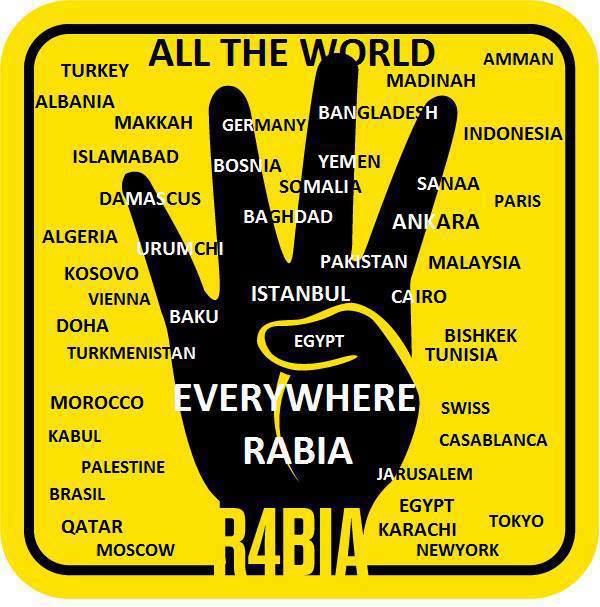
It is heartening to see the black-n-yellow image signifying solidarity with the victims of the Rabia massacre going viral on facebook profiles. It is in our capacity for empathy that our humanity lies. The symbolism of it is remarkably suggestive and layered, too: with the resistance bearing the name of a Muslim woman (Rabia Al Adawiyyah). It has in it the makings of a fresh and brand new Muslim feminism articulated as a response to the savage use of chauvinistic power: military and political.  The fact that Rabia Al Adawiyyah was an icon of Islamic spirituality- a tradition ignored and eclipsed as we embroiled ourselves in the battle for temporal power- is significant too. Salvation lies in rediscovering and reviving that spiritual tradition- not as a clever antidote to the socio-political struggle; not as a ploy to neutralize, but as a means to return the soul to that struggle; to inspire and revitalize and direct the course; and render that struggle meaningful.

Blood has been shed- but not in vain, inshaAllah. It must water the springtime- which may not reach its blossoming in our lifetimes, but we must sow the seeds and water it with sacred blood and tears. We must stand on the right side of history, realizing that we owe this to the future. Or we shall never be forgiven as History pens down its verdict in eternal stone.

“You may write me down in history

With your bitter, twisted lies,

You may trod me in the very dirt

But still, like dust, I’ll rise.

Just like moons and like suns,

With the certainty of tides,

Just like hopes springing high,

Still I’ll rise.

Out of the huts of history’s shame

I rise

Up from a past that’s rooted in pain

I rise

I’m a black ocean, leaping and wide,

Welling and swelling I bear in the tide.

Leaving behind nights of terror and fear

I rise

Into a daybreak that’s wondrously clear

I rise

Bringing the gifts that my ancestors gave,

I am the dream and the hope…

I rise

I rise

I rise.” (Maya Angelou: Still I Rise)
 

Humanity at Stake

1157633_289730281164755_734281549_n

A woman in many women- and children and men- was reported to be rushing back and forth in panic of the gunfire chasing her. A woman- another woman- was seen from her balcony with a portrait of General Al-Sisi; watching, observing, comprehending, and smiling. A grimly smile. This is not fantasy. This is not a scene from a horror movie. This is real life and real humans- or at least, real humanoids!

People are seen enjoying the beach in the scorching heat to get away perhaps from the tense city life. But behind the beach there is a road, and behind that road there are buildings, and behind that building we see smoke, a tense, scorching hot smoke. And we learn that that smoke is the product of chaos, of oppression, of resistance, of subjugation, of panic, of murder, of silence, and of noise. People lie dead on the streets and people lie flat on the beach. Two stories. One city.

Egypt is in crisis. This we are all told. But there is much more to the story. The crisis isn’t merely political. It isn’t merely about who you support. It isn’t about who you don’t support either. It’s not an Egyptian issue anymore. Boundaries don’t make sense now. It’s boiled down to the very essence of what it means to know and love freedom and democracy, to value dignity, to value humans as human subjects, to figure out what it means to be human.

But here is where narratives fail, and collide. The crisis in Egypt has consistently been portrayed as a clash between two parties- or to say, two narratives. This schema has been deliberately consolidated by both the coup-regime, which includes all its functionaries, and forces of the global hegemonic status quo. Locally there is this thing they call ‘the people’- a label created to function as a catchall term for supporters of the illegitimate regime- and then there are ‘terrorists’- a label used to discredit a demonstrably peaceful resistance movement against illegitimate regime change.  The mainstream global media on the other hand adopts a less obvious propaganda model. It divides people into ‘anti-morsy protestors’ and ‘pro-morsy protestors’- or sometimes calls them ‘Muslim Brothers’ straight out- and by doing so it very criminally distorts the picture. In doing so they’re undermining the fact that the ‘pro-Morsy protestors’ are in fact an ‘anti-coup’ and ‘pro-democracy’ movement. But of course, is it really a coup? And yet, it isn’t a matter of what definitions say when it is a matter of what global (western) interests say.

The most vulgar display of this politics of labels and binaries was when the world was watching military men, accompanied by tanks and cheering fascists, firing directly at the Al-Fattah Mosque in Cairo where a few hundred protestors were trapped. The domestic media portrayed it as an operation against anti-state elements and terrorists—one of the old classics- while the global mainstream media portrayed it as a clash between two rival parties- that very workable tactic. By calling it a ‘clash’ or ‘conflict’ of what is clearly obscene violence carried out by the establishment against individuals is the old method deployed in covering the ‘Israel-Palestine conflict’ or what is clearly Israeli repression of Palestinian individuals.

The Egyptian crisis has also become a crisis of confusion in Muslim majority societies. A victim narrative seems to emerge where the culprit is made to be democracy itself. The greatest beneficiary of this narrative is none other than Al-Qaeda itself; just as it was the greatest loser in the Arab Spring where it seemed as though change through peaceful and democratic means was a viable option. This optimism seems to fade away. This is the same optimism that makes sleeping difficult for oppressive regimes; for it’s easier to break bones than minds. The narrative serves both terrorist groups at the fringes of society and the establishment controlling society. But besides the damage that is carried out by this narrative, it is also flatly wrong. What happened in Egypt was not because of democracy but the lack thereof. There was nothing remotely democratic about it. Even the regime of Mubarak retained itself in all spheres of life. Not only was a democratically elected parliament disbanded immediately on a technicality, the democratically elected president was never given any true authority. He was overthrown by anti-democratic means and what is now present in Egypt is the suppression not only of people but of the very notion of democracy and freedom. It is here where the story needs to be squarely put as a matter of democracy, freedom and dignity. To place the problem elsewhere undermines and hurts the broader cause.

What else needs to be understood from the problem in Egypt is the consequences of polarization and uncompromising partisanship. To understand each other, to build on each other’s point of view, to discuss and debate critically are all essential to the health of a given society. A politics of empathy is the need of the hour. Unfortunately, Muslim majority societies are plagued by a clash of uncompromising narratives. The damages have played themselves out it Egypt. Pakistan is also deeply polarized and suffers from a politics of condemnation and ridicule of the other. In Tariq Ramadan’s words, Muslim majority societies need a ‘cultural revolution’ where we can think critically about our current state, be conversant with the challenges of modernity, offer creative solutions to contemporary challenges, as well as be consistent and employed with cultural, religious and civilizational references. This calls for moving beyond binaries and labels, and moving forward constructively and collectively.

When a Mob Sacked Democracy

Egypt-Morsi“Truth never damages a cause that is just” ~ Ghandhi

“Injustice anywhere is a threat to justice everywhere” ~ Martin Luthor King

Today is a throbbing day for democracy, rule of law, legitimacy, truth, factuality, principle and any other word that fits into the same category. An elected head of the state, with a victory margin of a million votes, was overthrown by an army chief who said blatantly and shamelessly ‘this is not a coup‘.  Shadi Hamid, a renowned analyst on Egypt and the director of research at the Brookings Institute, Doha, was almost spontaneous when he replied ‘If this is not a coup, the word “military coup” no longer have any meaning‘.

https://twitter.com/evanchill/status/352492220387041282

Robert Fisk writes:

For the first time in the history of the world, a coup is not a coup. The army take over, depose and imprison the democratically elected president, suspend the constitution, arrest the usual suspects, close down television stations and mass their armour in the streets of the capital.  But the word ‘coup’ does not – and cannot – cross the lips of the Blessed Barack Obama.

The inclinations and operations of Supreme Council of Armed Forces of Egypt better known as SCAF have been dubious at best from early on. Not that it is any excuse but this is a problem ingrained to all countries with powerful militaries and shallow and weak democractic institutions. The Egyptian military is no exception. In Post- Mubarak Egypt of early 2011, when SCAF was all in all of Egypt and protests broke out against it, the military police killed 14 unarmed protestors and attacked journalists in the famous Tehrir square. How can one forget the poor Egyptian woman in the clip who being seized by her hair was dragged unto the street with her abaya torn apart. Mona Eltawy, one of the secular voices, who was a strong part of protest movements in 2011 was attacked, sexually assaulted and recovered only with her arm broken by the same military police. These are a few examples of the legacy of policies kept for half a century of oppression directed towards political opponents. And trapped at the center of it was Muslim Brotherhood for last few decades.

One has to look back a few decades of the near past, if the real face of SCAF, the dictatorship, is to be unveiled. Concentration camps, extrajudicial killings, military trials, as well as some of the worst torture techniques known to man is the essence of the methods deployed on brotherhood workers and leaders. There is no reason to believe that the present day SCAF is any different. As a matter of fact, mumbling started on twitter the moment SCAF started movement last night regarding retribution and violence against Islamists. The ban on leaving the country put on twenty Muslim brotherhood leaders including Morsi is another indicator shedding some light on the gravity of the situation. [It should be remembered that the ban is applied despite there being no cases of fraud, attack or any such incidents from citizens of Egypt against those twenty leaders. Not once was the use of excessive force utilized by presidency against protests against him. Compare that with Mubarak times or Suleiman times in 2011 and the difference is un-concealable.]

There is no doubt in any serious analyst’s mind that the protests in Tehrir today are the direct result of prevailing dire economical scenario, petrol and electricity shortages in particular yet the anarchy is ironically preposterous. Tamarod (rebels) the group that coined the June 30th protest idea was formed just a few months ago. The one unequivocal demand they put forward unshakingly, was that the President of the majority of Egyptians, who they voted for themselves just an year ago, should resign. The reason: because he was unable to fulfill the promises of a prosperous economy, a reformed justice system and security of the country in 365 days, only 20% of the time he was given to serve.  Absurd, stupid, foolish and what not! Even for a newly democractic-leaning country like Pakistan once you think about. But this is how it works in an naïve and unmellowed system with volcanic political scenario and opportunistic opposition leaders who don’t even care about the precedence they are going to set, for not only the next government but the Egyptian generations to come. Tamarod leaders were as stupid as to say that army response actually crowns their movement

The crowd on Tehrir has been out of control. While there were few grave incidents of assaults on women when Religious and Secular Forces were protesting together against Mubarak, this time it was exceptionally high, alarming for the whole society . Guardian reported that over 90 women were raped  and sexually abused in Tehrir Square in a mere four day period. There are more than a few evidences suggesting anarchical mindsets and behaviors of protestors despite Tamarod’s repeated rejection of the presidency’s statements that put blames of such attacks on uncontrollable crowd. There were unconfirmed horrifying pictures and reports of MB youth being attacked and mauled by crowd. Another report described a brotherhood youth being burnt alive by protestors. The attacks on peaceful rallies of Muslim Brotherhood in Cairo University, the attacks and torching of the offices of brotherhood in Alexandria, Cairo, and a number of other cities summarizes the nature of the movement very clearly. The attack and shots fired on Cairo-University’s Pro-morsi protestors, who had the same right to protest as the Tehrir’s Anti-Morsi protestors,was an example of blatant savagery and ruthlessness of the crowd. 14 Morsi supporters died on spot, another 4 in hospital later while police watched. Putting aside the anarchy, the sheer use of violence, and the ridiculous demands, the hallmark of the Tamarod movement can be visually evident in the way they welcomed toppling of a legitimate democracy by an illegitimate force, the SCAF. Shadi Hamid put it forwards accurately:

Obviously, Morsi did make mistakes as was expected of him being the first democratically elected leader of the country. The presidential decree, the tax on IMF’s behest, the Attorney General  decision were the most highlighted of the bad decisions. The huge turnout against him would never have been possible, had the matters been smoothly run and the whole scenario would have been different. The most significant finding, however, that an analyst can easily draw from this crisis is the hypocrisy of the secularists. The same Egyptian secularists (to clarify: though these secularists like to consider themselves liberal we cannot fathom any reason to bestow them with this title. They are intolerant, prejudiced, closed-minded in practice, exactly what constitutes a non-liberal fascist) ran head over heels for protests against a presidential decree that gave Morsi almost absolute powers, which he needed to bypass a controversial court decision concerning political system. Similarly they condemned and were furious when the attorney general charged the famous satirist with contempt against president when he mocked the president during Morsi’s Pakistan visit and later when he mocked a salafist religious figure for his beard. The freedom of press can never be compromised, they said. Ironically, both of these two freedoms were snubbed last night with a lot more by SCAF. Aljazeera Mubashir crew was arrested for ‘undirected reporting’. Brotherhood’s Channel Misr 25 was forced shut with its crew arrested. Last nail in coffin: The interim president has decree powers. The protesting secularists cheerfully accepted both without a single word. Hypocrisy at its peak!


The role of United States was a replay of diplomacy it showed in 2011 as Mubarak was being ousted. While correctly showing concern for the assaults on women and the violence, President Obama correctly mentioned to his Egyptian counterpart that democracy is not only about voting. The 1.3 billion US aid for Egypt is based on a democracy based criteria. “We don’t make those decisions [on aid] just by counting the number of heads in a protest march, but we do make decisions based on whether or not a government is listening to the opposition, maintaining a free press, maintaining freedom of assembly, not using violence or intimidation, conducting fair and free elections,” Obama said on Tuesday amid SCAF’s ultimatum, subtly recognizing the fact that a free-press is still an entity in Egypt, and violence is still not used by state. It’ll be upto the US state officials and lawmakers how they interpret this recent turn of events which can be of huge consequence for Egypt. Labeling it a ‘coup’ would disqualify Egypt from this aid, an act that can be a huge blow to the paralyzed and sinking economy of the country. The political ambience of Washington DC put together with the history of US policies is however not suggestive of this. Ed Royce, a republican and the Chairman of the House Foreign Affairs Committee is all but concerned on military take over. The grin of islamophobes would not be easily disguisable over this epic fiasco of one of the largest experiment on the political system of Islam. The aid is the reason the Egyptian spokesperson and SCAF leader are going at great lengths not to get these events labeled as coup. It is also partinent to mention here that Obama’s support and gratitude to Morsi for the major part he played in terminating the war on Gaza by Israel, the IMF loan approval last year has fuelled enough conspiracy theorists among Egyptians linking the organization of brotherhood to US. Secularists put forward this propaganda and used it to their gain very successfully in recent protest campaign.

Finally, Let us present the most ironic, interesting yet disturbing comparison that is able to show the gist of all the hassle that is SCAF Vs Brotherhood Vs Secularists. 300 arrest warrants have been issued against MB leaders, 100 of MB leaders are put on Exit Control List in addition, Speaker of the parliament Al-Katatni alongwith another 300 was arrested. Supreme leader of brotherhood is arrested. Article 174 of Penal Code “Incitement to overthrow government” is punishable offense under Egypt’s law, and will probably be used to register cases against MB leaders and workers. There have been dozens of protest movements against Morsi in previous year. Not once was any illegitimate arrests made, or such articles of penal code  used by Morsi. Yet the standpoint of International media & secularists is: Morsi is is the axis of Evil, and SCAF is our heroes.

There are lessons to learn for all the Islamic movements in the world in this monstrous experiment of Egypt. The take away is of a serious moral nature for the so-portrayed ‘liberals’ of the Muslim world. They should decide what they want more, their cause or the truth, as well as honesty, justice, legitimacy, authenticity, principle, and so on. For Islamists, Abdul Kader Haqqani of Algerian Islamic Movement summed it up rather short.

“(For Islamic groups) Political victory is more dangerous than defeat” 


Reclaiming The Jihad: A Response to Tarek Fatah

Tarek-FatahTo condemn the Woolwich incident, spine-chilling and disgusting as it may be_ is pointless. Not because it may by any stretch of imagination be justified, but because the haste and anxiety with which this is so promptly done both by spokespeople of Western nations and by Muslim leaders denotes the uncritical acceptance of the predominant narrative on terrorism on the terms of the powerbrokers and the media that tell us who to condemn, how and how much. It is also inadequate to only condemn these instances when they occur while failing to understand and take on the deeper dynamics that set them off. For, terrorism and the usage of the term are far more nuanced than these facile proclamations make us believe.

While Tarek Fatah has rightly pointed out this inadequacy in his article ‘UK Beheading Shows It’s Time to Fight the Doctrine of Jihad’, and reminded Muslims of the need to take on such criminal elements within their ranks, the rest of the article teeters on presumptions that are ignorant at best and dangerous a worst: ignorant because of a complete inability to understand the ground realities of contemporary international politics and dangerous for the ideologization of terrorism that lends credence to the idea that Islam is inherently violent and Muslims inherently predisposed towards violence.

The writer makes the same error many neoconservatives calling for a ‘War on Terror’ made, with disastrous consequences: accepting the motives and objectives of terrorism as interpreted and explained by American rhetoric. He tells us that such elements wish to ‘sow fear into the soul of British people’ and are ideologically motivated ‘by one powerful belief of the doctrine of Jihad against the kuffar…’ Readers are asked to make some leaps of faith here as this denies any possibility that such dastardly acts may be a crazed protest out of desperation and frustration, driven by vengeance over what is seen to be unfair and brutal, such as unfair occupations, drone strikes and brutal torture in illegal detention camps. By ideologizing the motives, attention is deflected away from the policies that provoke extreme and desperate reaction. Moral culpability is ruled out and the inaccurate and dangerous idea that the problem is with the ideology believed in by these people is given credence. Hence an image is conjured up of a clash between Islam and the West: a false and pernicious idea that makes the world madly careen towards a clash of civilizations.

The fallacy of the premise of this ideologization of terrorism and whose interests it serves, need to be exposed. Terrorism, in fact, is a tactic used by disaffected individuals and communities, not an ideology. It is not inspired by a hatred of all that the West stands for, but is a reaction to policy and actions of Western nations.

Michael Scheuer states: “There is no record of a Muslim urging to wage jihad to destroy democracy or credit unions, or universities. What the US does in formulating and implementing policies affecting the Muslim world is infinitely more inflammatory.” The smokescreen of rhetoric, however, keeps a dispassionate analysis of the real grievances that fire such acts at bay.

Fatah goes on to state that Muslim terrorists have been ‘emboldened’ by the West’s ‘passivity’ towards terrorism, implying that Western nations are victims too infirm to take on the horrifying, audacious enemy consolidating its ranks in the wings. There clearly is in this a criminal oversight of the glaring and undeniable reality that wars, occupations, kidnappings, tortures, detentions have been carried out by Western nations on the pretext of pre-empting and countering terrorism; that Guantanamo still detains thousands without charge, that only 2% out of the many thousands killed in drone operations against terrorists have any suspicion against them.

While what happened at Woolwich was grotesquely inhuman, refusing to acknowledge similar grotesque wrongs at the hands of powerful occupying armies in other parts of the world is diabolical. While Woolwich is unjustifiable, one cannot lose sight of the connection between the actions of armies abroad and the psychology of vengeance. In all honesty, one may also be reminded of the fact that barely weeks ago an unarmed seventy-five year old was similarly hacked and butchered to death in Birmingham while on his way home. The reason no one heard of it was because the victim being a Muslim on his way back from the local mosque made the story not newsworthy enough. Islamist terror is the in-thing- other acts of violence and terrorism are relegated to individual criminality or insanity.

The writer reminds us that the tactics used by the Woolwich attackers were ‘straight from medieval times’, recklessly making a direct link with Islamic doctrine and tradition. Anyone with a basic understanding of terrorism would know that desperate tactics like this one are used when the might of perceived enemies is too great and invincible, defying conventional tactics. Reading more than that into it and connecting it to medieval Islamic doctrine is grossly irresponsible for the devastating social and inter-subjective consequences in an atmosphere of great prejudice and hostility against Muslims and Islam. The UK Muslim community is already targeted for hate-speech by white supremacist groups like the English Defence League, and Mr. Fatah’s proclamations serve to keep this atmosphere of hate and suspicion charged.

It is vital and urgent that Muslims take responsibility for such elements and tendencies within their community and the writer did well to highlight this, but to interject ‘Islam is the enemy!’ when the religion and its practitioners already stand much stereotyped and pigeonholed, misunderstood, mistrusted and maligned is highly irresponsible and reckless.

However, such reform has to come from within the Muslim community from authentic representatives and spokespeople of Islamic tradition. The gusto for ‘fixing Islam’ from the West is misplaced, insincere, uninsightful and comes loaded with malafide agendas and political interests.  Tarek Fatah’s exhortation to Western leaders to take on the Jihadic ideology and defeat it, is a fatal nonsense.

Having said that, Fatah’s disappointment with liberal Muslims rubbing in the fact that ‘Islam is Peace’ and keeping mum about the doctrine of physical Jihad as part of Islam, is valid- but for different reasons. Liberal Muslims desperately try to deny and eclipse this aspect of Islam and in so doing, implicitly accept the ignorant allegation that physical Jihad is a violent doctrine. Mr. Tarek Fatah too shares this inability to understand and appreciate the concept of Jihad with its contemporary ramifications in a holistic and insightful manner. This explains his enthusiastic call for rejecting Jihad altogether, and his great disappointment that Islamic scholars are not too excited about jettisoning the murderous idea once and for all.

Liberal Muslims often either deny or denigrate Jihad, as if it was an embarrassment. Jihad, standing for struggle spanning all means to resist injustice, evil and falsehood is to safeguard and protect the sanctity of human life, not to violate it. It aims at protecting the weak, the suffering and the sinned-against. Jihad purged the concept of war from excesses. The first Quranic exhortation to fight came with the emphasis to ‘be not aggressive.’

The Quran and the example of the Sunnah clearly and categorically lay down the conditions when Jihad should be resorted to. Simply, all is not fair in war, and rulings for protecting non combatants and those not directly engaged in confrontation are explicit. Besides, its objectives are clearly laid down: it is neither for territorial aggrandizement nor national power nor spreading the faith, but for resisting oppression and injustice and helping in the establishment of a just and peaceful social order. Fatah makes an ignorant and misleading connection between the senseless butchery at Woolwich and the concept of Jihad: the same criminal mistake that the perpetrators themselves made.

Mr. Fatah makes a pathetic attempt to validate his claim that Jihad is a savage expansionist ideology by quoting an inaccurate and false definition of Jihad from ‘A Shorter Encyclopedia of Islam’ which makes the unforgivable error or defining Jihad as ‘the spread of Islam by arms’, a claim unsubstantiated by any Islamic text or source of authority.

The need of the hour, contrary to Mr. Fatah’s prescription, is to rediscover and elucidate the concept of Jihad in contemporary context and expose its distortion, misperception and abuse by those hostile to Jihad as well as those claiming to wage it. The silence on this from Muslim scholars leaves the misconceptions and confusions to proliferate and hence provide justification to fringe extremist and criminal elements like those who carried out the brutal display at Woolwich in the name of Jihad.

This said, Mr. Fatah needs to be reminded that resistance to wrong and defence of the weak and marginalized against oppression and injustice is a basic virtue attested to by all spiritual and moral doctrines, hence the Jihadic philosophy is not an invention of Islam even though it may be a culmination of this universal idea. Stripping Islam off this beautiful crowning glory is a preposterous and revolting idea he can never find any support for. Both Mr Fatah and his ilk as well as sheepish Liberal Muslims need to be reminded of the fact that Islam extols and idealizes peace but also accepts the idea that when the rhetoric and pretense of peace hides the demons of injustice, it must be exposed and rejected and resisted.

Farid Esack writes, “When peace comes to mean the absence of conflict on the one hand and when conflict with an unjust political order is a moral imperative on the other, then it is not difficult to understand that the better class of human beings will be deeply committed to disturbing the peace and creating conflict.”

What is important to realize, however, is that in the absence of this understanding of Jihad and the spineless, fragmented state of the Muslim world, resistance to the great wrongs by Western nations at present is febrile, maniacal and as vicious as the actions of the powerful perpetrators. Yeats lamented, ‘The best lack all conviction, while the worst are filled with passionate intensity.’  Esack writes, ‘The problem with Muslim fundamentalism is that it is as totalitarian and exclusivist as the order that it seeks to displace. It seeks to create an order wherein they are the sole spokespersons for a rather vengeful, patriarchal and chauvinistic God.’ That is a judicious and vital understanding we as Muslims must acquire in order to reclaim the Jihad for our time.  

Incidents like Woolwich as well as the great wrongs that engender such sickness – stemming from both Western policy as well as Muslim degeneracy- are to be rejected and actively opposed. The underlying logic of wars of powerful Western nations against “terrorism” and terrorist attacks provoking or provoked by them is the same: both punish human beings for the actions of their governments or of individuals or groups sharing religious or ethnic identity. We are left with an important question: If terrorism is the direct and intentional killing of innocent people with the purpose for achieving a greater goal they are not directly linked with, are not both terrorism? While we correctly acknowledge Woolwich as savage terrorism, why are similar instances in Afghanistan or Pakistan or Yemen or Iraq also not recognized as equally unacceptable, intensely provocative and deeply damaging? As long as contemporary politics continue to operate on the premise of ‘some are more equal that others’, such ugly outrages will keep happening at the hands of the psychologically vulnerable. The need is an all-out struggle- a progressive ‘Jihad’ (struggle) if you will- against all wrongs that fuel the vicious cycle, regardless of who the perpetrators may be.

Woolwich and the Muslim Response

Woolwich murder suspectThe murder in Woolwich has shocked everyone, no one was prepared for such a killing on the streets of the UK.  The response has been of disgust and condemnation.  This incident has raised some questions that politicians and the mainstream media have conveniently dodged.   I am disgusted and appalled by what has taken place, but why should I have to apologise for such a crime, it had nothing to do with me.

Why is it that Muslims and Muslim organisations are expected to apologise for actions of two individuals?  Why is it that Muslim organisations do not even need to be prompted to condemn; they are readily condemning actions that have nothing to do with them.  There has been no attempt by Muslim organisations to discuss the causes of the attack, no attempt to question the mainstream media narrative that imposes labels on Muslims.

 I was born and brought up in a majority Muslim area of Birmingham.  I have travelled the country and the world.  I have come across thousands of Muslims, spoken, debated and challenged opinions.  Radicalisation is not a religious problem, it is a problem of society, and specifically, in this case, British society.

Muslim leaders have been scared into silence.  Prevent officers visiting mosques and community leaders frighten them.  They are told that if Muslims display any political opinions outside the mainstream then they are extremists, that if they do not inform on them, that their bank accounts can be frozen, mosques closed and they could face prison.   Muslims are afraid.  Muslim organisations and leaders are subservient to the state, scared to mention foreign policy as a radicalising factor just in case they are harangued for justifying the murder.  It has got to such a state that we do not even realise that our minds have been conditioned through years of media misrepresentation and widespread Islamophobia.  Questioning the reason for a murder does not mean condoning or justifying it.  Condemning something that has nothing to do with you feeds into the narrative that this is a Muslim problem, that this is something that the Muslim community are responsible for, at least in part.

In turn so-called Muslim leaders stifled debate and discussion in mosques, too afraid to discuss anything political.  For too long they have played a subservient role to the state, asking for a seat at the table and hoping for crumbs to be passed to them.  I have not met a Muslim that has condoned the actions in Woolwich, but let’s not ignore what radicalises.  British foreign policy radicalises, double standards radicalise, making Muslim youngsters feel like their opinions are not legitimate radicalises, stifling debate and discussion radicalises, not giving people a conduit to vent their opinions and frustrations radicalises, a lack of identity in Britain radicalises, we are either extremists or moderates.

We are told that Muslims are equal citizens in this country but the reality is something very different.  If we say we don’t drink, we are labelled anti-social or not willing to integrate, if we drink we are labelled moderate, if a Muslim wears a hijab, she is oppressed, if she doesn’t she is liberated, if we express an opinion outside of the mainstream narrative, we are angry, if we join a mainstream political party we are passionate, if we sing the praises of the British establishment we are liberals, if we object to foreign policy we are extremists or Islamists.  I for one am fed up of this apologetic and subservient tone.  I have nothing to apologise for, I should not be asked to condemn the actions of two men that had nothing to do with me just as a white man should not be asked to condemn the murders committed by Anders Brevik or for the violent actions of the English Defence League.

Have Muslims not proved their worth to this country?  Muslims have bled for this country during WWI and WWII, they have fought for Empire, they have served as colonial subjects, they have waved the flags, sang the anthems and anglicised their names –Mo and Ed.  But still we are not accepted; we still hear ‘Muslim appearance’ in the mainstream media, which basically means non-white, not one of us.

I am privileged, I went to university, I had an abundance of left-wing white friends that never questioned my opinions because of my religion or ethnicity, that accepted me as an equal, and made me feel that I had a place in society, we shared our politics as well as our battles.

My parents still fear that I will be arrested for writing and expressing an opinion as a journalist.  I have been inundated with calls since the attack from Muslims that are afraid of a backlash, one even asked me if there would be ethnic cleansing.  I told them not to be afraid because I had faith in the British people to see through the fog that politicians and mainstream media perpetuate.

Why is it that Joe Glenton can say that foreign policy is a radicalising factor but our so-called Muslim leaders tiptoe around the issue?  Why is it that George Eaton can say that Muslims should not have to distance themselves from the attacks, but our so-called leaders are falling over themselves to do it?  Why is it that Glenn Greenwald can question whether the attack is terrorism, but my fellow brothers and sisters are afraid to do the same?

I was born here, I am British, I am standing in the tradition that says that my opinion is just as valid as anyone else’s, that I have a right to object to the hypocritical treatment vented out to Muslims without being accused of condoning or justifying such attacks.   There are Muslims that will disagree with me, that is fine, we must understand that we are not a homogenous group, Anjum Choudry and his motley crew do not represent me, neither do the Muslim Council of Britain with their 400 affiliated mosques run by old men in committees.   Unfortunately non-Muslims in the public sphere represent my views more than our so-called Muslim leaders.

To be ‘leaders’, senior Muslim figures must lead.  Whilst politicians and the media carry on scapegoating Muslims, a true community leadership must face up to the reality of foreign policy and suppression of Muslim communities over the last decade, and call it out for what it is.

Courtesy:  AssedBaig.com

My Response to Inaccuracies About Islam in ‘The Hindu’ Article

laurenbooth_profileThis is my response to an article on The Hindu which has several inaccuracies about Islam.”Dear Editor of The Hindu,
In the Name of Allah the Most Beneficient the Most Merciful,As a Muslim convert featured in your article, I would like to request an explanation for several statements which appeared alongside my photo;In your editorial, on UK converts to Islam, you claimed that ; ‘Most converts were particularly critical of the concept of Sharia Council or courts operating in Britain, seeing them as a threat to women’s rights.’

In response, I refer you to the following substantive report issued in 2011 by Faith Matters. The first section of the Faith Matters report clearly states; ‘The majority of converts feel that there is no natural conflict between being a devour Muslim and living in the UK’. Also, ‘The vast majority of women changed their appearance after conversion with a significant majority adopting the hijab (either straight away or after some time)’. These findings are at odds with your spurious claim that ‘we’, as converts to Islam, fear our new faith and reject Sharia-based concepts. I have never met a convert to Islam to state such a thing and would request the basis on which you make such a statement.

At the start of your article you also make this claim ;..‘the fact is that Muslim women are more vulnerable to misogyny and cultural prejudices of their menfolk than women of any other faith. The more “Islamic” a society, the fewer individual freedoms its women enjoy’.The Quran remains the only scripture to categorically and comprehensively assert a wide ranging and comprehensive series of protections for women in relation to property, inheritance, marriage and divorce.In the area of economic rights, we have to remember that in Europe until the 19th century, women did not have the right to own their own property. When they were married, either it would transfer to the husband or she would not be able to dispense of it without permission of her husband. More than 1300 years earlier, that right was clearly established in Islamic law.

“Whatever men earn, they have a share of that and whatever women earn, they have a share in that.” [Noble Quran 4:32]Please note the word ‘earn’ here clearly denoting a woman’s right to employment.
By definition, in a truly Islamic society, there must be women physicians, women nurses, women teachers, because it’s preferable also to separate teenagers in the volatile years in high school education. And if she chooses to work, or if she’s married with the consent of her husband, she’s entitled to equal pay, not for equal work, but for work of equal worth.At the time of marriage, it is the duty of the husband, not the bride’s family, to pay for a marital gift. The Quran called it a gift, and it is exclusively the right of the woman. If the woman happened to own any property prior to marriage, she retains that property after marriage. It remains under her control.As far as treatment of daughters is concerned, Prophet Muhammad (peace and blessings be upon him) said, “Anyone who has two daughters, and did not bury them, did not insult them and brought them up properly, he and I will be like this,” holding his two fingers close together. Another version adds, “And also did not favor his sons over daughters.”

For many more Quranic examples of women’s rights please follow the relevant link below from Islamswomen.com.

It is necessary, as you have chosen to falsely assert that Muslim women suffer more misogyny ‘than women of any other faith’ to point out a series of online reports into Hinduism.

Lipika Sharma states in her academic piece; ‘Since time immemorial the framing of all laws (Hinduism) have been exclusively for the benefit of man, and woman has been treated as subservient. the Hindo Succession Act of 1956 is one of the living examples of the fact that laws are Patriarchal in nature.’

Whilst, the following research article of 2012 which appeared in the New England Journal of International and Comparative Law found;

‘The status of women in India is both poignant and paradoxical. There exists a wide chasm between the de facto and de jure position of women. From cradle to grave, the violence, abuse, and exploitation that girls and women encounter, both in the private and public realms, remain unparalleled and largely unaddressed. The reasons are multifaceted. The age old feudalistic and patriarchal underpinnings of the Indian societal, communal, and familial life have been the primordial causes for this subordinate and secondary status, as women within this framework are viewed as property of men’. 

In an especially disturbing article a young, female, Indian writer goes into detail about traditional Brahmic and Hindu teachings about such horrors as ‘wife burning’ ‘bride burning’ and the slaughter of baby girls.

‘BRIDE-BURNING 
…The extent of bride-burning is astonishing. ” Government figures show that at least 7300 women were killed by their in-laws in the first nine months of 1995 for bringing inadequate dowries.” [ 2 Men ] This custom of dowry has divine sanction, since the Ramayana explicitly mentions that Sita brought a huge dowry for Rama. Worse still is the custom of consuming the flesh of the burnt brides according to the Vedic `purushamedha’. After the helpless brides are burnt alive, their bodies are cooked as if they were some animal and their flesh consumed by the pious Hindu family of the bridegroom. In addition to destroying evidence of any crime, the pious Hindus also `gain merit’ by performing the `holy’ Vedic purushamedha (human sacrifice). This custom, more than any other, reveals the beastly nature of the Hindu male’.

Now I wish to state very clearly that the articles I relate to here are merely part of a 20 minute online search. They should therefore in no way clearly be seen as a comprehensive summary of the role – or status- enjoined by Hindu teachings relating to women. I put them here merely to show how simple it is provide unknowing readers a limited – or even misleading – view of a faith.

Thus, Hasan Suroor’s assertion that Islam does not provide women with either protection or rights when compared with other faiths, can only be viewed two ways; either as poor research or as a deliberate attempt to present a false and negative image of Islam to your readers. I would like my photo removed from the said article. In the interests of good journalism I suggest you either remove or rewrite the incorrect sections.

If you need help in your research into Islam, I will be happy to put you in touch with several renowned scholars to assist in this matter.

I ask Allah to forgive any errors I have made in this and all matters and All Praise is for Him alone.

Yours Sincerely,

Lauren Booth
Journalist and Broadcaster

Agenda for the Nation 2013 and Beyond-3

67896_402043779883085_1015773544_nOver the past five years, extremely bad governance wrought with corruption and compromise in the name of continuity of democracy has brought the country to a disastrous point. This has given rise to several crises having long-term repercussions, eroding our sovereignty, economy and even our identity as a nation. An incisive view of such issues and concerns follows.

Erosion of Independence and Sovereignty: First, as a result of all the above mentioned predicaments, the country is confronted with aspects of an existential crisis: erosion of independence and sovereignty, loss of national honor and neglect of vital national interests. Our independence, our autonomy and our identity as a nation are at risk. In view of this we have to search for a new security paradigm in the proposed ‘Agenda for 2013 and Beyond’. That security paradigm must have independence, sovereignty of the country, national interest and national honor, as our key concerns, to be protected and promoted within the context of availability of resources. We must realize that whether we are strong or weak, whether we are small or large, there is a core set of national interests that has to be protected at all cost.  Security is not merely a military phenomenon. It is multidimensional: having human, military, political, cultural and economic dimensions. As such protection of independence, sovereignty and national interest is an overriding concern and must be integral to our Security Paradigm.

Ideological, Moral and Cultural Identity: The second key issue relates to our country’s ideological, moral and cultural identity. That too has been compromised, tarnished and marginalized. A people cannot be inspired and motivated to rise up and sacrifice everything only for petty political and economic concerns. They live and die only for higher ideals. So along with security and independence, the ideological, moral and national identity of the nation is a matter of vital concern. Hence the cardinal importance of Islam as a source of our national identity.

Even a number of Western strategists are now recognizing that Islam is integral to a Muslim society. And if this aspect is ignored or allowed to be disfigured, peace within and peace with the rest of the world would remain elusive. This fact must be recognized that Islam is the basis of our identity, notwithstanding the narrative of the secular lobbies or vested interests. If this identity is ignored, camouflaged or compromised, the people and the rulers would never be on the same page. Consequently a country torn from within as a result of such a conflict would never achieve good governance.

Economic Dimension: The third one is the economic dimension. Power of a nation, political as well military, depends very much on its economic strength. It is of critical importance in respect of protection of independence and honour and promotion of national identity and well being. Security and economy go hand in hand. People’s welfare is the source of a nation’s real strength. During the last few years our economy has unfortunately gone down the drain. All major economic indicators are in the negative. Yet, if we have survived it is because of inherent resilience of the people. People’s will and presence of a large informal sector have come out as the hidden source of strength of our economy. That is how we have survived despite grossly flawed government policies, acute energy shortages, and rampant corruption.

The way economy has been handled since 2008 smacks of extreme incompetence and mismanagement. High rates of inflation, unemployment, and poverty; erosion in the value of money, both domestically and in world markets; low levels of production; flight of capital; mounting debts; escalating levels of debt servicing; precarious state of reserves — all have driven the economy towards brink of disaster.

It is the inherent resilience of the non-public sector that has enabled the country to survive. There is no doubt that people have suffered and every sector of economy has been affected. Only a certain elite wallows in prosperity and affluence. Common people suffered most. It is a sad commentary on the performance of the Government that public sector enterprises (PSE) have been a constant drain on the economy. Some energy shortages were there before 2008 but during the last five years shortages have snowballed, disrupting the economy and worsening the living conditions. The volume of domestic and international debt has increased from Rs6 trillion in 2008 to over Rs15 trillion in 2012. Capacity to repay debt has not been created. Debt servicing has become item number one in public expenditure. In 1970s and 1980s, defence expenditure was used to be the largest component of government spending. Now debt servicing is almost double the defense expenditure. It is eating away more than three times what is spent on development. This is a grave situation and a huge challenge which can be met only if the country gets a capable leadership. What is the economy needs is a paradigm shift: an economic path focusing on growth, human resource development, elimination of corruption, along with effective mobilization of domestic resources and also those of the expatriates—this coupled with good governance and shift of focus towards self-reliance and people’s welfare as centre-piece of all policies and programs.

‘War on Terror’: The ‘War on Terror’ is not merely a question of security and foreign policy. It is also a question of economy, as also of trust between the people and the rulers. Protection of life, honor and property are sine qua non of civilized existence. If security is to be privatized, it is a vote of no confidence in the Government and the institutions responsible for law and order in the country. The economic cost of the war on terror is horrendous. Poor people of Pakistan have financed this American war to the extent of over $100 billion which is the direct economic cost. Indirect costs are much higher. Deterioration of law and order is directly related to our involvement in the ongoing war. Our country is also suffering at the hands of terror mafias, criminal groups, sectarian outfits and secessionist forces. Foreign agencies too are engaged in overt and covert operations. This is over and above another direct cost in the form of loss of life of over six thousand armed and security forces personnel, over  forty thousand civilians, injuries to more than double those numbers, and displacement of over three million Pakistanis.

How to bring this war to an end is the most urgent issue. There cannot be only one way of dealing with all of the multifarious aspects of this challenge. There has to be a multidimensional strategy. War on Terror has to be brought to an end in a manner that does not aggravate terrorism. It is also important to ensure that the current war on terror is not replaced by another era of civil war in Afghanistan. If there is no real peace in Afghanistan we in Pakistan cannot live in peace.

Relationship between Federation and Provinces: Relationship between the federation and the provinces, and between the provinces and the local governments is also an extremely important issue. Genuine decentralization without compromising the foundations of federation is one of our existential needs. Serious work has to be done in this respect by developing a clear roadmap taking care of the genuine concerns of the federation as well as the provinces, particularly in Balochistan, in a manner that all stakeholders participate in this effort and ultimately arrive at consensus. Structural changes in the monetary and fiscal system are also required. We have a fiscal system which does not conform to principles of federalism. What we have is a kind of pseudo federalism.


There is a structural problem as almost all revenue collection is done by the Federal Government as is the case in a unitary state. But expenditure processes are in a different mould. Those who manage expenditure are not responsible for taxation. This lies at the roots of a lot of fiscal irresponsibility. Unless taxes are also decentralized, principles of fiscal responsibility cannot be promoted at all levels. The financial structure has to be redesigned and restructured. The fact that federation collects and provinces spend is recipe for indiscipline. That is why the task of development of a proper and responsible federal system demands major changes in structures, policies and processes of governance, political and financial. The 18th Constitutional Amendment was a step in the right direction, but only a first step. Successive steps required have not been taken yet. That is why we are faced with structural as well as political issues in this respect.

Role of Private Sector: Despite all economic constraints, if we can set our priorities right and mobilize our resource potential, particularly in the social sector and public sector development, we can inaugurate a new era of economic development and social welfare. Private enterprise should play a key role. It is borne out by history that whenever private sector was given proper opportunity it has played its role positively and constructively. But because of corruption, lack of good governance, real and contrived clash of interests, absence of clarity of vision, neglect of accountability, and failure of regulatory mechanisms, private sector has not been able to make its full contribution. A balanced approach is needed with a vibrant private sector, and responsible and supportive public sector. The role of the state particularly in the realm of infrastructure development, provision of social services, and bringing the lower strata’s of society into the mainstream of economy is of critical importance.

State’s responsibility to ensure education and health for all and adequate infrastructure development at the grassroots levels and financial structures that can provide lifeblood for all the layers of economic activity such as agriculture, small and cottage industry, small and medium enterprises (SMEs) are very important. Key targets must be set for macro-economic stabilization, as well as economic development ensuring social well-being for all members of the society and their active participation in economic processes. This calls for a different economic model. Development of such a model should be our immediate objective. If we are able to identify our real national objective, expound that vision with clarity and spell out a roadmap to move in that direction, we can help our future political leadership to lead the country out of this difficult situation.

Click here for Part I and Part II

Agenda for the nation 2013 and beyond-2

67896_402043779883085_1015773544_n

What is the real nature and extent of the domestic crisis? Let me try to highlight some of its major dimensions. First and foremost, it is a ‘crisis of legitimacy’. For any country’s good governance, legitimacy is essential. Military general turned president Pervez Musharraf lacked legitimacy, and the outgoing government, despite having the semblance of democracy, also lacked moral and political legitimacy.

There is a. lack of trust between the people and the leadership, as also between state institutions and the stake-holders. The government was an arrangement of convenience, lacking unity of thought, commonality of vision and concerns. The spirit and substance of co-participation, co-operation and co-sharing did not exist. Key institutions were either at loggerheads or in a state of uneasy coexistence.

Higher judiciary is perhaps the only exception. Media has generally played a positive role. Army, which has always enjoyed the trust of the people as defenders of our borders, has become disputed because of its involvement in the ‘War on Terror’, and also because of people’s apprehensions about the role of intelligence agencies in civil, political and regional affairs.

This crisis of legitimacy is a matter of deep concern. This situation calls for fresh elections, fair and with utmost transparency. It is only with the emergence of a new political leadership, that enjoys people’s trust, that a new beginning can be made.

CRISIS OF INTEGRITY: The second dimension of the crisis can be described as a crisis of integrity. It is more than a natural corollary of the crisis of legitimacy. While integrity includes legitimacy it is more than that. Integrity is achieved on the basis of vision, character, trust and incorruptibility. The incumbent political regime has failed to demonstrate any of these. The ongoing ‘War on Terror’ has seriously dented the integrity of the ruling classes. A large number of people think that their leadership is not making decisions on the basis of what constitutes Pakistan’s national interest.

There is a trust deficit between the army and the people. An alarming symptom of this was the official instruction issued to military personnel during the Musharraf regime not to travel in public transport in uniform. This was the lowest watermark. The role assigned to army viz-a-viz internal counter-terrorism is unavoidable. The essential part of a strategy of deterrence has its darker side. Undoubtedly, terrorism is a threat yet it has to be tackled in an effective manner, focusing upon the causes of the malaise and its origin and not merely its symptoms and expressions. There can be no military solution to an essentially political problem as the Parliament had recommended in its three resolutions. It had suggested having an independent foreign policy and a political solution of the problem based on dialogue, development and deterrence. The government painfully failed to follow that path. The imposed strategy it followed has failed even to contain terrorism, what to say of its elimination. Unfortunately, this strategy has dented army’s integrity viz-a-viz the people.

Unfortunately, the US has played a role in it by making the people feel that army and the political leadership are following American roadmap, not a truly Pakistani policy. This has a direct role in aggravating the crisis of integrity. It would be appropriate to suggest that a way out cannot be found without a well thought out political decision which is possible only if there is change in political leadership. Unless a new leadership comes up with a new vision and a fresh strategy to serve Pakistan’s interests we may not be able to come out of this crisis. This new strategy must take on board all the stakeholders as partners.

The political scene is clouded but there certainly are some positive developments. The government, despite all its failures and compromises, had not resorted to naked political vendetta and victimisation, as had been the case during military rules. However poor their performance was, major constitutional institutions, even though they had failed to fulfil the people’s expectations, were operational.

In this regard, at least three positive aspects can be noted: One, at the constitutional and legal level, major constitutional distortions which had destroyed the balance of power as envisioned in the original Constitution have been removed and a new balance achieved through a national consensus. All the problems have not been resolved yet, but a framework has certainly been agreed upon, which can take care of issues at the federal level and can lead to improvement in relations between the federation and provinces. It is a big failure that the provincial-local relationship could not be addressed so far although at federal and provincial levels, some developments are positive as far as the constitutional framework is concerned. Similarly, there is some improvement in the area of legislation through proper parliamentary process. Legislation by ordinances, although present, has decreased.

Secondly, there have been some positive developments as far as the higher judiciary is concerned. Independence of the Judiciary was achieved through a heroic struggle of the people and the legal community. The post-2008 government showed great reluctance, even resistance, to restore independent judiciary, but the will of the people prevailed and, while the independence of Judiciary had been achieved, tensions between the Executive and the Judiciary escalated.

Many of Judiciary’s decisions remain unimplemented. At times it seemed that there was a tug of war between the Executive and the Judiciary. Judicial activism becomes necessary because of the failure of the Executive to deliver and operate within the framework of the Constitution and Law. The Judiciary had to fulfil its normal responsibilities as also respond to people’s grievances caused by Government’s failure to do its duty fairly and honestly. In such cases it had to resort to its constitutional role as the defender of human rights. This has been due to an abnormal situation.

Judicial restraint must remain as important as judicial activism. A balance between the two is necessary. The whole idea of fundamental rights and the Supreme Court to be the guardian of fundamental rights was a very important contribution of the original 1973 Constitution. Embedded in this constitutional provision is the view that if fundamental rights are violated as a result of a faulty executive action, it becomes the duty of the Supreme Court (not any other court) to intervene. That is how a political issue becomes an issue of fundamental rights. And as such it comes under the original jurisdiction of the Supreme Court. Frequent use of this right is taking place because the executive had failed to deliver. But still, while we recognise the positive contribution of judicial activism, the danger is that if it becomes a norm that would not be helpful to promoting institutional balance and safeguarding structural equation as established in the Constitution. That leads us back to the core issue of good governance. Courts cannot play the role of the Executive and its different organs. It can only act as a source of restraint and guide, not as a substitute.

The third positive development relates to the freedom of media and its enhanced role both as a source of information and as a forum promoting debate that could influence policy-making. It has also a role to play to promote greater accountability in the society and polity. Unfortunately, there have been a number of excesses in this area as well, particularly because of the role of certain lobbies, both domestic and international; and also because of covert influence of certain cultural groups, political mafias and power elites who have also used advertisements to achieve their vested interests. Despite these failures and weaknesses, free media is a source of strength and whatever has been achieved has been a positive development.

CRISIS OF GOVERNANCE: The third challenge that we face relates to a serious, all-pervading crisis of governance. It is a central issue. Along with the crisis of legitimacy and integrity, it is the crisis of governance that has to be the centerpiece for an ‘Agenda for the Nation 2013 and Beyond’. Legitimacy and integrity are essential but not enough. Without good governance a country cannot make real progress. If the leadership and institutions lack the capacity to deliver, the governance would be at low ebb. And when a lack of capacity is coupled with corruption, all is lost.

Our failure of governance can be traced to many factors: lack of legitimacy and credibility, failure on the count of rule of law, disregard of the principle of merit, absence of transparency, and wanton violation of standing operational procedures, abuse of power and wealth-aggrandisement for personal ends. Some SoPs may also be flawed but whatever is there has to be respected. And if rules are openly and persistently violated good governance can never follow. It is because of this rampant culture of incompetence and corruption that has driven governance to near collapse. This is so throughout the length and breadth of the country. If a change for the better has to take place, both incompetence and corruption, would have to be addressed firmly.

I put incompetence and corruption as twin disasters because in my view corruption is antithetical to capacity. It is also a gateway to the destruction of capacity and credibility. Corruption is not merely monetary embezzlement, which is only one gruesome form of it. Each and every form of misuse of power is corruption. That destroys every fabric of the state and pollutes all those processes that produce capable leadership in a country. So the menace of corruption has to be fought at the foundational levels (legitimacy and integrity) and also at the operational levels (competence, capability, rule of law and respect for merit). An aggressive anti-corruption crusade can result in substantial reduction in corruption in the first phase and its ultimate eradication in due course of time. This should be one of the primary objectives in this National Agenda.

CRISIS OF CREDIBILITY: Primarily a moral phenomenon based on conformity between word and deed, policy and action, law and respect of law, the crisis of credibility is another aspect that needs to be urgently addressed as it affects every activity in every sphere of governance.

It is a pity that no serious steps have been taken to set things right, and the conditions allowed to go to such abysmal depths that all these crises are now considered the hallmarks of this government. All the forces, local and global, responsible for bringing about such a pass stand in the dock of history, charged with bringing about the worst form of governance in our history.

(To be continued)

Click here for Part I

Agenda for the Nation: 2013 and Beyond-1

67896_402043779883085_1015773544_n

The next government, which is expected to be in power sometime this year, shall have to formulate a national agenda for the next five years in the context of global, regional and domestic scenarios.

On the global scene, with haunting shadows of 9/11 still lingering, the real issue remains the need for an effective exit strategy. The way out is not yet clear and the costs of confusion and inaction are increasing, even multiplying. Despite some serious efforts, exit strategies are still in limbo. While this process has been unfolding, a new catastrophe in the form of a global financial crisis has cast its gloomy spell over the whole world.

The financial crisis began in September 2007 but the year 2008 was the worst hit. It was hoped that 2009 would be a year of recovery but even in the beginning of 2013, recovery remains a distant hope. During these five years, the financial predicament has impacted all the sectors of economy, attaining the proportions of an economic catastrophe.

Another important aspect is that a crisis emanating primarily in the private sector (banking, property and real estate), gradually affected other sectors having devastating consequences for production, trade, public debt, employment and budgetary deficits. State bailouts to save the system are beginning to change the role of government within the current capitalistic economic system. This has snowballed into an all-engulfing crisis. Greece, Spain and Italy are faced with crisis at the national levels. Other Western countries too have not been totally immune. Germany has so far been able not only to safeguard itself but also helped others, yet there is an increasing unease. France is in a difficult position.

In the US, national debt has crossed the 16-trillion-dollar limit and now they are trying to seek a new ceiling. The two-pronged strategy of tax cuts and state intervention to promote economic recovery has not been successful so far. It is now being realized that the economic crisis has the capacity to turn into a civilizational crisis exposing the weakness relating to the moral, political, structural and institutional dimensions.

In this context, the symptoms of a shift of global economic balance of power are also becoming visible. The role of Asia and Latin America is increasing. Even the developing countries, despite their problems, are searching for new roles. They are beginning to be looked upon as a source of strength in the future instead of a burden. China, Japan, Brazil, India and Turkey are being looked at as relatively more important players in the future. That is one scenario.

The second scenario relates to Arab Spring. From Pakistani point of view, two aspects are very important. One is that hegemonistic neo-colonial post-WWII arrangements that have so far been calling the shots in the region are crumbling. There is a universal urge for change. Secondly, this urge for change also reflects a new, assertive mood of the people, the real stakeholders, who were marginalized in the past. They are reasserting themselves to play a more decisive role. An unintended byproduct of these developments has a significant ideological dimension.

Whenever any genuine democratic process has unfolded in the Muslim World, it has also meant greater role of religion in general and Islam in particular. I recollect a very succinct observation by two Western scholars, of course in different contexts and with different objectives.

Wilfred Cantwell Smith mentions in his books, Islam in Modern History and Pakistan as an Islamic State, that whenever there would be democratization in Pakistan and other Muslim countries, Islamization would emerge as a corollary. Kissinger, also, in one of his speeches in the sixties, expressed this idea in with a deep concern. He was concerned that democratization in the Arab World may lead to a new role of Islam in politics that could be a challenge to the West and its interests. With this worry in his mind, Kissinger suggested stressed the need for balkanization of the Arab World, suggesting strategies for support of ethnic and sectarian movements. In his view, following a policy based on this strategy could also act as insurance to protect Israel. Promotion of ethnic and sectarian movements amongst the Kurds, Arabs, Iranians and Turks was part of this strategy. A similar game is being fostered in Iraq, Afghanistan, Pakistan and Arab World today. This scenario must be kept in view when planning a future agenda for our country.

Regional Scenario

The third one is the regional scenario. Pakistan is at the receiving end of what is happening in Afghanistan. It is also being directly affected by America’s role in Iraq and US alignment with India. China’s current efforts to evolve a more assertive and multidimensional strategy has also its implications for Pakistan-China relations. While continuing its earlier development-specific efforts towards self-reliance, it is now making serious efforts to play a more active role in Asia and Africa, on its way to an emerging global power. The most immediate challenge that we face comes from the expected exit of the US and NATO forces from Afghanistan. This is unavoidable. Yet the way this is coming about is very lopsided. France has withdrawn abruptly. So did Italy. Spain had done that earlier. The UK is on the verge of withdrawal. And the US, too, has no other option. The post American scenario in Afghanistan is going to have crucial consequences for Pakistan. As also the Iran-Israel-America tension whose escalation would have very serious consequences for Pakistan and the Middle East. We cannot afford to ignore all these challenges.

Domestic Situation

The fourth scenario relates to the domestic situation. Even if we do not go very far back, the last fourteen years are very important. These years can be grouped into two periods: (a) the Musharraf period (1999-2008) and (b) the Zardari-PPP period (2008-2013). The former period witnessed reversal of the democratic process, re-establishment of military rule, subordination of all constitutional organs to the will of the military ruler, promotion of an elitist capitalistic economy, weakening of the country’s ideological identity and serious compromises on issues of independence and sovereignty of the state.

The tragic events of 9/11 and abject surrender of Pakistani leadership to the US pressure changed the whole equation of Pak-US relationship and resulted not only in seriously denting our national sovereignty and independence but also caused huge losses in life, property and economy. India-Pakistan relationships also took a new turn to the disadvantage of Pakistan with the core issues of Kashmir and water dispute sidelined. Out-of-the-box solutions became favorites; yet they ended up in fiascos. In short, Pakistan suffered in all respects: politics, economy, law and order, national cohesion, culture and ideology.

(To be continued)

Click here for Part II and Part III

A Message From An American to Pakistanis

MicahMicah Daigle, an American citizen from San Francisco, posted on Facebook after Boston Bombings.
“On Friday at 7:05pm Eastern Time, Boston Police received a report that suspected terrorist Dzhokhar Tsarnaev was hiding in a boat in Watertown.At 7:15pm, the low buzz of a drone was heard overheard. Seconds later, an enormous explosion engulfed the area, destroying the boat and several nearby homes. Sources say 46 Watertown residents were killed in the missile strike, including 12 children….Of course, that’s not what happened. But if it did, wouldn’t we find it unconscionable?

If so, then why are Americans okay with our government doing this to people in other countries?

In Pakistan alone, the U.S. government has killed more than 3,000 people with drone strikes… and only 1 out of 50 were suspected terrorists. The rest were bystanders, rescue workers, and children.

Let’s stop this madness now.

One people. One planet. ♥”

The love and empathy that came with this powerful post flooded Micah’s facebook account with thousands of messages, followers and friend request as it went viral in Pakistan. Gratitude, love and respect for Micah from Pakistanis was all over his wall. Today his facebook wall says something that builds bridges across two nations. I couldn’t help sharing it.
“It’s been an amazing 24 hours. To my new Pakistani friends:
For years, I’ve only been able to imagine how it must feel to live under skies pregnant with hellfire missiles. But in the last day, I’ve had the honor of talking with hundreds of you and hearing your stories. Though I feel a bit undeserving of all the attention and praise, that hasn’t stopped me from scooping up as much knowledge as I can before this little bubble of Internet magic pops.Though the results aren’t surprising, this is what I’ve learned.
1. The vast majority of you are decent, reasonable, good-hearted human beings. There are certainly people who are violent and power-hungry in your country, but most of you just want to lead fulfilling, loved-filled lives. Just like many of us.
2. You are tired of living under the constant threat of violence. You’ve grown a resilience that comes from living in such a place, but there’s also a deep weariness. You just want it to stop. You don’t want to have to worry about being bombed at any moment. Just like many of us.3. You don’t support terrorists, but you can understand why some people become terrorists. You see that our bombings only fan the flames of hatred, by taking the lives of innocents, and creating a desire for revenge within their loved ones. You know that for every terrorist we kill, we create several more ready to take their place. And you are able to understand this terrible cycle without defending or excusing those who commit acts of terror. Just like many of us.

4. You are forgiving and understanding of Americans even though our government bombs you. You have your own corrupt government that doesn’t represent your interests, which allows you to see why a nation of good people can do horrible things. You can separate people from the system they are embedded in. Just like many of us.

5. Many of you think of yourselves as Global Citizens first and Pakistanis second. You can see that you share more in common with reasonable people in other countries than with the extremists in your own. So many of you have have shifted from a mindset dominated by Me into a mindset dominated by We. Just like many of us.

6. But that doesn’t mean you aren’t proud to be Pakistani! I can’t count the number of generous offers I’ve received to be hosted and fed if I come to your country. If there’s one thing I’ve learned, you are an incredibly hospitable people. You’re proud of your land, your food, your culture. Just like many of us.

7. You’re human, and you’re deserving of love.

Just like ALL of us.

♥”

Say no to war, say no to killings, say yes to love, peace and harmony. Live and let live!
553042_10100575024862504_1323332864_n