Such a little thing

I felt the freshness in the air; of the evening merging slowly into those blessed first moments of the first night of Ramadan. I felt the vigour in my step as I walked out the gate just after the pre-Ramadan study circle in my neighbourhood had finished. We had studied a collection of Hadith on Ramadan_ of the springtime of faith and the ethereal blessedness it comes wrapped up in. And it had touched some deep buried cord somewhere in the recesses of the soul.

I have walked the short distance from the neighbourhood weekly Quran study circle back home many times. Meeting on the way many a sidewalk bystander ogling to pass the hours away. I have met many a prying gaze of a passing vendor, a house guard, an urchin. Outside my weekly ‘haven’, another world awaits. From the surreal to the rudely real, the eyesores of a degenerate society. Sigh!

There he comes, yet another; a street vendor perhaps. I braced up for the unnerving stare, catching in the process, a glimpse of a face_ the kind that expunged the tautness, putting me so strangely at ease.

It struck. Instantly! The white prayer-cap and the beard removed the ‘otherness’. The gaze that lowered itself, the humble step that gave a freer passage, the innocence, nobility written all over was strangely comforting_ unlocking, decoding, and bringing home a message: a beautiful heart. The recognition came in an instant.

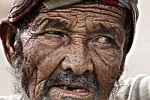
It unfurled an identity. I noticed the deep sun-tan with those long days of labour. I noticed the rough white Shalwar Kameez well-worn, having endured many washings, creased up, patched in places. I noticed the loosely hanging empty jute bag slung across the back of his bicycle and the two folded up paper bags of used cement. Clearly, this scrap seller hadn’t made a business today. Yet he persisted as the day receded,  still calling out to the many affluent perhaps still dozing away amidst the buzz of the air conditioners behind thick walls and locked doors. ‘Loya raddi waich lau’ (Sell off scrap metal and paper), he called out in the empty, darkening street, perhaps the only listener to his own persistent cry. He pedalled on speedily, not completing his round to the end of the street but turning round half way to make his way back_ perhaps having learnt that there were no listening ears behind the thick walls, no one to hear or make out his locally accented cry; to notice that hole at the border of his Kameez, the empty loose sack or the well-worn, cracked up, mud-stained slipper quickly pedaling on_ perhaps to make it to the masjid in time for Maghreb prayer.

It was in seconds. I felt the connecting, the bonding up. I didn’t think it up but surprised myself by suddenly calling out to him as he rode on past me, ‘Bhai!’ ‘My brother’_ effortlessly, in a spontaneous outpouring came the words. ‘Bhai zara rukna. Aap raddi bechtay hain?’ (Brother, please stop. Do you sell and buy scrap?)
He couldn’t perhaps register it as he cycled on, used to the stony, unrelenting, indifferent silence in affluent localities. For an instant, I thought I had missed, and I felt the heart sink. Till, having rode a few yards ahead, he turned back to look and finally stopped, getting off the bicycle, dusting off his hands and shirt and, still with that ‘Muslim’ gentility and modest gaze that had held me, waited for me to approach. ‘Ji baji.’ (Yes, sister).

The evening cast darker shadows, the first night of Ramadan waited in the wing to gradually suffuse. These sacred moments…

And this muddied scrap seller here with his sunburnt face irradiated, ennobled, beautified by the Sunnah. I saw it all in one radiant flash. ‘Ramadan Mubarak!’ I said. ‘Mere paas yeh Ramadan ka chhota sa tuhfa hai aap ke liye,’ I said (I have a small Ramadan gift here for you), handing out whatever I could rummage through my pockets.
Visibly surprised and at a loss for words, he said, ‘Jazakallah khair baji.’ Silence. And then, gathering himself, he added, ‘Allah aap ko iss ka bohat ajar dei. Aap ko bhi Ramadan Mubarak.’ (May Allah reward you greatly for this. Ramadan Mubarak to you too.) I noticed the flawless, unaccented Urdu and wondered where he had got it from. The labyrinth of destiny, who can make out?

Realizing perhaps the insufficiency, the inadequacy of my gesture, the unspeakability of that strange link, I added, ‘Bhai duaon mein zaroor yaad rakhye ga.’ (Brother, do remember me in your prayers).

As I made my way on, I felt lighter, unburdened, relieved. And I saw his frail figure, the beard, the cap merging into the twilight’s colours, soon a silhouette against the far end of the road.

And I wondered who he was, what was his name, where he lived… regretting not having asked. ‘Bhai’ (brother) I had called him, not feeling the need to call by a name, not feeling the need for statistics to identify. ‘My brother’, striving on life’s rocky road, striving among the pain and toil to keep to the straight and narrow, a lover of my Prophet (SAWW), a slave of my God.

As I sat on the prayer mat on the night of first Ramadan, I thought of the nameless scrap seller who must also be engaged in prayer somewhere. And I knew that the power of prayer, the faith we share creates the sacred link_ undying. I felt the indissoluble, ever-present link of Muslimhood, that thing called ‘love for Allah’s sake.’

‘What a little thing
To remember for years,
To remember with tears!’

Welcome Ramadan

By the grace of Almighty, the holy month of Ramadan is here. With every beginning of Ramadan, the environment suddenly changes in Islamic world and the bond between Muslims gets stronger and more beautiful. It’s a month of virtues, repentance, charity, forgiveness and blessings.  The month gives us opportunity to reconnect with our family and friends as well and rethink about our priorities in life.  This month gives a chance to everyone to be closer  to the Lord.  The opportunity is for everyone to utilize; to reflect, repent and cleanse the inner self.

Prophet Muhammad SAWW delivered a beautiful sermon to welcome the month of  Ramadan which is narrated below.

On the authority of Salman al Farsi (May Allah be pleased with him) it is narrated that during the last Jumu’ah of the month of Sha’ban the Prophet (Peace be upon him) recited a Khutba (sermon) in which he said:

  • ‘O people there comes over you now a great month, a most blessed month in which lies a night more greater in virtue than a thousand months. It is a month in which Allah has made Fasting compulsory by day, and has made Sunnah the Taraweeh by night. Whosoever intends drawing near to Allah by performing any virtuous deed, for such a person shall be the reward like the one who had performed a Fardh (Obligatory act) in any other time. And whoever performs a Fardh, shall be blessed with the reward of seventy Faraa-idh in any other time.
  • This is indeed the month of patience, and the reward for true patience is Jannah (Paradise). It is the month of sympathy with one’s fellowmen. It is the month wherein a true believer’s rizq (sustenance) is increased. Whosoever feeds another who fasted, in order to break the fast at sunset, for the feeder there shall be forgiveness of sins and freedom from the fire of Jahannum (hellfire), and for such a feeder shall be the same reward as the one who Fasted (who he fed) without that persons reward being decreased in the least.”
  • Thereupon we said, “O Messenger of Allah, not all of us possess the means whereby we can give a fasting person to break his fast.” (They were at the time under the impression that Rasullulah(saw) referred to a full meal). Rasullulah (saw) replied:
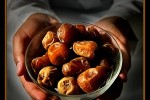
  • “Allah grants the same reward to the one who gives a fasting person to break the fast a mere date, or a drink of water, or a sip of milk (for Iftar).”
  • “This is a month, the first of which brings Allah’s mercy (i.e. the first 10 days), the middle of which brings His forgiveness and the last of which brings freedom from the fire of Jahannum.”
  • “Whosoever lessens the burden of his servants (d cor those under his authority) in this month, Allah will forgive him and free him from the fire of Jahannum.”
  • “And in this month four things you should continue to perform in great number, two of which shall be to please your Lord, while the other two shall be those without which you cannot do. Those which shall be to please your Lord, are that you should in great quantity bear witness that there is no deity to worship except Allah (i.e. recite the Kallimah Tayyibah Laa ilaha illallah) and make much Istighfaar (repentance, beg Allah’s forgiveness with Astagfirullah). And as for those without which you cannot do, you should beg of Allah, entrance into Paradise and ask refuge in Him from Jahannum.”
  • “And whoever gave a person who fasted water to drink, Allah shall grant that giver to drink from My fountain, such a drink where after that a person shall never again feel thirsty until he enters Jannah.”  [Ibn Khuzaimah in his Saheeh]

This Hadith not only signifies the value of Ramadan but tells us how to behave during the holy month. Ramadan takes us out of the usual routine life and places us in a total different scenario while we are doing the same routine tasks. Our behaviour totally changes. Its like a breath of fresh air. Syed Maududi rightly said that it’s a litmus test to check the ‘life’ of a Muslim society.  If there is some life left in a society, it will be evident during Ramadan.

One thing which we should ensure is that we must continue the virtues even after Ramadan.  This is a training workshop of unity, tolerance and piety for 30 days for entire Muslim society and we should learn from it and continue these good habits throughout the year. If we can refrain from ‘Halal’ (permitted) things when ordered by Allah and when we work together in unison, then it’s not difficult to stop ourselves from the ‘Haram’ (forbidden) if we are willing to obey and please the Lord.

Divided we fall

We have learnt and read through fascinating stories and examples of history that believing in unity as strength is the key to success and division is the route to downfall. Regardless of the number of population sect-wise in Pakistan, it is observed that implanting hatred and creating distances have always existed in one way or the other. Where our nation stands as one force when a calamity afflicts us or we win a cricket match, hatred and division is seen on the rise and it is surely one of the reasons why we are heading towards becoming a failed state.

Different sects, their own ideas of dominance, ‘holier than thou’ attitude and declaring each other as ‘non-believers (Kafir) are some serious problems. This attitude has given rise to violence in the society. It’s a fact that issues related to sectarian identities are not new.  Mosques and madrasas, or seminaries of traditional Islamic education, play a role in this regard. Where they have a responsibility to bring closer the Muslims and make the ties stronger among the Muslim community, some of them may actually take dividing the nation as their ‘noble’ duty.  They may feel their sectarian affiliation dearer to heart and cause, than their affiliation to the beautiful religion of peace itself. The leadership of such madrassas comes from people who began their careers as preachers and ‘imams’ in their neighbourhood mosques. They do not necessarily represent the most learned and wise men, as in the days of the Prophet (SAW).

A fear factor has emerged among the new generation which deserves to be loved, groomed, cherished and respected. The generation which should hold a pen and book in their hands, holds guns either to give protection to their families, or to do their so called “Jihad” getting paid or aid through different extremist organizations.

Given the brutal violence against the Shias in Pakistan over the past three decades, Shias have started to wonder if there is a future for them in Pakistan. While hundreds of thousands of Shias had migrated to Pakistan in 1947 in the hope of building a new life for themselves and their future generations, many are now contemplating emigrating from Pakistan to save their lives and property.  Hundreds of Shias have been murdered in their Imam Bargah’s by the different sectarian militants in the past. They have been taken off buses, lined up and shot dead. Their places of worship, religious processions, and civilian and religious leadership has come under relentless attacks while the state’s machinery has either refused or failed to protect shias and other religious minorities in Pakistan.

But the question also exists that who in Pakistan is safe. There are attacks on mosques and shrines too, even on people attending the funeral prayers. Blasts kill many people who do not get sectarian or religious tags.  They are just numbered. Some are not even numbered or mentioned. They are declared as collateral damage. We might never know exact figures of civilian casualties of war on terror. Drone attacks are a routine. Bomb blasts all over the country and especially Khyber Pakhtunkhwa are a norm. Balochistan’s situation is worsening. ‘Missing persons’ is another shameful reality.  Every person puts his life at risk when he leaves for work every morning. School going children are not safe either. Who is destroying our land? Do we have enemies within us? My Sunni friends and I sit together and discuss. We have never hated each other. We have enjoyed the most beautiful school and college days together and helped each other in difficult times. We have dined out, hiked in mountains and spent the most exciting time of our lives together. Our bond has only grown stronger.  But we look around the country and see terrorism, calamaties, blasts, killings either by our very own terror groups or in line of ‘war on terror’. There is only one common finding, ‘we are the ones who are suffering as a nation.’ We are going weak emotionally due to these divisions being implanted, and the tags given to the dead. The people killing us know how to divide us. It’s we as a nation who have to keep our eyes open and send a message of unity and love. For the sake of Muslim unity all sects should be acceptable and equal and we should learn to tolerate each other. I strongly believe that different sects are just different flavours of the same principle. If Christians can protect Muslims while they offer Namaz at Tahrir square, why can’t Sunnis protect Shias and Shias protect Sunnis?

When Pakistan needs some ‘life saving’ measures to restore peace and prosperity, let’s think about the country, rising above sectarian divisions. We are all different children of the same mother, our homeland. Whoever is killed is a human first without any tag and every human is precious and every killing is condemnable and shameful.

Now it’s time to either build or destroy the future of Pakistan. The time has come to unite as a force  and tell the rest of the world that Islam is the religion of love, faith, tolerance and freedom  and not hate, distrust and division.

Excerpt from the last sermon of Prophet Mohammed (PBUH):

‘O People, just as you regard this month, this day, this city as Sacred, so regard the life and property of every Muslim as a sacred trust. Return the goods entrusted to you to their rightful owners. Treat others justly so that no one would be unjust to you. Remember that you will indeed meet your LORD, and that HE will indeed reckon your deeds.’

My message to the whole Pakistani nation:

Love one another and you will be happy; it is as simple as that”