Of Regrets and Apologies

“We are sorry for the losses suffered by the Pakistani military. We are committed to working closely with Pakistan and Afghanistan to prevent this from ever happening again”, said Hillary Rodham Clinton to Hina Rabbani Khar on a telephone call, and Pakistan reopens its border to NATO supply convoys into Afghanistan after a seven-month blockade since November, when an American aircraft killed 24 Pakistan soldiers.

The nation went into shock and twitter was bombarded with questions like ‘Was this really an apology’, ‘they said sorry which they say even when they sneeze and did not apologize’ and ‘Is Clinton Camera-shy for a formal apology?’

I sat down and thought for a moment, ‘Would we be happy and satisfied if the word regret and sorry is replaced by an apology, a formal one, with a US official appearing on media?  The civilian and military leadership was so inclined to open the land routes that even a slightest blink of the eye was enough for them?  How was  it different from Cameron Munter’s condolences given immediately after the incident and those too in Urdu for which he must have done an extra effort to sound more convincing to the sheeple he was addressing. And, hand over heart, would you be satisfied if your wishes or demands of a ‘formal apology’ are met. Would you believe these statements coming from a super power that has a history of war crimes and blatant lies, very well acknowledged by internationally accredited activists and impartial commentators. Let us go through just a few of these.

-Just a few months ago, US Defence Secretary Leon Panetta apologised to the Afghan people for an incident in which copies of the Quran were burned and said that it wasn’t intentional.

‘These actions do not represent the views of the United States military. We honour and respect the religious practices of the Afghan people, without exception.”

NATO commander John Allen also addressed to the ‘noble Afghans’ and that too with an extra effort of learning to say ‘Assalam Alaikum’ and ‘Manan, Tashakkur’ to ‘calamin-ise’ the blistered sentiments with his amazing Pushto and Persian.

-Shortly after that, international media breaks the news, that a course for US military officers has been teaching that America’s enemy is Islam in general and suggesting that the country might ultimately have to obliterate the Islamic holy cities of Mecca and Medina without regard for civilian deaths, following second world war precedents of the nuclear attack on Hiroshima.

“This would leave open the option once again of taking war to a civilian population wherever necessary (the historical precedents of Dresden, Tokyo, Hiroshima, Nagasaki being applicable to the Mecca and Medina destruction decision point).”

The Joint Chiefs of Staff chairman General Martic Dempsey responded to it as “the material in the course was counter to American appreciation for religious freedom and cultural awareness. It was just totally objectionable, against our values, and it wasn’t academically sound,”

-A few weeks after burning of the Holy Quran incident, comes the horrible news of a US sergeant killing 16 innocent civilians, out of whom 9 were children and later all the bodies were set alight.  As always, the authorities tried to explain, they do not represent anybody. They were just mad (disagrees Robert Fisk).

Remember, US senator John Kerry was “deeply sorry” over the killing of two Pakistanis by a US official, and promised justice if he was handed over to the US? Similarly, there are numerous incidents which have torn apart United States claims of freedom and equality, belief in humanity and justice for all. Illegitimate drone attacks on Pakistani soil and civilian casualties are very frequent. Detainees in the Guantanamo held without charge, Abu Ghraib’s disturbing pictures where the soldier refuses to apologize for her ‘prisoner on the leash’ and other disturbing treatment, US military officials using Quran as target practice and urinating on corpses,  Aafia Siddiqui’s physical and sexual abuses in the world’s most horrifying jail,  sentenced for allegedly shooting (missing the target) a US soldier while a Marine gets three months in jail for massacring two dozen civilians in Iraq, are just a few. With a war that began with a lie of ‘Weapons of mass destruction’ in Iraq, US remains the first and the only country to have used Nuclear weapons and is the biggest manufacturer and supplier of chemical weapons. Let’s also recall heavy usage of white phosphorus on the city of Fallujah.

A former American soldier who fought at Fallujah says:

“I heard the order to pay attention because they were going to use white phosphorus on Fallujah. In military jargon it’s known as Willy Pete. Phosphorus burns bodies, in fact it melts the flesh all the way down to the bone, I saw the burned bodies of women and children. Phosphorus explodes and forms a cloud. Anyone within a radius of 150 metres is done for.”

What has the US or the NATO apologised for in the past? And if they have apologised, have the injustices and war crimes stopped? Have they ever apologised for Hiroshima ‘formally’ or for the usage of napalm bombs and chemical weapons on Vietnam civilians? I must mention, they felt ‘sorry’ for deliberate syphilis infections in Guatemala as a part of medical tests without prior consent.

So my dear countrymen, what is it that we really want? With this history of regrets and condolences of the masters, even a formal apology means nothing. I remember from my childhood what my mum used to say every now and then to my little brother, ‘My son, you say sorry and then repeat the same thing? What kind of an apology is this? Saying ‘sorry’, means you admit your mistake and you would never do that again’. Unfortunately this does not mean anything in the real world and our mums had kept us in a world of fantasy and text bookish philosophy which we only come to find out as almost non-existent as we grow up to the ugliness of the mighty in this world.

A dog is no doubt man’s best friend. But, either our spineless leadership should come out of this ‘ideal friendship’ and let us live like a sovereign nation, who is capable enough to deal with its own issues (including terrorism that started after US invasion) or keep wagging the tail and make us all a mere joke . The precious 24 soldiers would never come back and nor would the thousands of other soldiers and civilians who didn’t get a name. The solution is:  this war MUST end!

I leave with you the words of an American activist, a daughter of a Jewish mother and an Iraqi father demanding the same as I do today. No justice, No peace!

The Rise of Revivalists

It was a sunny day on 12th February 1949 when the leader of Muslim Brotherhood, Hasan al Banna was invited for a meeting with an Egyptian government minister in Cairo. At the venue, the minister never appeared and hence the brotherhood’s leader had to leave. While he was on the street to get a taxi, he was shot by unknown person.

The Brotherhood’s leader death was widely assumed as an officially planned assassination. Hasan al Banna funeral was publicly banned by the then Egyptian government and only his father, brothers and some family female members were allowed to carry out his final ceremony.

Hasan al banna was a highly charismatic person and a sharp-minded school teacher who laid the foundation of Muslim Brotherhood in Egypt in 1928. This was the first mass based Islamic party, which overtly worked politically and within country’s legal framework. Brotherhood challenged the ascendancy of secular and western ideology in Egypt and in the whole of Middle East countries. Hasan al banna strongly felt that in the unislamic ideology lays the root of the decay of Islamic societies in the modern world, and advocated a return to Islam as a solution to the ills that had befallen Muslim societies. The message of Brotherhood had spread swiftly not only across the adjacent Arab countries but reached countries far away like Indonesia, Malaysia, Iran and Pakistan.

Hasan al Banna’s achievement was creating a flexible and dynamic structure aiming to transform his vision into reality. He founded numerous schools, factories and mosques in less than 10 years. He was able to provide over a half million committed workers and twice as many supporters to the Brotherhood. The work of Brotherhood started to transcend the national borders. It was the time when Hasan was invited by the British ambassador for tea, complimented for his good character and admired for his work for the poor. He was told that it is in the Brotherhood’s interest to get assistance from British. Hasan politely listened to ambassador and told him that all of his money belongs to Egyptians and the time for British was soon coming to an end. This caused the starting of the conflict between him, British and the then Egyptian monarchy.

No one could have imagined the future of the then Egypt’s most influential and largest revivalist party after his founder, Hasan al banna was mercilessly murdered followed by a massive crack down on his party. Scores of his party members were arrested and subjected to worst physical torture inside the military jails. The party’s assets were confiscated. The situation not only lasted for months and years but for decades and any association with Brotherhood was consider as a serious and unforgivable crime.

The dawn of June 24th,2012 comes along with the election commission’s announcement that Muslim Brotherhood’s candidate, Mohammad Morsi, had won the country’s first contested presidential election, making him the first ever islamist president in the arab world. It took eight decades to Hasan al banna’s dream to come true. Morsi addressed to the tens of thousands at Tahrir square,


“I’m your president, but not without you. I’m your president, but I’m not the best of you…I fear Allah (swt) and no body else.. I will be always one of you. I have been given the authority over you, but I am not the best of you. If I do well, help me; and if I do wrong, set me right. Obey me so long as I obey Allah (swt)and His Messenger (s.a.w), but if I disobey Allah (swt) or His Messenger (s.a.w), you owe me no obedience.”

Despite the time taking and tough period, The Egyptian socio political Muslim Brotherhood has shown its commitment to its cause and vision, given many decades before by Hasan al banna. It would be interesting to see how their counter parts in other countries especially in Pakistan would be performing in the Elections to come. Jamaate Islami claims not only to have close ideological ties with Brotherhood, but due to the amazing similarity in organizational structure and working strategy, is considered to be the Muslim Brotherhood of Pakistan.

The political battle between Islamists and regimes all around the world is not over, it has not only begun but in fact has gained momentum. The brotherhood and such revivalists are emerging as significant forces in the politics of several Arab and non-Arab countries, either directly or through the movements they inspired.

They are appealing most to the masses and cultural conservatives who want their government and society to reflect and defend certain basic Islamic values and principles, and who favor a pragmatic and incremental approach to achieve these goals. The legacy of Hasan al-Banna is thus still presents, and will continue to shape the destiny of societies in the new millennium.

Islam and Rule of the People – III

The instinctual problem that arises with democracy is the belief that democracy originated in the west. The history of democracy is therefore presented as troublesome. The Ancient Greeks, who are told to be the founders of “democracy”, would probably be shocked and be dismissive of modern democracies. As modern representative governments are radically different in nature than the democracies of Greek city-states where all citizens would gather to make decisions. Democracy is a very fluid concept with radically different forms; direct, representative, functional, parliamentary, republican, federal, proletarian, and so on.

Modern democracy, however, from a conceptual standpoint, has a troublesome dynamic. In the west, it evolved in the background of the renaissance and the revolt against the authority of the church. It was in this sense a blow against religion and the ecclesiastical order. It was also a revolt against the European Monarchies, those of which claimed that they had the divine right to rule. While in actuality, as the slogan of the French Revolution went “We want neither a Lord nor a master”, the struggle was one of the masses against oppression of monarchy and theocracy at the same time, it became expressive in a revolt against the justifications presented by the regimes; Divine right and representation.  Hence, against the claim of the church of ‘the rule of God’, the movement demanded ‘the rule of man’.  The revolutionary notion of man’s independence from God manifested itself in form Secularism, Nationalism and Western Democracy.

Fortunately, however Islam does not endorse any religious class to begin with. While Islam does value knowledge and deeds, it does not give monopoly to either a scholarly or holier-than-thou class on the power-centers of society. Popular participation is a fundamental aspect of the Islamic socio-political order.  In this sense, an Islamic state is a civil state against what is understood as a “religious state” (a theocracy).

According to reputable Islamic scholar, Syed Maududi (RA), the Islamic ideal is unique in itself. But to describe it in its nearest terms for understanding and categorization, it can be called a “Theo-democracy”.  This is because while Islam recognizes the sovereignty of God alone, it gives the people the right to choose their rulers and be consulted.

The whole concept of Bay’et, or pledge of allegiance, in Islamic history, is a perfectly appropriate methodology to establish legitimacy based on public consent. The ballot system, and the whole electoral process, is just a more advance and modern way to achieve the same principle. For it’s time and circumstances, the Bay’et system was most suited and applicable. Now we simply have a more advanced and modern method to achieve the same end. Unfortunately, even this Bay’et system was misused by despotic rulers in our history. Forced Bay’et, or consent, became a method to justify monarchal rule in Islamic terms, which faced resistance, starting with the revolt of Imam Hussain(RA), from time to time. In modern times too, despotic rulers have used similar methodologies to justify their tyrannies by the illusion of consent, from Hosni Mubarak to Pervez Musharaf.

There are two main contentions left with the anti-democracy argument. The first refers to the failures of most Western democracies. The ‘corporations’ and ‘lobbies’ are the true parties that hold the strings in such so-called democracies, while public opinion is manipulated through mass media. While this may be true, there is an inherent admission of these democracies not being the real thing; a scam of sorts. In further response, one has to say that within an Islamic framework, monopolistic tendencies in corporations or interest groups are both to be contained. While an explanation of Islam’s socio-economic ideals and characteristics are too detailed to accommodate in this essay, one has to simply understand that they’re different from those of Western capitalist societies.

The second contention refers to the failures and the shape of democracies as ours in Pakistan. People at large are blamed for choosing the corrupt people again and again. This may be true but many other factors are involved, including the incessant shifts between dictatorships and democracies, the general moral and intellectual degeneration of our society, the gap between the elite and the masses, the colonial legacy, and the feudal structure of most of Pakistan. If we find the people today to be ignorant at large than it is the responsibility of the responsible few to create a critical mass that would reach out to the people. While this is another topic, I believe that the elite in Pakistan must take responsibility to engage with the masses. The professional and educated elite have generally been apolitical, while leaving the masses vulnerable to demagogues.

Democratization and Islamization in the Muslim world go together. This fact must be realized. For in true democracy, the consent, traditions, values, approval, customs and religion of the people must all be reflected. On the other hand, secularism in Muslim societies can, and has always, been imposed by force at the hands of despotic rulers. We must also understand that the greatest opponent to democracy in the Muslim world has always been the Western hegemonic powers. If true representatives of the people come to power, there is always the chance that they’ll reflect public aspirations.


Click here for Part I and Part II

Islam and Rule of the People -II

Islam is very democratic in its application of things. After all, in its truest essence, democracy is not only elections, but a variety of things. These include pluralism, free speech, freedom of association, basic human rights and so on. Islam encourages all of these within its own framework.

As far as the objection that in a democracy, people can make laws as they wish, one has to understand that Islam itself gives a framework within which there is room for human creativity and reason to come into play. In a constitutional democracy, democracy is restricted by the constitution. Legislation can only be carried out within that framework. If a constitution is based on Islamic principles, than there is abundant room for legislation. In fact, from the standpoint of being Muslims in a democracy, one cannot, by his allegiance, legislate or make decisions against the teachings of Islam. If he does, it is no less different than breaking the constitution. For in theory, one can always do that as well. Acting against faith, or law, is a crime. So to the response of ‘what happens when a Muslim parliament legislates in favor of alcohol’; one can simply reply that  when such a thing will happen, the members of parliament and their supporters, will be committing a crime against their faith, or even against the constitution, if it is based on Islamic principles. The blame will hence go on the whole Muslim community. And Allah has referred constantly in His revealed book in regard to what happens when a whole nation cooperates in wrong deeds.

Islam is not totalitarian, and does not have precise details and orders for every minute thing. In fact Islam sets broad guidelines and principles, while also setting some limitations. This aspect is sometimes missed, and mostly those who are overly defensive of their religion contest that Islam gives us a game-plan and to-do list for every single situation we face. While one may think that such were true, he must always realize that if it were than it would not be possible for Islam to have a universal character, and hence apply to changing times and circumstances. If the object in question changes, then how can the way we deal in it not? This doesn’t mean that Islam changes, but in fact the principles and guidelines it suggest remain universal and permanent.

I actually had a debate with an emotional friend of mine in which he argued that if something is not already endorsed in the Quran and Sunnah, and absent in Islam, then it cannot be permitted to be carried out. However, when I asked him whether he ever looked at religious sources before deciding to scratch his head, his response was a confused resort.  Another example I had to give him was regarding clothing; while the Prophet (SAW) himself is reported to have worn the dresses of both Persians and Byzantines, Islam still has a dress-code. That dress-code is not particular in the sense that it tells you what to wear, but rather it tells you how to wear what you wear. This means that you can wear clothes ascribed to any culture – Arab, Persian, Western, African and so on – or form as long as the Islamic criterion is met.

Two reputed Islamic scholars write in a collective article

“The Islamic approach is that faith, values and principles and some key institutions such as the Quran and Sunnah provide the permanent framework. Within that framework, there is a lot of flexibility for change and experimentation. Islamic commands have been divided into five categories. On the one end are fardh, the obligatory requirements, which are specific and occupy a relatively small proportion of commands. On the other end are haram (forbidden) elements: this is the bottom-line that may not be crossed. Between these two ends are desirable elements of conduct (mustahab) and undesirable elements (makruh). The rest of human activity falls in the vast middle area of mubah (permissible) conduct, which may be regarded the domain of human freedom.” *

To be continued…

Click here for Part I and Part III


References

“Religion, State and Society”  by Prof Khurshid Ahmad & Mahmood Ahmad Ghazi, in “Policy Perspectives, Volume.5, No. 1”


Islam and Rule of the People – I

Is there anything wrong with the idea that people should have the right to rule? Many people argue that there actually is something unacceptable and Islam does not permit such a thing; a blasphemy, maybe.  To say that the people have the right to rule, they argue, is to give away a right reserved for God alone as sovereignty belongs to God, no one should be allowed to be partner in it.

Seemingly, this does tend to make sense. More so, in times as ours when people have come to detest democracy in general after witnessing decades of jiyala politics in Pakistan, and hence express their frustration in various forms, including religious ones.

I, for one, cannot comprehend the absolutist condemnation of democracy. One may debate that politics in our country has degenerated to a very humiliating level (to which one can point out many other reasons besides ‘democracy’). But an outright condemnation to the point that one uses religion to oppose it brings many complications as the image of a religion – that is democratic to the core – is put at stake.

I believe that the argument above is based on certain confusions and mishandlings of conceptions in the Islamic tradition.

First of all, it is beyond doubt that God alone is sovereign. This concept emanates from the creed of Tawhid-the oneness of Allah.  This is undeniable and incontestable on all levels. But when we are talking about this world we have to be more explicit and clear in what we imply.

While we may recognize God’s supremacy in this world and the next, we never mean that humans don’t have worldly authority. To say that they don’t would be to deny both free will, everything we see all day and common sense, for the sake of it. It is people who already rule themselves; whether in the form of a singular individual, an institution, class, race, parliament and so on. If human rule is to be denied in its worldly sense then the only plausible form of government would be an anarchic one. Sadly maybe, neither God nor His angels come down on earth and take control of governments. It’s a human decision to make; with or without taking God into consideration.

The question that arises then is, in what form does an Islamic state manifest itself?

Islam has provided a socio-political framework and universal principles that guide us in this regard as well. While Islam recognizes the Divine authority, it fails to recognize a divinely class, and hence closes the doors of theocracy. In this sense, the Islamic ideal is not a religious state. Nobody represents God’s will on earth. Instead, God provides the legitimacy to people to rule on his behalf under the framework of His divine guidelines. He did this by making universal man (all humankind) His vicegerent on earth.

The Islamic principle of governance establishes itself on the basis of shoora (consultation) and Khalifat. Derived from these two principles, we can safely say that while western democracy champions popular sovereignty, Islam recognizes popular vicegerency. While there seems to be common ground on the functional level, conceptually both are worlds apart. It’s somewhat like praying in front of a rock; if your idea of the rock is that it is an idol worth worship then the same action – that would otherwise be completely appropriate – becomes a sin.

The Islamic ideal requires that the Muslim community be taken into confidence not only in the selection of the rulers but also in the decisions of the rulers. The welcoming attitude towards criticism by the Khulfa e Rashideen (the Pious Caliphs) is well established. The attitude of Hazrat Ali (RA) and Hazrat Usman (RA), for example, towards the rebels is without any precedent in history. At a moment, Hazrat Ali (RA) even refused to take action against a rebel who openly declared that he will murder the respected caliph. In both these cases, the caliphs in question had to bear many troubles to uphold such cherished ideals.

On an occasion, Hazrat Umer (RA) spoke unambiguously about the selection of the Muslim ruler. While explaining to people that the selection of Hazrat Abu Bakr (RA) was not to be taken as a precedent because it was only adopted out of circumstantial necessity, he went on to say that “If someone gives pledge (bay’et) of allegiance to another (to become a Caliph) without consulting the Muslim community, then the one he has selected should not be granted allegiance, lest both of them should be killed.” * Obviously, the strict connotation at the end refers to carrying out a crime against both the state and the community. The same treatment would today be reserved for someone who breaks the constitution to usurp power.

Click here for Part II and Part III

Reference“ *Sahih Bukhari, Volume 8, Book 82, Number 817”

Is Islam non-democratic?

It is true that while Islam may not be a proponent of liberal western democracy as we know it, but in its very essence Islam is quite democratic.

“Consultation” is a fundamental concept in Islam. If anything, the Islamic ideal is nearest to a constitutionally restricted democracy whereas democratic principles are ordained under, within and from the principles of the Quran and Sunnah.

The basic flaw is made in understanding as to what democracy essentially means. Contrary to popular belief, democracy is a very fluid concept. For example, if you attempt to understand democracy in its original, and strictly, Greek sense, you’ll be surprised to note that such a concept cannot be applied to ‘modern democracies’. This is because in the Greek city-states, all the citizens would gather in one place to decide their affairs. This is true not only in time but also in space as democracies around the world differ from each other on fundamental grounds. So one must realize that claiming ‘Islam upholds democratic ideals’ doesn’t mean that it also upholds western democratic models; which are based on the premises of secularism and nationalism.

The idea that democracy is the rule of the people while Islam only recognizes the rule of God doesn’t necessarily imply a contradiction. In effect, however, neither God nor His Angels will come down to earth to rule nor has God made anyone His representative (hence closing the doors for theocracy). In fact, it is people who rule and, I argue, by divine decree; as Allah has made man (not a specific man, but meaning all-humanity) His vicegerent (Khalifah) on Earth. Allah says clearly.

“We have honoured the children of Adam” (17: 70); to which the revered Algerian scholar, Malik Bennabi, writes

“The verse was revealed as if to lay the foundations of a democratic model that is above every other model, where the divine element within man is taken into consideration and not just the human and social aspects…”

The following is an excerpt from an English translation of the celebrated ‘Tafheem-ul-Quran’ by Maulana Syed Abul Ala Maududi. It’s the scholar’s commentary on the verse ‘amru-hum shura baina-hum’ (they (believers) conduct their affairs by mutual consultation) (42:38).  An understanding of the following will display that while restricting the negative effects of western democratic models, the Islamic model is yet still more democratic.

‘This quality (of consulting one another) has been counted here as the best quality of the believers and has been enjoined in Surah AI-‘Imran Ayat 159 as well.

‘So by mercy from Allah, [O Muhammad], you were lenient with them. And if you had been rude [in speech] and harsh in heart, they would have disbanded from about you. So pardon them and ask forgiveness for them and consult them in the matter. And when you have decided, then rely upon Allah. Indeed, Allah loves those who rely [upon Him].’

On this basis, consultation is an important pillar of the Islamic way of life. And to conduct the affairs of collective life without consultation is not only the way of ignorance but also an express violation of the law prescribed by Allah. When we consider why consultation has been given such importance in Islam, three things become obvious:

Firstly, that it is injustice that matters of the state be decided on the basis of personal opinions. No one has a right to do as he likes, in matters of common interest. Justice demands that all those whose interests are involved in a matter be consulted, and if it concerns a large number of the people, their reliable representatives should be made a party in consultation.

Secondly, a man wants to usurp the rights of others for selfish ends, or because he looks down upon others and regards himself as a superior person. Morally both These qualities are equally detestable, and a believer cannot have even a tinge of either of these in himself. A believer is neither selfish so that he should get undue benefits by usurping the rights of others, nor he is arrogant and self-conceited that he should regard himself as all-wise and all-knowing.

Thirdly, that it is a grave responsibility to give decisions in matters that involve the rights and interests of others. No one who fears God and knows what severe accountability for it he will be subjected to by his Lord, can dare take the heavy burden of it solely on himself. Such boldness is shown only by those who are fearless of God and heedless of the Hereafter. The one who fears God and has the feeling of the accountability of the Hereafter, will certainly try that in a matter of common interest he should consult all the concerned people or their authorized representatives so as to reach, as far as possible, an objective and right and equitable decision, and if there occurs a mistake one man alone should not be held responsible for it.

A deep consideration of these three things can enable one to fully understand that consultation is a necessary demand of the morality that Islam has taught to man, and departure from it is a grave immorality which Islam does not permit the Islamic way of life requires that the principle of consultation should be used in every collective affair, big or small. If it is a domestic affair, the husband and the wife should act by mutual consultation, and when the children have grown up, they also should be consulted. If it is a matter concerning the whole family, the opinion of every adult member should be solicited. If it concerns a tribe or a fraternity or the population of a city, and it is not possible to consult all the people, the decision should be taken by a local council or committee, which should comprise the trustworthy representatives of the concerned people according to an agreed method. If the matter concerns a whole nation, the head of government should be appointed by the common consent of the people, and he should conduct the national affairs in consultation with the leaders of opinion, whom the people regard as reliable, and he should remain at the helm of affair only as long as the people themselves want him to remain in that position. No honest man can try to assume the headship of a nation by force, or desire to continue in that position indefinitely, nor can think of corning into power by deception and then seek the people’s consent by coercion, nor can he devise schemes so that the people may elect representatives to act as his advisers not by their own free choice but according to his will. Such a thing can be desired only by the one who cherishes evil intentions, and such a fraud against the Islamic principle of consultation can be practiced only by him who does not feel any hesitation in deceiving both God and the people whereas the fact is that neither can God be deceived nor the people be so blind as to regard the robber, who is committing robbery in the bright day light openly, as their well-wisher and servant.

The principle of consultation as enshrined in ‘amru-hum shura baina-hum’ by itself demands five things:

(1) The people whose rights and interests relate to collective matters, should have full freedom to express their opinion and they should be kept duly informed of how their affairs are being conducted; they should also have the full right that if in the conduct of the affairs they see an error, a weakness or a deficiency, they can check it and voice a protest, and if they do not see any change for the better, they can change their rulers. To conduct the people’s affairs by keeping them silent and un-informed is sheer dishonesty which no one can regard as adherence to the principle of consultation in Islam.

(2) The person who is to be entrusted with the responsibility of conducting the collective affairs, should be appointed by the people’s consent, and this consent should be their free consent, which is not obtained through coercion, temptation, deception, and fraud, because in that case it would be no consent at all. A nation’s true head is not he who becomes its head by trying every possible method, but he whom the people make their head by their own free choice and approval.

(3) The people who are appointed as advisers to the head of the state should be such as enjoy the confidence of the nation, and obviously the people who win representative positions by suppression or by expending wealth, or by practicing falsehood and fraud, or by misleading the people cannot be regarded as enjoying the confidence in the real sense.

(4) The advisers should give opinion according to their knowledge and faith and conscience and they should have full freedom of such expression of opinion. Wherever this is not the case; wherever the advisers give advice against their own knowledge and conscience; under duress or temptation, or under party discipline; it will be treachery and dishonesty and not adherence to the Islamic principle of consultation.

(5) The advice that is given by a consensus of the advisers, or which has the support of the majority of the people, should be accepted, for if a person (or a group of persons) behaves independently and acts on his own whims, even after hearing the advice of others, consultation becomes meaningless. Allah does not say: “They are consulted in their affairs”, but says: “They conduct their affairs by mutual consultations”. This instruction is not implemented by mere consultation, but for its sake it is necessary that the affairs be conducted according to what is settled by consensus or by majority opinion in consultation. Along with this explanation of the Islamic principle of consultation, this basic thing also should be kept in view that this consultation is not independent and autocratic in conducting the affairs of the Muslims, but necessarily subject to the bounds that Allah Himself has set by His legislation, and is subject to the fundamental principle: “It is for Allah to give a decision in whatever you may differ,” and “if there arises any dispute among you about anything, refer it to Allah and the Messenger. ” According to this general principle, the Muslims can hold consultations in Shari ‘ah matters with a view to determining the correct meaning of a text or verse and find out the ways of implementing it so as to fulfill its requirements rightly but they cannot hold consultations in order to give an independent judgment in a matter which has already been decided and settled by Allah and His Messenger.”

Studying in East Asia

OK! so you wish to study abroad, and do not have the fortunes to pursue your dreams? Well, it’s not the end of the world for you. When there is a will, there is a way and the way is to get scholarships.

Universities around the world are waiting for scholars to do research but they are not getting enough suitable candidates, reason being the suitable candidates do not  have the information how to get there.
The focus of this article is on getting scholarships in East Asian countries, i.e. Japan, Korea, China, Thailand and Singapore. Countries like Japan and Korea are developing fast and investing a lot in the education sector. Their industries are fully supporting the academia, and it’s very easy to get a scholarship, only if you are persistent.

So let’s go directly to the tricks of the trade.

First step is to search the universities in your desired country on the internet.  Once you go to the website of any university, go to the faculty and see who are the professors and observe what they are doing. Drop an individual email to the professors of your interest. No, they don’t mind you sending them an email directly.  The email should contain your strengths and your desired area in few lines. The rates of response will be slow, one in ten probably, but if you get a response, that’s it!  You are nearly there. Every professor has got industrial and governmental projects in his lab, for which he needs researchers to work upon. If he is interested in you, he will support your studies,  will get the university to waive-off your tuition and will ensure that you are provided a living stipend so that you can simply relax and study!

It’s simple, isn’t it? Now if you want me to type an email for you, sorry I won’t do that for you. If you can read this, then your English is good enough, far better than a lot of Koreans and Japanese. English language is a great barrier especially in research for East Asian countries and they consider Pakistani students as a blessing. They need you to do research for them in English. Some universities like AJOU and KNU will give you direct access to the professors while for others you have to search the university website. Drop emails to the professors and wait for the response. I repeat, consistency and persistence is all that you need.

In each university, professors run labs based on industrial projects, so the funding is not an issue. If professor is interested in you, he will accept you and rest are formalities. For instance, in my lab, my professor accepted a medical student, who was a graduate in ophthalmology, to do PhD in Biomedical Engineering, a totally different field. I have seen people with the background of computer engineering having PhDs in chemical engineering. So it’s all about you, identify your area and locate the professors in those areas. Prefer the professors with more experience and more projects. Labs do have their websites, and it contains emails addresses of the PhD students, drop them an email as well. I know a lot of students who got scholarships by this method. Most importantly, you can find scholarships with living stipend for Masters degree without many prerequisites.
In the process, you might identify certain university scholarships, governmental scholarships, and some industrial scholarships. It was strange for me to see people with all those different scholarships, and their only ability was that they searched for it or someone told them about it. Korean and Japanese governments also give scholarship opportunities to the students of developing world, which need to be searched upon. For some students, even the tickets were paid by the professors. My professor paid my house rent for two consecutive years as I didn’t want to live in a dorm room.

The standard of education in the universities of East Asia, typically in Japan and Korea is getting much better. You can find quite a few of them in top 200 of international rankings. Tokyo University, National University of Singapore, KAIST, SNU and Yonsei are considered top class universities with tangible contribution towards research. One important factor which directly contributes towards the international ranking of a university is the number of enrolled foreign students; thats why the universities of East Asia are interested in attracting foreigners. Therefore, these universities are offering alot of opportunities to the foreign students, especially to those who are from developing world. So if you don’t have the fortunes to study in USA and UK etc, you can certainly utilize the opportunities which are being offered in East Asia.

Having said all this, life is not a piece of cake out there. You have to be strong enough to survive the test of times. If it doesn’t kill you, it will make u stronger. So if u can live alone, and live abroad in a different culture; then you can get the opportunity of studying there.  Most importantly, once you are out and in the open, you learn a lot. The benefit of getting scholarship in East Asia would be that you can quit and move on at any time as there’s very little you have invested in monetary terms. There is no bond and you have free will to carry on or quit. In short, all you need is passion and the doors will open for you InshaALLAH.


Heroes of Gaza – III

Thanks to a Manchester Masjid’s fund raising in the UK, the children now have shoes footballs, table tennis kits, new tracksuits for the boys and the father. The girls have a new abaya each. The mothers are given tapestry and sewing materials to teach the girls the beloved Palestinian artistry of sewing. The family has a hot meal during our visit and is provided with wood for cooking in the coming weeks. Israel’s illegal witholding of essential supplies such as enough gas, oil and the components to maintain the utility works here means that Gaza is being pushed back to the time before electricity existed.When the power is cut, families must cook using gas from canisters. When the gas runs out – and right now, even the smallest gas ration means an eight to ten hour wait – families scavenge for twigs and light fires inside their apartments to try and cook what food they can afford to buy. It is becoming the norm for children to miss meals entirely. In this Beit Hanoun family, I ask the youngest boy of four, what his dream is, what he wants to be; “ I want to eat’ he says. “Somehow. Somehow.” This makes all the family laugh.

Next stop, Jaffa Street, Gaza city. The smart home of Mohammed Ajur, 25. He is a handsome young man with the sweet smile of faith (emaan) on his lips. He happily greets his friend who has brought me to meet him and myself and we are seated in the family salon. Mohammed was in his uncle’s home when a rocket hit during what Israel proudly calls operation Cast Lead. He woke up in hospital in Egypt having been in a coma for four days. His family were around him weeping.

‘What happened?’ he asked.

‘Habibi, you have lost both your legs’ he is told. His eyes shine with light and he smiles (smiles!) at the memory.

‘What did you say?’ I ask. Although by his contentment I already know the answer.

‘I said “Thanks be to God”’ he replies.

“I was so grateful to Allah for saving my eyes and my hands and giving me so many chances to continue my life in a good way. Many, many others in Gaza lost their sight and their hands from the attacks. Alhamdulillah, I have those. Alhamdulillah!’

Mohammed has since completed his university degree in sports education.

He laughs at this ‘yes I know sports education right! But I can do anything and I will succeed in this life, with God’s blessing, inshaAllah. My life is only beginning. I am now looking for a wife. There is so much I have to do now and I will!’

He is the kind of man that makes you smile just being around him. On the middle of the table between us is a stunning urn, in copper glaze with rose workings and Arabic lettering across it. I admire it. ‘I made it’ he says shyly. He is also a talented artisan. ‘Do you like this jug?’ He asks me. I do. ‘Take it’ he says. I offer to pay but he refuses to sell it to me. It is a gift. Because I came to see him.

One final visit must be made this evening to a man whose livelihood mattered so much to my dear friend Vittorio Arrigoni; a fisherman. This father of six is in his late forties and hasn’t fished for two months. He explains that under the Oslo accord it was agreed that Gaza fisherman could sail up to 25miles from their coastline in order to fish. But Israel never honored this agreement. At first their naval forces forced the fisherman back to just six miles from the coast, then in recent years, to just three miles from the shore. There are no fish in this depth any longer due to over fishing and pollution. So, this fisherman took his boat, within his rights, to six miles and began to fish. The Israelis – as is a daily occurence for fishermen – attacked. At gunpoint he was told to strip naked and jump into the freezing February water where he was made to say for some time. Then still naked and humiliated he was handcuffed and taken to Ashdod for questioning. In the meantime the navy shot his boat so full of holes it is too damaged to repair. The livelihoods of four brothers and their thirty plus dependants – destroyed. Thanks to the same UK Masjid for donating the money to keep these families fed for the next month. After that, what will happen to them? Who knows?

As I type these words Israeli fighter jets are buzzing overhead jangling my nerves. They can be flying just for that effect or to launch yet another deadly attack on Gaza. It is 6am. The time when children are having breakfast and getting ready for school. Besides the night, this is the hour most favoured by Israel to inflict emotional terrorism on the population here. Driving through Gaza and seeing the queues of gas and petrol, I mentally titled my writing today as – Gaza’s suffering. But now the title has changed to ‘Gaza’s heroes’.


Previous links:

Heroes of Gaza – I

Heroes of Gaza – II

Heroes of Gaza – II

I, a stranger here in Beit Hanoun, walk down this road at dusk. Every window with a face in offers me ‘Salam.’ The doorway of the sole shop has a family sitting in it, I wave.

‘Assalamu Alaykum’, they shout at me – cheerily. Yes cheerily, I feel the lump in my throat that I carry inside forming again. “Peace’ they offer to the stranger in their midst, as they bathe me in smiles of instant friendship. On the corner two young guys come over and greet me as if I am a long lost cousin. There welcome is so warm that I wonder for a moment if we have met on a previous visit to Gaza.

“Okay’ says the tallest brother, after introducing himself.
‘Nice to meet you now you come to our home to spend the evening, First tea, then you stay with us. Yalla come!’..

I laugh..

‘Why you laugh?’ asks the other boy in his late teens or early twenties.

‘We don’t joking – you come for tea now, really, Fadal.’

These boys are brimming with life. Their eyes have energy and hope in them that is utterly at odds with the grim landscape they live in. They are heroes of Gaza, the next generation of hope, the ones who will not be broken.

We can’t take tea with them and are eventually allowed to leave only with sincere promises to return to their home as soon as possible.

We have come to visit, amongst this needy populace, a family in dire need.

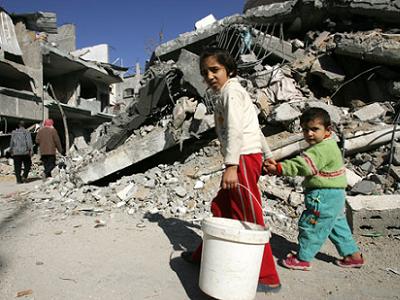
Through a broken wooden gate, behind a crumbling stone wall, my friend Yassir, silent and grim faced, points me into a cement building that has no right to be standing. It was once a PLO prison. Now it is ‘home’ to a family of one father, his two wives and their seventeen children. Before the second intifada the father used to work in Israel and he had enough money for his growing family. After the blockade, it stopped. So he worked as taxi driver. And that income was just enough to get by on for his growing family. Then the siege came. Food prices have shot up to parity with those in European nations whilst incomes here are Third World low. His car began to have small problems which he couldn’t afford to repair, which led to worse ones which killed it. I pass its rotting carcass and enter a large unplastered room with a cement floor. There is no furniture, no pictures, no adornments of any kind. Besides, two plastic chairs, the freezing space is utterly empty except for a small TV, on a crate in one corner. Children with hollow eyes, mill about, expressionless, wide eyed at the surprise visit of so many unknown faces. They look (and are) shell shocked.

One of the wives makes an attempt to smile. The husband in his shame at the poverty of his family mutters ‘salam’ and looks at the ground. Their sixteen year old son has a limp, I ask what the matter is, ‘has he hurt himself playing?’.

His trouser leg is pulled up and a large plaster ripped off revealing a fresh ten inch wound with stitches. His ankle is also bandaged. Two years earlier the boy (then 14) had been collecting rubble in the wasteland, once orchards that Israel has now stolen as its ‘buffer zone.’ His job was to sell the rock for whatever he could, to scavenge then, in the hope of some money for the hungry family. An Israeli sniper at a long distant shot him in his leg, shattering the bone. He has finally after years had the pins put in his shin. It is likely he will limp for the rest of his life.

A smaller boy of around ten is brought over. His dirty tracksuit bottoms are pulled above the knee to reveal strange white patches. White phosphorous, the napalm of the 21st century was blown across this area when Israel rained it, by the ton, onto one of the most densely populated cities in the world.

Another son of around seven, shoeless and silent clings to his father’s legs.
‘This boy’ he tells me, ‘has developed mental problems since the attack in 2009. The soldiers came many times into our home and wake the children up, shouting. Now he doesn’t talk and doesn’t act normally. Doctors can’t help him.’

Cooking is being done in the kitchen i.e. an empty cement space with a fridge that is empty except for four cauliflowers of questionable age. Due to the ‘cuts’ – twelve hour electricity blackouts – no family can chill or freeze food anymore. Fridges are just storage cupboards in Gaza. There is nothing else in the room except on the dirty floor, a single, ancient electric ring on which, now, a pan of chips is cooking. Chips that are enough for perhaps three children in the UK would here feed a family of 20.

It is Salah (prayer) time. The smaller of the wives takes me to another empty room. This one is called a bedroom because it has blankets in it. She lays out a prayer mat for me.

As I pray, I can see my own home, my own happy, educated, well fed, daughters. All the luxuries of London flood my sight and tears come. Besides me the mother makes her prayer. Behind me one of her daughters hold a torch on me as the room has no lights and no electricity anyway. It’s not the poverty that gets me it’s the evil of humanity that pours agony on almost two million Gazans, year in year out for 63 years. It is so much worse here than when I came four years ago, that words can barely describe the new cruelties Israel has designed to torture the people in this vast concentration camp.

‘Habeebiti’ says the mother beside me. ‘Please don’t cry.’

Her concern for me makes me sob even more. I can’t speak with the weight of my grief. ‘Oh God’, I think to myself. ‘Don’t let her be kind to me, please, I can’t take it’.

But she is. Of course she is. She is Palestinian.

‘My dear, why do you cry? Are you alright?’

‘I…I..hate this for you...’ is all I manage to utter.

She looks into my eyes. Mother to mother.

‘What? Don’t cry for us, it’s okay, you can stop now, shhh’.

Then, she says the words that almost break me, words that make me feel so humble. I fear, I may never stop crying. Tears that begin as frustration and sadness -become tears of love and respect.

‘We are so happy. We are Muslims, we know this is our test and we must be patient. We are happy, really sister, we are. Allah will reward us if we can just be patient’.

These are the exact words I have heard in EVERY home I have entered in Gaza at this terrible time.

Continue to  Heroes of Gaza – I

or Heroes of Gaza – III


Heroes of Gaza – I

I write this from a freezing, dark hostel room in the centre of Gaza. This area is now in a twelve hour blackout, so there will be no hot water to shower with this morning and no internet. After three days here, I feel, dirty, tired and emotionally wrung out. Yet, I know that in 48 hours, when the time comes to leave, I will not want to go. For Gaza’s incredible people have again overwhelmed a visitor with their warmth, their ability to offer friendship on a first meeting and their absolute resilience and faith in a Divine plan.

Yesterday, driving around was a stark reminder of just how serious the fuel shortage is here. At regular intervals the roadside becomes jammed with many hundreds of battered, near death, vehicles, stalled. Men sit at the wheels or smoke leaning against them, faces grim. They are locked into an 8 hour wait for just 100 shekels of fuel. Not enough for a quarter of a tank in the larger cars. When the fuel at the pumps becomes perilously low, each driver may buy just 50 shekels. As a result, cars are becoming if not quite a rarity, then certainly for a city with a population the size of Gaza – a luxury. Roads that were once jammed with the honking life typical of all major Middle Eastern cities are silent. The silence is not a blessing either; don’t think that for a moment! I remember when Diana died and cars were banned from the city centre for her funeral, what a beautiful day that was. Citizens could reclaim the streets and remember what it was to stroll in peaceful, bliss.

This is different. This silence is morbid and desperate. For alongside the near empty roads, are shops boarded up. And the pavements which you’d think would be jammed with people are empty too. There is simply no way to get to work – if you have it. Many shops simply close down due to the blackouts. This silence is the quiet of despair.

My bodyguard Mr Falafel (his nickname) and my friend Yassir, drive me to Beit Hanoun to visit a family living on the edge of one of Israel’s infamous and ever expanding buffer zones. On our way out of the main city, Yassir shouts,

‘Stop, Lauren let us get out and see this.’

It’s not clear what he wants me to see, As I get out there are men and boys milling everywhere, hundreds. There is shouting. Then I see them. A yellow, mountainscape of plastic containers piled four high in some places and stretching from one end of the road to the other. We follow the line of boys and are shocked to see the queue is the same length around the corner.

‘What is your name!?” shout boys of all ages
‘How are you today?’
‘Where you come from?’

The foreign lady in the hijab provides a welcome distraction from their miserable duty and Yassir and I are quickly embroiled in a human maelstrom of faces and laughter. We squeeze away from the youngsters towards a father in his fifties who is near the front of the queue. I ask him what he needs.

‘Fuel for the generator. We have no light. No electricity. We can’t eat. The children are cold.’

He has six children. That is a small family here. Looking at the thousands of containers waiting to be filled, each powering a generator that has become the only (ir) regular source of power for Gaza homes, I realise that each one represents a family of ten or more.

In a week, they say, even the fuel at these stations will run out. Then what?…

It is dusk, Maghrib prayer time, as we reach Beit Hanoun. An area that was, not too long ago, a place of farming. Of vast orchards stretching as far as the eye could see, where adults worked and children sheltered from the heat of the sun, playing the games that only children understand.

This evening the sun sets over what’s left; a sealed off scrubland of weeds and thorns.

We get out of the car. “Israel sent bulldozers and destroyed everything, all the trees; old trees, old orchards.’ I learnt.

Such is the sight to my right. To my left across the pot holed ‘road’ is Gaza’s frontline with Israel. The enemy that it fears so much are families in roughshod apartment blocks. No frills here. No trips to Ikea for little home touches. Here ‘home’ is a cement block low rise, half finished, slum. There are so many children here it’s hard to fathom for the first time visitor. Large families are the norm in Palestine and in Gaza, a pride. Each window of the hundreds I pass can represent easily five children within. Beside each and every window are dozens of Israeli bullet holes or the larger impact damage from shells of all variety. Hard to imagine the international reaction if a family suburb in Tel Aviv were attacked like Beit Hanoun is attacked by the IOF, over not just days, not even months – but years.

I remember once asking a very poor mother in Gaza why she had so many children.

‘We need atleast seven children to each family here’, she said

‘Why? Because atleast two will be killed by Israel. Two more, Israeli will take to prison for a long time or cripple with rockets. Two may (may) have a chance to get educated and they will leave Palestine and never return, which leaves just one child to look after us in our old age...’


Continue to Heroes of Gaza – II