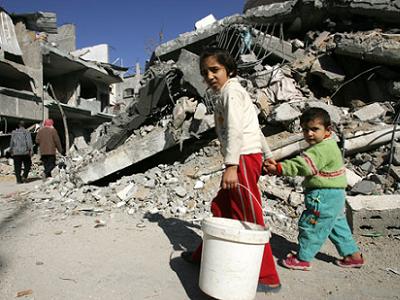
Gaza Bleeds

Israel destroyed in few days what Palestinians built in years. But this War proved one thing __ Israel is not unconquerable. Israel has used its full military power but wasn’t able to defeat the hearts and minds of people of Gaza. Even after such a heavy destruction, the people of Palestine are steadfast and pursuing their dreams of liberation from the illegal occupation of Israel.This is the month of Muharram, a month of sacrifices.  A month which starts with martyrdom of Hazrat Umar (RA) (Conquerer of Al-Aqsa)  and reminds us the battle of Karbala in which grandson of Prophet Muhammad (SAWW) was brutally martyred. 

This time, the battle field of Karbala is Gaza. 1.6 million people of Gaza are living in an open prison under Israeli blockade.  Can we think about a life in such a place where basic necessities of life are scarce and is constantly threatened by enemy strikes. 163 were brutally killed in a matter of few days and many more injured, including women and children, but they are not bowing down to Israel. Despite the propaganda of zionists that they are defending themselves, the spilling blood of Palestinians is evident that whats the real truth.

Social media played a vital role in bringing the issue into headlines. Palestinians were very active in it and Muslims all over the world helped them out. But facebook started showing its true face when it started blocking accounts and pages which were posting against Israel. The freedom of speech vanished for those who were standing with the victims of Gaza. But nontheless, brave Palestinians led the campaign  and showed the world the true face of Israel.

The role of of Pakistani media (electronic/print) was much deplorable. They totally remained aloof of the victims of Gaza and when they started airing/printing it, some of them were clearly standing with Israel. International media was expectedly inclined towards Israel. BBC and CNN were showing biased opinions. But it is a reality that entire world cannot be fooled for long by Israeli sponsored media.

USA was as usual on the side of oppressor while UNO kept mum. Israel has violated 65 UN resolutions  till date but no action has been taken against the oppressive country. Human rights organizations are raising voices but zionists and their backers are not listening to it.  OIC is still sleeping. Arab league is useless. So its left to ordinary people to raise their voices, help the poor victims and contribute towards the liberation of Palestine.

Majority of rulers of Muslim Ummah have probably forgotten this verse of Quran. Except Egypt, , Tunisia and Turkey, no one broke silence. Quran says:

“And what is [the matter] with you that you do not fight in the cause of Allah and [for] the oppressed among men, women, and children who say, “Our Lord, take us out of this city of oppressive people and appoint for us from Yourself a protector and appoint for us from Yourself a helper?” [Quran 4:75]

Not surprisingly, leftist(secular/liberal) elite of Pakistan decided to stand with Israel by taking refuge in the rhetoric that ‘Gaza is too far’ and ‘We have our own problems’. The answer is simple indeed, if we have our own problems, it does not mean that we  cannot talk about injustice and oppression going on in the world. We need to take practical steps to solve our issues, but we cannot ignore the violence going on in our surroundings. So do actions where  they are required (in Pakistan), and at least raise voice for those where you cant do anything more (in case for Gaza).
The most important thing is that we should not forget Gaza now. It should remain not only in our prayers but in our real life efforts. Palestinians need our help to rebuild what Israel has destroyed. They continuously need medical and food supplies. There should be more campaigns like that of ‘freedom flotilla’ for Gaza to help the innocent people. They are victims of brutal oppression and its time that we convert our words into actions.

Heroes of Gaza – II

I, a stranger here in Beit Hanoun, walk down this road at dusk. Every window with a face in offers me ‘Salam.’ The doorway of the sole shop has a family sitting in it, I wave.

‘Assalamu Alaykum’, they shout at me – cheerily. Yes cheerily, I feel the lump in my throat that I carry inside forming again. “Peace’ they offer to the stranger in their midst, as they bathe me in smiles of instant friendship. On the corner two young guys come over and greet me as if I am a long lost cousin. There welcome is so warm that I wonder for a moment if we have met on a previous visit to Gaza.

“Okay’ says the tallest brother, after introducing himself.
‘Nice to meet you now you come to our home to spend the evening, First tea, then you stay with us. Yalla come!’..

I laugh..

‘Why you laugh?’ asks the other boy in his late teens or early twenties.

‘We don’t joking – you come for tea now, really, Fadal.’

These boys are brimming with life. Their eyes have energy and hope in them that is utterly at odds with the grim landscape they live in. They are heroes of Gaza, the next generation of hope, the ones who will not be broken.

We can’t take tea with them and are eventually allowed to leave only with sincere promises to return to their home as soon as possible.

We have come to visit, amongst this needy populace, a family in dire need.

Through a broken wooden gate, behind a crumbling stone wall, my friend Yassir, silent and grim faced, points me into a cement building that has no right to be standing. It was once a PLO prison. Now it is ‘home’ to a family of one father, his two wives and their seventeen children. Before the second intifada the father used to work in Israel and he had enough money for his growing family. After the blockade, it stopped. So he worked as taxi driver. And that income was just enough to get by on for his growing family. Then the siege came. Food prices have shot up to parity with those in European nations whilst incomes here are Third World low. His car began to have small problems which he couldn’t afford to repair, which led to worse ones which killed it. I pass its rotting carcass and enter a large unplastered room with a cement floor. There is no furniture, no pictures, no adornments of any kind. Besides, two plastic chairs, the freezing space is utterly empty except for a small TV, on a crate in one corner. Children with hollow eyes, mill about, expressionless, wide eyed at the surprise visit of so many unknown faces. They look (and are) shell shocked.

One of the wives makes an attempt to smile. The husband in his shame at the poverty of his family mutters ‘salam’ and looks at the ground. Their sixteen year old son has a limp, I ask what the matter is, ‘has he hurt himself playing?’.

His trouser leg is pulled up and a large plaster ripped off revealing a fresh ten inch wound with stitches. His ankle is also bandaged. Two years earlier the boy (then 14) had been collecting rubble in the wasteland, once orchards that Israel has now stolen as its ‘buffer zone.’ His job was to sell the rock for whatever he could, to scavenge then, in the hope of some money for the hungry family. An Israeli sniper at a long distant shot him in his leg, shattering the bone. He has finally after years had the pins put in his shin. It is likely he will limp for the rest of his life.

A smaller boy of around ten is brought over. His dirty tracksuit bottoms are pulled above the knee to reveal strange white patches. White phosphorous, the napalm of the 21st century was blown across this area when Israel rained it, by the ton, onto one of the most densely populated cities in the world.

Another son of around seven, shoeless and silent clings to his father’s legs.
‘This boy’ he tells me, ‘has developed mental problems since the attack in 2009. The soldiers came many times into our home and wake the children up, shouting. Now he doesn’t talk and doesn’t act normally. Doctors can’t help him.’

Cooking is being done in the kitchen i.e. an empty cement space with a fridge that is empty except for four cauliflowers of questionable age. Due to the ‘cuts’ – twelve hour electricity blackouts – no family can chill or freeze food anymore. Fridges are just storage cupboards in Gaza. There is nothing else in the room except on the dirty floor, a single, ancient electric ring on which, now, a pan of chips is cooking. Chips that are enough for perhaps three children in the UK would here feed a family of 20.

It is Salah (prayer) time. The smaller of the wives takes me to another empty room. This one is called a bedroom because it has blankets in it. She lays out a prayer mat for me.

As I pray, I can see my own home, my own happy, educated, well fed, daughters. All the luxuries of London flood my sight and tears come. Besides me the mother makes her prayer. Behind me one of her daughters hold a torch on me as the room has no lights and no electricity anyway. It’s not the poverty that gets me it’s the evil of humanity that pours agony on almost two million Gazans, year in year out for 63 years. It is so much worse here than when I came four years ago, that words can barely describe the new cruelties Israel has designed to torture the people in this vast concentration camp.

‘Habeebiti’ says the mother beside me. ‘Please don’t cry.’

Her concern for me makes me sob even more. I can’t speak with the weight of my grief. ‘Oh God’, I think to myself. ‘Don’t let her be kind to me, please, I can’t take it’.

But she is. Of course she is. She is Palestinian.

‘My dear, why do you cry? Are you alright?’

‘I…I..hate this for you...’ is all I manage to utter.

She looks into my eyes. Mother to mother.

‘What? Don’t cry for us, it’s okay, you can stop now, shhh’.

Then, she says the words that almost break me, words that make me feel so humble. I fear, I may never stop crying. Tears that begin as frustration and sadness -become tears of love and respect.

‘We are so happy. We are Muslims, we know this is our test and we must be patient. We are happy, really sister, we are. Allah will reward us if we can just be patient’.

These are the exact words I have heard in EVERY home I have entered in Gaza at this terrible time.

Continue to  Heroes of Gaza – I

or Heroes of Gaza – III


Heroes of Gaza – I

I write this from a freezing, dark hostel room in the centre of Gaza. This area is now in a twelve hour blackout, so there will be no hot water to shower with this morning and no internet. After three days here, I feel, dirty, tired and emotionally wrung out. Yet, I know that in 48 hours, when the time comes to leave, I will not want to go. For Gaza’s incredible people have again overwhelmed a visitor with their warmth, their ability to offer friendship on a first meeting and their absolute resilience and faith in a Divine plan.

Yesterday, driving around was a stark reminder of just how serious the fuel shortage is here. At regular intervals the roadside becomes jammed with many hundreds of battered, near death, vehicles, stalled. Men sit at the wheels or smoke leaning against them, faces grim. They are locked into an 8 hour wait for just 100 shekels of fuel. Not enough for a quarter of a tank in the larger cars. When the fuel at the pumps becomes perilously low, each driver may buy just 50 shekels. As a result, cars are becoming if not quite a rarity, then certainly for a city with a population the size of Gaza – a luxury. Roads that were once jammed with the honking life typical of all major Middle Eastern cities are silent. The silence is not a blessing either; don’t think that for a moment! I remember when Diana died and cars were banned from the city centre for her funeral, what a beautiful day that was. Citizens could reclaim the streets and remember what it was to stroll in peaceful, bliss.

This is different. This silence is morbid and desperate. For alongside the near empty roads, are shops boarded up. And the pavements which you’d think would be jammed with people are empty too. There is simply no way to get to work – if you have it. Many shops simply close down due to the blackouts. This silence is the quiet of despair.

My bodyguard Mr Falafel (his nickname) and my friend Yassir, drive me to Beit Hanoun to visit a family living on the edge of one of Israel’s infamous and ever expanding buffer zones. On our way out of the main city, Yassir shouts,

‘Stop, Lauren let us get out and see this.’

It’s not clear what he wants me to see, As I get out there are men and boys milling everywhere, hundreds. There is shouting. Then I see them. A yellow, mountainscape of plastic containers piled four high in some places and stretching from one end of the road to the other. We follow the line of boys and are shocked to see the queue is the same length around the corner.

‘What is your name!?” shout boys of all ages
‘How are you today?’
‘Where you come from?’

The foreign lady in the hijab provides a welcome distraction from their miserable duty and Yassir and I are quickly embroiled in a human maelstrom of faces and laughter. We squeeze away from the youngsters towards a father in his fifties who is near the front of the queue. I ask him what he needs.

‘Fuel for the generator. We have no light. No electricity. We can’t eat. The children are cold.’

He has six children. That is a small family here. Looking at the thousands of containers waiting to be filled, each powering a generator that has become the only (ir) regular source of power for Gaza homes, I realise that each one represents a family of ten or more.

In a week, they say, even the fuel at these stations will run out. Then what?…

It is dusk, Maghrib prayer time, as we reach Beit Hanoun. An area that was, not too long ago, a place of farming. Of vast orchards stretching as far as the eye could see, where adults worked and children sheltered from the heat of the sun, playing the games that only children understand.

This evening the sun sets over what’s left; a sealed off scrubland of weeds and thorns.

We get out of the car. “Israel sent bulldozers and destroyed everything, all the trees; old trees, old orchards.’ I learnt.

Such is the sight to my right. To my left across the pot holed ‘road’ is Gaza’s frontline with Israel. The enemy that it fears so much are families in roughshod apartment blocks. No frills here. No trips to Ikea for little home touches. Here ‘home’ is a cement block low rise, half finished, slum. There are so many children here it’s hard to fathom for the first time visitor. Large families are the norm in Palestine and in Gaza, a pride. Each window of the hundreds I pass can represent easily five children within. Beside each and every window are dozens of Israeli bullet holes or the larger impact damage from shells of all variety. Hard to imagine the international reaction if a family suburb in Tel Aviv were attacked like Beit Hanoun is attacked by the IOF, over not just days, not even months – but years.

I remember once asking a very poor mother in Gaza why she had so many children.

‘We need atleast seven children to each family here’, she said

‘Why? Because atleast two will be killed by Israel. Two more, Israeli will take to prison for a long time or cripple with rockets. Two may (may) have a chance to get educated and they will leave Palestine and never return, which leaves just one child to look after us in our old age...’


Continue to Heroes of Gaza – II