Humanity at Stake

1157633_289730281164755_734281549_n

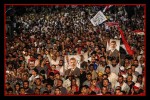
A woman in many women- and children and men- was reported to be rushing back and forth in panic of the gunfire chasing her. A woman- another woman- was seen from her balcony with a portrait of General Al-Sisi; watching, observing, comprehending, and smiling. A grimly smile. This is not fantasy. This is not a scene from a horror movie. This is real life and real humans- or at least, real humanoids!

People are seen enjoying the beach in the scorching heat to get away perhaps from the tense city life. But behind the beach there is a road, and behind that road there are buildings, and behind that building we see smoke, a tense, scorching hot smoke. And we learn that that smoke is the product of chaos, of oppression, of resistance, of subjugation, of panic, of murder, of silence, and of noise. People lie dead on the streets and people lie flat on the beach. Two stories. One city.

Egypt is in crisis. This we are all told. But there is much more to the story. The crisis isn’t merely political. It isn’t merely about who you support. It isn’t about who you don’t support either. It’s not an Egyptian issue anymore. Boundaries don’t make sense now. It’s boiled down to the very essence of what it means to know and love freedom and democracy, to value dignity, to value humans as human subjects, to figure out what it means to be human.

But here is where narratives fail, and collide. The crisis in Egypt has consistently been portrayed as a clash between two parties- or to say, two narratives. This schema has been deliberately consolidated by both the coup-regime, which includes all its functionaries, and forces of the global hegemonic status quo. Locally there is this thing they call ‘the people’- a label created to function as a catchall term for supporters of the illegitimate regime- and then there are ‘terrorists’- a label used to discredit a demonstrably peaceful resistance movement against illegitimate regime change.  The mainstream global media on the other hand adopts a less obvious propaganda model. It divides people into ‘anti-morsy protestors’ and ‘pro-morsy protestors’- or sometimes calls them ‘Muslim Brothers’ straight out- and by doing so it very criminally distorts the picture. In doing so they’re undermining the fact that the ‘pro-Morsy protestors’ are in fact an ‘anti-coup’ and ‘pro-democracy’ movement. But of course, is it really a coup? And yet, it isn’t a matter of what definitions say when it is a matter of what global (western) interests say.

The most vulgar display of this politics of labels and binaries was when the world was watching military men, accompanied by tanks and cheering fascists, firing directly at the Al-Fattah Mosque in Cairo where a few hundred protestors were trapped. The domestic media portrayed it as an operation against anti-state elements and terrorists—one of the old classics- while the global mainstream media portrayed it as a clash between two rival parties- that very workable tactic. By calling it a ‘clash’ or ‘conflict’ of what is clearly obscene violence carried out by the establishment against individuals is the old method deployed in covering the ‘Israel-Palestine conflict’ or what is clearly Israeli repression of Palestinian individuals.

The Egyptian crisis has also become a crisis of confusion in Muslim majority societies. A victim narrative seems to emerge where the culprit is made to be democracy itself. The greatest beneficiary of this narrative is none other than Al-Qaeda itself; just as it was the greatest loser in the Arab Spring where it seemed as though change through peaceful and democratic means was a viable option. This optimism seems to fade away. This is the same optimism that makes sleeping difficult for oppressive regimes; for it’s easier to break bones than minds. The narrative serves both terrorist groups at the fringes of society and the establishment controlling society. But besides the damage that is carried out by this narrative, it is also flatly wrong. What happened in Egypt was not because of democracy but the lack thereof. There was nothing remotely democratic about it. Even the regime of Mubarak retained itself in all spheres of life. Not only was a democratically elected parliament disbanded immediately on a technicality, the democratically elected president was never given any true authority. He was overthrown by anti-democratic means and what is now present in Egypt is the suppression not only of people but of the very notion of democracy and freedom. It is here where the story needs to be squarely put as a matter of democracy, freedom and dignity. To place the problem elsewhere undermines and hurts the broader cause.

What else needs to be understood from the problem in Egypt is the consequences of polarization and uncompromising partisanship. To understand each other, to build on each other’s point of view, to discuss and debate critically are all essential to the health of a given society. A politics of empathy is the need of the hour. Unfortunately, Muslim majority societies are plagued by a clash of uncompromising narratives. The damages have played themselves out it Egypt. Pakistan is also deeply polarized and suffers from a politics of condemnation and ridicule of the other. In Tariq Ramadan’s words, Muslim majority societies need a ‘cultural revolution where we can think critically about our current state, be conversant with the challenges of modernity, offer creative solutions to contemporary challenges, as well as be consistent and employed with cultural, religious and civilizational references. This calls for moving beyond binaries and labels, and moving forward constructively and collectively.

When a Mob Sacked Democracy

Egypt-Morsi“Truth never damages a cause that is just” ~ Ghandhi

“Injustice anywhere is a threat to justice everywhere” ~ Martin Luthor King

Today is a throbbing day for democracy, rule of law, legitimacy, truth, factuality, principle and any other word that fits into the same category. An elected head of the state, with a victory margin of a million votes, was overthrown by an army chief who said blatantly and shamelessly ‘this is not a coup‘.  Shadi Hamid, a renowned analyst on Egypt and the director of research at the Brookings Institute, Doha, was almost spontaneous when he replied ‘If this is not a coup, the word “military coup” no longer have any meaning‘.

https://twitter.com/evanchill/status/352492220387041282

Robert Fisk writes:

For the first time in the history of the world, a coup is not a coup. The army take over, depose and imprison the democratically elected president, suspend the constitution, arrest the usual suspects, close down television stations and mass their armour in the streets of the capital.  But the word ‘coup’ does not – and cannot – cross the lips of the Blessed Barack Obama.

The inclinations and operations of Supreme Council of Armed Forces of Egypt better known as SCAF have been dubious at best from early on. Not that it is any excuse but this is a problem ingrained to all countries with powerful militaries and shallow and weak democractic institutions. The Egyptian military is no exception. In Post- Mubarak Egypt of early 2011, when SCAF was all in all of Egypt and protests broke out against it, the military police killed 14 unarmed protestors and attacked journalists in the famous Tehrir square. How can one forget the poor Egyptian woman in the clip who being seized by her hair was dragged unto the street with her abaya torn apart. Mona Eltawy, one of the secular voices, who was a strong part of protest movements in 2011 was attacked, sexually assaulted and recovered only with her arm broken by the same military police. These are a few examples of the legacy of policies kept for half a century of oppression directed towards political opponents. And trapped at the center of it was Muslim Brotherhood for last few decades.

One has to look back a few decades of the near past, if the real face of SCAF, the dictatorship, is to be unveiled. Concentration camps, extrajudicial killings, military trials, as well as some of the worst torture techniques known to man is the essence of the methods deployed on brotherhood workers and leaders. There is no reason to believe that the present day SCAF is any different. As a matter of fact, mumbling started on twitter the moment SCAF started movement last night regarding retribution and violence against Islamists. The ban on leaving the country put on twenty Muslim brotherhood leaders including Morsi is another indicator shedding some light on the gravity of the situation. [It should be remembered that the ban is applied despite there being no cases of fraud, attack or any such incidents from citizens of Egypt against those twenty leaders. Not once was the use of excessive force utilized by presidency against protests against him. Compare that with Mubarak times or Suleiman times in 2011 and the difference is un-concealable.]

There is no doubt in any serious analyst’s mind that the protests in Tehrir today are the direct result of prevailing dire economical scenario, petrol and electricity shortages in particular yet the anarchy is ironically preposterous. Tamarod (rebels) the group that coined the June 30th protest idea was formed just a few months ago. The one unequivocal demand they put forward unshakingly, was that the President of the majority of Egyptians, who they voted for themselves just an year ago, should resign. The reason: because he was unable to fulfill the promises of a prosperous economy, a reformed justice system and security of the country in 365 days, only 20% of the time he was given to serve.  Absurd, stupid, foolish and what not! Even for a newly democractic-leaning country like Pakistan once you think about. But this is how it works in an naïve and unmellowed system with volcanic political scenario and opportunistic opposition leaders who don’t even care about the precedence they are going to set, for not only the next government but the Egyptian generations to come. Tamarod leaders were as stupid as to say that army response actually crowns their movement

The crowd on Tehrir has been out of control. While there were few grave incidents of assaults on women when Religious and Secular Forces were protesting together against Mubarak, this time it was exceptionally high, alarming for the whole society . Guardian reported that over 90 women were raped  and sexually abused in Tehrir Square in a mere four day period. There are more than a few evidences suggesting anarchical mindsets and behaviors of protestors despite Tamarod’s repeated rejection of the presidency’s statements that put blames of such attacks on uncontrollable crowd. There were unconfirmed horrifying pictures and reports of MB youth being attacked and mauled by crowd. Another report described a brotherhood youth being burnt alive by protestors. The attacks on peaceful rallies of Muslim Brotherhood in Cairo University, the attacks and torching of the offices of brotherhood in Alexandria, Cairo, and a number of other cities summarizes the nature of the movement very clearly. The attack and shots fired on Cairo-University’s Pro-morsi protestors, who had the same right to protest as the Tehrir’s Anti-Morsi protestors,was an example of blatant savagery and ruthlessness of the crowd. 14 Morsi supporters died on spot, another 4 in hospital later while police watched. Putting aside the anarchy, the sheer use of violence, and the ridiculous demands, the hallmark of the Tamarod movement can be visually evident in the way they welcomed toppling of a legitimate democracy by an illegitimate force, the SCAF. Shadi Hamid put it forwards accurately:

Obviously, Morsi did make mistakes as was expected of him being the first democratically elected leader of the country. The presidential decree, the tax on IMF’s behest, the Attorney General  decision were the most highlighted of the bad decisions. The huge turnout against him would never have been possible, had the matters been smoothly run and the whole scenario would have been different. The most significant finding, however, that an analyst can easily draw from this crisis is the hypocrisy of the secularists. The same Egyptian secularists (to clarify: though these secularists like to consider themselves liberal we cannot fathom any reason to bestow them with this title. They are intolerant, prejudiced, closed-minded in practice, exactly what constitutes a non-liberal fascist) ran head over heels for protests against a presidential decree that gave Morsi almost absolute powers, which he needed to bypass a controversial court decision concerning political system. Similarly they condemned and were furious when the attorney general charged the famous satirist with contempt against president when he mocked the president during Morsi’s Pakistan visit and later when he mocked a salafist religious figure for his beard. The freedom of press can never be compromised, they said. Ironically, both of these two freedoms were snubbed last night with a lot more by SCAF. Aljazeera Mubashir crew was arrested for ‘undirected reporting’. Brotherhood’s Channel Misr 25 was forced shut with its crew arrested. Last nail in coffin: The interim president has decree powers. The protesting secularists cheerfully accepted both without a single word. Hypocrisy at its peak!


The role of United States was a replay of diplomacy it showed in 2011 as Mubarak was being ousted. While correctly showing concern for the assaults on women and the violence, President Obama correctly mentioned to his Egyptian counterpart that democracy is not only about voting. The 1.3 billion US aid for Egypt is based on a democracy based criteria. “We don’t make those decisions [on aid] just by counting the number of heads in a protest march, but we do make decisions based on whether or not a government is listening to the opposition, maintaining a free press, maintaining freedom of assembly, not using violence or intimidation, conducting fair and free elections,” Obama said on Tuesday amid SCAF’s ultimatum, subtly recognizing the fact that a free-press is still an entity in Egypt, and violence is still not used by state. It’ll be upto the US state officials and lawmakers how they interpret this recent turn of events which can be of huge consequence for Egypt. Labeling it a ‘coup’ would disqualify Egypt from this aid, an act that can be a huge blow to the paralyzed and sinking economy of the country. The political ambience of Washington DC put together with the history of US policies is however not suggestive of this. Ed Royce, a republican and the Chairman of the House Foreign Affairs Committee is all but concerned on military take over. The grin of islamophobes would not be easily disguisable over this epic fiasco of one of the largest experiment on the political system of Islam. The aid is the reason the Egyptian spokesperson and SCAF leader are going at great lengths not to get these events labeled as coup. It is also partinent to mention here that Obama’s support and gratitude to Morsi for the major part he played in terminating the war on Gaza by Israel, the IMF loan approval last year has fuelled enough conspiracy theorists among Egyptians linking the organization of brotherhood to US. Secularists put forward this propaganda and used it to their gain very successfully in recent protest campaign.

Finally, Let us present the most ironic, interesting yet disturbing comparison that is able to show the gist of all the hassle that is SCAF Vs Brotherhood Vs Secularists. 300 arrest warrants have been issued against MB leaders, 100 of MB leaders are put on Exit Control List in addition, Speaker of the parliament Al-Katatni alongwith another 300 was arrested. Supreme leader of brotherhood is arrested. Article 174 of Penal Code “Incitement to overthrow government” is punishable offense under Egypt’s law, and will probably be used to register cases against MB leaders and workers. There have been dozens of protest movements against Morsi in previous year. Not once was any illegitimate arrests made, or such articles of penal code  used by Morsi. Yet the standpoint of International media & secularists is: Morsi is is the axis of Evil, and SCAF is our heroes.

There are lessons to learn for all the Islamic movements in the world in this monstrous experiment of Egypt. The take away is of a serious moral nature for the so-portrayed ‘liberals’ of the Muslim world. They should decide what they want more, their cause or the truth, as well as honesty, justice, legitimacy, authenticity, principle, and so on. For Islamists, Abdul Kader Haqqani of Algerian Islamic Movement summed it up rather short.

“(For Islamic groups) Political victory is more dangerous than defeat” 


The Rise of Revivalists

It was a sunny day on 12th February 1949 when the leader of Muslim Brotherhood, Hasan al Banna was invited for a meeting with an Egyptian government minister in Cairo. At the venue, the minister never appeared and hence the brotherhood’s leader had to leave. While he was on the street to get a taxi, he was shot by unknown person.

The Brotherhood’s leader death was widely assumed as an officially planned assassination. Hasan al Banna funeral was publicly banned by the then Egyptian government and only his father, brothers and some family female members were allowed to carry out his final ceremony.

Hasan al banna was a highly charismatic person and a sharp-minded school teacher who laid the foundation of Muslim Brotherhood in Egypt in 1928. This was the first mass based Islamic party, which overtly worked politically and within country’s legal framework. Brotherhood challenged the ascendancy of secular and western ideology in Egypt and in the whole of Middle East countries. Hasan al banna strongly felt that in the unislamic ideology lays the root of the decay of Islamic societies in the modern world, and advocated a return to Islam as a solution to the ills that had befallen Muslim societies. The message of Brotherhood had spread swiftly not only across the adjacent Arab countries but reached countries far away like Indonesia, Malaysia, Iran and Pakistan.

Hasan al Banna’s achievement was creating a flexible and dynamic structure aiming to transform his vision into reality. He founded numerous schools, factories and mosques in less than 10 years. He was able to provide over a half million committed workers and twice as many supporters to the Brotherhood. The work of Brotherhood started to transcend the national borders. It was the time when Hasan was invited by the British ambassador for tea, complimented for his good character and admired for his work for the poor. He was told that it is in the Brotherhood’s interest to get assistance from British. Hasan politely listened to ambassador and told him that all of his money belongs to Egyptians and the time for British was soon coming to an end. This caused the starting of the conflict between him, British and the then Egyptian monarchy.

No one could have imagined the future of the then Egypt’s most influential and largest revivalist party after his founder, Hasan al banna was mercilessly murdered followed by a massive crack down on his party. Scores of his party members were arrested and subjected to worst physical torture inside the military jails. The party’s assets were confiscated. The situation not only lasted for months and years but for decades and any association with Brotherhood was consider as a serious and unforgivable crime.

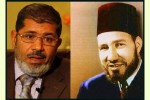
The dawn of June 24th,2012 comes along with the election commission’s announcement that Muslim Brotherhood’s candidate, Mohammad Morsi, had won the country’s first contested presidential election, making him the first ever islamist president in the arab world. It took eight decades to Hasan al banna’s dream to come true. Morsi addressed to the tens of thousands at Tahrir square,


“I’m your president, but not without you. I’m your president, but I’m not the best of you…I fear Allah (swt) and no body else.. I will be always one of you. I have been given the authority over you, but I am not the best of you. If I do well, help me; and if I do wrong, set me right. Obey me so long as I obey Allah (swt)and His Messenger (s.a.w), but if I disobey Allah (swt) or His Messenger (s.a.w), you owe me no obedience.”

Despite the time taking and tough period, The Egyptian socio political Muslim Brotherhood has shown its commitment to its cause and vision, given many decades before by Hasan al banna. It would be interesting to see how their counter parts in other countries especially in Pakistan would be performing in the Elections to come. Jamaate Islami claims not only to have close ideological ties with Brotherhood, but due to the amazing similarity in organizational structure and working strategy, is considered to be the Muslim Brotherhood of Pakistan.

The political battle between Islamists and regimes all around the world is not over, it has not only begun but in fact has gained momentum. The brotherhood and such revivalists are emerging as significant forces in the politics of several Arab and non-Arab countries, either directly or through the movements they inspired.

They are appealing most to the masses and cultural conservatives who want their government and society to reflect and defend certain basic Islamic values and principles, and who favor a pragmatic and incremental approach to achieve these goals. The legacy of Hasan al-Banna is thus still presents, and will continue to shape the destiny of societies in the new millennium.