Such a little thing

I felt the freshness in the air; of the evening merging slowly into those blessed first moments of the first night of Ramadan. I felt the vigour in my step as I walked out the gate just after the pre-Ramadan study circle in my neighbourhood had finished. We had studied a collection of Hadith on Ramadan_ of the springtime of faith and the ethereal blessedness it comes wrapped up in. And it had touched some deep buried cord somewhere in the recesses of the soul.

I have walked the short distance from the neighbourhood weekly Quran study circle back home many times. Meeting on the way many a sidewalk bystander ogling to pass the hours away. I have met many a prying gaze of a passing vendor, a house guard, an urchin. Outside my weekly ‘haven’, another world awaits. From the surreal to the rudely real, the eyesores of a degenerate society. Sigh!

There he comes, yet another; a street vendor perhaps. I braced up for the unnerving stare, catching in the process, a glimpse of a face_ the kind that expunged the tautness, putting me so strangely at ease.

It struck. Instantly! The white prayer-cap and the beard removed the ‘otherness’. The gaze that lowered itself, the humble step that gave a freer passage, the innocence, nobility written all over was strangely comforting_ unlocking, decoding, and bringing home a message: a beautiful heart. The recognition came in an instant.

It unfurled an identity. I noticed the deep sun-tan with those long days of labour. I noticed the rough white Shalwar Kameez well-worn, having endured many washings, creased up, patched in places. I noticed the loosely hanging empty jute bag slung across the back of his bicycle and the two folded up paper bags of used cement. Clearly, this scrap seller hadn’t made a business today. Yet he persisted as the day receded,  still calling out to the many affluent perhaps still dozing away amidst the buzz of the air conditioners behind thick walls and locked doors. ‘Loya raddi waich lau’ (Sell off scrap metal and paper), he called out in the empty, darkening street, perhaps the only listener to his own persistent cry. He pedalled on speedily, not completing his round to the end of the street but turning round half way to make his way back_ perhaps having learnt that there were no listening ears behind the thick walls, no one to hear or make out his locally accented cry; to notice that hole at the border of his Kameez, the empty loose sack or the well-worn, cracked up, mud-stained slipper quickly pedaling on_ perhaps to make it to the masjid in time for Maghreb prayer.

It was in seconds. I felt the connecting, the bonding up. I didn’t think it up but surprised myself by suddenly calling out to him as he rode on past me, ‘Bhai!’ ‘My brother’_ effortlessly, in a spontaneous outpouring came the words. ‘Bhai zara rukna. Aap raddi bechtay hain?’ (Brother, please stop. Do you sell and buy scrap?)
He couldn’t perhaps register it as he cycled on, used to the stony, unrelenting, indifferent silence in affluent localities. For an instant, I thought I had missed, and I felt the heart sink. Till, having rode a few yards ahead, he turned back to look and finally stopped, getting off the bicycle, dusting off his hands and shirt and, still with that ‘Muslim’ gentility and modest gaze that had held me, waited for me to approach. ‘Ji baji.’ (Yes, sister).

The evening cast darker shadows, the first night of Ramadan waited in the wing to gradually suffuse. These sacred moments…

And this muddied scrap seller here with his sunburnt face irradiated, ennobled, beautified by the Sunnah. I saw it all in one radiant flash. ‘Ramadan Mubarak!’ I said. ‘Mere paas yeh Ramadan ka chhota sa tuhfa hai aap ke liye,’ I said (I have a small Ramadan gift here for you), handing out whatever I could rummage through my pockets.
Visibly surprised and at a loss for words, he said, ‘Jazakallah khair baji.’ Silence. And then, gathering himself, he added, ‘Allah aap ko iss ka bohat ajar dei. Aap ko bhi Ramadan Mubarak.’ (May Allah reward you greatly for this. Ramadan Mubarak to you too.) I noticed the flawless, unaccented Urdu and wondered where he had got it from. The labyrinth of destiny, who can make out?

Realizing perhaps the insufficiency, the inadequacy of my gesture, the unspeakability of that strange link, I added, ‘Bhai duaon mein zaroor yaad rakhye ga.’ (Brother, do remember me in your prayers).

As I made my way on, I felt lighter, unburdened, relieved. And I saw his frail figure, the beard, the cap merging into the twilight’s colours, soon a silhouette against the far end of the road.

And I wondered who he was, what was his name, where he lived… regretting not having asked. ‘Bhai’ (brother) I had called him, not feeling the need to call by a name, not feeling the need for statistics to identify. ‘My brother’, striving on life’s rocky road, striving among the pain and toil to keep to the straight and narrow, a lover of my Prophet (SAWW), a slave of my God.

As I sat on the prayer mat on the night of first Ramadan, I thought of the nameless scrap seller who must also be engaged in prayer somewhere. And I knew that the power of prayer, the faith we share creates the sacred link_ undying. I felt the indissoluble, ever-present link of Muslimhood, that thing called ‘love for Allah’s sake.’

‘What a little thing
To remember for years,
To remember with tears!’

A Profane Spirituality

Pakistani private television channels glamorously sport sensational televangelists to satiate the public appetite for spirituality amidst tawdry entertainment galore. The trend rockets in Ramadan when popular media faces don sobriety in cotton shalwar kameezes of subdued hues, skull caps and most alluring beaded scarves and chiffon dupattas. It sells!

This year once again we have on screen with all his guns blazing one of these popular televangelists known for his versatile talents in speaking, singing, making dramatic invocations and tear-stained supplications as well as skills one cannot mention at the family dinner table. The latter came to light in a leaked video that had recorded this ‘aalim’s behind-the-camera antics and escapades. There was great shock and horror at this most dramatic volte face from a simple-minded populace that loves hero-worship. The wiser ones chuckled, saying, ‘I told you so.’ The ‘aalim’ carried on with classic composure, invoking divine retribution for the liars behind the scandal in his usual flowery and flamboyant language. The dexterous televangelist carries on with his repulsively seductive religious rhetoric aimed at the simplistic mass mind-set.

Notwithstanding the public humiliation he underwent and the aggravated sentiment of his massive fan-following (largely female), the aalim stuck to his guns and emerged unscathed. There you have it- the aalim (dis)graces the screen of Pakistan’s most popular private television channel this Ramadan with an unbelievable audacity. In your face. What adds a flabbergasting twist to the tale is the fact that the earlier video had been allegedly publicized on youtube and elsewhere by this very channel which now advertises his program as its Ramadan highlight. The channel also must be credited with putting up this ignoramus of abysmal moral standing and dubious background as an ‘aalim’ before the Pakistani public in the first place. After his metamorphosis into an ‘Aalim Online’ thanks to this channel, the so-called aalim reappeared on a similar evangelical show on another channel having quit his mentors in the previous one. That is when appalling off-camera clips from his programs recorded for the first channel went viral. In a mind-boggling move, the aalim returns to this channel he had quit, reaffirming his loyalties and once again using his odious eloquence to seduce gullible minds.

The entire episode reeks of a most worrying and dangerous trend in Pakistani society. The commercialization of the mass media has taken a heavy toll on our most sacred values, marketing spirituality. Religion too is to be sold, like soap or whitening creams or cheap powder. It is embellished with a deliberate spirituality calculated to keep the viewer glued to the screen, packaged under brand names, presented by alluring faces in lighter shades of lipstick framed by an oceanic-blue-green or pristine white sequined scarf. For a more dramatic touch, the camera captures a little tear droplet streaming down the lightly painted face at the precise time when the camera zooms in. It is a winning advert- sure to guarantee a sizeable viewership of semi-literate housewives from all over the country.

The ethos of Islamic culture is simplicity. Spiritual practice is an intensely private matter, and when it is brazenly flaunted by exhibitionists it loses all sanctity. The individual’s faith is a matter between him and his Creator, and humility is the defining trait of the believer. Religiosity dripping from phony appearances, hairy faces appropriate for the occasion, titles, and headgear exposes the emptiness, superficiality and hypocrisy of the trade. According to a hadith,

‘Allah does not look at your appearances, but He looks into your hearts.’

The Pakistani media has reached the lowest point of depravity with this commercialisation of spirituality. It steers directionless, blinded by the commercialist and competitive imperative, leading a nation wired into the matrix, frozen into a hypnotic trance like sleepwalking starry-eyed zombies.

The artifice, pretentiousness and even shameless hypocrisy of it all is a damning verdict on our collective morality as a society. I fear for the generation that grows up in and is socialized into this morass of values. When the persona of the ‘religious scholar’ is tarnished with debauchery, hypocrisy and showmanship; when spirituality is worn and flaunted for appropriacy according to the occasion; when our most sacred values are presented in such blatantly superficial and distasteful ways, I shudder to think of what we are dwindling into as a society and a nation, what papier mache ‘role models’ and inspiration we are leaving behind for our children.

Welcome Ramadan

By the grace of Almighty, the holy month of Ramadan is here. With every beginning of Ramadan, the environment suddenly changes in Islamic world and the bond between Muslims gets stronger and more beautiful. It’s a month of virtues, repentance, charity, forgiveness and blessings.  The month gives us opportunity to reconnect with our family and friends as well and rethink about our priorities in life.  This month gives a chance to everyone to be closer  to the Lord.  The opportunity is for everyone to utilize; to reflect, repent and cleanse the inner self.

Prophet Muhammad SAWW delivered a beautiful sermon to welcome the month of  Ramadan which is narrated below.

On the authority of Salman al Farsi (May Allah be pleased with him) it is narrated that during the last Jumu’ah of the month of Sha’ban the Prophet (Peace be upon him) recited a Khutba (sermon) in which he said:

  • ‘O people there comes over you now a great month, a most blessed month in which lies a night more greater in virtue than a thousand months. It is a month in which Allah has made Fasting compulsory by day, and has made Sunnah the Taraweeh by night. Whosoever intends drawing near to Allah by performing any virtuous deed, for such a person shall be the reward like the one who had performed a Fardh (Obligatory act) in any other time. And whoever performs a Fardh, shall be blessed with the reward of seventy Faraa-idh in any other time.
  • This is indeed the month of patience, and the reward for true patience is Jannah (Paradise). It is the month of sympathy with one’s fellowmen. It is the month wherein a true believer’s rizq (sustenance) is increased. Whosoever feeds another who fasted, in order to break the fast at sunset, for the feeder there shall be forgiveness of sins and freedom from the fire of Jahannum (hellfire), and for such a feeder shall be the same reward as the one who Fasted (who he fed) without that persons reward being decreased in the least.”
  • Thereupon we said, “O Messenger of Allah, not all of us possess the means whereby we can give a fasting person to break his fast.” (They were at the time under the impression that Rasullulah(saw) referred to a full meal). Rasullulah (saw) replied:
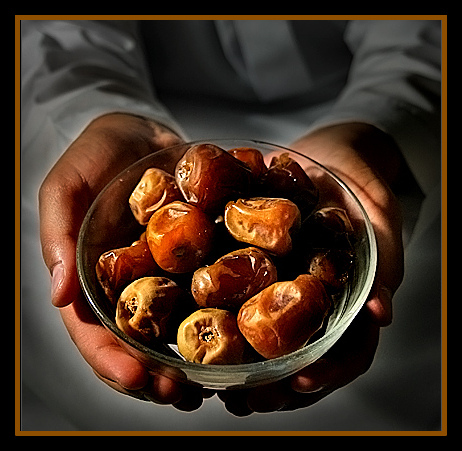
  • “Allah grants the same reward to the one who gives a fasting person to break the fast a mere date, or a drink of water, or a sip of milk (for Iftar).”
  • “This is a month, the first of which brings Allah’s mercy (i.e. the first 10 days), the middle of which brings His forgiveness and the last of which brings freedom from the fire of Jahannum.”
  • “Whosoever lessens the burden of his servants (d cor those under his authority) in this month, Allah will forgive him and free him from the fire of Jahannum.”
  • “And in this month four things you should continue to perform in great number, two of which shall be to please your Lord, while the other two shall be those without which you cannot do. Those which shall be to please your Lord, are that you should in great quantity bear witness that there is no deity to worship except Allah (i.e. recite the Kallimah Tayyibah Laa ilaha illallah) and make much Istighfaar (repentance, beg Allah’s forgiveness with Astagfirullah). And as for those without which you cannot do, you should beg of Allah, entrance into Paradise and ask refuge in Him from Jahannum.”
  • “And whoever gave a person who fasted water to drink, Allah shall grant that giver to drink from My fountain, such a drink where after that a person shall never again feel thirsty until he enters Jannah.”  [Ibn Khuzaimah in his Saheeh]

This Hadith not only signifies the value of Ramadan but tells us how to behave during the holy month. Ramadan takes us out of the usual routine life and places us in a total different scenario while we are doing the same routine tasks. Our behaviour totally changes. Its like a breath of fresh air. Syed Maududi rightly said that it’s a litmus test to check the ‘life’ of a Muslim society.  If there is some life left in a society, it will be evident during Ramadan.

One thing which we should ensure is that we must continue the virtues even after Ramadan.  This is a training workshop of unity, tolerance and piety for 30 days for entire Muslim society and we should learn from it and continue these good habits throughout the year. If we can refrain from ‘Halal’ (permitted) things when ordered by Allah and when we work together in unison, then it’s not difficult to stop ourselves from the ‘Haram’ (forbidden) if we are willing to obey and please the Lord.

Blockbuster deals: Are you ready?

‘What a dhamaka khaiz offer yaar!’ I heard a teenager speaking to his friend with bright eyes and excited tone, over the new offer by a leading multinational food chain in the city. He added “I am sure they won’t compromise on quality as they are up to international standards and it is world renowned global chain”.

This was the day when a multinational food chain started its business in Pakistan and offered one for one (Buy one, get one free) pizzas. Regardless of the quality they served, there streets were jam-packed with cars and people outside all of its outlets. People waited for hours to get that one free pizza. Most of them came out with some complaints that they were not served properly, the quality was not up to the mark etc. but at least they were happy and content that they got two pizzas and paid for one.

I recall an offer, I read a few days back, guaranteeing 700% returns on investment with no hidden marketing gimmicks, from someone extremely credible. It also talks about guaranteed spacious accommodation at the most peaceful and picturesque place ever existed, with all the incentives one could dream of.  You just need to find the right person, give him your investment money and  you have a pre-confirmed pact that your account has been upgraded with 700times (or more) the profit.

What a lucrative offer it is by none other than our Creator, Allah (Subhanahu Wata’aala). He guarantees:

The charity of those who spend their wealth in the way of Allah (charity) may be likened to a grain of corn, which produces 7 ears and each ear yields a 100 grains. Likewise, Allah develops manifold the charity of anyone He pleases, for He is All-Embracing, All-Wise. (Surah Al-Baqarah 261)

To add to this, Allah has offered some amazing incentives in the form of virtues of Ramadhan. It’s a month when rewards are multiplied 70 times for every obligatory act of worship (Farz), while each offered nafil (voluntary act) is rewarded as farz. In this very month, Allah has promised to forgive all sins provided a person fasts and spends sincerely, seeking rewards from Allah alone. This is the very month where prayer of one night is rewarded as if one has prayed for 84 years (1000months). Allah says that every deed will receive 10 to 700 times reward, except Siyam (fasting) as it is for Him and He will reward it as he likes.  Wow, now this is surely a called a “Dhamaka-khaiz offer”.

Ramadhan provides excellent opportunity for us to purify ourselves and make habit of abiding by the commands of Allah and his Prophet (S.A.W). It is the month of blessings when Quran was revealed, It is the month of Allah’s extreme mercy, forgiveness and emancipation from the Hellfire; a month when it is made easy for us to practice good deeds and the doors to Heaven are let open while devils are held captive.

In short, it’s a month of countless blessings from Allah like a rainfall but its effects are not the same everywhere and on everyone. For instance, when it rains, a piece of land absorbs and benefits according to its receptive quality. At one place the Earth turns into a lush green field and on the other, it only collects for a while and either drains or evaporates. So it is up to us how we spend Ramadhan and either avail it and prosper, or waste it and destine ourselves to complete destruction (according to a Hadith of the Prophet SAW).

Are we looting this sale, competing each other, as we queue up to get a free Mobile SIM, a half price worldly deal or as we put ourselves in pain by not going to bed only to avail a mere midnight food offer. Book your commitment order now and utilize these wonderful bunch of offers. Ramadhan Mubarak!


Reference:

Al-Quran (Surah Albaqarah (183, 261), Surah Al-Qadr, How to spend Ramadhan (Urdu)