Letting Shadows Fall Behind

When a friend from Bangladesh gifted me a jute bag with the Bangladesh flag motif painted on it, I asked her to explain the symbolism. She told me it stood for the rising sun over the green fields, reddened with the blood of liberation martyrs.

After the terrible atrocities in 1971 in which many innocent Bengalis lost their lives, retributive justice to the perpetrators of brutal crime needed to be carried out by Pakistan. This was never done, consumed as the country was in an unseeing jingoism. George Orwell wrote in his memoirs of the Spanish Civil War, ‘Everyone believes in the atrocities of the enemy and disbelieves in those of his own side.’

Resultantly, in Bangladesh, these atrocities have become over the years part of the collective memory and the national narrative. The hurt and anger has festered to the beat of nationalistic fervour and has turned into an unrelenting, bitter hate and hardened prejudice against the enemy.

On the backdrop of this charged nationalistic sentiment, in 2010 the International Crimes Tribunal was established by this government, though its legitimacy and capacity to deliver justice have been put to question by objective observers.

There is also the concern that the much-awaited decision announced recently was more a political than judicial decision. The Jamat e Islami is an important part of the political opposition against the current regime. The primary accused belong to the Jamat, widely considered to be complicit in Pakistan army’s violence against the Bengalis in 1971.

Justice is a great thing and often a vital part in healing and reconciliation. The events in Bangladesh carry the pretence of a justice that gratifies the strong national desire for vengeance. Whether real justice can be delivered given the lack of integrity and transparency about the proceedings, is open to question. The presiding judge Nizamul Huq resigned following questions over the publication of private conversations which cast doubt on the court proceedings. The Economist writes,

“The e-mails and phone conversations we have seen raise profound questions about the trial… the government tried to put pressure on Mr Nizamul… he worked improperly with a lawyer based in Brussels, and that the lawyer co-operated with the prosecution_ raising questions about conflicts of interest. In Mr Sayeedi’s case (head of JI, given a death sentence this week) it points to the possibility that, even before the court had finished hearing testimony from the defence witnesses, Mr Nizamul was already expecting a guilty verdict.”

Held under the thumb of mass public furore and the voracious appetite for vendetta, the verdict seems to have been preordained. Justice is blinded under pressure of emotionally charged public sentiment, and the hand of blind justice has a fell sweep. George Orwell adds,

“As far as the mass of the people go, the extraordinary swings of opinion which occur nowadays, the emotions which can be turned on… are the result of newspaper and radio hypnosis.”

Doling out death sentences in such an environment is a travesty of justice. In a conversation of October 14th, between Mr Nizamul and Ziauddin, the Brussels-based lawyer of Bangladeshi origin, the judge refers to the government as “absolutely crazy for a judgment. The government has gone totally mad. They have gone completely mad, I am telling you. They want a judgment by 16th December…it’s as simple as that.” December 16th, known as Victory Day in Bangladesh, is the anniversary of the surrender by Pakistani forces in the war of independence. (The Economist)

While the demand for justice to war criminals is understandable and legitimate, the concern is about whether this public sentiment has been used for political opportunism. Given the traumatic birth of Bangladesh and the horrific memories haunting public imagination, a regime credited with bringing offenders to book will win hearts. Given the many failures and weaknesses of this regime as well as the fact that the Jamaat is a vital member of the opposition alliance, there seems to be a method to the madness.

The social consequences have been grave with violence spiralling out of control. The long-term repercussions are graver still. Opposition to the verdict has been brutally crushed by the state machinery and violent reprisals have victimized hundreds. The crowds calling for a death sentence are led by secular-liberal segments of the society and have massive support from members of the civil society. The opposition to the death sentence comes from the Islamists led by the Jamat e Islami which has sizable following. The scars this will leave will drive a wedge between these two segments along ideological lines. It will accentuate and intensify a dangerous polarization which in the long run shall be in the interests of none. With the two opposed camps locked in confrontation against each other, a state eager to use force and one or both groups- having deep roots into the society- often violently lashing out against the other, the future looks grim. A gaping split across the social spectrum with a spattering of violence is the perfect recipe for disaster- the same disaster that Pakistan is mired up in. This dampens down the hopes for a stable, peaceful, progressive Bangladesh.

In this wider context, it becomes apparent that it is not vengeance but clemency that Bangladesh needs. Violence begets violence and sets off a vicious cycle. That vicious cycle needs to be broken. Forgetting bitter memories is hard, but sometimes, a bit of voluntary historical amnesia makes the future clearer and brighter for us. Justice and peace are great ends to be striven for. But the tribunal and its decision is at best a pretense and at worst a grave travesty of justice. Bangladesh is a rapidly progressing country and has risen out of the blood and fire it was born in- I hope its great people would prefer to look ahead, refusing to let their sentiment be used for political purpose. For, when you look towards the sun- which, as my friend explained- is the proud national symbol of a country that deserves to rise out of a bloody past- you let the shadows fall behind you.

Burma is Burning

Burma is burning and most of us are conveniently silent ….

Some believe that death toll is not high enough to condemn the killings because  few dozens have been murdered and few women have been raped; not a big deal because they were muslims. Some others say that we are far away from Burma, so leave them alone and try to solve our own problems first while some are confused to believe the atrocities did actually happen or not.

Media (international and local)  is silent because it has not received the dictation from its real masters to show ethnic cleansing of Muslims as a breaking news. Media didn’t even recognize the problem unless Amnesty International reported it. And all of those who want to keep mum are blaming social media for raising voice for the oppressed. Those who are against any check and balance on their own ‘freedom of expression’ want to have checks on social media, so that the issues like Burma are never highlighted anywhere. They are blaming the social media networks like facebook and twitter for propagating fake pictures, while forgetting their own fake stories and fake programs. The problem with electronic media is their capital influx, which they get from multinationals and governments and due to which they cannot go beyond a certain limit set by their sponsors.

Social media on the other hand has given voice to general public.  Common people can use  twitter, facebook and youtube to express their views and get their views across. Although in countries like Pakistan, internet access and social media usage is still limited, it is good enough to send a few shockwaves across the country. True that social media doesn’t have the access to reliable information some times and anything can get viral without authentication; the problem is not as severe as traditional media which feeds in sponsored news and deliberately corrupt the mindsets. Anything wrong if gets viral on social media, immediately a rebuttal is launched and most of the time people correct themselves.

But why do we need to speak against Muslim genocide in Mayanmar (Burma). The reason is simple, we need to speak up against all oppression, or we can be the next target. If I don’t speak against drones today, a drone can bomb my house tomorrow. Its not a matter of choice now, its an obligation.

Will merely highlighting the issue stop these atrocities? Of course not!  But raising our voice is the first and least we can do, so let’s do it. It may not be enough to stop the genocide, but surely its enough to gain the momentum, pile up the courage and cry halt. It will give us strength to do more and definitely will weaken the oppressor.

It is a legitimate question that we should not be silent over the problems prevailing in our own country. We have lawlessness, bombings and target-killings coupled with economic crisis in our country. Therefore when people say that lets sort out our own mess first, it sounds logical. But my take on this is that we need to have a collective approach. We cannot address issues one by one because a long list of issues will pop up when one is resolved. This is a continuous battle, between the oppressed and the oppressor. We have to choose on which side we are standing and then continuously play our role in a collective manner. Cherry picking selective items won’t serve the purpose.

Another question which is asked by our liberal elite in same context is ‘what’s this fuss called Muslim Ummah’ ? Well Muslim Ummah doesn’t mean a bunch of rulers or a few traitors. It’s about the masses of Muslims whose hearts beat together. If any Muslim anywhere in the world is suffering, all Muslims feel the pain and if someone claims to be Muslim but not feeling the pain he should recheck his belief.

So, if Bangladeshi government led by Haseena Wajid is not feeling the pain of displaced muslims of Burma, it doesn’t mean that Muslims of Bangladesh or the world are not concerned. If OIC is silent, it is because most of the people sitting in OIC are not true representatives of Muslim Ummah. The role of UNO is also shameful. It has multiple standards for different religions and regions.  Muslims being killed never get their attraction unless ‘oil’ is involved.

So in short, Buddhists, who are known to be peaceful so much so that they won’t crush an ant, are killing muslims, raping women burning villages. Thousands have been displaced so far and forced to live in concentration camps.  The military of Burma is fully involved in ethnic cleansing of Muslims. The numbers are not important, what’s important is that Muslims are being oppressed and we should raise our voice at least; therefore, raise it now as its already too late.

Man of integrity

In 1305, a Scottish knight, a main leader of Scotts was captured by the English Army and later on brought before the then English ruler, King Edward I. The charges against the knight were of most serious level and treason was among one of those. The knight was ordered to be executed through severe physical torture and was hence hanged, drawn and finally quartered. The slain knight was known as William Wallace, who became Sir William Wallace, an Icon of bravery and freedom, not only for the Scotts, but for the fighters and lovers of freedom around the world as well. The reason for the extreme sentiments of hatred of English army and its King for him were his mutinous activities against them. The Scottish nation was truly inspired by the ideological patriotism of Wallace. The practical devotion, struggle and ultimate sacrifice for an Independent Scotland earned him unmatched and unprecedented place in the heart of every Scottish citizen.

The act of loving the land and struggle for independence of one’s own nation is termed patriotism and should be duly acknowledged and admired by the people but this at the very same time can be taken into account as treason against any other nation. The Tiger of Mysore, Tipu Sultan was with his soldiers against those of the British army at battle field of Seringapatam in 1799, passionate for saving his land and nation from the invaders. Again, the patriotism of the Tipu was a symbol of immense bravery and freedom for his nation, but for the opponent army, of course he was a very deadly opponent and enemy who had bravely resisted the then occupant British army. Tipu even allied with the French army against the British expansionist attacks and plans. Tipu died with highest grace defending the fort of Seringapatam.

Sibghatullah Shah Rashidi, Pir Pagaro the sixth, was a sufi spiritual leader of Hurs in Sindh. In 1922, the Pir Pagaro noticed the insulting attitude and inhumane behavior of the British officials against his people and this forced him to prepare for the faceoff with the occupant Britishers and the time came when he was no more a silent sufi. He valorously decided to rise himself and agitate against the injustice by every possible mean. Rashidi gave his people the slogan of “homeland or death”. He in return bagged the unmatched love and respect of his people. He was arrested in 1941 and sent to Seaoni jail in India from where he was finally brought back to Hyderabad jail in 1943. On the charges of Rebellion, Pir Pagaro Rashidi was hanged by the British rulers. The whereabouts of his Grave is a mystery to date. His admirers gave him the title of ‘Soriah Badshah’ (The victorious King). The History witnessed the ambivalent phenomena once again as the Patriotism of an individual became the source of inspiration for defiant and rebellious acts against another nation.

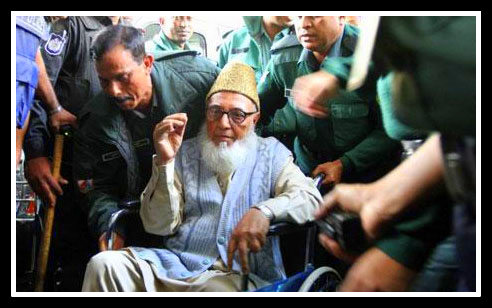
89 year old Professor Ghulam Azam born 1922 is a prominent and retired religious political leader of Bangladesh. The professor’s association with religion compelled him to join the Tablighi Jamaat during 1951 – 1954. However, after being convinced that Islam is not only about spirituality but the sociopolitical aspect is also an integral part, he became part of the Jamaat e Islami. He actively participated in the democratic movement against the dictator, General Ayub Khan. Being a devoted Pakistani, He opposed the separation of East Pakistan, even though he himself was a native Bengali. This was the time when he had to face the real critical situation. He remained steadfast by his ideology and adopted the rather unpopular stance and told his people that mere liberation from Pakistan would not be beneficial and worthy as secret Indian plots were being observed in the liberation movement.

East Pakistan was ultimately converted into Bangladesh and Professor Azam  faced the consequences in the form of arrest and torture, as politics of vengeance was on its peak. His basic right of citizenship was officially denied and he was left with no option other than to live in the Exile. He did not lose hope. Professor fought his legal case before the Supreme Court and was able to get his citizenship restored. In January 2012, the 89 year old Professor Azam was once again arrested, this time for charges of treason. The prosecution is still under process. Professor Azam is undergoing a unique experience of defending his patriotism for his pre-1971 country, the united Pakistan, a patriotism that is in fact a rebellion against his very same land, post 1971 country, Bangladesh.

No matter what the Bangladesh judiciary concludes regarding the fate of Professor Ghulam Azam, there is one thing that is certain. He has displayed his commitment to his ideology and patriotism for united Pakistan. He has nothing to complain regarding his past and is still following his inner self. This speaks for his character. He has encouraged his followers to obey the country’s law. Without undermining the efforts of any of the freedom hero, if one compares the difficulties and hardships faced by William Wallace, Tipu Sultan, the ‘Suriah Badshah’ and Professor Azam, it is evident that the earlier three Heroes enjoyed the support of their respective countrymen during their struggle, the Professor on the other hand was lonesome and against his people during the war that challenged his patriotism. The Professor is still going through much tougher and dire situation to prove his loyalty and attachment for his land. His unchanged spirit in the prison cell is an adequate proof that the man of integrity cannot be conquered. Anyone who feels the deep pain of separation of East Pakistan cannot live without paying homage to Prof.Ghulam Azam.

“ Mitte ki muhabbat may hum ashufta saroon nay..wo qarz utaray hain jo wajib bhi nahin thay”